Condemned Communities
Forced Evictions in Jakarta
I. Summary
Around 7 or 8 a.m., the military arrived. All together, there were about twenty military officers and some police-I saw them directly because I was already up and outside. I already knew their faces because they often came to our housing complex. But I was wondering why they were coming now. I asked one of them why they were here so early. I asked a military man directly. They were wearing full uniform. He said: "I have received orders from above to come here." I asked: "For what purpose?" The military man answered: "I have instructions from my commander, but it's not clear what my instructions are." So I thought, he must think I'm stupid if he tells me he has instructions from above that are not clear!...
Starting around 9 a.m. the gangs of thugs arrived. When I saw the thugs arrive in their cars, I went to tell my friend that they'd arrived. And I said it very calmly, because I still didn't understand, and then I went homeThey were just wearing normal clothes, shirts and jeans. I was still convinced that nothing was going to happen. I had already taken a shower, had my breakfast, and was looking after my children. Then I heard the sound of the bulldozer. I heard it, I came out of my house and saw that it was digging out the front of the complex, and I said "Oh my God, this is happening."
Then the thugs started coming into our houses and into my home. They told me to leave. They came into my house, into all the rooms. They smashed the windows of the houseI don't know how many came into my room. So many. They didn't want to give us an opportunity to get anything. They just came in to move everything and everyone out of the house. Some of them were carrying big knives, others had iron polesMy oldest daughter arrived. She was very angry with themThey destroyed her study desk
We were forced to leave the location. We took out things and went to the side of the streetSo now I just have to be strongI think we should continue to pray that everything will be okay.
-Eva Sugiharto, forty-three years old, evicted resident of Siliwangi Housing Complex[1]
Experiences like those of Eva Sugiharto, recounted above, are all too common in Jakarta today: the early morning arrival of government security personnel and gangs of thugs who force themselves into people's homes and use baton sticks, bulldozers, and fire to destroy a community's homes, shops, mosques, and churches. In the space of just a few hours, evicted residents can lose years' or even decades' worth of work and investment.
Disputes over land are a frequent source of conflict in Indonesia, and forced evictions are a long-standing and recurring problem in the history of Jakarta. During the rule of earlier Presidents Sukarno and Soeharto, government forces carried out brutal large-scale evictions in order to fulfill the urban planning dreams of city and national leaders, and to serve the private interests of a few privileged developers. Yet Indonesia's transition to democracy has not led to a halt in forced evictions. During the nine years of administration by Jakarta's current Governor, Sutiyoso, many tens of thousands of people have watched Jakarta's security forces demolish their homes and destroy their personal property with little notice, due process, or compensation. Many thousands more of Jakarta's poor live in fear that one day the security forces and bulldozers will come to their communities.
This report is based on over one hundred interviews and research carried out in Jakarta in January 2006. In this report, evicted residents describe how government security forces at times beat or mistreated them before destroying their homes and possessions. In the worst cases, witnesses recount how security forces opened fire on communities and set buildings alight while people (in two cases including children) were still inside.
Many residents say they were given little warning or given confusing messages before their homes were razed, and most say that public order officials provided them with little time to collect their belongings and abandon their homes. Almost without exception, residents explain that they received either no compensation at all, or such little compensation that it did not adequately cover the losses that they experienced.
Evictees also detail the problems they have faced as a consequence of their eviction. A significant number found themselves homeless and destitute. Women and migrants relate the impediments raised to their ability to earn a livelihood for themselves, and parents and children describe the disruption caused to children's access to schooling.
Evictions are organized by the local government authorities, and are enforced by the local police, public order officials, and the military. At times, the government forces use gangs of private individuals to help them carry out the demolitions. The evictions may remove communities from state-owned land, privately-owned land, or land where ownership is in dispute or unclear. Condemned communities exist in pockets all over the city, including slums under railways bridges constructed from salvaged materials, two-storey brick and concrete homes in the heart of the city, simple structures built on land reclaimed from the sea by fishermen, and villages with farmland on the city's periphery. In some evictions, only a few families may lose their houses, but in other instances many thousands of people have lost their homes in just one day.
Many people who occupy land in Jakarta do not enjoy the right of legal access to housing because such options simply do not exist or are completely unaffordable. Only 1 percent of land in Indonesia is held in freehold ownership. In Jakarta, the vast majority of the urban poor live on land that the government has yet to officially register. The legal status of the majority of homes in the capital, especially those of the poor and lower-middle income residents is uncertain-this may be a result of failing to comply with building codes, having been built without permits, or existing in unplanned and unregulated settlements. Yet most evicted residents have, through practice, acquired several elements of legitimacy, such as regularly paying local officials for permission to live at their sites, living on the same site for decades with no contestation from public or private entities, receiving a variety of government-provided utilities, or paying government land taxes.
The government of Jakarta justifies some of these evictions on the grounds that the land is required for infrastructure projects. Other communities are demolished for the declared intent of clearing slums in the name of public order, or removing trespassers from private or state land. Many local human rights lawyers and civil society groups, however, note that residents have lived on these lands for years and in some cases generations, and allege that many evictions reflect wider, arbitrary government efforts to intimidate the urban poor, deter urban migration, and support favored groups. While the government claims that it is trying to improve the quality of life in Jakarta, it only moves the problem to other locations when it evicts tens of thousands of people and deprives them of the assistance necessary to help re-establish themselves elsewhere.
Even in circumstances where international and Indonesian law permits evictions, the government must nonetheless carry them out in accordance with the law, without violence, with consultation with the affected communities, and with the provision of adequate compensation. Taking land and property without adequate compensation is like the city government stealing from its poorest citizens.
Many of these evictions violate basic human rights protections in both Indonesian and international law. When governments forcibly evict people from their homes they deprive citizens of one of their fundamental human rights and needs, that of the right to adequate housing, and expose them to violations of other fundamental rights and hardship which may amount to inhuman treatment. While international law does not place an affirmative duty on governments to provide housing for all of its citizens, it does prohibit governments from demolishing the shelter built by the homeless and landless to provide for their own survival, except in extraordinary circumstances. Indonesia has an obligation under international law to respect individuals' right to adequate housing and to refrain from impermissible forced evictions, not only for individuals who can show documents to prove full legal title or who live on registered land, but also for people living in informal settlements.
A human rights based approach to development acknowledges that the process in which development occurs is often as important as the outcome. Local communities must be involved in the decision-making process about the use of the land they occupy in a transparent, participative, and consensual manner.
When carried out without offering residents meaningful alternatives or compensation, forced evictions decrease the available stock of housing, increase poverty, and even further reduce the urban poor's ability to access affordable housing. The current approach to carrying out evictions in Jakarta fails to address the structural problems posed by the city's insecure land tenure system, rural-urban migration, blatant corruption, inappropriate planning frameworks, poor land management systems, and economic inequality.
Key Recommendations
Evictions should never render individuals homeless or vulnerable to further human rights violations. Where evictees are unable to provide for themselves, the government should take all appropriate measures to ensure that adequate housing and assistance are available.
As a preliminary measure, we urge the Jakarta regional government to enact a short-term moratorium on all "public order" evictions. The moratorium should remain in place until officials develop and implement a mechanism-in consultation with civil society groups and representatives of the urban poor-to assess the likely impact of evictions on affected residents and determine whether the public order interest served by evictions outweighs the impact on the lives of evictees. Such a mechanism should include baseline surveys by independent experts of the affected community's population, assets, and socio-economic situation prior to any eviction. These surveys would allow the government to determine the true costs of evictions and, should officials nonetheless conclude in any given case that evictions are necessary and justified, would help them design an appropriate and effective resettlement plan.
To emphasize its commitment to fairness and transparency, the Jakarta regional government should also place a moratorium on all evictions related to public-interest development projects until an investigation can be carried out into the alleged human rights abuses related to the "Double-Double Track" project, and any systemic problems identified are addressed.
In the future, any justified evictions should be carried out in coordination with a broad range of relevant social welfare agencies to ensure that vulnerable individuals receive any necessary assistance to deal with the economic and social impact of displacement. A joint working group from relevant government ministries and national commissions should be established to monitor and ensure that eviction procedures and practices comply with international standards.
In order to reduce the likelihood that future evictions will result in violence, the government should also consider a series of other reforms. Only well-trained police and public order officials should carry out evictions. Private individuals or gangs should never be permitted to carry out evictions. The government should grant permission to carry out an eviction only after a fair and transparent public process. Moreover, the government should provide all members of the affected community with adequate and reasonable notice, information about the reasons for the eviction, and legal remedies for those who oppose the eviction. Notice should leave enough time for the negotiation of compensation agreements and to allow for resettlement. The exact eviction date should be open to negotiation. Affected residents should receive fair market value or replacement cost compensation for any loss of land, personal property, and interruption to their income activities.
II. Methods
Indonesian nongovernmental organizations have been working on the issues of forced evictions, land acquisition, land rights, and housing rights in Jakarta and Indonesia for decades. This report builds on their work, and seeks to contribute to their larger efforts.
This report is based on five months of research, including thirty days of field research in Indonesia in January 2006. Human Rights Watch conducted fifty-eight in-depth interviews with victims and witnesses of forced evictions. These interviews, conducted in Indonesian by a Human Rights Watch researcher or through an interpreter provided first-hand testimony of fourteen different incidents of evictions that occurred between 2001 and 2006.
Various Jakarta-based nongovernmental organizations assisted us in making the initial contact with communities affected by a forced eviction. Once this first contact had been established, interviewees were generally asked to recommend fellow community members for us to interview. Occasionally, interviewees were asked to recommend a fellow community member of a certain gender or age in order to investigate a variety of experiences. Thirty-seven of the evictees interviewed were male, and twenty-one were female. Six of the interviewees were aged sixty years or older, and three of the interviewees were children.[2] All names of evicted residents cited in this report have been changed to protect their identity.
Of the fourteen incidents of evictions examined by Human Rights Watch, four were carried out because a private entity claimed rights over the land, three occurred in areas where public-funded development projects were scheduled (although this was not necessarily the justification for the eviction provided by the government authorities), three were from land claimed by a government agency, three were in riverbank areas where public order regulations forbid settlements, and one was of a community living under a train overpass where public order regulations also forbid settlements. These fourteen incidents came from each of Jakarta's municipalities, except for South Jakarta. Researchers from Human Rights Watch attended an eviction while in progress in Pisangan Timur, East Jakarta, on January 12, 2006. In all fourteen cases, evictions were accompanied by human rights abuses.
Human Rights Watch also interviewed more than fifty representatives from the Governor of Jakarta's office, other Indonesian government agencies, nongovernmental organizations, civil society organizations, academics, lawyers, and international donors. A handful of these interviewees spoke with us on condition of anonymity, and their names have therefore been withheld. In addition, Human Rights Watch consulted a wide variety of Indonesian media sources, including newspaper articles, and television and video footage of forced evictions. In combination with the broader perspective offered by these sources, the fifty-eight individuals testifying to fourteen evictions over the past five years, with varying forms of tenure, and from all over the city, indicate that the problems reflected in this report are widespread. Moreover, this report indicates flaws in the laws and policies of the Indonesian government and Jakarta administration that suggest broad systemic and structural problems. This is not to discount that there may be cases in which the government treats evictees properly while carrying out legally permissible evictions.
|
Case Studies Summaries of nine of the major eviction incidents documented by Human Rights Watch appear in grey boxes such as this throughout the report. |
III. Background
Jakarta is Indonesia's political and economic center. With a population of 7.47 million,[3]Jakarta is Indonesia's largest city, as well as the largest city in Southeast Asia and the eleventh largest city in the world. Like so many cities throughout the world, Jakarta struggles with problems of urban poverty, inadequate housing, high unemployment, poor transportation, inadequate provision of health care, lack of services, and decreasing environmental quality. Jakarta is also a segregated city, where the rich live in exclusive residential communities while the poor reside in unplanned urban villages[4] or slums.
Jakarta is formally known as Daerah Khusus Ibukota Jakarta, or the Special District of the Capital City Jakarta. Administratively, Jakarta is a region headed by a governor. It consists of five separate municipalities-Central Jakarta, North Jakarta, West Jakarta, South Jakarta, and East Jakarta-each with its own mayor appointed by the governor.
Jakarta's current governor, retired army lieutenant-general Sutiyoso, was appointed by President Soeharto in October 1997. Following changes in how governors are selected, the Jakarta provincial parliament elected Sutiyoso to a second five-year term in September 2002.[5]
A Legacy of Evictions and Inadequate Access to Housing for the Poor
The Regional Government for the district of Jakarta holds the mandate to create a capital city which is orderly, safe, comfortable, clean, and beautiful, so that Jakarta is representative of a capital city. However, the regional government faces the obstacle of unhindered urbanization and it is mostly the people with social welfare problems who obstruct the [public order laws]. Because of that, the regional government has chosen the means of law enforcement.
-Governor Sutiyoso[6]
One of the overarching themes of the history of Jakarta is the conflict between the desires of its rulers to create a model city to display to the world, and the desires of the poor of Indonesia to seek opportunities within it.[7] This tension has often caused clashes between the urban poor who have built homes and communities to provide for their own survival, and regional and national leaders with urban planning visions and private developers with their own business interests. Over the years, a number of factors have been presented by the Jakarta government as justification for forcibly evicting people from their homes, including development and infrastructure projects, urban redevelopment and beautification projects, public order concerns, property market forces supported by state intervention, and alleged natural hazards such as flood risks.
Following the end of the Second World War and Indonesia's independence, Jakarta attracted internal economic migrants from around the country who fled poverty in rural areas for the opportunities available in the city. This rapid influx of migrants put incredible pressure on the city's facilities and led to a critical housing shortage. Many migrants could not afford land on which to build.Then, as today, the result was overcrowding of the existing housing stock and an explosion of informal squatter settlements. Scarcity of available or affordable residential land forced many people to build on land which they did not own. Migrants and the city's indigenous urban poor provided communities for themselves by building in any available space: reclaiming coastal areas and swamp land; subdividing unused lots; or staking plots in the public spaces along railway tracks, canals, rivers, roads, and under bridges.[8]
As Jakarta grew, retail and commercial buildings surrounded these more informal and unplanned settlements, but city leaders rarely incorporated these "urban villages" into their development plans or structures. Although a government initiative begun in 1968 known as the "Kampung Improvement Program" began to upgrade the physical infrastructure of many urban villages (kampung) with the help of foreign donors, it did not address underlying land tenure issues.[9] Many communities, which had started as squatter settlements, acquired paved streets, drainage canals, and access to public utilities.[10]Although the scheme has been hailed as a landmark in slum management in the developing world, in many cases officials did not consult with residents and the program was not as successful as it might have been.[11] Indeed, researchers who have assessed the program have noted that many residents had little interest in maintaining the new facilities which they felt had been imposed on them.[12] In other cases, upgraded settlements were later demolished in favor of new business and commercial facilities.[13]
As Jakarta's importance as an economic center increased, large private developers sought to build office buildings and shopping malls in the city center. These developers often exploited the tenuous legality and physical nature of many of the communities built by the indigenous and migrant urban poor to acquire the land for minimal compensation. The local government, at times aided by martial law, cleared large tracts of land to make way for public works projects as well as commercial buildings.
An improving economy during the 1970s, buoyed by high oil prices, assisted both public and private construction. Housing construction claimed tens of thousands of hectares of land during the 1970s, three-quarters of which was sub-divided in a manner that violated planning regulations.[14] Many of today's urban villages grew out of these subdivisions. During the 1980s, Indonesia's economy began to diversify and local entrepreneurs invested more in property and construction, helped by financial deregulation and increased demand from an expanding middle-income group.
This increase in development led to a rise in land prices and also speculative practices by private investors. Less educated farmers and urban inhabitants were more prone to intimidation and non-market price acquisitions, and thousands of individuals were evicted from their farms and homes to make way for new luxury houses.[15] During the 1990s, speculators controlled about 40 percent of the land in central Jakarta. They had considerable power over land prices and used it to construct large numbers of high-rise office buildings on favorable terms.[16] Property speculators also moved aggressively to construct luxury houses during the 1990s, leading to over-building at the expense of agricultural land on the fringes of the greater Jakarta area.[17]
Indonesia's economic crisis that began in 1997 hit Jakarta hardest, and the city's urban poor population increased significantly as economic activity declined and high unemployment pushed workers from low-income jobs into the informal sector.[18] The crisis also hurt property developers, large-scale developments slowed, many infrastructure projects were suspended, and sizeable areas of land fell idle.[19]
Today, the majority of poor and middle-income residents continue to live in unplanned and unregulated settlements.[20] Poor residents continue to occupy disputed land, state land, and private unoccupied land. Land supply remains constrained because national government agencies, local government, and private developers hold most of the land that could be developed for new housing yet choose not to make it available.[21]
During Sutiyoso's tenure as governor, market-produced non-subsidized housing for low- and moderate-income groups has declined despite oversupply in high-income housing.[22] Most low-cost housing is financed at the household level without any assistance from the government or formal financial institutions. People often start by building small houses, and then gradually expand and improve structures as needs dictate and finances allow. Such practices account for about 80 percent of Indonesia's housing supply.[23] In contrast, the other 20 percent of housing, which is directed at moderate- to high-income households, is built with the assistance of direct government support through subsidized interest mortgages from the state-owned housing and savings bank.[24]
The state-owned housing company, Perum Perumnas,[25]fails to provide sufficient housing to meet the demands of the existing urban poor or new migrants to Jakarta, and their units are too expensive for the poorest of Jakarta's residents.[26] Between 1997 and 2004, Perumnas constructed only 786 new units of housing,[27] and many units are believed to be occupied by residents with incomes higher than allowed under eligibility criteria.[28]Perumnas constructed just ten units of housing in Jakarta in 2004.[29] In comparison, twelve new malls were completed in the same year.[30]
In 2005, a coalition of NGOs sued the National Commission for Human Rights (Komnas-HAM) for what the NGOs saw as its failure to take action to stop demolitions in Jakarta. The NGOs won their case, brought before the Public Court of Jakarta.[31] When asked how the Commission had changed its activities in light of this ruling, a representative told us that the Commission had decided to increase the public information campaign about the work that the Commission does.[32]
The revival of economic growth in Indonesia and its likely impact on urbanization, urban productivity, and the broader economy can be expected to place further demand on land, housing, and infrastructure in Jakarta in the near future.
Infrastructure Development and the Role of International Agencies
The Indonesian government has announced that it considers infrastructure development to be one of the primary targets for foreign investment and financing.[33] Over the past few years the government has aggressively pursued international investors, private sector developers, and construction companies. The number of incidents of evictions is likely to continue or increase during the next few years, as Jakarta has a number of large-scale development projects scheduled. The government will need to acquire land for new dedicated traffic lanes for buses ("busways"), and the construction of a monorail, overpasses and underpasses, six turnpikes, flood canals, port expansion, and for the development of low-cost apartments.[34]
Governor Sutiyoso's Campaign Against the Poor and Migrants
Since 1999, alongside the forced evictions detailed in this report, Governor Sutiyoso has waged a campaign against the informal sector which employs so many of Jakarta's poor, targeting street vendors, homeless children, pedicab drivers, commercial sex workers, and beggars. Public order officials evict individuals employed in the informal sector from their places of work. A large coalition of NGOs has organized to oppose this anti-poor campaign and forced evictions, bringing together evicted residents with urban poor, students, indigenous communities, local NGOs, farmers, and even religious scholars.
Governor Sutiyoso, himself not a native of Jakarta, also blames migrants for a variety of urban problems in Indonesia's capital, from unemployment to flooding, as well as the city's informal settlements.[35] The Governor's attempts to deal with what he sees as a problem of "overcrowding,"[36] includes heavy-handed tactics such as house-to-house raids targeting migrants unable to produce evidence of jobs and official residence. Under a draconian regulation promulgated by the Governor, new Indonesian internal migrants who fail to register with the city's population agency and obtain a visitor's identity card within fourteen days of their arrival-a process which requires proof of permanent employment and residence-are liable to imprisonment for up to three months or a Rp. 5,000,000 (US$550) fine.[37]
Public Order Officials
As Human Rights Watch has documented extensively in previous reports, Indonesia's military and police forces have a record of violating international human rights law with impunity.[38] The internal security apparatus involved in evictions in Jakarta include the military (Tentara Nasional Indonesia; TNI), the police, and groups of security forces known as "public order officials." This last group has received little attention from non-Indonesian sources.
The term "public order officials" is used throughout this report to refer to three local government security forces under the authority of the governor and mayors of Jakarta: Satuan Polisi Ketentraman Dan Ketertiban (TRAMTIB; Police Unit for Peace and Order), Satuan Polisi Pamong Praja (SATPOL PP; Municipal Police Unit), andLindungan Masyarakat (LINMAS; Community Protectors). Established in 1990, these forces are separate from the police and are empowered to enforce administrative regulations concerning public order and security. They are used to collect local taxes, and enforce local public order ordinances, yet their overall mandate is not particularly well defined.[39]
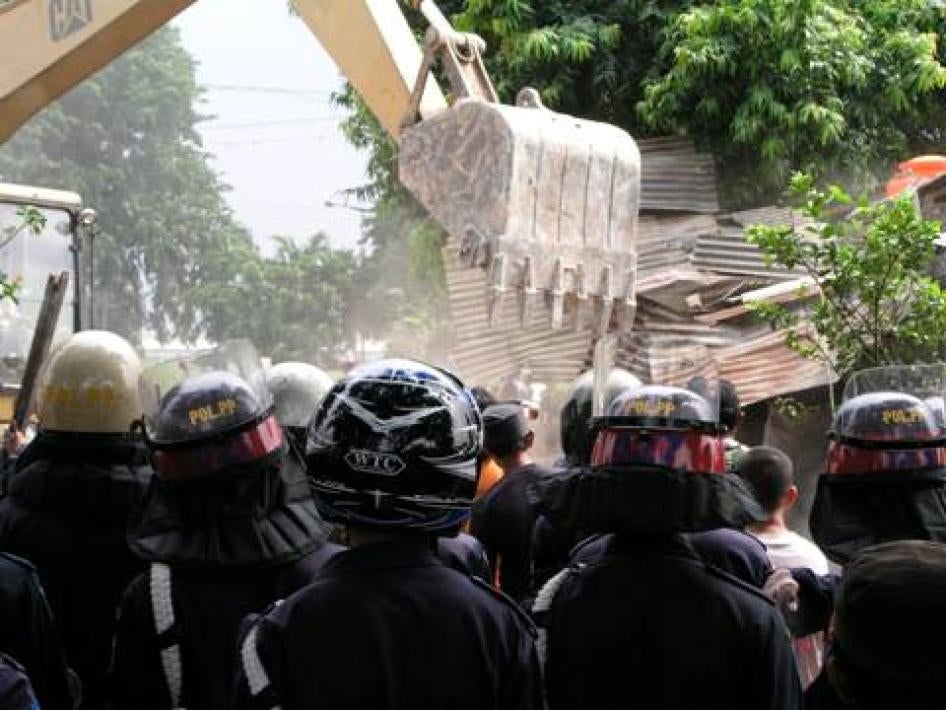
Photo 1: Public Order officials carrying out an eviction in Pisangan Timur, January 12, 2006. The "POL PP" on the back of some of the officials' helmets is an abbreviation for Satuan Polisi Pamong Praja, the Municipal Police Unit (c) 2006 Bede Sheppard/Human Rights Watch
Although they are empowered to use firearms and various forms of non-lethal weaponry, they receive less training in their use than Indonesia's regular police force.[40] Public order officers may carry baton sticks (truncheons), gas-pistols (a pneumatic gun), and electric shock devices.[41]
One declared objective of the public order units is to operate closer to the people than the police do and to gain more respect from citizens.[42] Numerous interviews, however, conducted by Human Rights Watch with victims of excessive use of force by these public order forces suggest that they are viewed as arrogant and aggressive. Some witnesses said the regular police actually had to intervene to protect civilians from excessively violent public order officials during evictions.[43]
Because the uniforms for all three forces can look similar, witnesses sometimes used the names for the different units interchangeably and were often uncertain as to exactly which units had been present at their eviction.
Urban Gangs Involved in Evictions
Frequently, gangs of thugs assist government security forces in carrying out evictions. Indonesians refer to these thugs by the term "preman."[44]
The phenomenon of gangs and youth organizations based on ethnic, religious, or political affiliations that make their living from racketeering and the use of force is not new to Indonesia. During the regime of President Soeharto, such groups acted as government henchmen, and have since transformed themselves into powerful social and political players.[45] Following that regime's collapse, these gangs have become more organized in urban areas, often along ethnic or religious lines. These gangs have large territorial networks and connections with members of Indonesia's political and economic elite, affording them some immunity from the law.[46] As a staff member from one of Indonesia's leading human rights NGOs explained to us: "The government doesn't want to be directly in conflict with the community. So Sutiyoso and others build new groups to face the community[Jakarta's indigenous] Betawi people feel that they are not being respected. Feel that this is their place. They resent new migrants. So when Sutiyoso touched upon this issue they gave him help."[47]
In interviews with Human Rights Watch, some witnesses and evicted residents provided the names for different gangs involved during their evictions, while on other occasions witnesses were unable to identify the thugs as belonging to any particular gang. In three instances, only one witness was able to give a name to the gang, and in the absence of corroborating evidence we have declined to identify those gangs in this report.
One very visible group in Jakarta is a gang known as Forum BetawiRempung (FBR; Betawi Brotherhood Forum), which claims to work to protect the rights of Jakarta's indigenous Betawi population.When Human Rights Watch met with a group of five members of FBR to discuss the allegations against their group regarding the eviction at Cakung Cilincing, East Jakarta, they denied being paid upfront by anyone for any of their activities. One member told us: "We would not take any payment because what is important for us is to defend those who are on the right track, who deserve the right of the land, these people who are being victimized.We're doing it voluntarily, without being paid."[48] When asked where their money comes from to pay for items such as their uniforms, offices, and large black four-wheel-drive vehicles with "FBR" emblazoned in bright yellow, he responded: "It's a gift, or a blessing for Betawi, also donations. When FBR manages to help one person with a case, we would not ask for payment, but willingly they will give a donation [afterwards]."[49]
The representatives from FBR were also very reluctant to talk about the group's relationship with the government. This is how one FBR member explained how the group gets involved in a case:
There are some cases related to landthat if you're leaving the government to take care of this it would take decades. So FBR would like to help the government so that they will become a clean government by giving assistance and taking care of the situation.We're not really working with public order officials[and in some instances we have even] had a lot of members captured by public order officials, because principally we're defending the right side[W]hen residents are facing a problem, they will come and submit a claim to FBR, and report the problem they are facing. But FBR will not just take all their complaints or claims, but we'll start an investigation on this land and its legal situation and its historical background. Who owns the land, year by year. The host will know more about their home.So we have lawyers-it's almost the same as LBH [an Indonesian human rights legal NGO]-an investigation team.[50]
Governor Sutiyoso denies giving any money to FBR members,[51] but the Governor has attended an FBR gathering at which the founder of the organization, Fadloli el-Muhir, supported Sutiyoso's re-election as governor in 2002.[52] However, as the FBR representative was keen to stress: "We're not government officials and we could also fight against the government if they took the wrong step."[53]
IV. Insecure Land Tenure
From the legal perspective, [the evictees] don't have rights, so they have to move.
-Jornal Effendi Siahaan, Deputy Head of Department for Public Order and Community Protection[54]
Secure land tenure[55] gives residents clear legal rights against either the government or private entities who make competing claims on the land. When evictions occur, clear rights to the land place residents in a stronger position to negotiate agreeable quit terms and adequate compensation. Indonesia's current policies and legal regime for regulating land ownership and land use, however, offer only minimal security to many users, thus increasing their vulnerability to forced evictions. Almost all of the evicted residents interviewed by Human Rights Watch lacked land certificates to indicate that they had rights over their land. However, this situation is true for the vast majority of poor residents in Jakarta, and for people in Indonesia as a whole.[56]
International human rights bodies have expressed the view that secure tenure is a legal entitlement for individuals arising from the right to adequate housing. The United Nations' Committee on Economic, Social, and Cultural Rights (CESCR), has called on governments to provide the greatest possible security of tenure to occupiers of houses and land, but stressed that notwithstanding the type of tenure all persons should possess a degree of security that guarantees legal protection against forced eviction, harassment, and other threats.[57]
Secure tenure does not necessarily require full legal title or complete registration.[58] Instead, it is the perception of secure tenure by residents, creditors, and the government that is important.[59] For example, the United Nations Human Settlements Program (UN-HABITAT), recommends that governments survey extra-legal settlements and identify those that will be required for strategic public purposes during a certain time period, or which are in areas subject to environmental hazards.[60] The government should then grant all other extra-legal settlements some medium-term form of tenure with increased rights but not necessarily full title.[61] However, indirect means of generating the necessary sense of security depend upon the confidence that residents have in continued government support for their tenure. Forced evictions destroy all perceptions of security, not only in the directly affected communities, but also for inhabitants in other informal settlements.[62]
Sources of Insecurity
The insecurity of tenure in Jakarta is a product of several factors: flaws in Indonesia's legal regime for administering land; poor administration by government agencies; corruption by some officials and developers; a lack of transparency by government agencies; and pervasive government violations of the rights of the urban poor.
Indonesia's legal system employs more than 2000 pieces of legislation, regulation, and directives, on land use.[63] The vast majority of these are outdated and overly complex, and many are inconsistent and contradictory.[64] Sometimes there are numerous conflicting claims over the same piece of land. According to one study, 65 percent of administrative court cases involve land disputes.[65] Litigation of land disputes is time consuming and often prohibitively expensive for the poor. Although a number of projects over the last few years, supported by both domestic actors and international donors, have proposed a variety of reforms to the Basic Agrarian Law of 1960 (Undang-Undang Pokok Agraria; UUPA) that still controls land law issues in Indonesia, no reform has yet been instigated.
Under the current land system, only 1 percent of the land in Indonesia is held in the form of tenure known as Hak Milik that is most closely equivalent to freehold ownership.[66] Instead, almost all land is held in other forms of tenure, which are defined by the kind of use that is permissible for that piece of land. If the holders of the title do not conform to those restrictions, they risk forfeiture of the title to the government. The granting of any of the formal forms of title by the government is also discretionary and no tenure form is available as of right. This ability of the government to revoke even formal forms of tenure creates a dynamic between the state and land users that facilitates corruption, political patronage, and the exploitation of land users.[67]
Administrative problems that lead to insecure tenure include slow progress in registration,[68] fees that are prohibitively costly for the urban poor, and inadequate administrative and technical skills within the relevant government agencies. A study in 2000 noted that the land registration process in Jakarta involves seventeen steps, eighteen different agencies, and an average of two to three years to complete.[69] There are over 80 million land parcels in Indonesia, of which only 17 million are currently registered.[70] At the current rate of registration of 2.5 million parcels every five years, it would take another 125 years to register and provide land certificates for all land in the country. Not only is the cost of the process, in the view of the World Bank, "simply too high"[71] for the urban poor, it may also require the paying of bribes to officials.[72] The cost of registering land includes not only the basic fees paid to the National Land Agency, but also the costs of obtaining permits for any building construction, of using only permitted construction materials, of building to standardized densities and space requirements, and of maintaining only proper residential activities in a zoned residential area.[73] All of these requirements have significant costs. These costs are sufficient to exclude large portions of Jakarta's population from the official registration system.
The agencies that deal with land administration, including the National Land Agency, the National Coordinating Agency for Surveying and Mapping, the Ministry of Agriculture, and the Ministry of Forestry have been criticized as being notoriously fragmented and overlapping, and for performing land registrations largely for their own interests.[74] Moreover, each of these government agencies has branches at both the national and the provincial level, increasing the overlapping web of responsibilities and dispersing activities to individuals with less training and skills.
Finding out who has rights over a piece of land is also a difficult enterprise because of the low level of official registration, lack of transparency, and low levels of competency within the responsible government agencies. An NGO advocate described trying to identify who genuinely had rights over a site threatened with evictions:
First they said that it was the developer's land. And we did some investigation, but the company could not prove that they had any certificates on the land.The National Land Agency of West Jakarta didn't give us any information about the land. [They didn't tell us] who owned it. I went to them, I gave them an official letter from [my organization] and I explained that I wanted to find out about the land. It was like ping-pong-"Go to this division," and when I went to that division, they said "Go to another division, and then another." After three weeks I gave up.[75]
The current land administrative system has also allowed thousands of fake and conflicting land titles to circulate.[76] An advocate who worked for residents evicted from a site at Jembatan Besi, West Jakarta, explained the contradictory and complicated situation for that particular site: "There were overlapping certificates on the land, so they didn't know which one was real. More than twenty-five certificates. There was no legal basis that could prove that the land belonged to one certain person.The problem is the National Land Agency, because as you can see there were far too many certificates."[77]
In some instances, corruption allows developers not only to acquire land and development permits when their plans do not conform to the spatial plan or zoning regulations, but also to acquire land without the knowledge of the residents actually living on the land.[78] As the head of a Jakarta-based legal policy center put it:
The bureaucracy here is corrupt, so people who can't get access can't access their rights.There are people who stay on land for maybe ten years, but then they go to the land office to try and get a certificate, but it's a real problem. You would have to bribe. And even worse, somebody who can pay a lot of money to the office, they can then get the certificate, and then they get the land. It's a problem of corruption in the office, and also the land registration system.[79]
Even though Indonesian law formally allows individuals who reside on non-state land for more than thirty years to convert their occupation into full ownership, this right is difficult to access because 99 percent of land in Indonesia is considered state-land[80] and is therefore ineligible for this legal provision. In the rare chance that the plot is not considered state land, strict requirements of proof of occupancy and an expensive process still make this an unlikely option for the urban poor.[81]
Acquiring Tenure
Although a few evictees Human Rights Watch interviewed would express that they considered themselves to be illegal occupiers of land, most residents we met with believed that they had secured some form of tenure over the land from which they were evicted. Evictees often had good reason for this belief, such as having regularly paid local officials for permission to live at their sites, living on the same site for decades with no contestation from public or private entities, receiving a variety of government-provided services such as electricity and telephone lines, paying government land taxes, or having been advised by the government to use idle land during periods of economic crisis-such as by Governor Sutiyoso's own 1998 decree.[82]
By failing to provide these communities with practical and accessible mechanisms to regularize their tenancy the government essentially is able to have it both ways. Prior to the evictions, state companies receive payments for utilities; local officials receive payments to allow a settlement to exist; and local officials establish a patronage system with the local community in exchange for their ongoing largess.[83] All the while, however,residents live in a state of perpetual insecurity and fear that their tenure may not be as secure as they hope-even those who have worked hard to establish clear rights probably have violated some regulation-and that they may end up evicted. While officials profit from their presence, substantial portions of Jakarta's urban poor live under constant fear they will lose their housing and be left literally on the street.[84]
Many residents interviewed by Human Rights Watch held various forms of proof of their rights to the land, such as receipts for the payments that they made for their land. Susi Setyowati described her situation: "I only had a copy [of the paperwork for my land], not an original, because I bought the land, not as one whole piece, just gradually, bought fifty square meters, and then bought more. So, I had no land certificate, but I did have the proof of transactions."[85]
Other individuals interviewed by Human Rights Watch had gained a claim to tenure by moving onto previously unoccupied swamp or coastal land and working to reclaim the land. A resident from Cakung Cilincing told us how his community had worked to improve the land: "It was a swamp area before but we cleared the land and then built houses."[86] Residents from Pondok Kopi also converted a swamp into solid land, and fishermen at Ancol Timur created dry land from the sea to build.
Many residents we interviewed had paid previous owners or original community members who had established the area and then subdivided the site. Because conveyancing formalities are expensive, informal conveyancing of unregistered titles is common and accepted.[87] Agus Adil recounted how seven years ago: "We bought the land from the community here. We were given receipts, but I think that was all."[88]
Many residents had paid money to local officials for the right to live on the land. Kersen Saptono, a former resident of Cakung Cilincing evicted from the land he had lived on for thirteen years because the mayor now claims that the land is owned by a group of private businessmen, recounted to us: "I bought the land from the [the local neighborhood official]. I got a garap [right to use]letter. I built my house myself."[89]
Members of a community living under a railway flyover at Cikini also told us about how they paid their local neighborhood official. Soleh Atmaji explained:
Before the eviction, we were paying Rp. 10,000 (US$1) per month per house to the [local neighborhood official]. Now we don't pay anything. I'm not brave enough to pay it anymore because we might get evicted again. Before, we were paying it because we thought it guaranteed us not to get evicted from here, but that didn't happen. The [local neighborhood official] said that "If you pay me, if there are any problems, I will solve them for you." But when we got evicted, he didn't do anything, he didn't want to. At the time of the eviction he said "It's not my job."[90]
Testimony from Sinta Suryana demonstrates a problem whereby residents may have occupied land for decades but still have not had their land registered:
I don't have a land certificate, but my mother has been staying here since 1960. Before, a long time ago already, they wanted to make certificates for the area, but the people who lived here, some understood, and others did not. Maybe the young people understood, but the older residents didn't understand. The [local neighborhood official] didn't want to sign to register the land. This was about 1990.[91]
Even in the most informal settlements visited by Human Rights Watch, there had almost always been some form of acknowledgment from the government that the residents had some entitlement to use the land, because the government did not attempt to remove them from the land for many years. Because the local government does not enforce national and local regulations, both local residents and officials begin to accept the residents' tenure as being de facto legitimate, even though it may not be in full conformity with all existing regulations. Government agencies can further compound this perception of de facto legitimate status by taking affirmative actions that support the existence of the communities, such as issuing Jakarta identification cards, providing government services, developing related infrastructure, and collecting taxes.[92]
Residents at all but two of the eviction sites investigated by Human Rights Watch had electricity supplied by the state electricity company, Perusahaan Listrik Negara (PLN). Praman Prihanti described the situation in his community at Pondok Kopi prior to their eviction: "I had electricity in the old place for seven years. From PLN. We paid for it. The bill was under my name. Each household paid for themselves. Some people had telephones; I didn't."[93] Sofian Tjahjadi explained the process by which he acquired electricity from the government: "I registered with PLN almost five years ago. I had to give them my ID card and the address here. It took one week after registration to get a meter.We pay every month. It's controlled by PLN."[94]
Some evicted residents had also received municipal water and land line telephones. As Agus Adil recalled: "I had been living here for seven years before the eviction. Everything was complete. I had electricity, telephone; it was all in our name."[95]
Many residents also claimed to have paid land taxes (Pajak Bumi dan Bangunan, PBB) to the government on a regular basis. For example, Budi Santoso told us: "We had electricity and water and we paid for it. We also paid land tax to the government. We've been paying it for a long time."[96]
A representative of an NGO that has worked with evicted communities for many years framed the problem this way: "The state doesn't stop people building on the land. It's not just one person, but hundreds of people. And every year they use water and electricity, that they pay for each month. And they're paying each month to the government. And then suddenly [the government people] come and say that they want the land."[97] This leads to an incongruous situation whereby the government will charge and accept land taxes and utilities payments, but, according to Indonesian legal expert Bivitri Sustanti "Even if you have paid the PBB [Pajak Bumi dan Bangunan, the land tax]it cannot be seen as proof to rights over the land."[98] One NGO advocate wanted to ask the government: "Why did you provide electricity to their village? Why did you provide a small health clinic there? It's so ambiguous. You provide these services for all these years, and then all of a sudden you say they are illegal? I'm just questioning the logic of the government."[99]
Many urban villages are constructed from simple building materials. There was, however, a great variety in the physical characteristics of evicted neighborhoods visited by Human Rights Watch, from slums made from salvaged wood and plastic, to neighborhoods dominated by permanent concrete and plaster structures.
Photo 2: The community at Pisangan Timur contained permanent housing built of brick, concrete, and plaster. (c) 2006 Bede Sheppard/Human Rights Watch
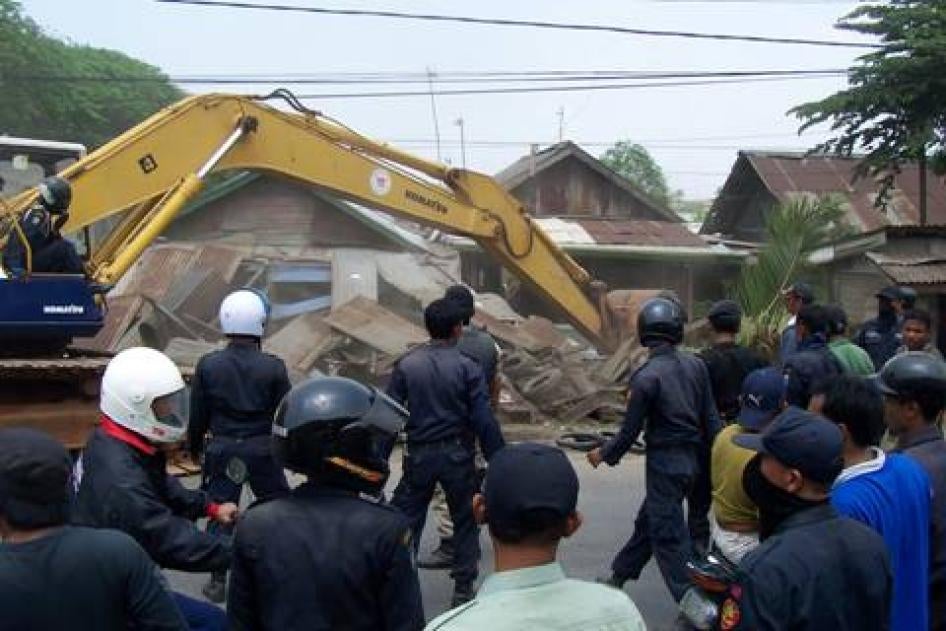
Photo 3: The homes in the community on Cakung Cilincing Road were made of less sturdy materials, such as wood and corrugated metal, as seen in this photo from the day of the community's eviction. (c) 2005 LBH-Jakarta.
V. What is a "Forced Eviction"?
They burned down houses using petrol. It was [public order officials] and police and military. At around 10 a.m., they arrived over there. They were burning homes. They arrived at this location around 11 a.m.They were using water bottles with petrol inside them. They were splashing them. They came from behind and in front. We wanted to move our things, but they said we could not get our things because they were worried people would get hurt from the burning. After they poured the petrol they straight away set it alight so we couldn't go get our things. We only had enough time to get what was important. Everything else was left behind.
-Arij Wiyano, a forty-three-year-old laborer[100]
Forced evictions violate fundamental human rights contrary to international law. In its "Resolution on Forced Evictions," the U.N. Commission on Human Rights affirmed that forced evictions constitute a "gross violation of human rights."[101] The term "forced eviction" is defined for the purposes of international law as "the permanent or temporary removal against their will of individuals, families and/or communities from the homes and/or land which they occupy, without the provision of, and access to, appropriate forms of legal or other protection."[102]
It is important to note that international standards focus on protecting individuals who occupy homes and land and do not depend on any particular form of ownership title to the land or house, nor on the legality of the occupancy. Although all evictions could be considered inherently involuntary or forced in some manner, the term "forced evictions" is a discrete term under international law that refers to evictions that are arbitrary or that fail to comply with international human rights standards or domestic laws.[103] Therefore, evictions which occur without physical force or violence may nevertheless constitute "forced evictions" if the taking of the land is unjustifiable, or the procedure fails to include adequate consultation, compensation, and notification. Indeed, Human Rights Watch learned of residents of a community in East Jakarta who saw the violence and destruction involved in the forced eviction of a nearby community and, having been warned that their community would be next, decided to demolish their own homes in the hopes of better preserving their building material for rebuilding-a circumstance that would also qualify as a forced eviction.[104] Conversely, the prohibition on forced evictions does not apply to evictions carried out against the will of the occupant yet conducted in accordance with the law, including international human rights treaties and customary law, with appropriate legal remedies available to those affected.
Legal Standards
Indonesia's Constitution guarantees that "[e]very person shall have the right to live in physical and spiritual prosperity, to have a home and to enjoy a good and healthy environment."[105]Indonesia's Law on Housing and Settlement further states that "[e]very citizen has the right to occupy and/or enjoy and/or own a decent house in a healthy, safe, harmonious and orderly environment."[106]
As stated above, forced evictions have been recognized in international law as a gross violation of human rights irrespective of treaty obligations. However, Indonesia has also recently ratified the International Covenant on Economic, Social and Cultural Rights (ICESCR), which provides similar guarantees to those already existing under Indonesian law.[107]The ICESCR requires states to "recognize the right of everyone to an adequate standard of living for himself and his family, including adequate food, clothing and housing, and to the continuous improvement of living conditions."[108]The United Nations body entrusted with authoritatively interpreting the ICESCR, the Committee on Economic Social, and Cultural Rights (CESCR), has stated its view that "a State party in which any significant number of individuals is deprived of essential foodstuffs, of essential primary health care, of basic shelter and housing, or of the most basic forms of education is, prima facie, failing to discharge its obligations under the Covenant."[109] The CESCR has also concluded that "forced evictions are prima facie incompatible with the requirements of the Covenant."[110]
Indonesia has also recently ratified the International Covenant on Civil and Political Rights (ICCPR), which protects individuals from "arbitrary or unlawful interference with his privacy, family, home or correspondence," and guarantees everyone the right to the protection of the law against such interference or attack.[111]
A state party to the ICESCR is obliged to take steps "to the maximum of its available resources, with a view to achieving progressively the full realization" of the right to adequate housing. While the law contains this "available resources" caveat, it is largely irrelevant to the issue of forced evictions identified here, because fulfillment of the state's obligation to refrain from arbitrary forced evictions is largely a negative one and does not depend on resources.Nor does scarcity of resources excuse a country from ensuring that its laws are enforced against officials or third parties who carry out forced evictions.[112] In fact, forced evictions are a step backwards from a state's obligations, because, by definition, they involve the state's arbitrary destruction of resources that individuals and families have invested in building their homes.[113]
As the findings within this report demonstrate, forced evictions not only violate the right to adequate housing, but may also result in violations of other protected rights protected by both Indonesian and international law.For example, evictions infringe upon the rights to freedom of movement and the freedom to choose one's place of residence.[114] Violence and reckless destruction threaten the right to security of the person.[115] The harassment and arrest of NGO activists who oppose forced evictions can violate the freedom of expression, assembly, and association.[116]The disruption caused to children's schooling can constitute a violation of the right to education.
Because forced evictions may infringe on such a large number of rights, appropriate procedural protections and due process are, in the views of the CESCR "especially pertinent."[117] Procedural protections that should be applied include: genuine consultation with those affected; adequate and reasonable notice of the date of eviction; timely information on the proposed evictions and the alternative purpose for which the land is to be used; proper identification of those carrying out the eviction; and the availability of legal remedies for those affected and access to legal aid.[118]
According to international human rights standards, it is the obligation of a country's government to ensure that in instances of forced evictions "all the individuals concerned have a right to adequate compensation for any property, both personal and real,[119] which is affected."[120] Compensation must be made following "mutually satisfactory negotiations with the affected persons,"[121] and women and men must be co-beneficiaries of all compensation packages.[122]
International law does allow for governments, under "the most exceptional circumstances,"[123] to expropriate the land of private citizens even without the owner's consent. Such circumstances might include: efforts by a government to use the land to promote the general public's well-being; the case of persistent non-payment of rent without reasonable cause; racist or other discriminatory attacks or treatment by one tenant or resident against a neighbor; persistent antisocial behavior that threatens public health or safety; manifestly criminal behavior that threatens others; the illegal occupation of property inhabited at the time of the occupation; or the occupation of land or homes of occupied populations by nationals of an occupying power.[124] A distinction therefore exists between residents who are peacefully living in a particular place and those who have actively reneged on their legal or contractual duties towards fellow residents or citizens. Instances where the government makes claims justifying an eviction must be examined on a case-by-case basis, however, to determine the veracity of the claim and to examine whether the eviction complies with broader human rights law.
Notice and Compensation Requirements in Indonesia
The Central Government has issued a regulation on "Community Participation in Spatial Development"[125] elaborating that communities should play a pro-active role in the spatial planning process. However, the regulation does not clearly define how the community could participate, and what the role of the government would be in each phase. The City Bylaw on the Jakarta Spatial Plan states that all people have the right to know about the plans of a certain area, whether it is the spatial, technical or building plan.[126]
Both the Jakarta administration and human rights NGOs accept that as a general principle of good governance, notification of an eviction should be provided in three separate letters, the final one arriving no later than seven days prior to the intended date of eviction.[127]
When the Jakarta government does attempt to provide compensation, it has a policy of providing compensation either through money or substitute land.[128] When an eviction is carried out for the purpose of a public interest project, Indonesian law provides for compensation for the loss of land to be provided at either the market value or a value known as "NJOP" (Nilai Jual Obyek Pajak; Sale Value of Tax Object).[129] As will be discussed in greater detail in the chapter on compensation, these two values are not equal as NJOP values are almost uniformly lower than the market value. When an eviction is carried out because the occupier of the land did not have permission to build on the land, is considered a squatter on the land, or is violating public order regulations, then there is no entitlement to any compensation under Indonesian law. Such individuals could, however, file a civil case against the local administration for arbitrary material losses suffered during an eviction. Sometimes, these individuals do receive some money from the private developers or local government officials, but it presented as a gesture of charity rather than compensation.
Justifications for Evictions Offered by the Jakarta government
The local government of Jakarta generally justifies evictions under three broad headings: the housing or occupancy is "illegal," the housing disrupts public order, or the land is required for the creation of a development project that will benefit the broader public interest.
"Illegal" Housing
These evictions are only to give the people a lesson to respect the law, as legal certainty is one of the major concerns of investors in the capital.
-Governor Sutiyoso[130]
The government of Jakarta is quick to justify its eviction and destruction of communities of urban poor on the grounds that such settlements are "illegal" or "built without permission." The status of community settlements in Jakarta, however, is rarely as clear cut as such labeling or the government suggests.[131] The vast majority of homes in Jakarta, especially those of poor and lower middle-income residents may have questionable legal status, such as failing to comply with building codes, being built without permits, or existing in unplanned and unregulated settlements.[132] Most Indonesians hold only customary rights to their land without any official registered title or certificate.[133] Yet, as illustrated in the previous chapter, many homes and settlements have also acquired legitimacy through practice and usage, generally with government complicity (see "Acquiring Tenure" on page 23).
Many people who occupy land in Jakarta do not enjoy the right of housing because such options simply do not exist or are unaffordable.[134] By labeling all such individuals or communities illegal, the government is placing responsibility for poor housing conditions on those individuals, ignoring the reality that informal slum and squatter settlements are in fact the product of failed government policies, poor governance, corruption, inappropriate and outdated regulation, dysfunctional land markets, and a lack of political will to find adequate solutions. It also ignores the historical reality of selective enforcement of housing policy and law at the expense of the poor. The administration turns a blind eye to the illegal conversion of houses into business premises by the rich. Shopping malls, gas stations, and luxury apartments are often permitted to be located near riverbanks, violating existing regulations, and to encroach into protected green areas.[135] Under housing development regulations in Jakarta, large-scale developers are obliged to build three units of middle class housing and six units of low-income housing for every one unit of exclusive housing, yet this regulation is routinely ignored and penalties for non-compliance are lenient and rarely enforced.[136]
As Miloon Kothari, the United Nations Special Rapporteur for Adequate Housing, has noted, "While public policy provisions and legislation are important to promote the right to adequate housing, laws can also be applied in ways that result in the right to adequate housing being violated."[137] The selective application of public order legislation and building codes for the purpose of carrying out evictions, though ostensibly based on law, can nonetheless run counter to international human rights obligations by exposing vulnerable populations to significant harm, including homelessness and further violation of their rights.[138] Once the government determines that specific social groups are living outside of the law the application of law can become unequal and arbitrary, as the state fails to provide protection to its citizens as a whole and instead serves only the needs of particular classes within society.[139] The sentiments expressed by the Governor of Jakarta, as quoted at the beginning of this section-that evictions are being carried out purely as a punitive measure to promote "respect for the law" among the urban poor-are therefore wholly inconsistent with the norms of international human rights law.[140]
Public Order Regulations
Many evictions in Jakarta are carried out for the stated reason of protecting "public order," using Jakarta Regulation (Perda) No. 11/1988, which prohibits individuals from living along riverbanks, under flyover bridges, or near railway tracks. Homeless and landless individuals who build shelters in these areas in order to provide for their own survival are liable to three to six months imprisonment or monetary fines.[141]
International law does allow governments to restrict individual's freedom to choose their place of residence, but only when provided for by law and when necessary to protect public order.[142] Any restrictions must also be consistent with other human rights obligations, and must also conform to the principle of proportionality.[143] Although the reason for an eviction may be legitimate and there may be an appropriate basis in law, the way in which the eviction is implemented, whether the procedure provides for compensation for damage caused, and the ultimate impact which the eviction would have on an individual may still render an eviction unlawful. Therefore, even when there is a legal basis for an eviction, the eviction will still be unlawful under international human rights law if local authorities have failed to assess the impact of the eviction on the affected individuals and determined whether there is an alternative means of achieving the public order goal which would cause less harm to the basic rights of the evicted individuals.
In making this assessment, local authorities should take into consideration the impact that the eviction will have on the individuals, such as whether the evictees will be left destitute, and whether the local authorities are willing and able to provide adequate assistance to residents so that they can find adequate housing and livelihoods at an alternate location that does not raise similar public order concerns.[144] The calculus should also take into account the degree to which failures in the government's own housing and land policies may have contributed to an individual's situation and lack of alternatives.
This report presents evidence that the effect of evictions on communities can be devastating as forced evictions frequently expose residents to further human rights violations, regularly place evictees in a poorer condition than prior to the eviction, and often do nothing more than move the problem to another area. In many instances a forced eviction, even on legal grounds, is therefore unlikely to be a proportionate action to protect broader public order interests, especially when the government does not carry out the eviction in conformity with the due process standards stipulated under international human rights standards, such as the provision of adequate compensation, consultation, and notification. In such instances, human rights law would require that local authorities not carry out evictions despite more minor public order concerns.
Land Acquisition in the Public Interest
This Presidential Regulation is more brutal than laws enacted by Soeharto. This is not to say that we agree with Soeharto, but that under [current President Susilo Bambang Yudhoyono], who tries to be very popular, he enacts an even worse law on land procurement.
-A. Patra M. Zen, Vice Chairperson, Indonesian Legal Foundation[145]
In two of the incidents researched by Human Rights Watch for this report, the stated aim for the land being acquired through evictions was its intended use for the construction of government infrastructure projects: a railway track expansion known as the "Double-Double Track" project, and the EastFloodCanal project. The Jakarta administration plans to increase investment in infrastructure projects over the next few years, and both the regional and national government appears to believe that a lack of clear procedures for acquiring land in a speedy manner is deterring international investors and companies from becoming involved in supporting such projects.
In May 2005, President Susilo Bambang Yudhoyono promulgated a Presidential Regulation ("Peraturan Presiden" in Indonesian, abbreviated as Perpres), on land acquisition for development projects in the public interest (Perpres 36/2005). The regulation was widely viewed as a conciliatory effort aimed at potential foreign investors in infrastructure projects. The new regulation met with broad opposition from Indonesia's leading civil society groups and Indonesian human rights organizations, a coalition of whom have asked the Supreme Court to provide judicial review of the legislation.Behind much of the opposition to the regulation appeared to be a general mistrust-based on the legacy of past abuse of land acquisition regulations-that the government would misuse any new regulation to facilitate private developers taking land from people.
In June 2006, the President issued a further regulation (Perpres 65/2006), modifying elements of his original regulation supposedly in response to the criticisms voiced. However, the second regulation appears to have been produced with little consultation with relevant civil society organizations, and contains many of the elements of Perpres 36/2005 that civil society groups opposed, including:[146]
- The members of the "Land Acquisition Committees," which are entrusted with the responsibility of appraising the appropriate level of compensation to be given to land and building owners, are selected solely by government officials, and in the case of Jakarta, by the Governor of Jakarta. These committees are therefore not independent assessors or mediators.
- Compensation in some cases can still be based on the government's valuation of the land for land tax purposes (known as "NJOP," see above), an amount almost always less than the market value or replacement cost.
- If negotiations over compensation levels last more than 120 days (extended from 90 days in the original regulation), the government has the ability to nonetheless begin the construction of the project. Any compensation that has been offered by the government is then given to the local court to keep while an appeal is made to the courts. This system provides insufficient incentive for the government to negotiate in good-faith with the public, and experience suggests that officials and developers will use it to threaten residents that, if they do not accept the government's proposal, they will be evicted in 120 days with no guarantee they will ever be compensated (the money will be deposited with the court, not delivered into their hands).
VI. Violence and Excessive Use of Force
It was war. I can remember it vividly because my tears haven't dried yet.The police came with their shields and were screaming 'Attack! Attack!'
-Rini Rumasilan, a fifty-five-year-old small trader[147]
Excessive Use of Force Against Residents
Evictions typically take place in highly charged circumstances. Clashes between a community's residents and the police and public order officials during forced evictions are common. Residents and observers explained to Human Rights Watch that they felt compelled to resist the efforts to evict them and that there was often physical resistance to police, public order officials, and the irregular thugs. This resistance would take the form of brandishing sharpened sticks, throwing rocks, physically blocking access to their homes, and setting tires on fire. The Deputy Chief of Jakarta's public order officials, Jornal Effendi Siahaan, also alleged that residents have used knives in defense of their homes.[148] Human Rights Watch found no evidence or allegations that any residents had resorted to or had possession of firearms. The police and public order officials who come to enforce the evictions carry firearms, knives, or baton sticks, and have access to tear gas and water-cannons. Police and public order officials also wear protective helmets with faceguards and protective padding, and have riot shields for protection.
Given the limited threat which the residents' resistance offers and the equipment and numbers available to the police and public order officials, it is striking how consistently residents reported excessive force by the police in responding to unrest or potential unrest. The resort to force is compounded by the fact that it is largely due to the failings of the Jakarta administration-such as its failure to consult with residents, negotiate in good faith, and provide adequate compensation to those who are uprooted-that evictions take place in highly charged circumstances.
Agus Adil recounted for us the mayhem of the eviction of his community in Pondok Kopi, East Jakarta:
A group of us formed to negotiate with the public order officers so that we could get a little time to collect our things. But the response was that they wanted to do the eviction then and there.The public order officials didn't want to negotiate and there was fighting. Many people were injured.At least one person was shot but I think there were more. There were also people beaten until they were bleeding. We were throwing stones at the public order officials. After we failed, we all fled and straight away they started destroying the houses.[149]
Fellow community member, Pramana Prihatin, shared his experiences:
It started at 10 a.m.[The public order officials, police, and military] arrived and we formed a sort of resistance. They let off tear gas and then shot bullets, some real bullets and some ["non-lethal"][150] bullets. As soon as we heard the gunshots we ran. We were scared we would be killed. It was the police who were shooting. I was resisting and fighting, but as soon as we heard the gunshots we retreated. I saw that it was the police who drew their guns. They were not shooting into the air; they were shooting at the [members of the] community who were resisting them. Maybe five or seven shots, so we ran to the back, and we were chased by the security forces, the police, and public order officials. There were possibly a thousand of them, there were several of us who were injured.[151]
Human Rights Watch interviewed a number of other people beaten by public order officials during the same Pondok Kopi eviction. One woman we spoke with, Kalarensi Aries, was badly beaten when she tried to intervene in the arrest and beating of her younger brother:
I saw that my younger brother was arrested by some public order officialsso I went to talk to them to ask them not to beat my younger brother. When I went to protect my brother, I was also hit. I was beaten on my head until it was bleeding. I had to have seven stitches. I don't know who hit me, it was very crowded, and there were many public order officials. I was just trying to protect my brother. The public order officials were carrying wooden [baton] sticks.Some were hitting me with their sticks, and some with their hands and fists. I can't tell how many were hitting me. Many. They hit me on my head. What I felt the most was on my head, and on my left side, but I was also hit in other parts.My younger brother was also wounded. Some police arrived and one of them said, "Don't kill him," and then they took him to the police station. I came home and [then] went straight to get some medicine from the health clinic. At the clinic they stitched my head, but I was still feeling sick, so I went to the [alternative health practitioner]. One of my ribs was broken, on my left side.I went to the [alternative health practitioner] for one month before my broken rib was healed.[152]
Kalarensi's brother had to receive stitches above his right eye and on his head, and also lost one of his teeth.[153]
Pramana Prihatin, quoted above, was also beaten:
I got a cut on my head. I was beaten on the head with a wooden stick [baton/truncheon]. It was about fifty times, in my head, on my body, on my back alsoI went to the hospital for the cut on my head. I had to have stitches in my head.At the time of the beating I was standing outside my house trying to resist. I was standing outside my room, and about one hundred public order officials came toward my house.My friend and I were trying to [close] a fence so that the entrance was shut off. The public order officials arrived and pulled us apartThen I was beatenI don't know exactly who hit me. I was straight away hit in the head, and I fell. There was some dirty oil nearby, and they poured the oil over me. It was about five public order officials who did it. Then I ran off. They chased me but they couldn't catch me, because my skin was very slippery from the oil.The community health center gave me five stitches.[154]
The government forces appeared to resort to firearms in an offensive, rather than a defensive, manner during the eviction at a site in Cengkareng Timur. Fifty-three year old Rini Rumasilan told us what she saw that day:
There were five hundred households at the time, but the forces sent to evict was ten thousand. It was [all the different divisions of] public order officials, and [gangs of thugs]. I myself can't say exactly how many, because there were so many people.The police came with their shields.I was panicking because suddenly there was a siren, suddenly all the electricity was out, which is why we couldn't save many of our things, and people got shot because we weren't really prepared to be evicted. Yes, I saw it with my own eyes. There were two people shot, and we couldn't count how many got hit by ["non-lethal"] bullets. First, they attacked with the water-cannon, and then they released tear gas. Then the community backed off, and that's when the forces started to enter the location. They started shooting and beating people up. One person diedI was there, because the local population made a human barrier, singing folk songs and trying to negotiate with the public order officials.When they used the water-cannon, people tried to fight back using sharpened bamboo, then they were pushed back, and the forces shot at the people[They used] a long black weapon.When we were still struggling, they shot in the air. But after the barricade gave way, then they were shooting at the people.It was like a war. Afterward we were all looking around asking: "Where is my husband? Where are my children?" It was just like a war. I feel like crying just remembering now.[155]
Human Rights Watch interviewed a number of people displaced by an eviction from a site on Cakung Cilnicing Road in East Jakarta in September 2005. Hariadi Tadji explained what he experienced:
I was in my house when the forces arrived. It was about 10a.m. It was the public order officers. They were wearing blue uniforms. They arrived and started destroying the house next to me. I panicked and started gathering my things together. They were very rude. They were not looking for any compromise, they just started destroying things straight away. There were about one hundred public order officials and police. Some of them were using iron sticks[I saw some] community people try to burn some tires to stop the public order officials. They had already poured the petrol over some tires, and were about to light it, when the police arrived-five of them, but they were wearing civilian clothes-and they took out their pistols and the community ran away. [These five police] were wearing civilian clothes, but I knew they were police because they had pistols.They hadn't drawn their pistols fully, they were just beginning to when the people ran away. I was about five meters away at the time.[156]
Kersen Saptono, another former resident of the site on Cakung Cilincing Road, offered this account of the same eviction:
On the day of the eviction, one of my friends and I were hit by some public order officials. It was by many of them. I was standing in front of my house trying to stop them destroying it, and I was kicked in the legs and punched in my stomach and face, and then carried and thrown out of the site. I reported this violence to the police but I have had no response, and they didn't make a [preliminary investigation report].[157]
Herman Haryani described the conflict broke out during an eviction at another site, Jembatan Besi, in West Jakarta:
[There were] around seven hundred police, and around four hundred public order officials, plus or minus. But I'm pretty certain there were five hundred thugs.The thugs brought bamboo sticks and wood sticks. The public order officials had wooden batons. The police had batons and a teargas launcher.When they arrived, we threw stones at them. We were defeated, and then we had to step back, and then they started launching the tear gas.We confronted the forces with sharpened bamboos, and then the police say "Why don't we do this peacefully? Why don't we talk about this?" Then the people backed off, and that's when they shot the tear gas.I saw them launch the tear gas, I don't know names, but I know it was the police. I don't know the exact number of tear gas canisters but it was a lot. They launched them into the location in even proportions. They had surrounded us, and they shot inwards.[158]
Fifty-one-year-old Lusiana Angga, told us about what happened to her son during the eviction: "Another one of my sons was shot in the buttocks. I think it was a ["non-lethal"] bullet. It hit his behind while he was running."[159]
On occasion, police and public order officials destroy structures with complete disregard to the safety risks caused to residents. Ani Fatah, a forty-three-year-old woman who tried to protect a group of children during the eviction at Cengkareng Timur told us: "I collected the children and put them in the church. I put them in the church, and then the police came and burned the top of the church, so I pulled out the children and ran."[160] Wawan Muliadi, who is seventeen years old, related a similarly close call during another eviction: "I was asleep, and when [the public order officials] arrived I started gathering up our things, so they wouldn't be burned.The public order officials just destroyed the houses. Straight away burned them. They threw oil on the house and then set it alight. I was inside the house, they'd already poured oil on the house and set it alight, and then I came out."[161]
Human Rights Watch asked the Deputy Chief of Jakarta's public order officials, Jornal Effendi Siahaan, to respond to these allegations of excessive use of force. He told Human Rights Watch: "Usually, it is that we are attacked first. People spit on us, attack us. Because of the provocateurs and the land speculators. It's law enforcement. We have to enforce the law and clear the land."[162] The Deputy Chief also rolled up his sleeve to show a seven-inch scar on his left forearm he says was caused by a knife wielded by a resident during an eviction.[163]
Under international standards, the government must ensure that prior to carrying out any evictions, all feasible alternatives are explored in consultation with the affected community, with a view to avoiding, or at least minimizing, the need to use force.[164] The Jakarta administration claims that it does pursue alternatives prior to evictions. The Deputy Chief of the public order officials told Human Rights Watch: "What you see in the media, it only concerns the last stage, the law enforcement forcing people to move. Usually we take preemptive precautions, negotiation, offering compensation in the form of money or another program of transmigration-helping them to move to places outside Java island, or help to go back to their original region."[165] The repeated occurrence of excessive use of force during evictions, and the failure to negotiate and offer compensation as detailed elsewhere in this report, indicates that the government is in fact failing to take sufficient preemptive precautions to avoid clashes.
Destruction and Loss of Personal Property
My house, I built that with my own sweat, using things that I had collectedAnd now I'm old and I don't have a home. And my cutlery and my furniture are my things, not the government's! How dare they take these things and throw them in the river? Most of my furniture they burned.
-Rini Rumasilan, a fifty-three-year-old small trader[166]
Public order officials wielding baton sticks, lighting fires, or directing bulldozers also destroy or steal residents' personal property, including furniture, household appliances, and clothing. This arbitrary destruction and confiscation of residents' personal belongings violates Indonesian law, and is completely punitive as it serves no legitimate government purpose.[167] In the aftermath of evictions, residents also face the problem of losing their possessions to scavengers who descend on eviction sites to collect anything with resale value. We were told that police and public order officials sometimes fail to protect residents from these scavengers, even when the officials are still at an eviction site.
Eviction: Pondok Kopi, East JakartaThe community at Kampung Rawadas, Pondok Kopi, in East Jakarta was established in 1986 on an area of swampland that the initial groups of residents filled in and reclaimed.[168] In 2001, the community contacted the National Land Agency to contest claims being made by a local government agency in charge of graveyards which asserted that it had rights over the land.[169] Nonetheless, on the morning of October 29, 2001, before the National Land Agency could rule on the various competing claims of ownership on the land, some 400 public order officials, 300 police, one hundred thugs, and a handful of military forces and representatives from local government all arrived at the village.[170] According to witnesses, the security forces entered the village using teargas, firearms, and batons sticks.[171] Using ropes and bulldozers, the government forces destroyed approximately 400 houses, home to around 1,600 people.[172] Twenty-one residents were injured.[173] Evicted residents were given the option of finding their own alternative location to live and receiving construction materials from the government, or moving to land provided by the government outside of Jakarta, for which they would have to pay Rp. 1.3 million (US$127)[174] in advance payments, and Rp. 170,000 (US$17) per month in rent.[175] Much of the community, however, simply remained on the land. As there has been no subsequent use of the land by the government, the community has rebuilt their village in the exact same place, calling into question the legitimacy and purpose of the original eviction. As Agus Adil, a member of the community told Human Rights Watch: "Until now, the land hasn't been used for anything else, so for what reason were we evicted? I'm wondering why the government is making the community here suffer? If [the land was used by the government] then we would feel less upset, but until now there is nobody using the land."[176] |
Sri Suharti, who was evicted from her home in early 2005, told Human Rights Watch about how she lost not only all of her personal belongings but also the goods that she sells in the shop next to her house: "My house and my shop were totally gone. Everything, all of my belongings, were all gone. All that was left were the clothes on my body. I came back, it was empty, everything was gone."[177]
Kersen Saptono told Human Rights Watch that he was only able to remove some of his belongings: "It's only the things that we had the opportunity to move out of the houses that were saved. Everything else we lost: our fridge, our TV, our wardrobe. We also lost some money. There was no opportunity to do anything. We were panicking."[178]
Jullieta Indriyanti's belongings were all destroyed by fire during an eviction carried out just days before she met with Human Rights Watch: "All of my things were burned. Some of my things had been secured by friends, but everything else has been burned. Everything was burned, all my clothes, all my cooking stuff, only the clothes I was wearing were saved."[179]
A community visited by Human Rights Watch that lives under a railway flyover bridge in Cikini, Central Jakarta, complained that when the public order officials came to evict them, they came with trucks which they used to carry off the community's belongings.[180] Arti Sudewo, told us how "[the public order officials] were taking the triplex [wood board] that was good. They put it in their truck, and they left the bad."[181]
Photo 4: A sign posted by a member of the community at Pisangan Timur warns "Scavengers Enter and DIE!!!" (c) 2006 Bede Sheppard/Human Rights Watch
Budi Santoso, a tailor in his forties, told Human Rights Watch that his community had to contend with scavengers stealing from them during the confusion and destruction of the eviction and its aftermath: "There were other people who came who were reclaiming the wood and metal. People were scavenging through the debris and stealing things."[182] When Human Rights Watch attended an eviction at Pisangan Timur while it was still in progress, we observed that despite the presence of hundreds of public order officials and police, it was the residents themselves who were taking precautions against theft by posting warning signs and threatening people trying to steal other people's belongings.[183] (Photo 4above shows a sign posted by the community to deter scavengers.)
Government Use of Urban Gangs
We have this motto: "For those who don't behave well, let's give them a thrashing!"
-Fajri Husen, member of Forum Betawi Rempung (Betawi Brotherhood Forum) gang[184]
One of the military men asked me: 'Have the thugs arrived yet?' I was thinking that the military were there to protect us. Then a short time afterwards, two buses arrived and two jeeps, about two hundred thugs. The gang of thugs arrived and shook hands with the police and the military. I was right there. I saw it. After a while the police and the military left. Then the thugs came straight to us, into the housing complex. There was no one there to help us. I was feeling scared, I don't know what kind of country this is with the police and the military just allowing this to happen.
-Eddie Hariyanti, a forty-eight-year-old unemployed man[185]
In at least seven of the fourteen incidents investigated by Human Rights Watch, gangs of thugs (preman) assisted the government authorities in the physical process of carrying out the eviction and destruction of communities. These thugs threatened residents, destroyed homes and personal property, and sometimes stole valuable belongings. These gangs routinely carried sticks, long knives, iron poles, sticks with balls on the end, and occasionally guns. As the testimony from Eddie Hariyanti above indicates, the government security forces sometimes accepted and welcomed the presence of these groups during the evictions. Human Rights Watch was told of incidents where the thugs would arrive at an eviction site around the same time as the government forces, that the thugs talked with the government forces, that the thugs carried out the physical aspect of an eviction either alongside the government forces or while the government forces were watching, and one incident where the eviction notice was first delivered by a gang and then official forces turned up to carry out the eviction. Human Rights Watch also received reports of such gangs intimidating residents prior to some evictions.
The use of untrained and unaccountable civilian groups to carry out government policies puts civilians at considerable extra risk of violence and violations of their rights. International legal standards require the government to ensure that legislative and other measures are adequate to prevent and punish forced evictions carried out by private persons without appropriate safeguards.[186] Moreover, all persons carrying out evictions must be properly identified.[187] Under international law, the Indonesian government remains responsible for the actions of these gangs of thugs when the government has delegated what is essentially a function of the state-carrying out evictions-to these private actors. This responsibility remains even when these gangs break the law while carrying out the eviction, through the destruction of property or violence against residents.
Herman Haryani talked to Human Rights Watch about the day of his eviction from Jembatan Besi and illustrated for us the coordinated nature of these thugs: "I'm pretty certain there were five hundred thugs.The thugs wore ribbons. Yellow ribbons. They wore them [on their wrists and upper arms]. Besides the ribbons, they wore just regular clothing. They brought bamboo sticks and wood sticks.[188]
An organized gang was involved in an eviction in Pondok Kopi, East Jakarta. As Pramana Prihatin recalled:
There were also gangs of thugs involved.Every time one of the houses was destroyed, they erected their flag on the site. The flags symbolized jihad, and they named themselves some kind of Islamic military group. They were acting with the police [but] were wearing civilian clothing. I saw it myself. About one hundred of them. They arrived at the same time as the police and the military.[189]
These urban gangs destroy not only homes but also arbitrarily destroy residents' personal property. Eva Sugiharto told Human Rights Watch about the courageous actions of her fourteen-year-old daughter when a gang carried out the eviction of their housing complex in Pasar Baru, Central Jakarta, under the watchful eye of the local authorities:
My oldest child arrived. She was very angry with [the thugs]. I was more scared, but she was shouting at them, telling them to be careful, to slow down. They were taking her computer out, but they destroyed her study desk. She kept shouting at them but I was just scared.My husband had a motorbike parked outside and one of them tried to smash the headlight and had already raised his stick in the air and my daughter stood in the way and yelled at them not to do it, and they didn't.[190]
Gangs of thugs may also be involved in the intimidation of a community prior to an eviction. Setiono Muang, a fifty-year-old employee of the railway company, told us about the threats made on his community in Kampung Melayu where the government is attempting to acquire land so as to expand the existing railway tracks as part of the "Double-Double Track" infrastructure project:
We were intimidated for three full months by these guys with guns who were acting like they were police. We don't know them by name but they're hired thugs[We think] these people were hired by the [local neighborhood official] to intimidate us to move. They were carrying pistols like the gun of police. No uniforms, they were in civilian clothes with longish hair. Hired thugs. They never talked seriously to people, but they'd say "Move away or else you will be arrested by the police" to people who passed by[They] came every day. They started their rounds at seven o'clock in the morning, then they would walk around this street, then in the afternoon they would post themselves on the road. And then in the evening they would post themselves by the [local neighborhood official's] house drinking alcohol. Then at midnight they would walk around again. Six people, always the same people.[191]
A gang was involved from the outset in the 2005 eviction of a community on Cakung Cilincing Road, in East Jakarta. Human Rights Watch asked Hariadi Tadji, a thirty-three-year-old who sells gasoline on the side of the road, whether his community had received any official notification that they were going to be evicted. He replied: "We had notification letters for the eviction. The first was from [this gang], and the second came from the sub-district office."[192] As Riduan Budiarti, a twenty-six-year-old salvager of waste metal, further explained, "The letter came directly from the [gang]. The letter was from the people who claimed to own the land [a group of businessmen], but it came through the [gang]; they delivered it."[193]
Kersen Saptono told Human Rights Watch about the involvement of a gang known as Forum BetawiRempung (FBR; Betawi Brotherhood Forum) following the eviction at Cakung Cilincing: "FBR erected the fence [around the site] five days before the Idul Fitri [holiday in October after Ramadan]. They were wearing FBR uniforms.They didn't explain why they put up the fence."[194]
One of the residents of Cakung Cilincing told Human Rights Watch how he was intimidated into accepting compensation at a level that he was unhappy with because of his fear of assault by FBR members:
We have received some money, but we were forced to accept it. I don't know who the money is from, but it came through the [the local neighborhood official]. If we didn't accept the money, we would have been attacked by FBRI was terrorized by phone calls, saying "Whether you accept the money, or you don't accept the money, you will still have to move." The phone number of the person calling didn't come up on my phone.[195]
Violence and Intimidation Against NGO Activists
Members of the Indonesian security apparatus have been involved in intimidating and using unnecessary force against members of groups who protest evictions, or who oppose legislation aimed at making it easier for the government to acquire land. Because these activists working with non-governmental organizations (NGOs) play a role in mobilizing concerted public opposition to forced evictions, government harassment of them, including the arbitrary arrest and detention of advocates or physical violence against them, infringes upon the rights to freedom of expression, peaceful assembly, and association, which are fundamental rights enshrined in Indonesian and international law.[196]
Berkah Gamulyan works as an advocate at a Jakarta NGO called the Urban Poor Consortium which promotes the rights of the city's poorest residents. In a lengthy interview with Human Rights Watch he detailed his experiences being arbitrarily arrested and physically ill-treated by the police because of his role leading a demonstration opposing the new Presidential Decree intended to ease the ability of the government to acquire and clear land:
It was July 10, [2005]. This was one of our regular demonstrations. Right around 3 p.m. they asked us to stop and leave the site. It was the intelligence agents, from the police, who came to us and asked us to show them our permission [to hold the demonstration].After we told the Intel officers that we would not leave the site, we informed our friends that we would not leave. Then the head of the sub-district police came to me and asked me to disperse because, he said, we didn't have permission. I told him that it had nothing to do with permission, because we didn't need it, we just needed to notify the police of our intention [to demonstrate], and so we showed him the notification letter. We had faxed it twice, three days before and then one day before.And then the police surrounded our car. I was standing on the car across the street from the Presidential Palace. I was standing on the back of a pick-up, and the police surrounded the car. Some of them pulled me down. It was police in police uniformsthere were about fifteen policesurrounding the car, only some were wearing uniforms. Some were wearing civilian clothes. Maybe five in civilian clothes, the rest in uniform. Some of them came upand pulled me down. They grabbed me by the arms and shirt to pull me down. I fell down and they started beating me. All the police in uniform. They were using their hands and feet. They hit me on the head, the chest. They kicked my back. Punched my face. Kicked my chest. Pulled my hairThe beating process maybe took two minutes. Maybe hit me ten times, I forget. They held my arms behind my back. Then tried to take me to their police car.[197]
According to Gamulyan, the police arrested eight NGO members:
They arrestedone of them because he had punched the police trying to protect me. [Another] three had formed a circle to protect the car. So four were arrested for trying to protect me.The last four were the driver and the three technicians of the sound system car, because [the police] took the car as evidence. They took us to the police station in Central Jakarta. They interrogated the eight of us until eight in the morning the next day.On the next day, six of the eight were released at 1p.m., because they were only witnesses.[198]
Human Rights Watch spoke with an Indonesian lawyer who confirmed that the protestors had indeed conformed with the legal requirements, as the Law on Freedom of Expression only requires that protestors give police notice prior to their demonstration and does not require a letter of confirmation from the police.[199] Arresting people without grounds established in law is a violation of Indonesian and international law.[200]
Gamulyan went on to describe the physical and verbal abuse that the police inflicted on two of the NGO activists once they were all already detained at the police station:
Before the interrogation, between 4p.m. and 4:30p.m., two of the demonstrators were beaten in the room. I saw this. It was Eldon and Abdul [not their real names[201]] from the Urban Poor Consortium and [Environmental NGO] Walhi. The police were shouting at them, calling them bad words. We were in the same room. Eldon was beaten because he had earlier hit a police officer during [our arrest], so they were having revenge. They were beating Abdul because he had a big body, and a tattoo. It was two police officers, one by one. One punch from each police officer against each of them. Just one on one.[202]
Gamulyan also shared his own treatment at the police station:
On the first night, I was kept in the interrogation room. On the second night, I stayed in the temporary detention room where I was still allowed to wear civilian clothes.On the third and fourth night I was kept in the prison with the prisoner clothes.I was placed in the same room withconvicted criminals. Nine of us in the same room. All of them were convicted. The size of this room was like this mat [approximately six square meters].I was released on July 14, at 7p.m. Until now, I have the same status, as a suspect, and all the [files] about me are ready to proceed to the court. It's all in the police officers' hands. We had another demonstration in November, about rising fuel pricing, and then I was arrested for twenty-four hours and they were telling me that I was still in the same status so I must be careful.[203]
International law requires that except in exceptional circumstances the government must segregate accused persons from convicted persons.[204]
A second case of intimidation of NGO activists that Human Rights Watch investigated involved a community organizer visited at night by two individuals who he believed were members of the government security forces who verbally intimidated him because of his efforts organizing opposition to an upcoming eviction. Irwan Naibaho heads a small community group that is advocating for better compensation for land being acquired for the East Canal Project. At an anniversary celebration for the organization, Irwan Naibaho gave a speech to the community members and local government officials in attendance:
I started by complaining, in a bit of a harsh way, about the non-transparent mechanisms of the project. I addressed that statement to the security forces officers. I dared to speak that day, to speak a bit harshly, at the officers, because I had the legal basis as a representative of the community. You have the right to represent a community as long as you get approval from the village official, and I had that approvalbut afterwardsI already felt a bit worried, and then when I went homethere were two people outside my home. There were two guys, well builtthey were saying that I was being too criticalthey sat me in the middle between them in front of the house. I was asked to watch my words when I speak or when giving any statement. They were wearing brown uniforms. But I don't know what kind of security forces.They just said that I should watch my statements.[205]
Human Rights Watch spoke to another NGO advocate beaten by public order officials while attempting to rally community residents to resist an eviction that was in progress and denouncing the eviction as illegal over a loudspeaker. Nurkholis Hidayat, a lawyer, recounted what happened at the eviction at Cakung Cilincing, on September 15, 2005:
There were about one hundred public order officials pulling down the houses with cables. I tried to meet their commanderI explained to him that the forced eviction was a violation of human rights and that this was an illegal eviction. I asked him for his letter giving him the authority to carry out the eviction. He could not answerI tried to meet the head of the sub-district.He was commanding the public order officialsI told him that the forced eviction was a violation of human rights and was inhumane. But hedidn't care about my warningsI called the community together with a loud speaker. I said to them that this was an illegal eviction and that we should struggle to defend our rights. But then suddenly, while I was speaking, from the side of the road the public order officials and the police grabbed me around the neck with their arm. My t-shirt was ripped. I was with [my colleague], and both of us were taken by our necks by public order officials. They pulled us like animals. [The head of the public order officials] took me by the collar of my shirt from the front. I had been standing on a tableFive or ten public order officials pulled me down. The public order officers tried to hit me on my head.In the chaos, three police officials came to me, and tried to protect me from the public order officials-to block the punches. I don't know who hit me. I saw around five or ten public order officials trying to hit me in my head, and I was just conscious that I had pain in my headand then a police officer took me around the neck from behind, saying he would protect me. Two police took me by the arms toabout 30 meters awayThey dropped me on a chair under a tree. They were angry at me. They said "This is no good, you are the lawyers but if you confront the public order officials, it is dangerous for you."[206]
Nurkholis filed a complaint with the police about this treatment, but has not received any official response from the authorities.
Evictions: Pisangan Timur, East Jakarta
Human Rights Watch visited the community at Cipinang, Pisangan Timur, on two occasions. During our first visit we spoke with members of the community who had been evicted days earlier on January 4, 2006. We returned on January 12, 2006 when we witnessed the eviction of the remainder of the community. Residents and their families had lived on this land for generations. Eviction letters for the first eviction stated that the houses were to be demolished because they were built without permission. The letters, however, came from the government office of the "Double-Double Track" project-a project designed to add a second set of tracks next to the existing tracks-and local officials made public statements justifying the clearance on the grounds of this infrastructure project. A comparison of the location of the first eviction with the official design plan for the project, however, indicates that much of the area cleared is in fact well outside the boundaries of the project: the government cleared land as far as 250 meters from the train track (see Photo 6on page 61), yet the "Double-Double Track"-a project partially funded by the Japan Bank for International Cooperation-is intended to occupy only a few meters of land on each side of the existing track. Both evictions were carried out by hundreds of public order officials, in the presence of both police and military. Destruction of the permanent houses was completed using a bulldozer. |
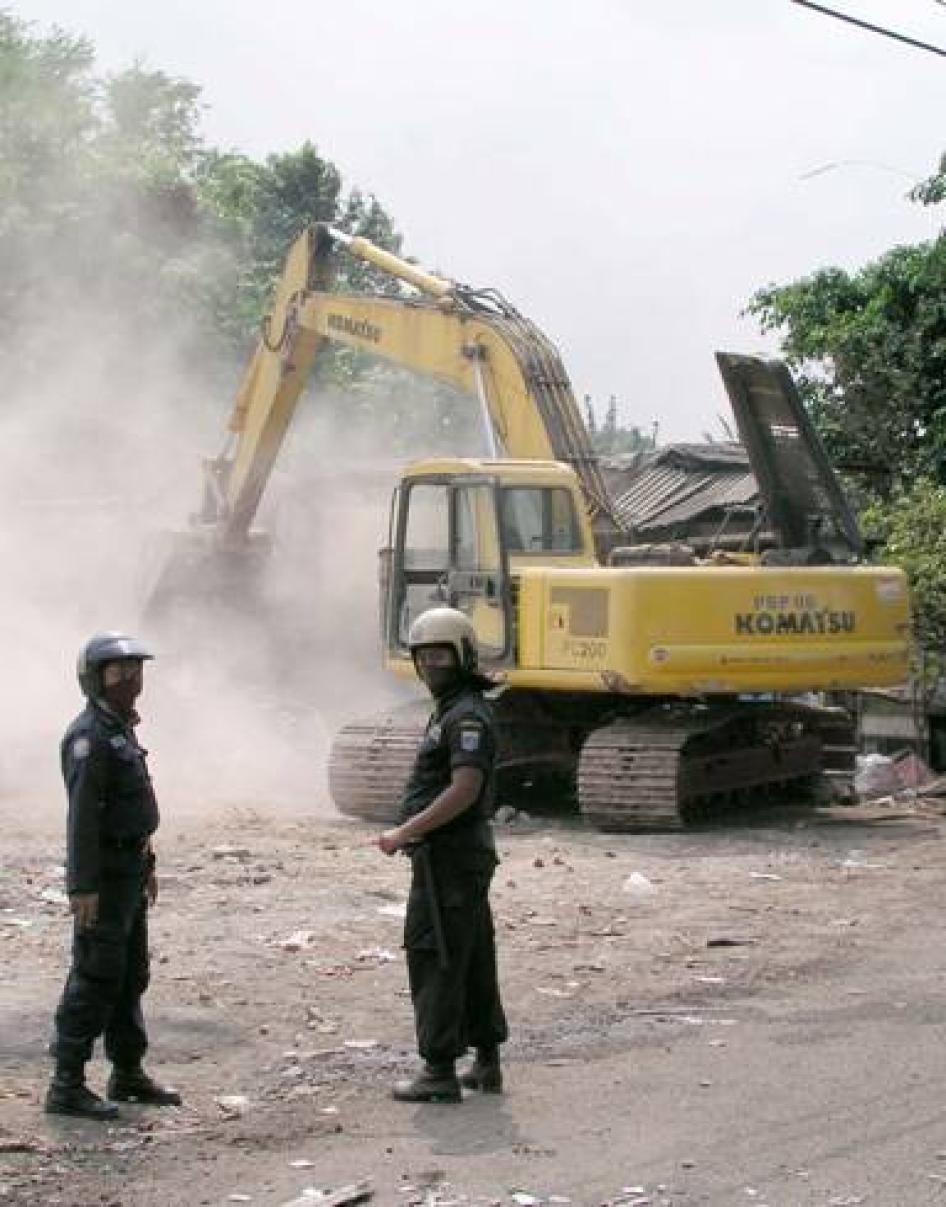
Photo 6: The eviction at Pisangan Timur cleared land approximately 250 meters from the train track scheduled for widening. The government claimed that the houses were to be demolished because they were built without permission. The eviction letters, however, came from the government office of the Double-Double Track project. (c) 2006 Bede Sheppard/Human Rights Watch
VII. Lack of Consultation
Failure to Consult
We were very worried because there was no meeting.
-Suryo Witoelar, a fifty-five-year-old businessman[207]
The government of Jakarta fails to provide basic procedural protections to residents facing eviction. The authorities generally implement evictions with little or no consultation with affected residents, despite obligations under domestic and international law to do so.[208] Instead, residents are often threatened, intimidated, and obstructed by government authorities. The government is also failing to have meaningful consultations with communities regarding planning decisions that affect them.
An NGO advocate we spoke with described the Jakarta government's unwillingness to consult with affected communities about the development plans for their land: "There is no transparency. The reason there is no transparency is because the government's priority is businessThe government of the city does not want to involve the people in the planning of development. [The decisions are] driven by business priorities, not strategic priorities."[209]
Residents frequently complained that the government rejected efforts by the residents to meet with local government officials to negotiate and discuss details regarding the use of their land or eviction plans. Some evictees had little understanding of the reasons for their evictions and of their right to be involved in such decisions. When Human Rights Watch interviewed Ibnu Darmawan, a fifty-year-old seller of second-hand goods, we asked him if the government had provided him with any reason for destroying his home. He returned our question with a confused expression: "I don't know why they evicted us. What do you mean by asking 'Was there a reason?'"[210]
When government forces arrive at a community on the date of the eviction, they are frequently unwilling to negotiate with the residents, even as to providing time for the community to secure their belongings. Agus Adil explained how the eviction at Pondok Kopi turned violent after government security forces refused to give the local community time to secure their belongings before the demolition began:
The forces from the government were already here, so a group of us formed to negotiate with the public order officials, to negotiate so that the eviction would not happen now, and that if we had to be evicted we were just asking for a little time to collect our things. But the response was that they wanted to do the eviction then and there. And the result was that we resisted the eviction and there was a fight.[211]
Insufficient Notice
There was no notification that the eviction was going to happenThere were no rumors, no talk that anything was wrong.
-Jullieta Indriyanti, a forty-year-old salvager of second-hand materials[212]
At the time I was washing clothes, and cooking some things, and I heard the sound of the knocking, so I ran out of the house to see what was happening. Not long after, the bulldozers arrived, I didn't know what was happening.
-Atin Rukiyah, a thirty-one-year-old unemployed woman[213]
The sound of approaching bulldozers should never be residents' first notice that they are about to lose their homes.[214] Some evictees complained to Human Rights Watch that they either received no prior notification of their eviction, or that they had been confused by the messages they received.
In a number of incidents, residents complained that they felt confused by the manner in which the government notified them. Several people told Human Rights Watch that eviction notices were never delivered personally to residents. Rini Rumasilan explained to us how her community at Cengkareng Timur received their notification letters: "[Notices] weren't handed to people, they were just scattered around. They were just suddenly there. The people didn't have the courtesy to discuss it with us."[215]
Human Rights Watch collected similar testimony from residents of evicted communities in Pondok Kopi and Pisangan Timur where notification letters were simply left on the ground in a pile or strewn around the edge of the community. Agus Adil explained to Human Rights Watch how many of the residents of his community in Pondok Kopi viewed this form of delivery to be confusing and used it to justify their belief that the eviction was illegal:
Indeed there was a letter. But it was non-official. Not official because it wasn't given to each member of the community, it was just thrown to the group[I]f I receive a letter from the electricity company, it comes straight to me, so if a letter like this comes how do I know it is for me?.[216]
For notification to be adequate, the government must also provide alternative means for those who are unable to read. Chahaya Utari told us that the government failed to do this with his community: "The main problem is that most of the fishermen are illiterate and could not read. Imagine being given a letter that you cannot read!"[217]
Evictions: EastCanal
Photo 7: The island in this section of the EastCanal was created as builders dug around a lot where the owner of a house had not yet received compensation. (The structure has now been dismantled.) Despite the constructors' concerns not to disturb uncompensated property, the owner could have made little use of his preserved, yet inaccessible, property. (c) 2006 Bede Sheppard/Human Rights Watch Flooding has been a chronic problem for the city of Jakarta, in part because so much of the city is built on low-lying areas, and in part because of haphazard and ill-advised development decisions in the past. The EastFloodCanal was first designed in 1973 in an effort to reduce the problem, but commitment to the project was inconsistent until 2003 when President Megawati announced that work was to go forward on the project. Digging began in November of 2003, and associated land acquisition and construction continues to this day. The canal will redirect five rivers, and will carve a path one hundred-meters wide and five-meters deep along twenty-three kilometers. Some 401 hectares of land are needed for the project,[218] and a Jakarta-based NGO estimates that this will require the resettlement of around 500,000 people.[219] Human Rights Watch interviewed residents facing eviction due to this project who reported intimidation to accept compensation, inadequate compensation for expected losses, and corruption during the assessment and compensation process. |
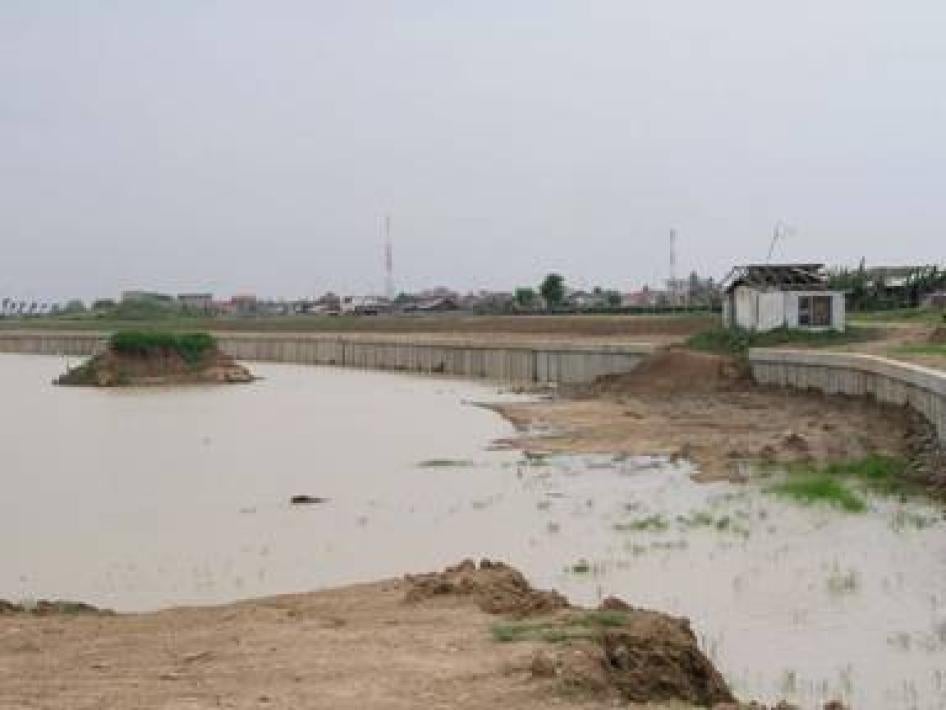
Discriminatory Impact of Notification Process on Women
Communities in most parts of Indonesia are traditionally headed by men, but the government's duty to consult and notify affected populations about pending evictions applies to all those who will be affected, irrespective of gender.[220]Jakarta's government consistently fails to compensate for existing gender biases in the notification and consultation process related to evictions. As a result, women are excluded from decisions on issues including when to move, whether their family should accept compensation or alternative land, or on the adequacy of the compensation. In certain communities the government may need to take proactive steps to ensure that women are adequately involved in consultations and are made aware of impending evictions, for example, by organizing separate community meetings specifically for women, or conducting outreach to women well-respected or with influence in the community. This is particularly important for female-headed households who may be marginalized from the larger community structures, and may therefore be disproportionately affected by an eviction.
Sri Suharti, a forty-three-year-old woman who runs a small shop next to her home under the train-track flyover bridge in Cikini, told us how the notification process failed to reach her because the men never shared the content of the letter they had received: "[The community] received notification twice through the head of the village and the sub-district office. [The community] received a letter. It was the men who read it."[221]
Sujatmi Wadud explained how the failure of the government to inform her adequately about what was going to happen left her confused by the reasons for the eviction. "I didn't really understand why [the eviction happened]. There were the group leaders who got the [eviction] letters. I just saw this piece of paper, but I didn't understand it. It was the group leaders who got the letters, not the rest of the community."[222]
Eviction: Siliwangi Housing Complex, Pasar Baru, Central JakartaMost of the twenty-seven families evictedfrom Siliwangi Housing Complex by thugs under the watchful eyes of the military on December 22,2005, are relatives of armed forces veterans from Indonesia's fight for independence who have lived on the land since 1950. In 1984, personnel from the Jakarta Military command forcibly evicted the 600 residents, leading some of the families to file a complaint with the Central Jakarta District Court and the High Court. In 1989, both courts ruled that the residents had a rightful claim to the land and that the eviction was illegal. Nonetheless, while this legal process was still ongoing, the National Land Agency issued a land ownership certificate to the Ministry of Security and Defense. Lawyers for the residents claim that the Ministry's ownership certificate is not legal because it was issued while there was still a legal dispute in progress over the land's ownership.[223] |
The Japan Bank for International Cooperation (JBIC)Japan is currently Indonesia's largest bilateral aid donor. Japan provides the largest portion of its assistance as concessional-rate loans (loans with below market rates of interest) directed through a Japanese government agency called the Japan Bank for International Cooperation (JBIC).[224] At present, JBIC loans support more than fifty economic and social development projects throughout Indonesia, including one project in Jakarta that has required large-scale evictions during the land acquisition process: the expansion of the Java railway line project, commonly referred to as the "Double-Double Track." Although JBIC recently adopted stricter internal guidelines that restrict the Bank from supporting projects that have detrimental social implications,[225] the Bank has stipulated that these new guidelines will not apply to projects approved prior to 2003. This excludes the "Double-Double Track" project from coverage. (Details of JBIC's new policy on involuntary resettlement of communities is provided in Appendix 1: How to Submit an Objection to a JBIC Project.) Nonetheless, JBIC's earlier policy on involuntary resettlement included a commitment that requires governments to develop a plan "to mitigate negative impacts of involuntary resettlement[with the objective of the] restoring of living, income, etc., for project-affected people after resettlement."[226] Because JBIC does not make such plans public, it is impossible for Human Rights Watch or Indonesian NGOs to monitor precisely the extent to which the Indonesian government is adhering to the plan, but the evidence we do have gives serious grounds for concern. As noted above, residents evicted by the JBIC-funded "Double-Double Track" project were forced to sign false receipts for more compensation than they actually received, lost considerable personal property during evictions, and were intimidated by thugs prior to their eviction. In one instance, the eviction turned violent. Human Rights Watch is also concerned about the lack of consultation between JBIC and Indonesian NGOs and civil society groups.[227] None of the Indonesian NGOs that Human Rights Watch contacted have had any involvement with JBIC. None have ever been invited to participate in meetings related to project selection or project monitoring for any JBIC-funded project. JBIC does not fund the land purchasing or land acquisition aspects of projects that it otherwise supports. The Embassy of Japan's Counselor for Economy and Development Affairs explained the policy to Human Rights Watch by saying, "It's hard to convince Japanese taxpayers why they should finance land acquisition. Because land is land, it's not creating anything. So land acquisition is a pre-condition for making infrastructure, but it should be settled by the government itself-at least the financial aspect."[228] Even if this is the motive, the policy gives the appearance that Japan is willing to share the financial but not the social responsibilities and human rights obligations of economic cooperation and development. Human rights obligations extend beyond a state's own borders. In addition to being responsible for the human rights implications of their own actions abroad, states are also under an affirmative duty to take steps through international assistance and co-operation toward the realization of human rights, including the right to adequate housing.[229] Under international standards, international agencies should avoid involvement in projects which involve large-scale evictions or displacement of persons without the provision of all appropriate protection and compensation, and conducted in compliance with all human rights obligations.[230] |
VIII. Inadequate Compensation
Basically we areoffering alternatives, but the problem is that [the people] are demanding compensation. But we see that compensation should be related to [registered property] rights, not occupation.
-Jornal Effendi Siahaan, Deputy Head of Department for Public Order and Community Protection[231]
The evictions have increased our poverty and made us into homeless people.
-Budi Santoso, a tailor in his forties[232]
The Jakarta government is repeatedly failing to provide adequate remedies for evicted residents' loss of property, whether it is the loss of rights over land seized or the destruction of property in the form of a home or personal belongings. Failing to provide fair market value or replacement cost compensation for land or property confiscated or destroyed amounts to stealing from the city's poor. The financial loss to evicted residents is not limited to their property, however, but also includes the value of their existing business ventures in the destroyed community and the disruption to their sources of income caused by the displacement. An adequate compensation package must therefore take into account not only the loss of land, buildings, and personal property, but also the disruption to an individual's income.[233]
In some instances investigated by Human Rights Watch, evictees received absolutely no compensation at all. In other instances, residents complained that the compensation offered to them was insufficient to find adequate or comparable alternative housing. We found no instances where the government paid compensation for loss of income in the case of properties used for family businesses, or income losses caused by other disadvantages related to displacement.
Coercion and Lack of Consultation in the Compensation Process
The current legal regulations in Indonesia on compensation for land acquired for public interest projects require that the government negotiate with affected communities for 120 days (recently extended from 90 days, the applicable period at the time of our interviews with evictees), after which point the government may seize the land and the level of compensation then becomes a matter to be decided by the courts.[234] Some residents noted that government officials used this provision to pressure them into accepting an unfavorable settlement on compensation, because residents felt they could not sustain themselves while waiting for the outcome of a court case once they had already been evicted. Adi Saleh tried to negotiate the level of compensation for his land which is to be seized for the East Canal Project, but when he tried to object to the money offered, he tells us: "The mayor informed me of the legislation, saying that if I didn't take the money offered then I'd have to go to court."[235]
Residents who were already evicted before they were offered compensation found themselves in a very difficult position to negotiate. As Suryo Witoelar explained: "Because the community was living in tents [following the eviction] and had no food, that forced the community to accept the money even though it was [inadequate]."[236]
Government officials sometimes also intimidate residents into agreeing to compensation. Irwan Naibaho, who at the time of our interview was due to be evicted for the East Canal Project, told us about the experiences of members of his community:
A lot of intimidation happens, but one example of it is my neighbor, who is insisting on staying in his place. One day, an officer in military uniform came and intimidated him by saying, "Oh, so this is the guy who does not want to move." Because my neighbor is so afraid, he called me, and I went to my neighbor's house. When I went there, I met the officer, and I asked him, "Who are you? Where are you from? From what institution? Where is your ID? Are you from the office of the head village official?" And he said "No," that he was coming from one of the military institutions. And then I said, "if this person still wants to stay where he is, then that is his right.".The military guy said that he was only doing what his commander had asked him to do it.[237]
No Compensation
Human Rights Watch met with some individuals to whom the government had offered no compensation at all. The community we visited in Cikini received no money for the destruction of their homes by public order officials in March 2005. Soleh Atmaji, who had lived in the community for seven years, told us: "We've received no compensation for the goods taken during the eviction."[238] Another community member, Sri Suharti, who has lived there for five years agreed: "We received some help from some of my friends. Some brought clothes. But from the government, nothing at all."[239]
Sometimes, even though local officials promise compensation, it is not actually paid. Arif Wijayanto, a forty-three-year-old part-time laborer, told us about the experiences of his community at Teluk Gong: "Some of the community was given compensation of Rp. 500,000 [US$50] per family. Even that money was not enough for us to moveBut only about 30 percent of the community got their compensation, and after that [the government] said they'd run out of money, but [those who didn't receive the compensation] were still evicted."[240]
A former lawyer who worked for evictees from a site in Tanjung Duren explained to Human Rights Watch the situation of his clients: "It was in the news that [the local government] would offer alternative housing, but that didn't happen. No one got any money. The Social Department also offered Rp. 200,000 [US$24], but [the community] didn't receive that either."[241]
We also met with some communities that were offered minimum levels of compensation, but individuals felt pressured either by local officials or their fellow community members not to accept the compensation as it was deemed too low. Some ended up receiving nothing all. Sujatmi Wadud, a twenty-three-year-old mother of one, explained this situation to us: "[I've received] no compensation. Before the eviction, there was an offer, but [the local neighborhood official] said we shouldn't take it, and also the people didn't want to take it. The money didn't cover our needs. It was Rp. 500,000 [US$59] or maybe Rp. 300,000 [US$36]."[242]
Lusiana Annga, told us of pressure from some members of her community not to accept compensation when she was evicted from Jembatan Besi:
First of all they said they were going to compensate Rp. 1,100,000 [US$130] for permanent houses, and Rp. 600,000 [US$71] for non-permanent housing. The [head village official] told us this. They told us we had to take money there [at his office]. But Rp. 600,000 [US$71]? What can we do with it?I didn't ask [for the compensation]. The others didn't take it. If the others had taken it, at once if the others took it we'd have the courage to take it. I didn't want the other people to think "how dare she take the compensation?" But we had to be united. If I was not united then the people could hate me.[243] At the end of the day we didn't get a penny.
This decision by some community members to refuse compensation on the grounds that what the government was offering was so inadequate was perhaps a negotiation tactic pushed by some leaders within the community.[244] An advocate who used to work with the community from Jembatan Besi told us that as a result of this pressure from certain community members: "They didn't get any compensation. The [head village official] only gave them a box of rice to eat. He gave enough for only three days."[245]
Eviction: Cakung CilincingPhoto 8: Eviction at Cakung Cilincing, September 15, 2005 (c) 2005 LBH-Jakarta Around one hundred public order officials and a handful of police officers arrived at a site on Cakung Cilincing Road in East Jakarta on the morning of September 15, 2005. Using machetes, cables, and bulldozers, the public order officials destroyed twenty-seven homes. Although many of the 126 residents had lived on the land for more than a decade, the land was claimed by a group of private developers who claimed ownership of the land.[246] The first eviction letter received by the residents came from an ethnic Betawi militia rather than the government, although the East Jakarta mayor later sent additional eviction letters as well.[247] Residents have been paid compensation ranging from Rp. 3 million to Rp. 10 million (US$300 - US$990), although residents claim they were intimidated by thugs into accepting the compensation. Uniformed members of the Forum Betawi Rempung gang later fenced the land.[248] |
Eviction: Ancol Timur, North JakartaDuring the early hours of October 4, 2001, public order officials, supported by police, demolished the houses of about 160 people in a community of fishermen in Ancol Timur, on the north Jakarta coast.[249] The village was destroyed by the city authorities to make way for the development of a yacht club and recreation center.[250] This was the fourth time in seven years that the government had evicted the fishermen from their homes. The community was originally formed during the 1960s, but was evicted from their original site in 1997 as a result of a reclamation project, and then again in 1999, and once more in 2001, as the community moved around within the area after each eviction. Residents evicted from their third site were offered alternative land in the village of Marunda or compensation of Rp. 6,100,000 (US$613).[251] A case brought by members of the community against the local municipality was rejected by the Jakarta State Administrative Court and the Jakarta High Court. An appeal to the Supreme Court was still pending at this writing. |
Low Compensation
When evicted residents do receive some monetary compensation, frequently the amount given is small in comparison to the value of the property lost, let alone the financial costs of moving and the interruption to residents' livelihoods.
The Chairperson of Indonesia's National Human Rights Commission's sub-commission on economic, social, and cultural rights, told us: "Compensation that is being given by the Jakarta government is very low, about Rp. 500,000 [US$56] per family."[252] As an NGO advocate who is himself an evictee told Human Rights Watch: "That's not appropriate compensationRp. 500,000 isn't even enough to hire a car to move people's belongings. So many people remain on the land to try and find a solution that [works for them]."[253]
Because homes had already been destroyed by the time Human Rights Watch met with evicted residents, we were unable to obtain market value assessments for properties. Instead, we asked many evicted residents to compare the amount of money they received in compensation to the cost of purchasing and moving to a comparable dwelling. Chahaya Utari told us that the compensation he received lasted only four months:
I received Rp. 6,100,000 [US$611]I used the money to fulfill my daily needs-for food. Even in the village if you want to build a house you need at least Rp. 30,000,000 [US$3,007] for a proper house. [The money] lasted four months. I used it also for schooling, because I had to move my children. So I had to use it wisely.[254]
The compensation Hariadi Tadj received for his eviction from his home in Cakung Cilincing would be sufficient to cover nearby alternative accommodation for just over one year: "I'm now renting a house near here. We pay Rp. 300,000 [US$30] per month. I received Rp. 5,000,000 [US$495] in compensation."[255]
Irwan Naibaho fretted about the amount the government proposes to compensate him for surrendering his land for the East Canal Project: "How would you afford to buy a new house with Rp. 802,000 [US$89] per square meter? Maybe you could buy land in the [far away] hill areas for that price." [256]
Budi Santoso, whose house was demolished in early 2006, received more compensation than many people with whom we spoke. But even he told us: "If I had to buy a new house, this Rp. 16,000,000 [US$1700] is not enough. I would need Rp. 50,000,000 [US$5335] and that would just be for the house, [not to mention] for the land."[257]
One resident who is scheduled to be evicted because of the East Canal Project, Siringo Ringo, showed Human Rights Watch letters from a real estate developer offering to sell on the open market neighboring land unaffected by the East Canal Project for between Rp. 2,000,000 (US$220) and 2,500,000 (US$275) per square meter.[258] In contrast, the government was offering Siringo Ringo and his affected neighbors just 57 percent of this amount, Rp. 1,147,000 (US$126) per square meter. This demonstrates that the residents who will be displaced by the EastCanal project will be unable to buy a comparable property given their current level of compensation. "How can I buy a nearby place, when land nearby is already Rp. 2,500,000 per meter?" he asked.[259]
Siringo Ringo was particularly upset because administration officials had publicly declared in 2003 that residents displaced by the East Canal Project would receive compensation of between Rp. 1,500,000 and Rp. 1,800,000. "And we're wondering how has the [value] gone down?"[260] he exclaimed. Moreover, although the regional government's Office for the Planning of Structures and Buildings issued guidelines in 2004 citing the amount of compensation due for buildings in Jakarta, when the assessments for housing to be affected by the East Canal were released by the same office and the mayor of East Jakarta in 2005 values for most forms of building structures had dropped to an average of just 69 percent of even the minimum amounts originally prescribed by the regional office.[261] The decrees provide no explanation for the reduction in compensation.
Eviction: Jatinegara, East JakartaOn January 11, 2006, approximately 400 public order officials and 100 police officers oversaw the demolition of a community in Kampung Melayu, Jatinegara, East Jakarta. Approximately 300 residents had their homes demolished by a bulldozer.[262] The land was cleared in connection with the expansion of the nearby railway tracks as part of the "Double-Double Track" project, which is funded in part by the Japan Bank for International Cooperation. Minor scuffles broke out between police and community members.[263] Many in the community had lived on the land for more than twenty years, and the State Railway Company had granted them official permission to live on the land because they worked for the company.[264] Although residents received minimum amounts of compensation, numerous members of the community told Human Rights Watch that local officials intimidated them into signing receipts with amounts higher than what they actually received, or blank receipts that did not specify how much residents received. The local officials threatened to withhold or delay compensation if the residents did not sign. Residents also complained that their local community leader forced them to pay him a portion of what compensation they did actually receive.[265] |
Compensation Reduced by Government
Even when the government offers residents compensation, residents may sometimes lose part of their money to dubious "commissions" or "taxes" taken by local government officials. In other instances, the standards established by the government to assess and disburse compensation are flawed and result in less than adequate compensation.
Kersen Saptono, who was evicted from a site in Cakung Cilincing in September 2005, did receive some compensation after he was evicted from his home of more than thirteen years: "We got the money after the eviction. Rp. 10,000,000 [US$990]. But the [local neighborhood official] took a cut from the compensation of Rp. 3,000,000 [US$295], so I only got Rp. 7,000,000 [US$693]."[266]
Adi Saleh, whose house is scheduled to soon be demolished to make way for the East Canal Project, lost money to a "tax": "They measured the land, and gave it avaluation of Rp. 1,147,000 [US$113 per meter squared] and then they cut that with a 10 percent taxThe government took [the 10 percent]."[267] Participants at a meeting of affected communities attended by Human Rights Watch also expressed concern and uncertainty over the government reducing payments related to the East Canal Project.[268] Human Rights Watch has been unable to confirm whether these "commissions" or "taxes" are officially prescribed. Nonetheless, even if they are legally provided for, the impact of imposing a tax on already low amounts of compensation is that the compensation can not be considered adequate, despite the government's assertion to the contrary.
In compensating people for land being acquired for the East Canal Project, the Jakarta administration is varying the level of compensation depending on what kind of proof of ownership individuals have over their land. As one resident worried:
I have girik [not yet certified] land, and I'm worried about compensation. I heard that if you have a hak milik [owner] certificate then you get 100 percent compensation, but if you have a akte jual beli [proof of transaction document], you only get 90 percent compensation. I feel disappointed and unsatisfied. It's a government project, so the government is expecting the community to help them with this project. So, in return, we also expect the government to help us out.[269]
This system penalizes landowners merely because the government has not yet registered their land. Another resident soon to be evicted for the East Canal Project asked: "Why in the mayor's process do people with a land certificate get 100 percent of [the assessed price] while people with tanah adat [customary land] get 90 percentwhen they all pay the same amount of land taxes?"[270]
Another fundamental flaw in the Jakarta administration's policy for assessing the value of compensation for people displaced for the East Canal Project is that they are tying compensation to a value known as Nilai Jual Obyek Pajak (NJOP), which is a government-appraised valuation for calculating land taxes. The recent Presidential Regulation on Land Acquisition specifies that one of three factors that should be taken into account when calculating compensation for land taken for public interest projects-along with the market value of the building and crops on the land-is the "NJOP or real/actual value of the land."[271] However, as a representative from the World Bank in Jakarta informed us: "There is a big gap between NJOP and market values."[272] The Bank recently estimated that NJOP on average tends to be 40 to 50 percent less than the actual market value.[273] Even the government appears to recognize this disparity, as it prints a statement on the back of its tax letters that the "NJOP" value cannot be used to determine the price of the land, but only to determine the amount of tax.[274] By relying on NJOP valuations rather than actual market rate valuations or replacement costs, the government is systematically under-compensating at the expense of the residents.[275]
Corruption in the Compensation Process
In numerous testimonies collected by Human Rights Watch, residents described being asked to sign blank receipts or receipts for amounts larger than they actually received. As already noted, several people also said that local officials demanded a portion of the compensation. The result is that residents are not receiving their full entitlement to compensation, and that other intermediaries and public officials are instead profiting from the evictions.
We interviewed Lena Arbali while she was sitting on her rain-soaked mattress under a temporary shelter where she had been living for a week since her eviction. Government security forces demolished her home in Jatinegara, East Jakarta, to make way for the "Double-Double Track" project. She told us:
Yes, I received compensation. I signed a receipt for the value of Rp. 27,000,000 [US$3,045] but I only received Rp. 15,200,000 [US$1,715]. But then the local village official asked me for Rp. 1,600,000 [US$180]. I don't know why. I gave it to him, I gave it to him because I was under pressure from the government because we were threatened that if we didn't give Rp. 1,600,000 [US$180] we would have to get compensation in court. The local village official told this to all the peopleThe officer from the transportation department gave me the money, and it was he who gave me the receipt to sign. I didn't ask [for the full amount of money stated on the receipt] because I knew that the other people who asked were refused it by the government and I was scared I'd have to go to court or be taken to the police.[276]
Lena's neighbor, sixty-one-year-old Ira Netra, told us: "I only received half [compensation]. The government promised Rp. 42,000,000 [US$4,738] but I only received Rp. 21,000,000 [US$2,369]. A letter sent by the government promised Rp. 42,000,000 [US$4,738]. A [local official] gave me the money. I didn't ask him why only half the compensation, I just followed what the other people did."[277] Residents first reported these problems to the Corruption Eradication Commission in August, 2005, but they have received no reply or remedy, illustrating the lack of access to an effective remedy to challenge their exploitation by corrupt officials.[278]
Human Rights Watch also learned of bribery in the process of determining levels of compensation. Public order officials collected payments to expedite administrative processes. Some also extracted bribes before they would pay evictees proper compensation. In one case, a resident said that he had initiated the bribery knowing that, without "helpers," his property likely would have received a low, inadequate valuation:
I had to give a commission-willingly-to middlemen,[279]people who offered to help. I paid them, but I promised not to tell on them. I gave some people Rp. 4,000,000 (US$450), and others Rp. 2,000,000 (US$225). Different people, different placesIt was a token of gratitude for people who helped me by making the process be done quickly. I was the one who insisted to give the money, because at first the people refused to take the money. But in the end, they accepted the money. And we got fast service. We got prioritized first. I paid the people who carried out the [assessment and compensation] processI also paid someone to assess my land as being bigger than it is.[280]
Ali Sadeh went on to admit that he paid a government evaluator to assess and grade his house at a higher level for compensation, not as a "fifth class" house (the most basic category of permanent house), but as a "third class," medium quality, house.
A neighbor of Ali Sadeh's suggested to us that payments to government valuators are not always entirely voluntary. Tommy Rustanto told us:
There is this [middleman/broker[281]]who is asking to take money from the people to measure the land and the house. For me, that does not go along with the rulesIt doesn't go that you are paying to have your house and land measured. It's not stated in the regulation that they can ask for money. This [local government] has actually been provided a budget for this field office, for the people doing the measurement.[282]
Numerous interviewees who worked for the Jakarta government, NGOs, and international financial institutions also complained about the involvement of land speculators profiting from using confidential and privileged information.[283]
Provision of Inadequate AlternativeLand
In three of the incidents of forced eviction investigated by Human Rights Watch, the Jakarta administration gave the evicted communities the option of moving to alternative land or accommodations instead of taking monetary compensation. The United Nations' Human Rights Commission has noted that, as an alternative to monetary compensation, governments may provide "appropriate and sufficient alternative accommodation or land, consistent with their wishes and needs, to persons and communities that have been forcibly evicted."[284] However, in all three incidents, residents of the affected communities found the alternative land inadequate given their chosen livelihood pursuits.
In 2001, government forces evicted the community of fishermen in Ancol Timur from their homes so that a yacht club and a sports club could be built on the North Jakarta coastline. The government offered the fishermen either Rp. 6,100,000 (US$613) or alternative housing in a different area. Santoso Mulyani, a sixty-one-year-old fisherman, explained to Human Rights Watch the problems with the land offered:
They offered a place called Marunda, but they were only providing shelter, not a house[And] it was far from the seaThe previous area [where we lived before the eviction], it was really near the sea; you could just open your door.We depend on the boats for our living, so if you stay far from the sea it's useless.[285]
Chahaya Utari, a fellow fisherman from the Ancol Timur community, who now sleeps on his boat, told Human Rights Watch why he did not accept the alternative land:
The problem with the alternative place was that it was five kilometers from the sea, and you couldn't monitor the weather out at sea, and we would find it difficult to remove our boats from the sea at [the closest] point on the coastAt that alternative place you would have to fight the wind and the ocean.[286]
At another eviction site, Pondok Kopi in East Jakarta, the government offered residents land owned by the state-owned housing company. "But the location was very far away from the current location," an NGO advocate who worked with the community in 2001 informed Human Rights Watch, and was therefore far from residents' existing livelihood activities.[287] Accepting the social housing also required an advance payment by residents to the state-owned housing agency of Rp. 1,300,000 (US$130) and installments of Rp. 170,000 per month (US$17).[288]
In the case of both Ancol Timur and Pondok Kopi, some of the residents who took the alternative land found their livelihoods unsustainable and returned to their original site of residence. Santoso Mulyani, a fisherman from Ancol Timur, initially accepted the alternative land, but by the time Human Rights Watch interviewed him, he was living in an informal shelter on the side of the road close to the coast and near the site of his old fishing village. Santoso explained to us:
I took the alternative facilitiesI moved in. [But] you have to take three forms of transportation to get to the sea from Marunda. And it's more [a problem] about where to put your boat. I worry about the condition of my boat. Here it's only 300m away. So if something happens to the boat [it's close][There] someone could take the engine from the boat and you wouldn't know.[289]
Former residents of Pondok Kopi who accepted the alternative land faced similar problems pursuing traditional livelihoods and therefore returned to their original site. Of the sixty-eight families evicted from Pondok Kopi, only fifteen moved to the land offered in Parung Pajang, in West Java. But, as an NGO advocate for the community explains, "the fifteen familieshave their place [in Parung Pajang] but they still live in Pondok Kopi because Parung Pajang is too far from their work."[290]
In the case of the residents evicted from land in Cengkareng Timur, East Jakarta, in 2003, the government also failed to offer viable alternatives. Following the eviction from land claimed to be owned by the state-owned housing company, Perum Perumnas, the company gave residents two options for alternative sites.[291] The first option was for the former residents to buy a Perum Perumnas house in Parung Pajang district, outside of Jakarta, for a discounted price of Rp. 14 million (US$1,647). Considering that the residents received no compensation for the loss of their original housing, even these discounted apartments were pricey. The apartments were also far from existing work and family ties for some residents. Moreover, the apartments offered by the government had yet to be built.[292] This offer cannot be said to have constituted an adequate alternative.[293]
The second alternative accommodation offered was to rent low-cost apartments to be built on the site of the cleared land, where residents were promised they would only have to pay Rp. 100,000 (US$12) per month to rent. Again, however, the apartments had not yet been built. In fact, when Human Rights Watch visited the site in 2006, two-and-a-half years after the eviction, no new Perum Perumnas housing had yet been built.
Eviction: Kampung Baru, Cengkareng Timur, West JakartaAround 2,600 public order officials, police, and thugs demolished the homes of 1,000 residents on a fifty hectare plot in Cengkareng Timur, West Jakarta, on September 17, 2003. The government claimed that the land was owned by the state-owned housing company Perum Perumnas. Media reports and witness testimony noted that the police used tear gas, firearms, and a water-cannon against the residents who resisted the eviction.More than thirty-five residents and nine policemen were injured, according to media sources.[294] One man died a week later from injuries sustained during the eviction.[295] The National Commission on Child Protection reported that a thirteen-year-old girl was raped by public order officials as her parents' house was demolished.[296] The state-owned housing company blamed the West Jakarta mayor for having encouraged unemployed people to farm on the neglected site in 1998. Some residents also claim that they bought the land from heirs of the original owner.[297] At the time of the eviction, the state-owned housing company claimed that the land was to be used for building state-owned housing, while 25 hectares of the land would be used to develop a commercial zone for shopping malls and office buildings.[298] When Human Rights Watch visited the site in 2006, the commercial development had indeed occurred, but there was no new Perumnas housing to be seen on the site.[299] In 2005, the District Court of West Jakarta ruled that the eviction was carried out illegally and that the residents had the right to live on the land. Both the mayor of West Jakarta and the state-owned housing company were found liable for losses to the residents, and were required to return the land to the residents.[300]Perum Perumnas has appealed that decision and the government has yet to pay any compensation for the wrongful eviction. Construction work continues on the land and residents have not yet been allowed to return. |
IX. Consequences of Evictions
Let me put it this way: in the old place, I could eat rice with chicken. Here, only rice with salt.
-Kasan Percaya, a sixty-one-year-old businessman[301]
Effects of Evictions on Women and Girls
Women evictees face particularly adverse consequences from evictions, most notably interruptions to income-generating activities they run out of their homes. Several such cases are detailed below. Women also face heightened exposure to sexual and gender-based violence[302] and, because they make up the majority of internal Indonesian migrants to Jakarta,[303] are disproportionately exposed to abuses to which migrants are susceptible (see "Effects of evictions on migrants," below).
As the principal targets of sexual and gender-based violence, women and girls are particularly exposed to such abuse by forced evictions.[304] The chaos during an eviction, and the disruption of community structures and the change to less secure living circumstances in the aftermath of an eviction, may all increase the risk of such violence. During the eviction at Cengkareng Timur in West Jakarta, a public order official is reported to have raped a thirteen-year-old girl, according to the National Commission on Child Protection.[305] Reports of sexual and gender-based violence may be underreported due to the stigma involved.
Many evicted women told Human Rights Watch they used their homes, or shops connected to their homes, as part of their income generating activities. Susi Setyowati showed us her new shop as she related the story of her life prior to the eviction of her community from Kapuk Muara in 2003: "I had a food stall in my old house. My house had two levels. I used the second level to sleep, and the first level for a food stall." Following her eviction, Susi Setyowati was fortunate to receive assistance from a private charitable foundation that helped her move to a new apartment in the city's periphery. She has now opened another small food stall near her new home. However, she noted:
I now earn between Rp. 150,000 [US$16] and Rp. 200,000 [US$21] per week. That's [income] not profit. My profit is only like Rp. 50,000 [US$5]. It's less than at the other place. Back then, in the previous place, I could earn Rp. 400,000 [US$42] per day. This shop is only for the people who live hereAt the other place there were offices, factories, supermarkets, so they'd all come and buy something."[306]
Sinta Suryana used to run a series of rental homes, another occupation common for Indonesian women.[307] Local security forces demolished all of her rental houses during the clearance of the community in Pisangan Timur. She told us, "I earned Rp. 2,500,000 [US$262] per month from all seven of my rental houses. That was my only business."[308]
Ani Fatah used to work as a tailor from her home. She told us about her eviction:
I was just grabbing whatever I could: some clothes, but most of them were burned; my sewing machine, but it got damaged along the way; and my papers.I did part-time tailoring in my house. That's why I had my sewing machine. Sometimes, when there was a good day, I would earn Rp. 10,000 [US$1.20]. But I couldn't work [following the eviction when I was camping out at the] National Commission for Human RightsIt was five to six months after I moved here before I could start doing sewing again. That was sixteen months after the eviction.[309]
Sri Suharti told us about the destruction of her shop by the public order officials along with her house: "It took maybe six months to rebuild my small shop. We had to do it little by little."[310] These testimonies indicate that once an eviction disrupts an individual's domestic-based income activities, it may take many months to restart that kind of work.
Losing work may also effect a woman's children and her extended family, because many Indonesian women are likely to remit part of their income to family members in other parts of the country, often contributing to a sibling's education.[311]
Effects of Evictions on Children
I didn't know what to do with my children. My little girl kept crying, "Mom, our house is destroyed."
-Atin Rukiyah, a thirty-one-year-old unemployed woman[312]
My children are not going to school anymore. I've asked for permission from the school to take them out for a little while because they are still traumatized. All their school books have been destroyed. Also, now that we are living here, the school they went to is very far away.
-Dian Yusif, a forty-seven-year-old former businessman[313]
The sheer noise, confusion, and scale of an eviction can be a terrifying experience for any child. The loss of possessions such as school books and uniforms during evictions, and the disruption to parents' lives can have a serious effect on the ability of children to attend school. Adequate housing and secure living conditions are integral to children's welfare, and are guaranteed by Indonesian and international law.[314]
Eddie Hariyanti was brought to tears when recounting the emotional impact of the eviction on his young daughter: "[The thugs] went and destroyed everything, including my children's books and my children's things, and my daughter kept asking me, 'What are they doing? What are they doing?' And I had to tell her just to be patient. And she saw the bulldozers coming in, destroying her house. She will definitely always remember that, and never forget."[315]
When Human Rights Watch visited Budi Santoso just four days after local security apparatus destroyed his home in Pisangan Timur, he was concerned that the eviction had caused his daughter to run away:
One of my children has not come home since the day of the eviction. We don't know where she is. We've been looking for her. It's been four days since we've seen her.She's a high school student. We looked at school, and asked her friends about her, but they don't know where she is. I don't know what happened to herShe was at school during the eviction. But she didn't come home on that day. Normally she comes home at 11 a.m. I think the reason has to be the eviction.[316]
Reflecting on her experiences, Lastri Sukainar, who was twelve years old when government forces evicted her from her home in Teluk Gong, told Human Rights Watch: "I was scared seeing the eviction."[317] Three years after the eviction, Lastri is doing well, thanks largely to a private charitable foundation that helped her family find a new apartment and provided Lastri with affordable schooling.
Impact on Children's Education
Evictions frequently cause disruption in children's abilities to access their right to education as guaranteed by Indonesian and international law.[318] Many evicted children had their school books and school supplies destroyed or lost during the eviction process. Other children lost their school uniforms, which are mandatory for attending school. We met Pramana Prihatin who told us: "I lostour children's school books and uniforms."[319] One father, Santoso Mulyani told us: "Our children were supposed to go to school, but because [the public order officials] had destroyed our house we could not find the clothing and books, so they could not go to school."[320] The three school-age children of Sri Suharti experienced a similar problem. As their mother describes: "My children's school things were gone. They couldn't go to school for three weeks."[321]
Schools in Indonesia charge a variety of fees for starting and attending classes. A number of parents complained that the disruption caused to their own livelihoods by the eviction meant that they could no longer continue to pay such fees for schooling. As Kersen Saptono explained, "The consequence of the eviction is that the education of our children has been disruptedOur employment has been cut off, so now we don't have any money to send our children to school."[322] When we interviewed Kersen his children had not been able to attend school for almost five months. In her 2002 examination of the Indonesian education system, the United Nations' Special Rapporteur on the Right to Education, Katarina Tomaevski, concluded that poverty and costs are the key obstacles to Indonesian children's access to education.[323] A recent investigation by Human Rights Watch further concluded that direct and indirect school costs play a role in forcing Indonesian children to drop out of elementary and lower secondary school and is a contributing factor to children being pushed into the labor force, including the worst forms of child labor.[324]
When evictions force families to move to new locations, parents must choose between enrolling their children in a new school or keeping their children in their old schools. Transferring children to a new school can require paying registration fees that may be prohibitive, or at the very least entail a delay in the schooling until the family can raise sufficient funds. After government forces and gangs of thugs evicted Ani Fatah from her home in Cengkareng Timur, it took her ten months before she could find another permanent place to live and work:
My child, every time he saw school children he would cry because he couldn't go to schoolWhere would we find the money to send the children to school? I approached a school, and they said [I would have to pay] Rp. 5 million [US$535] up front. Then another school wanted Rp. 2 million [US$214] up frontBut we had to prioritize food.[325]
Even taking the time to fulfill the new school's administrative requirements can lead to an interruption in children's schooling. Chahaya Utari told Human Rights Watch about his experiences when moving his children to his old home village after the government destroyed the fishing village where he and his family were living: "I have five childrenBefore the eviction they were in elementary school, they went to a school nearby. They didn't go to school for two months after the eviction before starting school in my village.My children did not go directly to school because we had to take care of administration matters, letters of recommendation, and so on."[326]
When parents choose to keep children in their old schools for the time being, despite the family being moved, this may necessitate long and expensive travel for the children and the parents. Arti Sudewo, who has two daughters, explained: "When we moved here, they didn't go to school for three months. Then my husband bought us a bicycle so I could take them to school. Then I would wait all day to bring them home. After [my daughters] finished their semester, I put them in a closer school. We got assistance from some of the families to pay for the school."[327] When we met Budi Santoso, he was still sending his children to their old school: "My children are still going to school here, but [where we are now staying] is quite far away, so now we have to pay to take them here which is expensive."[328]
Eviction: Jembatan Besi, West JakartaThe mayor of West Jakarta, through its public order officers, and with the assistance of police, military, and gangs of thugs evicted around 6,000 residents from the 5.5 hectares at Jembatan Besi, Tambora on August 26, 2003.[329] Some of the residents had lived on the land since 1994, although the majority of the community moved to the land during the economic crisis. The mayor claimed the land belonged to a private company, PT Cakra Wira Bumi Mandala.[330] The eviction turned violent, with the security forces using teargas and firing shots as they entered the community. |
Effects of Evictions on Migrants
This problem is actually the affair of the central government because they are not Jakarta residents. They are not my people.
-Governor Sutiyoso[331]
Migrants who have moved to Jakarta from other areas of Indonesia are particularly vulnerable to the consequences of forced evictions. Some will be vulnerable as they will not have acquired the legal documentation required under Indonesian law to reside in the Jakarta district, while others who have obtained the necessary documentation may still lack extensive social support networks within their new communities to aid with the displacement.[332] Rather than providing additional support to evicted migrants, the Jakarta government instead uses the fact that migrants are not originally from Jakarta and that some lack residency identification cards as an excuse to deny them compensation and assistance.[333] For all affected by forced evictions the overriding criteria for compensation and assistance should be that the individual has in fact suffered harm or loss because the government evicted him or her from the house and land where he or she was living. Within any scheme of assistance or compensation, provision can be made to distinguish between categories of evictees on objective criteria such as ownership or length of residency. However arbitrary criteria, or criteria which cause undue hardship on certain categories of victims or lead to significant difference in the way in which victims are treated are incompatible with international standards.[334] For example, while it might be appropriate to establish minimum residency requirements for certain forms of assistance, it should not be done exclusively by way of showing a JakartaID cards as some have great difficulties in obtaining ID cards, despite their long time residency in Jakarta. Instead residents should be allowed to establish residency through other forms of proof, and allowed to access compensation and assistance where they have suffered harm or loss through eviction.
Excluding rural-to-city migrants from compensation and assistance after an eviction on the basis that they do not possess JakartaID cards can be seen as part of a wider pattern of arbitrary treatment of migrants by the Jakarta government. For example, the Governor recently promulgated a regulation whereby Indonesian citizens who move to their capital city but fail to register with the city's population agency and obtain a visitor's identity card within fourteen days of their arrival-a process which requires proof of permanent employment and residence-are liable to imprisonment for up to three months or a Rp. 5,000,000 (US$550) fine.[335]
Jakarta is Indonesia's capital, and as such, it should be accessible to every Indonesian citizen. Because the government does not provide shelter for poor and migrant communities, these communities rely on informal settlements when moving to the city in search of jobs and a better life for themselves and their families. Destroying those settlements without providing adequate compensation or adequate alternative shelter only makes it more difficult for them to integrate fully into the city. Urban growth is an inevitable part of economic development, and Jakarta's government should not limit access to the enormous potential for human development that urban life can offer to many.
As a representative from an NGO that works with Jakarta's poor explained to us: "If people stay in their village, they cannot eat, they cannot live. There's so much development happening in Jakarta, but not in their village, and that is why people come to Jakarta. And that is why they come and use the empty land."[336] Yet, as a leading Indonesian NGO activist put it to us, "You can't stop urbanization, you can only manage it."[337] As well as being ineffective, Governor Sutiyoso's attempts to restrict migration to Indonesia's capital violates both Indonesia's constitution and international law, which guarantee individuals freedom of movement and freedom to choose where to establish a residence.[338]
It is also important to stress that many of the residents that Human Rights Watch met in informal settlements were in fact Jakarta natives, or had moved to Jakarta decades before and had registered as Jakarta residents and held Jakarta identification cards. Even such long-term residents, however, can lose their status as a result of an eviction. One of the requirements for getting a new Jakarta identity card is to present an introductory letter from the local neighborhood official verifying where an individual is living.As Jullieta Indrivanti told us: "I have an ID from my village, but my children have Jakarta IDs. I used to have a JakartaID, but it was burned in 2001 during one of the evictions. After that I needed another ID from my village. After I was evicted I wasn't recognized by the government here, which is why I had to get an ID from my village."[339]
Inadequate Shelter Following Evictions
We were forced to leave but that night we came back. We slept on the ground and we slept here. It was raining and everything got wet. We came back here because we had nowhere else to go It was about three months before we could build again. The public order officials were constantly patrolling the area. We couldn't build a tent or a fence that could be seen from the road. The public order officials said "Later. Later, you can build, but now it has to be clear"We still have no roof, just a tarpaulin.
-Arti Sudewo, thirty-seven-year-old housewife[340]
In the days, weeks, and months following an eviction, many evictees have no choice but to live in sub-standard facilities. Some become homeless. The local government in Jakarta is failing to fulfill its obligations under international standards to ensure that evictions do not result in individuals becoming destitute or homeless.[341] Human Rights Watch visited families who were living under blue tarpaulin beside the remains of their houses that had been destroyed a week earlier (see Photo 9on page 98).[342] Evicted residents frequently stated that they lacked the necessary financial resources to provide permanent forms of shelter for themselves in the immediate aftermath of an eviction, and that it can take between one and six months to save enough to rebuild a semi-permanent or permanent shelter. Some evictees are still living in temporary shelters years after their eviction.
Human Right Watch met with a number of evictees who were living on the sides of the streets adjacent to the lot in Jembatan Besi where they had been evicted two-and-a-half years earlier. Joenna Susandra was living in a very narrow, basic shelter made from blue tarpaulin and some light wood. When asked why her shack was so narrow, she explained that she had tried to build no wider than the covered sewers running below, believing that this meant she was on government land and would therefore be afforded more protections. But, as Joenna Susandra explained to us: "Sometimes the public order officials will come and we have to take down this tent, and then recreate it when they're gone. It's very sad really."[343]
Sri Suharti, a forty-three-year-old shopkeeper, shared her experiences in the aftermath of her eviction from her house under the railway flyover in Cikini:
We slept here that night on some tarpaulin. We had to sleep like that for a very long time. I think it was about two months before we had collected enough wood to build againWe had to wait about three months for the electricity to come back because the public order officials had cut the electricity lines.[344]
Praman Prihanti, a forty-nine-year old salvager of second-hand materials from Pondok Kopi, had a similar experience: "We slept in emergency tents for one month. Then we built just one room to sleep in. We rebuilt in the exact same place. We wonder why we were evicted in the first place. There's been no development here since 2001."[345]
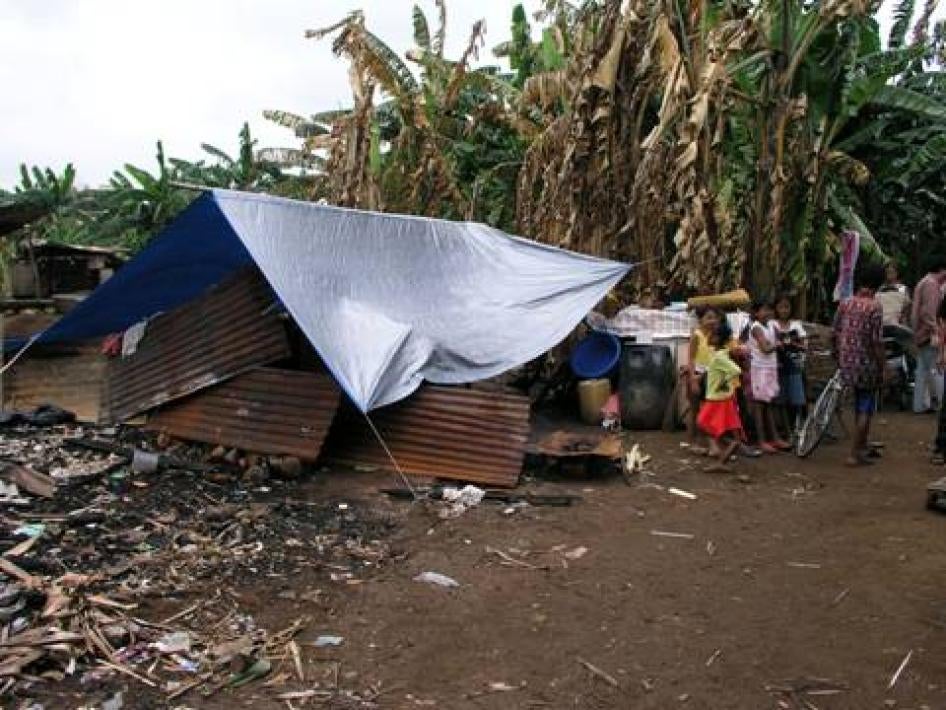
Photo 9: Evicted residents live under blue tarpaulin next to the burned remains of their home
(c) 2006 Bede Sheppard/Human Rights Watch
Evictees from Cakung Cilincing also resorted to temporary tents following their eviction. As Atin Rukiyah, a thirty-one-year-old unemployed woman, related to us: "We started making shelter at about 8p.m. Not just me, the whole community made some tents out of some blue tarpaulin that we had."[346]
Some residents from the eviction at Cengkareng Timur in 2003, and from Siliwangi, Pasar Baru in 2005, took to living in the parking lot of the National Commission for Human Rights (Komnas-HAM) in an attempt to bring greater attention to their plight.[347] Sujatmi Wadud, a twenty-three-year-old homemaker, was one of these people following her eviction from Cengkareng Timur. "I was at the National Commission for Human Rights. I went there to seek protection. I stayed there ten or eleven months, from September until July. It was not until late July that we found this [other] place and moved," she told Human Rights Watch.[348]
One NGO representative who worked with evicted residents from Jembatan Besi explained her frustration at the government's practice of evicting residents without providing meaningful alternatives or solutions, thereby forcing them to continue living in informal settlements. As she put it, the government's approach flatly contradicts its stated goal of ending informal settlements:
Those people were Jakarta citizens, and after the eviction, the government just said they were illegal, didn't give them compensation, didn't relocate them, it just treated them like animals. If only [Governor] Sutiyoso had a little brain in his head, he would realize that these people, if they become jobless, they will increase criminal activity. He just evicted the marginalized people but he didn't give any solution after the eviction. Some of the people of Jembatan Besi are [now] living under highway flyovers.[349]
Cyclical Nature of Evictions
I have been living here thirty-five years, and we've been evicted many many times. But we just come back because we have nowhere else to live.
-Ibnu Darmawan, a fifty-year-old salvager of second-hand goods[350]
The fact that government forces have evicted some individuals again and again from locations all over Jakarta illustrates the sheer futility of conducting evictions without adequate consultation and compensation. A number of evicted residents told Human Rights Watch stories of being evicted from one location, moving to another place, and then being evicted again, or of returning to the very same piece of land that they were originally evicted from. These serial and cyclical displacements highlight the fact that often the government does not put the cleared land to productive forms of use, and it also shows that evictions-absent coordination with other assistance-are not addressing the government's stated concerns with informal settlements.
One woman that Human Rights Watch met with claimed that the government had evicted her from four separate locations.[351] Residents who remain at Teluk Gong explain that evictions for them have become almost routine. Jullieta Indriyanti told us that as far as she was concerned, the eviction that had occurred just days before we met her was nothing exceptional: "It's already been thirty times, including this one. Thirty times over five years."[352]
Human Rights Watch was able to meet with two groups of former evictees living in exactly the same place from where the government had originally evicted them. Ibnu Darmawan, a fifty-year-old seller of second-hand goods told us how her family reacted after the public order officials arrived in force at her community: "We just left voluntarily, there wasn't any violence. We just went to the other side of the road, waited there all afternoon until [the forces] left, and then we came back."[353] A nearby neighbor, Soleh Atmaji, waited a little longer until his return: "After the eviction I came back here five months later. I was renting a house for those five months. After five months I didn't have enough money and I came back here."[354]
Arti Sudewo explained that the government had evicted her from two different locations, although she was once again living in the same place as her last eviction:
We were evicted from the last place [that we lived too]. That land was empty when we got there, and we made a house from tarpaulin and then they wanted to put a hospital there, so we were evicted and moved here. We were there about one year.Less than a year ago there was an evictionWe were forced to leave and that night we came backWe came back here because we had nowhere else to go.[355]
X. Detailed Recommendations
To the Jakarta Regional Government
Impose a Short-Term Moratorium
- Impose a moratorium on all evictions carried out on "public order" grounds, until a mechanism can be established whereby independent experts carry out participatory baseline surveys prior to any eviction.
- Baseline surveys should take a census of affected residents, their assets, and their socio-economic conditions.
- This information should be used to identify the impact that an eviction will cause and to assess whether the public order interest desired would be proportionate to the impact on the lives of the evicted residents.
- The information collected can also be used to design a resettlement program that will leave residents with at least the same, if not better, standards of living and income levels, but in a manner where they will not risk causing public order infringements in the future.
- The determination of who should perform these surveys should be decided during the moratorium in consultation with civil society groups and representatives from the urban poor.
- Jakarta Regulation (Perda) No. 11/1988 may require revision so as to permit local officials to consider the proportionality of the public order goals of restrictions on where people can live with the detrimental effect an eviction would have on a community.
- Impose a moratorium on all evictions related to the construction of public interest infrastructure projects until an independent investigation can be completed regarding allegations of human rights violations related to the "Double-Double Track" project, and any systemic problems identified are addressed.
Conform Eviction Processes to International Standards
- Evictions should never render individuals homeless or vulnerable to the violation of other human rights. Where those affected by evictions are unable to provide for themselves, officials should take all appropriate measures to ensure that adequate alternatives are available.
- Future evictions should be carried out in coordination with: the Department of Housing and Regional Infrastructure, Department of Social Affairs, Department of Education, State Ministry of Women Empowerment, Indonesian Human Rights Commission, National Commission on Women, National Commission on Child Protection and other relevant social agencies.
- Representatives from these ministries and commissions should establish a joint working group to monitor and ensure compliance of eviction procedures and practice with international standards.
- Evictions, when necessary and justified, should be granted permission only when they are authorized following a fair and transparent public process.
- This process should include the establishment of an objective and justified need for the eviction, genuine consultation with the affected communities, with an opportunity for all affected to have a say in the process, and an assessment of alternative measures to the eviction.
- All members of a community, including the poor, illiterate people, women, the elderly, and children living without parents, should be informed of, and have the opportunity to be involved in, this process.
- Evictions, when justified, should be preceded by adequate and reasonable notice for all affected persons prior to the scheduled date of eviction.
- The period of advance notice should include enough time for the negotiation of compensation agreements and for resettlement.
- The exact date of evictions should be open to negotiation with the affected community to ensure they are adequately prepared.
- As part of the notification process, communities should be informed of available legal remedies so that individuals who wish to challenge the eviction or raise due process concerns are able to do so.
- Indigent residents should be provided with legal assistance for such claims.
- Adequate, market value/replacement cost compensation should be provided to all right-holders and occupants on the land. The participatory baseline survey of socio-economic conditions in the area should inform compensation for non-property losses associated with displacement.
- If the government wants to offer alternative land, aim to use sites as close as possible to the original area, and ensure that alternative sites offer residents adequate opportunities to continue existing livelihood activities.
- Evictions should not occur during the school year or at times when the displacement of families will interrupt children's education. Compensation should cover fees associated with changing schools.
- Evictions should not take place in particularly bad weather or at night.
- Community-based resolution of land disputes should be supported. The government should consider creating a mediation mechanism at the local level to provide faster dispute resolution.
Minimize Use of Force
- Private individuals and gangs should not be allowed to be involved in the eviction process.
- Ensure that public order officials receive appropriate professional training for carrying out their public security responsibilities. Review rules of engagement to ensure their compliance with international law enforcement standards, such as the U.N. Code of Conduct for Law Enforcement Officials and the U.N. Basic Principles on the Use of Force and Firearms.
- Provide public order officials trainings on human rights and the needs and problems faced by the poor.
Consider Broader City Planning Reforms
- Review current government land holdings and compare them to existing and projected needs for land. Consider redistributing any lands not slated for public use to poor landless households or selling the lands on open markets to increase land supply.
- Consider surveying all extra-legal settlements and identifying those located on land that will be required for strategic public interest projects over the next ten years or in areas subject to environmental hazards. This evaluation should be subject to independent review. Prioritize residents in all such settlements for relocation to sites that offer access to existing livelihood activities and services. Provide an official license or permit allowing continuing occupancy for a limited period until the date the land is expected to be required for other purposes.
- Grant residents in all other extra-legal settlements forms of tenure with increased rights, though not necessarily full title. For unauthorized settlements on private land, consider land sharing arrangements. Local authorities should assist residents in mediating with private enterprises, using all available incentives, such as the ability to withhold future development permits to the private corporations, should the corporations fail to act in good faith.
- Provide local government agencies with training and retraining so as to bolster their capacities in: land administration; managing and implementing urban land-use development; public information and outreach services; impact assessments; consultation with stakeholders; relocation planning; income restoration programs; resettlement monitoring and evaluations; and making routine assessments of the human rights impact of their work.
- In order to ensure transparency and accountability in the process of city planning, institutionalize regular and genuine community consultation that facilitates participation from all sections of Jakarta's population, including the poor, women, the elderly, and children. Make gender analyses an essential part of project planning.
- Implement mechanisms by which low-income citizens can easily access information on proposed development projects.
- Uphold the rights to freedom of expression, assembly, and association. Recognize the rights of residents and their supporters to speak out publicly on evictions, legal regulations, and other issues of concern.
To Both the Regional and National Governments
Ensure Accountability
- Investigate and prosecute thugs and vigilantes who violate human rights, and any government officials who employ them.
- Investigate and prosecute military, police, and public order officials responsible for violence, rape, theft, or arbitrary destruction of personal property during evictions.
- Investigate and prosecute corruption, fraud, and forgery within national and regional agencies involved in land registration and development. Where government employees have been involved in fraudulent registrations, there should be consequences, including criminal prosecutions and dismissal where appropriate.
- The Anti-Corruption Commission should consider dedicating full-time staff to investigating allegations of corruption related to infrastructure projects.
To the National Government of Indonesia
Implement Legislative Reform
- In accordance with the comments of the United Nations Committee on Economic, Social, and Cultural Rights, enact legislation that prohibits forced evictions, by including measures, in conformity with human rights treaty obligations, which provide the greatest possible security of tenure to occupiers of houses and land, and are designed to control strictly the circumstances under which evictions may be carried out.
- Ensure that existing legislation and policies are adequate to prevent and prosecute private persons-such as thugs or vigilantes-who carry out forced evictions without appropriate safeguards.
- Provide strong penalties against any public developer or corporate enterprise that harasses or intimidates citizens in any way, including pressuring individuals to move or to accept any particular form or level of compensation.
- The issue of land acquisition needs more comprehensive and clear legislation than is offered by a Presidential Regulation. Draft a comprehensive law on land acquisition for development activities in the public interest, in full cooperation with civil society and nongovernmental organizations, that:
ocorrectly limits the power to take land for public interest purposes;
oexplicitly covers all affected people irrespective of their tenure status;
omakes the process for acquiring private land for public purposes more transparent and participatory;
omandates active, free, and meaningful participation by affected communities in all phases of development planning: assessment, analysis, planning, implementation, monitoring, and evaluation.
oguarantees adequate, market value/replacement cost compensation to all rights-holders and occupants on the land;
oguarantees adequate compensation for loss of income related to the displacement so that displaced residents can maintain or improve their current standard of living;
oensures that monetary compensation is distributed prior to eviction, or arranges alternative accommodation that is available prior to eviction;
oprovides for the right to appeal to an independent body adjudications of right to land and levels of compensation; and
oprovides for land appraisers who are genuinely independent and who use publicly declared assessment criteria that can be contested by the public.
- Undertake further consultation with national and international experts on the Basic Agrarian Law of 1960.
- Consider reforming existing regulations on land title and registration to simplify the process, reduce the costs to individuals, provide flexible requirements on the forms of title evidence required, increase efficiency, and diminish delays. Allow indigent and small-scale landowners and land users to register their land rights for free.
To International Donors
- Provide capacity building assistance to local NGOs and civil society groups so they can better monitor the compliance of government agencies with human rights obligations in development projects. In particular, provide technical training on: financial auditing; housing and land development issues; best practices on regulating and administering land; and the mechanisms for implementing economic, social, and cultural rights.
- Provide national and local government agencies with trainings so as to bolster their capacities in: land administration; managing and implementing urban land-use development; public information and outreach services; and making routine assessments of the human rights impact of their work.
- Consider offering funding for international experts to provide the Indonesian judiciary with trainings on how to ensure that in their deliberations and decisions all of Indonesia's obligations under the International Covenant on Civil and Political Rights and the International Covenant on Economic, Social, and Cultural Rights are being met.
To the Japan Bank for International Cooperation
- Investigate allegations within this report of corruption, inadequate compensation, arbitrary destruction of property, and insufficient consultation, related to the land acquisition process for the "Double-Double Track" project. Publicly release the findings of such an investigation, and, if appropriate, provide appropriate remedies for evicted residents.
- Produce annual reports demonstrating compliance with human rights standards in each JBIC-funded project.
- Extend the application of the Environmental and Social Guidelines to projects signed prior to the enactment of the new guidelines. Review projects currently not covered by the social responsibility guidelines to consider whether they comply with the new standards, and identify necessary changes to bring such projects into compliance.
- Provide regular supervision of projects which necessitate involuntary resettlements to ensure compliance with JBIC social guidelines and applicable human rights standards. Make public the findings of such monitoring.
- Condition ongoing financing of projects on local authorities meeting set requirements, including: providing advance notice to residents of eviction, demonstrating genuine community consultation in project selection, avoiding use of force, and establishing functional arbitration and judicial procedures for residents who refuse to relocate. Monitor and report publicly on government compliance with these requirements.
To Private Sector Developers, Construction Companies, Architectural Firms, and Others Involved in Building Projects in Indonesia
- Before entering into any partnerships or contractual dealings with the government of Indonesia, or regional governments, demand assurances that the land for projects was acquired in a manner consistent with human rights obligations, and that former residents were adequately notified and compensated for their loss of land, property, and income.
- Conduct an analysis of the process of forced evictions in project areas, including an examination of persons currently living on the site, and the background and prior conduct of contractors and the local government actors. Based on this analysis, develop policies that will minimize negative impact on residents.
- Adopt explicit policies in support of human rights and establish procedures to ensure that the financing of projects, or participation in projects, does not contribute to, or result in, human rights abuses. At a minimum, implement a policy to conduct a "human rights impact assessment" in coordination with local civil society groups prior to entering into any partnerships or contractual obligations.
To the United Nations
- The U.N. Special Rapporteur on Adequate Housing should write to the Indonesian government raising concerns about forced evictions, and should request an invitation to conduct a mission to Indonesia.
- The Human Rights Committee and the United Nations Committee on Economic, Social and Cultural Rights should raise questions about forced eviction violations in relation to Indonesia's first report to the respective Committees.
- UNHABITAT should use its cooperative relationship with the Jakarta administration to advocate for the city to adopt the recommendations listed in this report, and provide the Jakarta Regional Government with assistance in developing a local action plan for secure tenure.
Appendix 1: How to Submit an Objection to a JBIC Project
If two or more individuals have suffered actual and direct damage, or are likely to suffer damage in the future, as a result of JBIC's non-compliance with its own Environmental and Social Guidelines regarding a project funded by JBIC, they may submit a complaint to the Banks' independent examiner. The Bank's independent examiner is then obliged to complete an investigation within three months after the acceptance of such a complaint.
Such an "Objection" may be submitted in Bahasa Indonesian, English, or Japanese, and should include:
1)The name and address of the complainant.
2)The project with respect to which the complaint is submitted.
3)A description of the substantial damage incurred by the complainant, or of the damage likely to be incurred by the complainant in the future, as a result of JBIC's non-compliance with its guidelines.
4)The relevant provisions of JBIC's guidelines that have been violated by JBIC, and the facts demonstrating this non-compliance. For example, the Bank's guidelines include the following restrictions on involuntary resettlement:
- Involuntary resettlement and loss of means of livelihood are to be avoided where feasible, exploring all viable alternatives. When, after such examination, it is proved unfeasible, effective measures to minimize impact and to compensate for losses must be agreed upon with the people who will be affected;
- People to be resettled involuntarily and people whose means of livelihood will be hindered or lost must be sufficiently compensated and supported by the project proponents, etc. in timely manner. The project proponents, etc. must make efforts to enable the people affected by the project, to improve their standard of living, income opportunities and production levels, or at least to restore them to pre-project levels. Measures to achieve this may include: providing land and monetary compensation for losses (to cover land and property losses), supporting the means for an alternative sustainable livelihood, and providing the expenses necessary for relocation and the re-establishment of a community at relocation sites; and
- Appropriate participation by the people affected and their communities must be promoted in planning, implementation and monitoring of involuntary resettlement plans and measures against the loss of their means of livelihood.[356]
5)State the causal nexus between JBIC's non-compliance with its guidelines and the substantial damage.
6)The resolution or solution desired by the complainant;
7)Detail the complainant's consultation with the project proponent (e.g. the government of Indonesia), as the complainant is requested to endeavor to have a dialogue with the project proponent prior to the submission of a complaint. State in the objection letter the date and time, names of persons with whom the complainant had dialogues, the contents of response by the other party and other detailed facts concerning the complainant's endeavors to have dialogues with the project proponent. If, however, there were unavoidable reasons why a complainant could not have dialogue with the project proponent, such reasons can be stated instead.
8)Similarly, detail the complainant's consultation with the Operational Department of JBIC. The complainant may also state the reasons why the Operational Department's response was considered to be insufficient. If the Bank's public relations department receives an inquiry from an outside person, it must promptly introduce that person to the relevant Operational Department handling the project.
The complaint should be sent to: Office of Examiner for Environmental Guidelines, Japan Bank for International Cooperation, 4-1 Ohtemachi 1-chome, Chiyoda-ku, Tokyo 100-8144, Japan.
This summary is based on the procedures outlined by JBIC; further details, including a sample complaint form, are available on their website at http://www.jbic.go.jp/english/ environ/pdf/objection.pdf.
Appendix 2: Links to Important Documents
The following important documents on the laws and policies relevant to forced evictions can be found online:
The International Covenant on Economic, Social, and Cultural Rights:
http://www.ohchr.org/english/law/cescr.htm
The International Covenant on Civil and Political Rights:
http://www.ohchr.org/english/law/ccpr.htm
The U.N. Committee on Economic, Social, and Cultural Rights' "General Comment 4: The Right to Adequate Housing":
http://www.ohchr.org/english/bodies/cescr/comments.htm
The U.N. Committee on Economic, Social, and Cultural Rights' General Comment's "General Comment 7: The Right to Adequate Housing: Forced Evictions":
http://www.ohchr.org/english/bodies/cescr/comments.htm
Special Rapporteur on Adequate Housing's "Basic Principles and Guidelines on Development-Based Evictions and Displacement," E/CN.4/2006/41, March 14, 2006:
http://www.ohchr.org/english/issues/housing/annual.htm
The Office of the High Commissioner on Human Rights' "Fact Sheet No.25, Forced Evictions and Human Rights":
http://www.unhchr.ch/html/menu6/2/fs25.htm
The Japan Bank for International Cooperation's "Environmental and Social Guidelines":
http://www.jbic.go.jp/english/environ/guide/eguide/pdf/guide.pdf
The World Bank's "Revised Policy on Involuntary Resettlement (OP/BP 4.12)":
http://wbln0018.worldbank.org/Institutional/Manuals/OpManual.nsf/toc2/CA2D01A4D1BDF58085256B19008197F6?OpenDocument
Acknowledgements
This report was written by Bede Sheppard, Leonard H. Sandler Fellow in the Asia division, based on research conducted by the author and Charmain Mohamed, researcher in the Asia Division, in January 2006.
Charmain Mohamed; Sophie Richardson, deputy direct of the Asia Division; and Joseph Saunders, deputy program director of Human Rights Watch, edited the report. Aisling Reidy, senior legal advisor for Human Rights Watch, provided legal review. Nisha Varia, senior researcher in the Women's Rights division; Zama Coursen-Neff, senior researcher of the Children's Rights Division; and Arvind Ganesan, director of the Business and Human Rights Division also reviewed and commented on the manuscript. Jo-Anne Prud'homme, associated for the Asia Division, provided administrative and technical assistance. Fitzroy Hepkins, Andrea Holley, and Grace Choi provided production assistance to the report.
Human Rights Watch would like to thank the evicted residents and residents facing eviction who agreed to talk to us for this report.
We are indebted to the many nongovernmental organizations and individuals who generously assisted us in the course of our research and often provided comments and feed-back on our work. Among them are: Taufik Basari and his team at Lembaga Bantuan Hukum Jakarta (LBH-Jakarta); the Urban Poor Consortium (UPC); Forum Warga Kota Jakarta (FAKTA); Yayasan Lembaga Bantuan Hukum Indonesia (YLBHI); Perhimpunan Bantuan Hukum dan Hak Asasi Manusia Indonesia (PBHI); Perhimpunan Bantuan Hukum dan Hak Asasi Manusia Jakarta (PBHI Jakarta); Kontras; Centre on Housing Rights and Evictions (COHRE); Bivitri Susanti at Pusat Studi Hukum & Kebijakan Indonesia (PSHK; Centre for Indonesian Law and Policy Studies); Wahana Lingkungan Hidup Indonesia Jakarta (WALHI-Jakarta); and Michael Leaf at the University of British Columbia. A special thanks to Floribertus Pramidanarto; Sarina Kilham, intern in the Asia Division; and others who asked not to be named, for their interpreting, translation, and research assistance. A number of academics and individuals within government agencies were of great assistance but requested not to be named.
[1] Human Rights Watch interview with Eva Sugiharto (not her real name), forty-three years old, January 6, 2006. Eva Sugiharto was evicted from her home in Siliwangi, Pasar Baru, Central Jakarta, on December 21, 2005.
[2] In this report, the world "child" refers to anyone under the age of eighteen. The U.N. Convention on the Rights of the Child states: "For the purposes of the present Convention, a child means every human being below the age of eighteen years unless under the law applicable to the child, majority is attained earlier." Convention on the Rights of the Child, Article 1, adopted November 20, 1989 (entered into force September 2, 1990).
[3] As of 2004. Data from Badan Pusat Statistik Propinsi DKI Jakarta, Jakarta Dalam Angka (Jakarta in Numbers), (BPSP: Jakarta, 2004).
[4] Throughout this report, the term "urban village" is provided as an English translation of the Indonesian word "kampung." In rural Indonesia, kampung are villages, but in cities, the term is used to refer to urban neighborhoods that are generally characterized by having developed incrementally, frequently endogenously and without government planning or regulations. Kampung are predominately home to low- and middle-income earners, many of whom work within the same kampung as they live, and partake in kampung-centered social and cultural activities such as schools and religious institutions.
[5] Sutiyoso is a former deputy commander-in-chief of Kopassus, the Indonesian military's notorious special forces unit responsible for various atrocities in East Timor and Aceh. He was also Jakarta Military commander in 1996 during a bloody attack on the headquarters of the Indonesian Democratic Party (PDI) while occupied by supporters of future President Megawati Soekarnoputri (See e.g., Human Rights Watch, World Report: 1997 (New York: Human Rights Watch 1997), pp. 164-166; Theodore Friend, Indonesian Destinies (Cambridge: Belknap Press of HarvardUniversity Press, 2003), p. 230; Kornelius Purba, "Sutiyoso: Behind the smile," Jakarta Post, April 2, 2002.)
[6] Governor Sutiyoso, statement in meeting with Second Commissioner of the Indonesian Legislative Council and the Sub-Commissioner for Law and Human Rights, February 7, 2002.
[7] Susan Abeyasekere, Jakarta: A History, OxfordUniversity Press, 1987.
[8] Abeyasekere, Jakarta: A History.
[9] Lana Winayanti and Hercules C. Lang, "Provision of urban services in an informal settlement: a case study of Kampung Penas Tanggul, Jakarta," Habitat International 28 (2004) 41-65; Radinal Moochtar, "Urban Housing in Indonesia," Habitat International, vol. 4 (1980), pp. 325-338; and Herbert Werlin, "The slum upgrading myth," Urban Studies, vol. 9 (1999), 1523-1534.
[10] Herbert Werlin, "The slum upgrading myth."
[11] Michael Lee, "The Evolution of Housing Finance in Indonesia: Innovative Responses to Opportunities," Habitat International, vol. 20 (1996), pp. 583-594.
[12] Lea Jellinek, The Wheel of Fortune, (Honolulu, University of Hawaii Press, 1991), pp. 111-112 and 128-129; Abeyasekere, Jakarta: A History, pp. 225-226.
[13] Winayanti and Lang, "Provision of urban services in an informal settlement."
[14] Sun Sheng Han and Ann Basuki, "The Spatial Pattern of Land Values in Jakarta," Urban Studies, vol. 38 (2001), pp. 1841-1857.
[15] Andrea Peresthu, "Jakarta's 'Exurbia' Kampongs," Perspectives Urbanas / Urban Perspectives, (2002); Abeyasekere, Jakarta: A History, p. 244.
[16] Charles Goldblum and Tai-Chee Wong, "Growth, crisis and spatial change: a study of haphazard urbanization in Jakarta, Indonesia," Land Use Policy 17 (2000) 29-37.
[17] Tommy Firman, "New town development in Jakarta Metropolitan Region: a perspective of spatial segregation," Habitat International, vol. 28 (2004), pp. 349-368.
[18] The term "informal sector" covers a wide range of labor and economic activities, including casual and temporary jobs, and small-scale entrepreneurial activity and work that avoids government regulation.
[19] Tommy Firman, "Urban development in Indonesia, 1990-2001: from the boom to the early reform era through the crisis," Habitat International, vol. 26 (2002), pp. 229-249; Tommy Firman, "Major issues in Indonesia's urban land development," Land Use Policy, vol. 21 (2004), pp. 347-355; and World Bank, "Averting an Infrastructure Crisis," Policy Brief, January 2005.
[20] Tommy Firman, "New town development in Jakarta Metropolitan Region."
[21] Marja C. Hoek-Smit, "Impementing Indonesia's New Housing Policy: The Way Forward," draft World Bank report, June 2002.
[22] World Bank, "Cities in Transition," p. 49.
[23] Ibid, p. 50.
[24] Ibid.
[25] Established in 1974, Perum Perumnas was charged with building new houses for low-income citizens. The first units built were reserved predominantly for public servants and the military, and units which were later offered to the public were located on the city's periphery, far from work opportunities. The high cost of the apartments also kept these homes out of the hands of their supposed intended recipients. By 1989, the company had adopted a plan to construct houses for middle-income families as a means to cross-subsidize its construction of housing for the poor, and over the years, Perumnas became increasingly involved in the middle-income and high-income housing market as it entered into market competition with private developers. See Radinal Moochtar, "Urban Housing in Indonesia," Habitat International, vol. 4 (1980), pp. 325-338; Jellinek, The Wheel of Fortune, pp. 128-129; Marco Kusumawijaya, of the Indonesian Coalition for Social Housing, Jakarta, "Evictions highlight lack of proper housing policy," Jakarta Post, April 10, 2003.
[26] Roman Cybriwsky & Larry R. Ford, "City Profile: Jakarta," Cities, vol. 18 (2001), pp. 199-210.
[27] Data from Badan Pusat Statistik Propinsi DKI Jakarta, Jakarta Dalam Angka (Jakarta in Numbers).
[28] Bambang Nurbianto, "Too many evictees for number of apartments," Jakarta Post, January 13, 2004.
[29] Data from Badan Pusat Statistik Propinsi DKI Jakarta, Jakarta Dalam Angka (Jakarta in Numbers).
[30]"Overpopulation remains a threat for Jakarta," Jakarta Post, November 15, 2005.
[31] Human Rights Watch interview with representatives of FAKTA, January 9, 2006.
[32] Human Rights Watch interview with Nieke Masruchiyah, Human Rights Investigator, staff to commissioner on forced evictions, January 17, 2006.
[33] Speech by Sri Mulyani Indrawati, Minister of State for National Development Planning, and Chairperson of National Development Planning Agency (Bappenas), presented at at the Pre-Consultative Group for Indonesia (CGI) meeting held in Jakarta, January 19, 2005.
[34] Bambang Nurbianto, "City draft budget still focuses on infrastructure," Jakarta Post, November 22, 2005.
[35]See e.g. Bambang Nurbianto and Tertiani ZB Simanjuntak, "Violence marks forced eviction in Cengkareng," Jakarta Post, September 18, 2003; Bambang Nurbianto, "City prepares for influx of migrants after Idul Fitri," Jakarta Post, November 19, 2003; and Damar Harsanto, "Sutiyoso opposes plan to create smaller municipalities," Jakarta Post, June 20, 2005.
[36] According to the government's own statistics, the population growth and density of DKI Jakarta actually appears to in fact be slowing, and may in fact be beginning to decrease, in part because outward migration to surrounding cities is at time exceeding in-migration. Between 2000 and 2004 (the most recent year for which statistics are available), the city in fact experienced negative population growth, from a population of 8,347,083 in 2000 to 7,471,866 in 2004.See BPS Statistics Indonesia, Population Growth by Province (2005); BPS Statistics Indonesia, Population Density per Square Kilometer by Province 1971, 1980, 1990, 1995 and 2000. See also Tommy Firman, "The restructuring of Jakarta Metropolitan Area: A 'global city' in Asia," Cities, vol. 15 (1998), pp. 229-243.
[37] Bylaw No. 4/2004 on population and civil registration; Damar Harsanto, "Fewer migrants enter city after holiday," Jakarta Post, November 16, 2005.
[38] Military operations carried out in Papua and Aceh have been characterized by undisciplined and unaccountable troops committing widespread abuses against civilians, including extrajudicial executions, torture, forced disappearances, beatings, arbitrary arrests and detentions, and drastic limits on freedom of movement. Torture of detainees in police and military custody is also widespread across the country. Indonesia's executive and judicial branches regularly fail to address such abuses. See e.g. "Aceh at War: Torture, Ill-Treatment, and Unfair Trials," a Human Rights Watch Report, vol. 16, no. 11(C), September 2004; "Aceh Under Martial Law: Inside the Secret War," a Human Rights Watch Report, vol. 15, no. 10(C), December 2003; and Human Rights Watch, World Report: 2005 (New York: Human Rights Watch 2005).
[39] The recent expansion is based on district government bylaws formally approved by Central Government Regulation No. 8/2003. See Stein Kristiansen and Lambang Trijono, "Authority and Law Enforcement: Local Government Reforms and Security Systems in Indonesia," Contemporary Southeast Asia, vol. 27 (2005), pp. 236-54; and Ari Kuncoro, "Bribery in Indonesia: Some Evidence from Micro-Level Data," 40 Bulletin of Indonesian Economic Studies 3 (2004), 329-54.
[40] Human Rights Watch interview with Jornal Effendi Siahaan, Deputy Head of Department for Public Order and Community Protection, January 26, 2006; Kristiansen and Trijono, "Authority and Law Enforcement."
[41] Human Rights Watch visit to an eviction in progress at Pisangan Timur, January 12, 2006.
[42] Kristiansen and Trijono, "Authority and Law Enforcement."
[43]See e.g., Human Rights Watch interview with Kalarensi Aries (not her real name), a forty-four-year-old woman who runs a small food store, interviewed in the rebuilt community of Pondok Kopi on January 12, 2006, whose home in Pondok Kopi was destroyed on October 29, 2001; and Human Rights Watch interview with Nurkholis Hidayat, lawyer at Jakarta Legal Aid Institute, January 16, 2006.
[44] The colloquial term "preman" is sometimes translated into English as "thugs," "heavies," or "gangsters."
[45] Ian Wilson, "The Changing Contours of Organized Violence in Post New Order Indonesia," Asia Research Centre, MurdochUniversity, Working Paper No. 118, April 2005; Kristiansen and Trijono, "Authority and Law Enforcement;" and Abidin Kusno, "Whither Nationalist Urbanism? Public Life in Governor Sutiyoso's Jakarta," Urban Studies, vol. 41 (2004), pp. 2377-2394.
[46] Ian Wilson, "From Criminal to Contractor: Free-Market Racketeering and the Struggle for Control over Jakarta's Streets," AsiaView, MurdochUniversity, December 2005, pp. 1-2;Kristiansen and Trijono, "Authority and Law Enforcement."
[47] Human Rights Watch interview with staff member of Kontras, January 4, 2006.
[48] Human Rights Watch interview with Fajri Husen, Personal Assistant to FBR Central Management, January 29, 2006.
[49] Ibid.
[50] Ibid.
[51] "City denies financing Betawi group, fund exists," Jakarta Post, April 2, 2002.
[52] Ian Wilson, "The Changing Contours of Organized Violence in Post New Order Indonesia."
[53] Human Rights Watch interview with Fajri Husen, Personal Assistant to FBR Central Management, January 29, 2006.
[54] Human Rights Watch interview with Jornal Effendi Siahaan, Deputy Head of Department for Public Order and Community Protection, January 26, 2006.
[55] "Land tenure" is the mode by which land is held or owned, or the set of relationships among people concerning the use of land. See Geoffrey Payne, Urban Land Tenure and Property Rights in Developing Countries (London : Intermediate Technology Publications : Overseas Development Administration, 1997), p. 3.
[56] World Bank, "Cities in Transition," p. 34.
[57] Committee on Economic, Social, and Cultural Rights, General Comment 4, para. 8; Committee on Economic, Social, and Cultural Rights, General Comment 7. The United Nations' Commission on Human Rights has also urged governments to confer legal security of tenure on all persons threatened with forced eviction; United Nations Commission on Human Rights, Resolution 1993/77: Forced Evictions, March 10, 1993, Art. 3.
[58] In fact, immediately formalizing land tenure may have negative effects on poorer residents, as it can lead to the purchasing of the land of poorer citizens by middle- and high-income earners (a phenomenon known as "down raiding").
[59] Michael Leaf, "Legal Authority in an Extralegal Setting: The Case of Land Rights in Jakarta, Indonesia," Journal of Planning Education and Research, vol. 14 (1994), pp. 12-18; Payne, Urban Land Tenure and Property Rights in Developing Countries.
[60] Residents in all such settlements should be prioritized for relocation to sites that offer access to existing livelihood activities and services.
[61] UN-HABITAT, Urban Land for All (Nairobi: UN-HABITAT, 2004).
[62] Payne, Urban Land Tenure and Property Rights in Developing Countries.
[63] Jude Wallace, Dr. A. P. Parlindungan, Arie S. Hutagalung, "IndonesianLand Law and Tenures-Issues in Land Rights," National Development Planning Agency and NationalLandAgencyLand Administration Project, Part C (1999), p. 1:3.
[64] Tommy Firman, "Major issues in Indonesia's urban land development."
[65] Wallace, Parlindungan, and Hutagalung, "IndonesianLand Law and Tenures," p. 1:12.
[66] Ibid, p. 3:17.
[67] Ibid, p. 3:22.
[68] The 1960 Basic Agrarian Law instituted a major reform in the country's land law system by creating a completely new series of land rights that had to be registered with the newly created National Land Agency in order to obtain a land certificate proving the right holder's claim.
[69] Dr. Mohammad Zaman, "International Comparative Review: Displacement of People and Resettlement," National Development Planning Agency and National Land Agency (2000), p. 25.
[70] World Bank, "Land Policy, Management and Administration," World Bank Policy Brief, January 2005.
[71] World Bank, "Cities in Transition."
[72] Human Rights Watch interview with Bivitri Susanti, Executive Director, Pusat Studi Hukum & Kebijakan Indonesia (PSHK; Centre for Indonesian Law and Policy Studies), interviewed January 12, 2006; O.B. Server, "Corruption: A Major Problem for Urban Management, Some Evidence from Indonesia," Habitat International, vol.1 (1996), 23-41.
[73] Michael Leaf, "Land Rights for Residential Development in Jakarta, Indonesia: the Colonial Roots of Contemporary Urban Dualism", International Journal of Urban and Regional Research, vol. 17 (1993), pp. 477-491.
[74]See e.g., Tommy Firman, "Major issues in Indonesia's urban land development;" Bambang Susantono, "Transportation and Land Use Dynamics in Metropolitan Jakarta," Berkeley Planning Journal, vol. 12 (1998), pp. 126-144.
[75] Human Rights Watch interview with Yasmin Purba, former advocate at Berantas, who worked on Jembatan Besi eviction case, January 16, 2006.
[76] Server, "Corruption: A Major Problem for Urban Management, Some Evidence from Indonesia."
[77] Human Rights Watch interview with representative from Perhimpunan Bantuan Hukum Dan Hak Asasi Manusia Indonesia (PBHI; Indonesian Legal Aid and Human Rights Association), who worked on Tanjung Duren eviction case, January 25, 2006.
[78] Winayanti and Lang, "Provision of urban services in an informal settlement;" see also Susantono, "Transportation and Land Use Dynamics in Metropolitan Jakarta."
[79] Human Rights Watch interview with Bivitri Susanti, Executive Director, Pusat Studi Hukum & Kebijakan Indonesia (PSHK; Centre for Indonesian Law and Policy Studies), interviewed January 12, 2006.
[80] The National Land Agency defines land as state-land (tanah negara) if it is not held under full-ownership (hak milik) and is not claimed by anyone else. Only 1 percent of Indonesian land has been registered as hak milik. See H. J. B. Rooseboom and Ir. Nugroho S. Semedi, "Displacement of People and Resettlement-Indonesia Context," National Development Planning Agency and National Land Agency (2000), p. 3.
[81] Human Rights Watch interview with representative from Perhimpunan Bantuan Hukum Dan Hak Asasi Manusia Indonesia (PBHI; Indonesian Legal Aid and Human Rights Association), who worked on Tanjung Duren eviction case, January 25, 2006.
[82]SK Gubernur No. 184/1998, Tentang Pemanfaatan Lahan Milik untuk bercocok tanam di DKI Jakarta. See also ELSAM, Briefing Paper: Situation of Human Rights in Indonesia, January 2004.
[83] Geoffrey Payne, Urban Land Tenure and Property Rights in Developing Countries.
[84]See Michael Leaf, "Legal Authority in an Extralegal Setting: The Case of Land Rights in Jakarta, Indonesia," Journal of Planning Education and Research, vol. 14 (1994), pp. 12-18.
[85] Human Rights Watch interview with Susi Setyowati (not her real name), a forty-nine-year-old who runs a small food stall, interviewed at work on January 26, 2006. Susi Setyowati's home in Kapuk Muara was destroyed on July 28, 2003.
[86] Human Rights Watch interview with Kersen Saptono (not his real name), a thirty-five-year-old salvager of second-hand materials, interviewed across the road from his demolished home, January 8, 2006. Kersen Saptono's home in Cakung Cilincing was destroyed on September 15, 2005.
[87] Wallace, Parlindungan, and Hutagalung, "IndonesianLand Law and Tenures," p. 1:12.
[88] Human Rights Watch interview with Agus Adil (not his real name), a forty-eight-year-old who sometimes scavenges for second-hand goods, and sometimes sells clothes. He was interviewed in the rebuilt community of Pondok Kopi on January 11, 2006. Agus Adil's home in Pondok Kopi was destroyed on October 29, 2001. His neighbor, Pramana Prihatin told us of his identical experiences; Human Rights Watch interview with Pramana Prihatin (not his real name), a forty-nine-year-old salvager of second-hand materials, interviewed in the Pondok Kopi on January 12, 2006. Pramana Prihatin's home was also destroyed on October 29, 2001.
[89] Human Rights Watch interview with Kersen Saptono (not his real name), a thirty-five-year-old salvager of second-hand materials, interviewed across the road from his demolished home, January 8, 2006. Kersen Saptono's home in Cakung Cilincing was destroyed on September 15, 2005.
[90] Human Rights Watch interview with Soleh Atmaji (not his real name), a thirty-year-old unemployed man, interviewed under the railway tracks flyover where he still lives, on January 9, 2006. Soleh Atmaji's home in the same place under the railway tracks flyover in Cikini was destroyed on March 12, 2005.
[91] Human Rights Watch interview with Sinta Suryana (not his real name), a thirty-three-year-old, who used to run seven rental houses until they were all demolished during the eviction at Pisangan Timur on January 3, 2006.
[92]See also Leaf, "Land Rights for Residential Development in Jakarta;" Leaf, "Legal Authority in an Extralegal Setting;" Daniel J. Carr, "Expective Land Rights, House Consolidation, and Cemetery Squatting: Some Perspectives from Central Java," World Development, vol. 24 (1996), pp. 1925-1933.
[93] Human Rights Watch interview with Pramana Prihatin (not his real name), Pondok Kopi, January 12, 2006.
[94] Human Rights Watch interview with Sofian Tjahjadi (not his real name), Cikini, January 9, 2006.
[95] Human Rights Watch interview with Agus Adil (not his real name), Pondok Kopi, January 11, 2006.
[96] Human Rights Watch interview with Budi Santoso (not his real name), a tailor in his forties, interviewed besides the ruins of his community, on January 7, 2006. Budi Santoso's home in Pisangan Timur was destroyed on January 3, 2006.
[97] Human Rights Watch interview with representatives of FAKTA, January 9, 2006.
[98] Human Rights Watch interview with Bivitri Susanti, Executive Director, Pusat Studi Hukum & Kebijakan Indonesia (PSHK; Centre for Indonesian Law and Policy Studies), interviewed January 12, 2006.
[99] Human Rights Watch interview with Yasmin Purba, former advocate at Berantas, who worked on Jembatan Besi eviction case, January 16, 2006.
[100] Human Rights Watch interview with Arif Wijayanto (not his real name), interviewed under the blue tarpaulin tent he had recently erected for shelter, January 14, 2006. Arif Wijayanto has been evicted from his home in Teluk Gong, on numerous occasions between November 13, 2001 and January 4, 2006.
[101] U.N. Commission on Human Rights, Resolution 1993/77, para. 1; see also U.N. Sub-Commission on the Protection and Promotion of Human Rights, Resolution 1998/9 on Forced Evictions, E/CN.4/SUB.2/RES/1998/9 (Aug. 20, 1998).
[102] Committee on Economic, Social, and Cultural Rights, General Comment 7, Art. 3.
[103] To avoid the tautology, while still distinguishing evictions which are consistent with human rights law and those which are not, terms such as "arbitrary evictions," "illegal evictions" and "unfair evictions" are sometimes used. However, the term "unfair evictions" has been criticized for being too subjective, while the phrase "illegal evictions" assumes that the relevant domestic legal protections exist, which is frequently not the case. See Office of the High Commissioner for Human Rights, "Fact Sheet No.25, Forced Evictions and Human Rights," May 1996, available at http://www.ohchr.org/english/about/publications/docs/fs25.htm; and Committee on Economic and Social Rights, General Comment 7 The Right to Adequate Housing, 1997, Art. 3.
[104] Human Rights Watch interview with Pramana Prihatin (not his real name), Pondok Kopi, January 12, 2006.
[105] Constitution of the Republic of Indonesia, Art. 28H(1).
[106]Undang-Undang No. 4/1992, Tentang Perumahan dan Permukiman (On Housing and Settlements), Art. 5.
[107] International Covenant on Economic, Social and Cultural Rights (ICESCR), entered into force January 3, 1976. Indonesia ratified this treaty on February 23, 2006.
[108] Article 11 (emphasis added).
[109] Committee on Economic, Social and Cultural Rights, General Comment 3, The nature of States parties obligations (Art. 2, par.1), December 14, 1990, para. 10 (emphasis added). See also Government of Republic of South Africa and Others v. Grootboom and Others, Constitutional Court of South Africa, CCT 11/00, October 4, 2000.
[110] Committee on Economic, Social and Cultural Rights, General Comment 4, The right to adequate housing.
[111] ICCPR Art. 17. The Human Rights Committee, a body established by the ICCPR, has noted that the expression "arbitrary interference" can sometimes even extend to interference provided for under the law as the treaty's use of "the concept of arbitrariness is intended to guarantee that even interference provided for by law should be in accordance with the provisions, aims and objectives of the Covenant and should be, in any event, reasonable in the particular circumstances." U.N. Human Rights Committee, "General Comment No. 16: The right to respect of privacy, family, home and correspondence, and protection of honor and reputation (Art. 17)," April 8, 1988, para. 4.
[112] Committee on Economic, Social, and Cultural Rights, General Comment 7 The right to adequate housing, para. 8. The Committee points out that enforcement of the law against arbitrary evictions is also an obligation under Article 17 of the ICCPR.
[113] CESCR, General Comment 3, para. 9 notes: "[A]ny deliberately retrogressive measureswould require the most careful consideration and would need to be fully justified by reference to the totality of the rights provided for in the Covenant and in the context of the full use of the maximum available resources." In The Social and Economic RightsActionCenter for Economic and Social Rights v. Nigeria, Comm. No. 155/96 (2001), the African Commission on Human and Peoples' Rights interpreting the African [Banjul] Charter on Human and Peoples' Rights, noted: "At a very minimum, the right to shelter obliges thegovernment not to destroy the housing of its citizens and not to obstruct efforts by individuals or communities to rebuild lost homes. The State's obligation to respect housing rights requires it, and thereby all of its organs and agents, to abstain from carrying out, sponsoring or tolerating any practice, policy or legal measure violating the integrity of the individual or infringing upon his or her freedom to use those material or other resources available to them in a way they find most appropriate to satisfy individual, family, household or community housing needsThe right to shelter even goes further than a roof over ones head. It extends to embody the individual's right to be let alone and to live in peace- whether under a roof or not." (Para. 61).
[114] ICCPR, Art. 12(1).
[115] The Constitution of the Republic of Indonesia, Art. 28G(1), reads: "Every person shall have the right to protection of his/herself, family, honor, dignity, and property, and shall have the right to feel secure against and receive protection from the threat of fear to do or not do something that is a human right."International human rights standards require all officers of the law to protect the civilian population against illegal acts and to respect and protect human dignity and maintain and uphold the human rights of all persons. Law enforcement officials may only use force when strictly necessary and only to the extent required for the performance of their duty.While the police and public order officials may use force as is reasonable and in accordance with a principle of proportionality for the prevention of a crime or in carrying out the lawful arrest of suspected offenders, no force going beyond that may be used. United Nations' Code of Conduct for Law Enforcement Officials, General Assembly Resolution 34/169, arts. 1-3, and commentaries.
[116] ICCPR, Arts. 19(2), 21, and 22. The Constitution of the Republic of Indonesia, Art. 28E(3) reads: "Every person shall have the right to the freedom to associate, to assemble and to express opinions."
[117] Committee on Economic, Social, and Cultural Rights, General Comment 7, para. 16.
[118] The full details of these procedural rights are outlined in Committee on Economic, Social, and Cultural Rights, General Comments 4 and 7.
[119] "Real property" is a legal term referring to land and anything growing on, attached to, or erected on land that cannot be removed without damaging the land. It can include material, tangible items, such as buildings or soil, as well as intangible ownership or use rights attached to the land.
[120] Committee on Economic, Social, and Cultural Rights, General Comment 7, para. 13.
[121] United Nations Commission on Human Rights, Resolution 1993/77: "Forced Evictions," March 10, 1993.
[122] Special Rapporteur on Adequate Housing, "Basic Principles and Guidelines on Development-Based Evictions and Displacement," E/CN.4/2006/41, March 14, 2006, para. 61.
[123] Committee on Economic, Social, and Cultural Rights, General Comment 4, para. 18.
[124]See e.g. Office of the High Commissioner for Human Rights, "Fact Sheet No.25, Forced Evictions and Human Rights," May 1996, available at http://www.ohchr.org/english/about/publications/docs/fs25.htm.
[125]Perpres no. 69/1996.
[126]Perda no.6/1999, Chapter 7, Art. 79.
[127] Email message from Taufik Basari, an Indonesian lawyer with LBH-Jakarta, to Human Rights Watch, July 9, 2006; email message from a lawyer with the Urban Poor Consortium, to Human Rights Watch, July 21, 2006; email message from a lawyer with FAKTA, to Human Rights Watch, July 27, 2006; email message from individual with the State Ministry of Housing, to Human Rights Watch, July 7, 2006.
[128] Human Rights Watch interview with H. Amidhan, Chairperson of Sub-commission on Economic, Social, and Cultural Rights, Komnas HAM (Komisi Nasional Hak Asasi Manusia; National Commission on Human Rights) January 13, 2006.
[129]Perpres 65/2006, art. 15.
[130] Governor Sutiyoso speech to House of Representatives' Commission II for home affairs, quoted in Evi Mariani, "House Hearing with Governor Sutiyoso Turns Farcical," Jakarta Post, December 19, 2003.
[131] Michael Leaf, "Land Rights for Residential Development in Jakarta." Such a simple dichotomy is in fact unlikely throughout the developing world, see Payne, Urban Land Tenure and Property Rights in Developing Countries.
[132] Tommy Firman, "New town development in Jakarta Metropolitan Region;" Server, "Corruption: A Major Problem for Urban Management."
[133] World Bank, "Cities in Transition," p. 34.
[134] Human Rights Watch interview with representatives of FAKTA, January 9, 2006.
[135] Damar Harsanto, "Jakarta: An old city that goes nowhere," Jakarta Post, June 22, 2004; Try Harijono, "Penggusuran dan Pembakaran Menjadi Ciri Khas Jakarta" (Evictions and Arson Became Typical Jakarta Characteristics), Kompas, December 6, 2001.
[136] Because the developers avoid having to build 60 percent of the total units as low-cost housing, they are then able to build more luxury and middle-income housing on the same tract of land. As these more elite types of homes tend to reap a higher profit margin than low-cost housing, the developer is therefore able to bid higher for the required location permits, thus excluding low-cost housing developers from the market.Even when developers do build with this ratio, the style of the low-cost housing may be so extravagant and thus comparatively expensive, that they are out of the range of the urban poor. Human Rights Watch interview with Nieke Masruchiyah, Human Rights Investigator, staff to commissioner on forced evictions, January 17, 2006; Ian Hamilton and Dr. Maria W. Sumardjono, "Land Acquisition and Development Controls in Indonesia," National Development Planning Agency and National Land Agency (1998), p. 4:20; Tommy Firman, "New town development in Jakarta Metropolitan Region;" Hoek-Smit, "Impementing Indonesia's New Housing Policy;" Harald Leisch, "Structures and Functions of Private New Towns in Jabotabek," in Peter J. M. Nas (ed.), The Indonesian Town Revisited (Singapore: Institute of Southeast Asian Studies, 2002), pp. 89-100.
[137] Report of the Special Rapporteur on adequate housing as a component of the right to an adequate standard of living, E/CN.4/2005/48, March 3, 2005.
[138] Ibid.
[139] Michael Leaf, "Land Rights for Residential Development in Jakarta."
[140] Committee on Economic, Social, and Cultural Rights, General Comment 7, para. 12.
[141]Perda No. 11/1998, Art. 27.
[142] ICCPR Article 12(1) reads: "Everyone lawfully within the territory of a State shall, within that territory, have the right to liberty of movement and freedom to choose his residence." ICCPR Article 12(3) reads: "The above-mentioned rights shall not be subject to any restrictions except those which are provided by law, are necessary to protect national security, public order (ordre public), public health or morals or the rights and freedoms of others, and are consistent with the other rights recognized in the present Covenant."
[143] Human Rights Committee, General Comment 27: Freedom of movement (art. 12), U.N. Doc. ccPR/C/21/Rev.1/Add.9 (1999).
[144]See e.g. Government of Republic of South Africa and Others v. Grootboom and Others, Constitutional Court of South Africa, CCT 11/00, October 4, 2000; and The Social and Economic Rights Action Center for Economic and Social Rights v. Nigeria, African Commission on Human Rights, Comm. No. 155/96 (2001).
[145] Human Rights Watch interview with A. Patra M. Zen, Vice Chairperson, Yayasan Lembaga Bantuan Hukum Indonesia (YLBHI; Indonesian Legal Aid Service Foundation), January 12, 2006.
[146] Human Rights Watch interview with representatives of FAKTA, January 9, 2006; Human Rights Watch interview with Bivitri Susanti, Executive Director, Pusat Studi Hukum & Kebijakan Indonesia (PSHK; Centre for Indonesian Law and Policy Studies), interviewed January 12, 2006; Human Rights Watch interview with A. Patra M. Zen, Vice Chairperson, YLBHI, January 12, 2006; Human Rights Watch interview with representatives from the Urban Poor Consortium, January 17, 2006.
[147] Human Rights Watch interview with Rini Rumasilan (not her real name), interviewed January 20, 2006. Rini Rumasilan's home in Cengkareng Timur was destroyed on September 17, 2003. Before the eviction she worked as a farmer, but after the eviction she does small trading.
[148] Human Rights Watch interview with Jornal Effendi Siahaan, Deputy Head of Department for Public Order and Community Protection, January 26, 2006.
[149] Human Rights Watch interview with Agus Adil (not his real name), interviewed January 11, 2006. Law enforcement officials may only use firearms against people when less extreme means are insufficient for self-defense, or for the defense of others against an imminent threat of death or serious injury, to prevent a particularly serious crime involving grave threat to life, or to arrest a person presenting such a danger who is resisting arrest. United Nations' Basic Principles on the Use of Force and Firearms by Law Enforcement Officials, Adopted by the Eighth United Nations Congress on the Prevention of Crime and the Treatment of Offenders, August 27 to September 7, 1990, U.N. Doc. A/CONF.144/28/Rev.1 at 112 (1990), art. 9.
[150] "Non-lethal" bullet is used to refer to metal pellets or plastic and rubber bullets which are substituted for live ammunition. Although they are sometimes referred to as non-lethal bullets in fact the large number of fatalities which have occurred when police forces have used such bullets has led to a number of police forces deciding not to use them.
[151] Human Rights Watch interview with Pramana Prihatin (not his real name), Pondok Kopi, January 12, 2006.
[152] Human Rights Watch interview with Kalarensi Aries (not her real name), a forty-four-year-old woman who runs a small food store, who was interviewed in the rebuilt community of Pondok Kopi on January 12, 2006. Kalarensi Aries's home in Pondok Kopi was destroyed on October 29, 2001.
[153] Human Rights Watch interview with Kalarensi Aries (not her real name), January 12, 2006.
[154] Human Rights Watch interview with Pramana Prihatin (not his real name), Pondok Kopi, January 12, 2006.
[155] Human Rights Watch interview with Rini Rumasilan (not her real name), January 20, 2006.
[156] Human Rights Watch interview with Hariadi Tadji (not his real name), a thirty-three-year-old who sells gasoline on the side of the road, interviewed across the road from his demolished home on January 8, 2006.
[157] Human Rights Watch interview with Kersen Saptono (not his real name), Cakung Cilincing, January 8, 2006.
[158] Human Rights Watch interview with Herman Haryani (not his real name), a fifty-two-year-old unemployed Bajai driver, interviewed beside the tarpaulin shelter where he lives on January 22, 2006.
[159] Human Rights Watch interview with Lusiana Angga (not her real name), interviewed on January 22, 2006. Before the eviction, she used to work teaching the Koran, but now is a housewife. Lusiana Angga's home in Jembatan Besi was destroyed on August 26, 2003.
[160] Human Rights Watch interview with Ani Fatah (not her real name), interviewed January 20, 2006. Ani Fatah's home in Cengkareng Timur was destroyed on September 17, 2003. Before the eviction, she worked as a part time farmer and a part time tailor, but now she's generally unemployed.
[161] Human Rights Watch interview with Wawan Muliadi (not his real name), a seventeen-year-old who salvages for waste plastic in the river, interviewed January 14, 2006. Wawan Muliadi has been evicted from his home in Teluk Gong on numerous occasions between November 13, 2001 and January 4, 2006.
[162] Human Rights Watch interview with Jornal Effendi Siahaan, Deputy Head of Department for Public Order and Community Protection, January 26, 2006.
[163] Ibid.
[164] Committee on Economic, Social, and Cultural Rights, General Comment 7, para. 13.
[165] Human Rights Watch interview with Jornal Effendi Siahaan, Deputy Head of Department for Public Order and Community Protection, January 26, 2006.
[166] Human Rights Watch interview with Rini Rumasilan (not her real name), West Jakarta, January 20, 2006.
[167] Constitution of the Republic of Indonesia, Art. 28H(4), reads: "Every person shall have the right to own personal property, and such property may not be unjustly held possession of by any party." The Universal Declaration of Human Rights, widely regarded as customary international law, also provides that "Everyone has the right to own property" and that "No one shall be arbitrarily deprived of his property" (Art. 17).
[168] Urban Poor Consortium, "Kampung Rawadas, Pondok Kopi, East Jakarta," information sheet produced by Jakarta-based NGO, date unknown, given to Human Rights Watch, January 31, 2006.
[169] Human Rights Watch interview with M. Berkah Gamulyan, advocate for the Pondok Kopi community, Urban Poor Consortium, January 17, 2006; "Hundred might lose their houses," Jakarta Post, October 30, 2001.
[170] Urban Poor Consortium, "Kampung Rawadas, Pondok Kopi, East Jakarta;" Human Rights Watch interview with Pramana Prihatin (not his real name), January 12, 2006.
[171] Human Rights Watch interviews with Pramana Prihatin and Agus Adil (not their real names), January 12, 2006.
[172] Ibid.; and Urban Poor Consortium, "Kampung Rawadas, Pondok Kopi, East Jakarta."
[173] Urban Poor Consortium, "Kampung Rawadas, Pondok Kopi, East Jakarta."
[174] Throughout this report, all figures quoted in rupiah have been converted into United States dollars using the exchange rate at the relevant date, and thus may vary throughout.
[175] Human Rights Watch interview with M. Berkah Gamulya, advocate for the Pondok Kopi community, Urban Poor Consortium, January 17, 2006.
[176] Human Rights Watch interview with Agus Adil (not his real name), Pondok Kopi, January 11, 2006.
[177] Human Rights Watch interview with Sri Suharti (not her real name), a forty-three-year-old woman who runs her own small shop next to her house, interviewed under the railway tracks flyover where she still lives in Cikini, January 9, 2006. Sri Suharti's home under the railway tracks flyover in Cikini was destroyed on March 12, 2005.
[178] Human Rights Watch interview with Kersen Saptono (not his real name), Cakung Cilincing, January 8, 2006.
[179] Human Rights Watch interview with Jullieta Indriyanti (not her real name), a forty-year-old salvager of second-hand materials, interviewed beside the blue tarpaulin tent she had recently erected for shelter, January 14, 2006. Jullieta Indriyanti has been evicted from his home in Teluk Gong on numerous occasions between November 13, 2001 and January 4, 2006.
[180] Human Rights Watch interview with Soleh Atmaji (not his real name), Cikini, January 9, 2006.
[181] Human Rights Watch interview with Arti Sudewo (not her real name), Cikini, January 9, 2006.
[182] Human Rights Watch interview with Budi Santoso (not his real name), Pisangan Timur, January 7, 2006.
[183] Human Rights Watch visit to Pisangan Timur during the course of an eviction, on January 12, 2006.
[184] Human Rights Watch interview with Fajri Husen, Personal Assistant to FBR Central Management, January 29, 2006. The Indonesian expression was "Bagi mereka yang kurang ajar, mari kita hajar."
[185] Human Rights Watch interview with Eddie Hariyanti (not his real name), forty-eight years old and unemployed, interviewed while living in the courtyard of the National Commission on Human Rights, January 6, 2006. Eddie Hariyanti was evicted from his home in Siliwangi housing complex, in Pasar Baru, on December 21, 2005.
[186] Committee on Economic, Social, and Cultural Rights, General Comment 7, para. 9.
[187] Committee on Economic, Social, and Cultural Rights, General Comment 7, para. 15.
[188] Human Rights Watch interview with Herman Haryani (not his real name), Jembatan Besi, January 22, 2006.
[189] Human Rights Watch interview with Pramana Prihatin (not his real name), Pondok Kopi, January 12, 2006.
[190] Human Rights Watch interview with Eva Sugiharto (not her real name), forty-three years old, interviewed while living in the courtyard of the National Commission on Human Rights, January 6, 2006. Eva Sugiharto was evicted from her home in Siliwangi, in Pasar Baru, on December 21, 2005.
[191] Human Rights Watch interview with Setiono Muang, a fifty-year-old employee of the state railway company, interviewed among the rubble of his demolished community, January 16, 2006. Setiono Muang's home in Kampung Melayu was destroyed on January 11, 2006.
[192] Human Rights Watch interview with Hariadi Tadji (not his real name), Calung Cilincing, January 8, 2006.
[193] Human Rights Watch interview with Riduan Budiarti (not his real name), a twenty-six-year-old salvager of waste metal, interviewed across the road from his demolished home on January 8, 2006. Riduan Budiarti's home in Cakung Cilincing was destroyed on September 15, 2005.
[194] Human Rights Watch interview with Kersen Saptono (not his real name), Cakung Cilincing, January 8, 2006.
[195] Ibid.
[196] Constitution of the Republic of Indonesia, Art. 28E(3) reads: "Every person shall have the right to the freedom to associate, to assemble and to express opinions;" ICCPR, Arts. 19, 21, and 22.
[197] Human Rights Watch interview with Berkah Gamulyan, advocate at Urban Poor Consortium, January 17, 2006.
[198] Ibid.
[199] Human Rights Watch interview with Taufik Basari of Jakarta Legal Aid Institute (LBH Jakarta), January 28, 2006.
[200] ICCPR, Art. 9(1) reads: "Everyone has the right to liberty and security of person. No one shall be subjected to arbitrary arrest or detention. No one shall be deprived of his liberty except on such grounds and in accordance with such procedure as are established by law."
[201] Because Human Rights Watch was unable to meet with these individuals, we have chosen to use pseudonyms for them.
[202] Human Rights Watch interview with Berkah Gamulyan, January 17, 2006.
[203] Human Rights Watch interview with Berkah Gamulyan, January 17, 2006.
[204] ICCPR Art. 10(2)(a).
[205] Human Rights Watch interview with Irwan Naibaho (not his real name), a sixty-one-year-old unemployed man, interviewed January 29, 2006. Irwan Naibaho will be evicted as part of the land acquisition process for the East Canal Project.
[206] Human Rights Watch interview with Nurkholis Hidayat, lawyer at Jakarta Legal Aid Institute, January 16, 2006.
[207] Human Rights Watch interview with Suryo Witoelar (not his real name), interviewed across the road from his demolished home, January 8, 2006. Suryo Witoelar's home in Cakung Cilincing was destroyed on September 15, 2005.
[208] Committee on Economic, Social, and Cultural Rights, General Comment 7, para. 15; United Nations Commission on Human Rights, Resolution 1993/77: Forced Evictions, para. 3.
[209] Human Rights Watch interview with representatives of FAKTA, January 9, 2006.
[210] Human Rights Watch interview with Ibnu Darmawan (not his real name), interviewed under the railway tracks flyover where he still lives, on January 9, 2006. Ibnu Darmawan's home in the same place under the flyover in Cikini was destroyed on March 12, 2005.
[211] Human Rights Watch interview with Agus Adil (not his real name), Pondok Kopi, January 11, 2006.
[212] Human Rights Watch interview with Jullieta Indriyanti (not her real name), Teluk Gong, January 14, 2006.
[213]Human Rights Watch interview with Atin Rukiyah (not her real name), interviewed down the road from her destroyed home, on January 8, 2006. Atin Rukiyah's home in Cakung Cilincing was destroyed on September 15, 2005.
[214] International standards require governments to provide, prior to an eviction, "adequate and reasonable notice for all affected personsinformation on the proposed evictions, and, where applicable, on the alternative purpose for which the land or housing is to be used," Committee on Economic, Social, and Cultural Rights, General Comment 7, para. 15(b)-(c).
[215] Human Rights Watch interview with Rini Rumasilan (not her real name), West Jakarta, September 17, 2003.
[216] Human Rights Watch interview with Agus Adil (not his real name), Pondok Kopi, January 11, 2006.
[217] Human Rights Watch interview with Chahaya Utari (not his real name), a fifty-two-year-old fisherman, interviewed on January 24, 2006. Chahaya Utari's home in Ancol Timur was destroyed on October 4, 2001.
[218] Bambang Nurbianto, "Council okays use of reserve fund for canal work," Jakarta Post, December 4, 2004.
[219] Urban Poor Consortium, quoted in Ivan A. Hadar, "Presidential Regulation No. 36/2005: The Motherland for Public Interest," INFID News, August 2005, p. 5; "Land disputes washing out EastFloodCanal," Jakarta Post, April 26, 2006.
[220] The non-discrimination provisions of both the ICCPR (Arts. 2(1) and (3)) and the ICCESR (Arts. 2(2) and 3) impose an obligation upon Indonesia's government to ensure that, when evictions do occur, they act appropriately to ensure that no form of discrimination is involved.The Convention on the Elimination of All Forms of Discrimination Against Women (CEDAW), which Indonesia ratified in 1984, also stipulates that states must refrain from any practice that discriminates against women and ensure that public authorities and institutions also comply with this obligation (Art. 2(d)).
[221] Human Rights Watch interview with Sri Suharti (not her real name), Cikini, January 9, 2006.
[222] Human Rights Watch interview with Sujatmi Wadud (not her real name), a twenty-three-year-old woman homemaker, interviewed January 20, 2006. Sujatmi Wadud's home in Cengkareng Timur was destroyed on September 17, 2003.
[223] Evi Mariani, "Military Families Protest Eviction," Jakarta Post, November 12, 2003.
[224] In financial year 2004 (April 2004 March 2005), Japan provided US$977 million in concessional rate loans to Indonesia, and US$182 million in grant aid. Human Rights Watch interview with Koji Yonetani, Counselor for Economy and Development Affairs, Embassy of Japan, January 17, 2006.
[225] Japan Bank for International Cooperation, "Guidelines for Confirmation of Environmental and Social Considerations," April 2002, available at http://www.jbic.go.jp/english/environ/guide/eguide/pdf/guide.pdf.
[226] Japan Bank for International Cooperation, JBIC Environmental Guidelines for ODA Loans, October 1999.
[227] Human Rights Watch met with a senior official within JBIC's Jakarta office, but he asked not to be named or directly quoted. Subsequent emails from Human Rights Watch to JBIC's Jakarta office, including to both the official previously interviewed and to their public information contact, to establish an on-the-record interview were unsuccessful.
[228] Human Rights Watch interview with Koji Yonetani, Counselor for Economy and Development Affairs, Embassy of Japan, January 17, 2006.Although it used to also be World Bank policy not to provide financing for land acquisition related to World Bank funded projects, this has recently changed so that new policy loan funds are now available for land acquisition; email message from Lis Nainggolan, Social Sector Officer, World Bank Indonesia, to Human Rights Watch, April 17, 2006.
[229] ICESCR, Art. 2(1): "Each State Party to the present Covenant undertakes to take steps, individually and through international assistance and co-operation, especially economic and technical, to the maximum of its available resources, with a view to achieving progressively the full realization of the rights recognized in the present Covenant by all appropriate means."
ICESCR Art. 11(1): "States Partiesrecognize the right of everyone to an adequate standard of livingincluding adequate food, clothing and housing.The States Parties will take appropriate steps to ensure the realization of this right, recognizing to this effect the essential importance of international co-operation based on free consent."
[230] Committee on Economic, Social, and Cultural Rights, General Comment 2 International technical assistance measures (Art. 22 of the Covenant), February 2, 1990, para. 6. The Vienna Declaration and Programme of Action also notes: "while development facilitates the enjoyment of all human rights, the lack of development may not be invoked to justify the abridgement of internationally recognized human rights;" Vienna Declaration and Programme of Action, Vienna World Conference on Human Rights, A/CONF.157/23, July 12, 1993, Part I, para. 10.
[231] Human Rights Watch interview with Jornal Effendi Siahaan, Deputy Head of Department for Public Order and Community Protection, January 26, 2006.
[232] Human Rights Watch interview with Budi Santoso (not his real name), Pisangan Timur, January 7, 2006.
[233] Special Rapporteur on Adequate Housing, "Basic Principles and Guidelines on Development-Based Evictions and Displacement," E/CN.4/2006/41, March 14, 2006, para. 59-62.
[234]Perpres 36/2005, art. 18 and Perpres 65/2006, art. 18a.
[235] Human Rights Watch interview with Adi Saleh (not his real name), a forty-eight-year-old who sells food from a food cart, interviewed in his home on January 27, 2006. Adi Saleh will soon be evicted as part of the land acquisition process for the EastCanal project.
[236] Human Rights Watch interview with Suryo Witoelar (not his real name), Cakung Cilincing, January 8, 2006.
[237] Human Rights Watch interview with Irwan Naibaho (not his real name), a sixty-one-year-old unemployed man, interviewed January 29, 2006. Irwan Naibaho will be evicted as part of the land acquisition process for the East Canal Project.
[238] Human Rights Watch interview with Soleh Atmaji (not his real name), Cikini, January 9, 2006.
[239] Human Rights Watch interview with Sri Suharti (not her real name), Cikini, January 9, 2006.
[240] Human Rights Watch interview with Arif Wijayanto (not his real name), Teluk Gong, January 14, 2006.
[241] Human Rights Watch interview with representative from Perhimpunan Bantuan Hukum Dan Hak Asasi Manusia Indonesia (PBHI; Indonesian Legal Aid and Human Rights Association), who worked on Tanjung Duren eviction case, January 25, 2006.
[242] Human Rights Watch interview with Sujatmi Wadud (not her real name), a twenty-three-year-old homemaker, interviewed January 20, 2006. Sujatmi Wadud's home in Cengkareng Timur was destroyed on September 17, 2003.
[243] Human Rights Watch interview with Lusiana Angga (not her real name), a fifty-one-year-old woman, interviewed on January 22, 2006. Before the eviction, she worked teaching the Koran, but now is a housewife. Lusiana Angga's home in Jembatan Besi was destroyed on August 26, 2003.
[244] Government officials and some NGO advocates, however, have both suggested that at times communities may be infiltrated by outsiders who offer to act as brokers or middlemen but who in fact manipulate the decision making process, either for their own private interests or the interests of other stakeholders.
[245] Human Rights Watch interview with Yasmin Purba, former advocate at Berantas, who worked on Jembatan Besi eviction case, January 16, 2006.
[246] Human Rights Watch interview with Suryo Witoelar (not his real name), Cakung Cilincing, January 8, 2006.
[247] Human Rights Watch interview with Hariadi Tadji (not his real name), Cakung Cilincing, January 8, 2006.
[248] Human Rights Watch interview with Kersen Saptono (not his real name), Cakung Clincing, January 8, 2006.
[249] Human Rights Watch interview with Santoso Mulyani (not his real name), a sixty-one-year-old fisherman, interviewed on January 24, 2006, whose home in Ancol Timur was destroyed on October 4, 2001; Human Rights Watch interview with Chahaya Utari (not his real name), a fifty-five-year-old fisherman, interviewed on January 24, 2006, whose home in Ancol Timur was also destroyed on October 4, 2001; Human Rights Watch interview with advocates for East Ancol community from Jakarta Legal Aid Institute (LBH Jakarta), January 24, 2006; Muninggar Sri Saraswati and Ahmad Junaidi, "Ancol homes destroyed in public order operation," Jakarta Post, October 6, 2001.
[250] Circular from Office of Mayor of North Jakarta, January 15, 2001, and Letter from Office of Mayor of North Jakarta, September 24, 2001, copies kept by Human Rights Watch; Human Rights Watch interview with Chahaya Utari (not his real name), January 24, 2006; Human Rights Watch interview with advocates for East Ancol community from Jakarta Legal Aid Institute (LBH Jakarta), January 24, 2006.
[251] Letter from Office of Mayor of North Jakarta, September 24, 2001. Copy kept by Human Rights Watch.
[252] Human Rights Watch interview with H. Amidhan, Chairperson of Sub-commission on Economic, Social, and Cultural Rights, National Commission on Human Rights, January 13, 2006.
[253] Human Rights Watch interview with the Chairman of a small NGO working with evictees, who is also himself a victim of a forced eviction, interviewed on January 12, 2006.
[254] Human Rights Watch interview with Chahaya Utari (not his real name), Ancol Timur, January 24, 2006.
[255] Human Rights Watch interview with Hariadi Tadji (not his real name), Cakung Cilincing, January 8, 2006.
[256] Human Rights Watch interview with Irwan Naibaho (not his real name), East Jakarta, January 29, 2006.
[257] Human Rights Watch interview with Budi Santoso (not his real name), Pisangan Timur, January 7, 2006.
[258] Offer Letter for land in Cipinang Indah II, Jakarta Timur, from PT. Inti Utama Dharma, Building Contractor Real Estate and Developer, June 24, 2005. Copy of letter held by Human Rights Watch.
[259] Human Rights Watch interview with M. Siringo Ringo, Secretary, Suara Warga Terkenta Banjil Kanal Timur, January 27, 2006. Siringo Ringo, 55 years old, also works as a teacher at a Senior High School, and will be evicted as a result of the land acquisition process for the EastCanal.
[260] Human Rights Watch interview with M. Siringo Ringo, Secretary, Suara Warga Terkenta Banjil Kanal Timur, January 27, 2006.
[261] Compare: minimum prices in Decree of the Regional Government Office for the Planning of Structures and Buildings No. 91/2004, "Assessment for the amount of compensation for building structures in DKI Jakarta," October 15, 2004; Supplementary Letter of the Regional Government Office for the Planning of Structures and Buildings, "Standard Value of structures in the region of East Jakarta from 2005-2008," June 6, 2005; and Decree of the Mayor of East Jakarta No. 123/2005, "The form and amount of compensation for land, structures, crops and other objects on the lands that are connected with the East Flood Canal Project," June 29, 2005. It is noted that in three of the sixteen categories of structures, the decree of the Mayor of East Jakarta actually raised compensation levels from that stated in the regional government's supplementary letter, between 8 percent and 25 percent. For these three structure standards, the increased price given by the mayor raised compensation to between 75 percent and 95 percent of the minimum values prescribed by the earlier decree of the regional government.
[262] "Ratusan Warga Kampung Melayu Bentrok," Gatra.com, January 11, 2006.
[263] Ibid.
[264] Human Rights Watch interview with Ira Netra (not her real name), a sixty-one-year-old woman, interviewed beside the remains of her demolished home on January 16, 2006, evicted from Kampung Melayu on January 11, 2006, who previously worked for the state railway company; and Human Rights Watch interview with Setiono Muang, Kampung Melayu , January 16, 2006.
[265] "Ratusan Warga Kampung Melayu Bentrok," Gatra.com, January 11, 2006; Human Rights Watch interview with Lena Arbali (not her real name), a forty-year-old of a printing store, interviewed January 16, 2006, while sitting on a rain-soaked mattress under a temporarily erected shell where her house in Kampung Melayu was until the eviction on January 11, 2006; Human Rights Watch interview with Ira Netra (not her real name), Kampung Melayu, January 16, 2006; Human Rights Watch interview with Setiono Muang, Kampung Melayu, January 16, 2006.
[266] Human Rights Watch interview with Kersen Saptono (not his real name), Cakung Cilincing, January 8, 2006.
[267] Human Rights Watch interview with Adi Saleh (not his real name), East Jakarta, 2006. This problem of a "10 percent tax" being taken by the government was also raised during a meeting of communities affected by the EastCanal, on January 29, 2006.
[268] Meeting of communities affected by the EastCanal, on January 29, 2006.
[269] Human Rights Watch interview with Ari Sulo (not his real name), a twenty-nine-year-old unemployed man, interviewed on January 29, 2006. Ari Sulo will be evicted as part of the land acquisition process for the EastCanal project. Although operational guidelines have yet to be released for the new Presidential Regulation on land acquisition, the guidelines for the previous Presidential Decision on land acquisition (Keppress 55/1993), specified that compensation rates vary depending on the tenure status and land rights certificates. Individuals who hold hak milik (right of ownership) title receive 100 percent of the market value if they have a land certificate, but only 90 percent of the value if they own the land but do not have a certificate. Operation Guidelines No. 1/1994 on Keppress 55/1993 on Land Acquisition, art. 17; see also Dr. Mohammad Zaman, "International Comparative Review: Displacement of People and Resettlement," p. 14 and p. 24.
[270] Human Rights Watch interview with M. Siringo Ringo, Secretary, Suara Warga Terkenta Banjil Kanal Timur, January 27, 2006. Siringo Ringo, 55 years old, also works as a teacher at a Senior High School, and will be evicted as a result of the land acquisition process for the EastCanal. This policy was officially stated in a Decree of the Mayor of East Jakarta, in the capacity of the Head of the Committee on the Procurement of Land in the Public Interest, No.123/2005, June 29, 2005.
[271]Perpres 36/2005, Art. 15(1)(a).
[272] Human Rights Watch interview with Lis Nainggolan, Social Sector Officer, World Bank Indonesia, January 20, 2006; see also Dr. Mohammad Zaman, "International Comparative Review: Displacement of People and Resettlement," p. 14.
[273] World Bank, "Indonesia: Review of Implementation of the World Bank Policy on Land Acquisition and Resettlement," December 2005.
[274] Back of tax letter issued to Irwan Naibaho (not his real name), a sixty-one-year-old unemployed man, interviewed January 29, 2006. Irwan Naibaho will be evicted as part of the land acquisition process for the EastCanal project.
[275] Such a disparity between the assessment of value of land for land tax purposes and the real market value of land is common across Asia. Because property taxes in most Asian countries, including in Indonesia, are primarily used as an instrument to raise revenues rather than as a mechanism for land development control, they are not necessarily related to realistic estimates of the market value of land as an efficient and equitable tax system would normally require. Moreover, the land tax system is so rigid that it is unable to respond to changes of value, resulting in these widely recognized disparities between the "NJOP" value and market value. See Tommy Firman, "Major issues in Indonesia's urban land development," Land Use Policy, vol. 21 (2004), pp. 347-355.
[276] Human Rights Watch interview with Lena Arbali (not her real name), Kampung Melayu, January 16, 2006.
[277] Human Rights Watch interview with Ira Netra (not her real name), Kampung Melayu, January 16, 2006.
[278] Adianto P. Simamora, "Residents allege railway scam," Jakarta Post, May 1, 2006.
[279] The term used by the interviewee was "calo." This term is usually used to refer to young men who work on public transport buses, to get people onto the buses and take their tickets. It can also be used to refer to a ticket scalper. "Calosime," is a system characterized by using the power of one's position for personal gain.
[280] Human Rights Watch interview with Adi Saleh (not his real name), East Jakarta, January 27, 2006.
[281] The interviewee used the term "oknum," an Indonesian word used to denote a person in a position of responsibility or in a certain capacity, especially with a negative connotation
[282] Human Rights Watch interview with Tommy Rustanto (not his real name), January 27, 2006. Tommy Rustanto will be evicted as a result of the land acquisition process for the EastCanal.
[283] Email message from from Lis Nainggolan, Social Sector Officer, World Bank Indonesia, to Human Rights Watch, April 27, 2006.
[284] United Nations Commission on Human Rights, Resolution 1993/77: "Forced Evictions."
[285] Human Rights Watch interview with Santoso Mulyani (not his real name), Ancol Timur, January 24, 2006.
[286] Human Rights Watch interview with Chahaya Utari (not his real name), Ancol Timur, January 24, 2006.
[287] Human Rights Watch interview with M. Berkah Gamulya, advocate for the Pondok Kopi community, Urban Poor Consortium, January 17, 2006.
[288] Urban Poor Consortium, "Kampung Rawadas, Pondok Kopi, East Jakarta," information sheet produced by Jakarta-based NGO, date unknown, given to Human Rights Watch, January 31, 2006.
[289] Human Rights Watch interview with Santoso Mulyani (not his real name), Ancol Timur, January 24, 2006.
[290] Human Rights Watch interview with Berkah Gamulya, advocate for the Pondok Kopi community, Urban Poor Consortium, January 17, 2006.
[291] Evi Mariani, "Evicted residents offered state housing," Jakarta Post, October 4, 2003.
[292] Ibid.
[293] According to the CESCR: "Adequate housing must be in a location which allows access to employment options, health-care services, schools, child-care centers and other social facilities. This is true both in large cities and in rural areas where the temporal and financial costs of getting to and from the place of work can place excessive demands upon the budgets of poor households."The provision of adequate and appropriate alternative land as compensation to evictees should be understood within this context of adequate housing; Committee on Economic and Social Rights, General Comment 4, Art. 8(f).
[294] "Penggusuran di Kampung Baru Diwarnai Bentrok, 44 Orang Luka," (Clashes at Eviction in Kampung Diwarnai, 44 Wounded), Kompas, September 18, 2003; Anastasya, "Kampung Baru, West Jakarta, Evicted,"Tempo Interaktif, September 17, 2003; T. Sima Gunawan, "Eviction: Who's to blame?," Jakarta Post, September 20, 2003; Bambang Nurbianto and Tertiani ZB Simanjuntak, "Violence marks forced eviction in Cengkareng," Jakarta Post, September 18, 2003.
[295] Evi Mariani and Bambang Nurbianto, "Governor disregards human rights summons," Jakarta Post, October 29, 2003; Tertiani ZB Simanjuntak and Zakki Hakim, "Eviction Injuries Take Their Toll," Jakarta Post, September 26, 2003.
[296] Mariani and Nurbianto, "Governor disregards human rights summons;" Simanjuntak and Hakim, "Eviction Injuries Take Their Toll."
[297] Nurbianto and Simanjuntak, "Violence marks forced evictions in Cengkareng."
[298] Mariani, "Evicted residents offered state housing," Jakarta Post, October 4, 2003.
[299] Human Rights Watch visits to eviction site in Cengkareng Timur, West Jakarta, on January 20 and January 26, 2006.
[300]Tinus Sitanggang et al. v. Perum Perumnas and the Government of Indonesia, the Governor of Jakarta, and the Mayor of West Jakarta et al., District Court of West Jakarta, 209/Pdt.G/2004/PN.JKT.BAR, March 8, 2005. Copy on file with Human Rights Watch.
[301] Human Rights Watch interview with Kasan Percaya (not his real name), interviewed near his new home at the Tzu Chi complex, Cengkareng Timur,on January 26, 2006. Kasan Percaya's home in Kampung Gusti was destroyed on July 12, 2003.
[302] As the principal targets of sexual and gender-based violence, women and girls are particularly exposed to such abuse by forced evictions (see Committee on Economic, Social, and Cultural Rights, General Comment 7, para. 10). The chaos during an eviction, and the disruption of community structures and the change to less secure living circumstances in the aftermath of an eviction, may all increase the risk of such violence. Reports of sexual and gender-based violence may be underreported due to the stigma involved. Although not a primary focus of our research, Human Rights Watch understands that according to the National Commission on Child Protection, during the eviction at Cengkareng Timur in West Jakarta, a public order official is reported to have raped a thirteen-year-old girl (see Mariani and Nurbianto, "Governor disregards human rights summons;" and Simanjuntak and Hakim, "Eviction Injuries Take Their Toll.")
[303] This is in part because Jakarta offers more employment opportunities for women because of increasing export-oriented manufacturing and service sector jobs. See Tommy Firman, "Metropolitan expansion and the growth of female migration to Jakarta," Asia Pacific Viewpoint, vol. 40 (1999), pp. 45-58.
[304] Committee on Economic, Social, and Cultural Rights, General Comment 7, para. 10.
[305] Mariani and Nurbianto, "Governor disregards human rights summons;" Simanjuntak and Hakim, "Eviction Injuries Take Their Toll."
[306] Human Rights Watch interview with Susi Setyowati (not her real name), a forty-nine-year-old who runs a small food stall, interviewed at work on January 26, 2006. Susi Setyowati's home in Kapuk Muara was destroyed on July 28, 2003.
[307] Lilianny S. Arifin and Reidar Dale, "Housing needs of migrant women industrial workers in Surabaya: insight from a life story approach," Habitat International 29 (2005), 215-226.
[308] Human Rights Watch interview with Sinta Suryana (not her real name), Pisangan Timur, January 7, 2006.
[309] Human Rights Watch interview with Ani Fatah (not her real name), West Jakarta, January 20, 2006.
[310] Human Rights Watch interview with Sri Suharti (not her real name), Cikini, January 9, 2006.
[311] Lilianny S. Arifin and Reidar Dale, "Housing needs of migrant women industrial workers in Surabaya: insight from a life story approach," Habitat International 29 (2005), 215-226.
[312] Human Rights Watch interview with Atin Rukiyah (not her real name), Cakung Cilincing, January 8, 2006.
[313] Human Rights Watch interview with Dian Yusif (not his real name), interviewed while living in the courtyard of the National Commission on Human Rights, January 6, 2006. Dian Yusif was evicted from his home in Siliwangi, Pasar Baru, on December 21, 2005.
[314] Constitution of the Republic of Indonesia, Art. 28B(2), reads:"Every child shall have the right to live, grow and to develop, and shall have the right to protection from violence and discrimination." The Convention on the Rights of the Child, to which Indonesia is a party, requires states to "ensure to the maximum extent possible the survival and development of the child" (Art. 6(2)). Under the Convention, governments also "recognize the right of every child to a standard of living adequate for the child's physical, mental, spiritual, moral and social development," (Art. 27(1)) and should therefore "take appropriate measures to assist parents and others responsible for the child to implement this right and shall in case of need provide material assistance and support programs, particularly with regard to nutrition, clothing and housing" (Art. 27(3)).
[315] Human Rights Watch interview with Eddie Hariyanti (not his real name), courtyard of the National Commission on Human Rights, January 6, 2006.
[316] Human Rights Watch interview with Budi Santoso (not his real name), Pisangan Timur, January 7, 2006.
[317] Human Rights Watch interview with Lastri Sukainar (not her real name), a fifteen-year-old student, interviewed near her new home in the Tzu Chi complexon January 26, 2006. Lastri Sukainar's home in Teluk Gong was destroyed in 2003.
[318]Indonesia's Constitution, Art. 31(1), the Convention on the Rights of the Child (CRC), Art. 28, and the ICESCR, Art. 13, provide that every child has the right to education. The CRC, Art. 28(1)(b) and ICESCR, Art. 13(2)(1) provide that primary education must be compulsory and available free to all. Secondary education, must be "available and accessible to every child," and countries must "take appropriate measures, such as the introduction of free education and offering financial assistance in case of need," CRC Art. 29(1)(b). ICESCR Art. 13 also provides that secondary education and vocational education, "shall be generally available and accessible to all by every appropriate means, and in particular by the progressive introduction of free education." Countries are obligated "to take measures to encourage regular attendance at school and the reduction of drop-out rates," CRC Art. 28(1)(e). In 2004, the Committee on the Rights of the Child, the body which monitors state compliance with the CRC expressed its concern that in Indonesia "education is not free, even at the primary level, and that higher education is not affordable for many families."The Committee recommended that Indonesia "strengthen measures to achieve universal and free primary education [and] progressively ensure that girls and boys, from urban, rural, and least developed areas have equal access to educational opportunities, without any financial obstacles." Committee on the Rights of the Child, Concluding Observations: Indonesia, U.N. Doc. CRC/C/15/Add/223, January 30, 2004, para. 61 (a-b) & 63 (a-b).
[319] Human Rights Watch interview with Pramana Prihatin (not his real name), Pondok Kopi, January 12, 2006.
[320] Human Rights Watch interview with Santoso Mulyani (not his real name), Ancol Timur, January 24, 2006.
[321] Human Rights Watch interview with Sri Suharti (not her real name), Cikini, January 9, 2006.
[322] Human Rights Watch interview with Kersen Saptono (not his real name), Cakung Cilincing, January 8, 2006.
[323] U.N. Commission on Human Rights, The Right to Education, Report Submitted by Katarina Tomaevski, Special Rapporteur in accordance with Commission Resolution 2002/23, Addendum, Mission to Indonesia July 1-7, 2002, U.N. Doc. E/CN.4/2003/9/Add.1, November 4, 2002, para. 23.
[324] "Always on Call: Abuse and Exploitation of Child Domestic Workers in Indonesia," a Human Rights Watch Report, Vol. 17, No. 7(C), June 2005, pp. 43-46.
[325] Human Rights Watch interview with Ani Fatah (not her real name), West Jakarta, January 20, 2006.
[326] Human Rights Watch interview with Chahaya Utari (not his real name), Ancol Timur, January 24, 2006.
[327] Human Rights Watch interview with Arti Sudewo (not her real name), Cikini, January 9, 2006.
[328] Human Rights Watch interview with Budi Santoso (not his real name), Pisangan Timur, January 7, 2006.
[329] "Digusur, Warga Jembatan Besi Telantar," (Evicted, Residents of Jembatan Besi were Neglected), Kompas, August 28, 2003.
[330] Tertiani ZB Simanjuntak, "NGO Activists condemn squatter evictions," Jakarta Post, August 29, 2003; "Digusur, Warga Jembatan Besi Telantar," (Evicted, Residents of Jembatan Besi were Neglected), Kompas, August 28, 2003.
[331] Governor Sutiyoso, quoted in Bambang Nurbianto and Tertiani ZB Simanjuntak, "Violence marks forced eviction in Cengkareng," Jakarta Post, September 18, 2003.
[332] World Bank, "Indonesia: Review of Implementation of the World Bank Policy on Land Acquisition and Resettlement," December 2005, p. 4.
[333] Human Rights Watch interview with H. Amidhan, Chairperson of Sub-commission on Economic, Social, and Cultural Rights, National Commission on Human Rights, January 13, 2006; see also Nurbianto and Simanjuntak, "Violence marks forced eviction in Cengkareng."
[334] Both the ICCPR and ICESCR provide in Article 2 that the rights in the respective covenants shall be enjoyed without distinction of any kind, such as race, colour, sex, language, religion, political or other opinion, national or social origin, property, birth or other status (emphasis added).
[335] Bylaw No. 4/2004 on population and civil registration; Damar Harsanto, "Fewer migrants enter city after holiday," in Jakarta Post, Nov. 16, 2005.
[336] Human Rights Watch interview with representatives of FAKTA, January 9, 2006.
[337] Human Rights Watch interview with NGO representative, January 12, 2006.
[338] Constitution of the Republic of Indonesia, Art. 28E(1) reads: "Every person shall be free to chooseone's place of residence within the state territory." ICCPR, Art. 12(1) reads: "Everyone lawfully within the territory of a State shall, within that territory, have the right to liberty of movement and freedom to choose his residence."
[339] Human Rights Watch interview with Jullieta Indriyanti (not her real name), Teluk Gong, January 14, 2006.
[340] Human Rights Watch interview with Arti Sudewo (not her real name), Cikini, January 9, 2006.
[341] According to the Committee on Economic, Social, and Cultural Rights, "Evictions should not result in individuals being rendered homeless or vulnerable to the violation of other human rights. Where those affected are unable to provide for themselves, the [government] must take all appropriate measures, to the maximum of its available resources, to ensure that adequate alternative housing, resettlement or access to productive land, as the case may be, is available." The Committee also stresses that evictions are "not to take place in particularly bad weather or at night unless the affected persons consent otherwise." Committee on Economic, Social, and Cultural Rights, General Comment 7, para. 15(f).
[342] Human Rights Watch visit to Teluk Gong, January 14, 2006.
[343] Human Rights Watch interview with Joenna Susandra (not her real name), a thirty-five-year-old clothes washer, interviewed in her new shelter, on January 22, 2006. Joenna Susandra's home in Jembatan Besi was destroyed on August 26, 2003.
[344] Human Rights Watch interview with Sri Suharti (not her real name), Cikini, January 9, 2006.
[345] Human Rights Watch interview with Pramana Prihatin (not his real name), Pondok Kopi, January 12, 2006.
[346] Human Rights Watch interview with Atin Rukiyah (not her real name), Cakung Cilincing, on January 8, 2006.
[347] Human Rights Watch visit to the National Commission on Human Rights, January 6, 2006. The families living in the parking lots of the National Commission on Human Rights were evicted from the housing complex at Siliwangi, Pasar Baru, on December 22, 2005.
[348] Human Rights Watch interview with Sujatmi Wadud (not her real name), West Jakarta, January 20, 2006.
[349] Human Rights Watch interview with Yasmin Purba, former advocate at Berantas, who worked on Jembatan Besi eviction case, January 16, 2006.
[350] Human Rights Watch interview with Ibnu Darmawan (not his real name), Cikini, January 9, 2006.
[351] Human Rights Watch interview with Ani Fatah (not her real name), West Jakarta, January 20, 2006.
[352] Human Rights Watch interview with Jullieta Indriyanti (not her real name), Teluk Gong, January 14, 2006.
[353] Human Rights Watch interview with Ibnu Darmawan (not his real name), Cikini, January 9, 2006.
[354] Human Rights Watch interview with Soleh Atmaji (not his real name), Cikini, January 9, 2006.
[355] Human Rights Watch interview with Arti Sudewo (not her real name), Cikini, January 9, 2006.
[356] JBIC Environmental Guidelines, available at http://www.jbic.go.jp/english/environ/guide/eguide/pdf/guide.pdf.