Custody and Control
Conditions of Confinement in New York's Juvenile Prisons for Girls
Glossary
adjudication |
A guilty finding for juvenile delinquents; the equivalent to a "conviction" for an adult accused of a crime. |
aftercare |
Programs and services mandated by OCFS for a child released from OCFS custody; the equivalent of "parole" in the adult criminal system. |
commitment facility |
An institution in which children may be held after they are found to have committed a criminal act; the equivalent to a "prison" in the adult correctional system. |
detention facility |
An institution in which children may be held while delinquency proceedings are underway; the equivalent to a "jail" in the adult correctional system. |
disposition |
The equivalent of "sentencing" in the adult criminal system. |
juvenile delinquent |
A child between the ages of seven and fifteen who is found to have committed an act that would be a crime if committed by an adult; delinquency cases are reviewed by the Family Court. |
limited secure facility |
A facility classified by OCFS as a restrictive environment in which children found to be juvenile delinquents are held. |
non-secure facility |
A facility classified by OCFS as the least restrictive environment in which children found to be juvenile delinquents are held. |
OCFS |
The New York State Office of Children and Family Services; a state agency whose Department of Rehabilitative Services administers juvenile placement facilities and programs and aftercare. Other departments of OCFS administer foster care, services for disabled adults, and other programs. |
OJJDP |
Office of Juvenile Justice and Delinquency Prevention; a federal government agency which provides grants to state and local juvenile justice agencies, develops policy, and funds research and training on juvenile justice issues. |
PINS |
Person In Need of Supervision; under 712 of New York's Family Court Act, a child who is found to be truant or "incorrigible, ungovernable, or habitually disobedient and beyond the lawful control" of a parent or guardian, or who possesses marijuana. (See "status offense"). |
placement |
One of four dispositions (sentences) available for juvenile delinquents or juvenile offenders; similar to "incarceration" in the adult system, but juveniles can be "placed" in relatively home-like non-secure facilities. |
reception center |
A facility in which children remanded to OCFS custody are held for an initial period. Reception centers are charged with assessing children's needs to determine where they should be placed. |
secure facility |
A facility classified by OCFS as the most restrictive environment in which children found to be juvenile offenders, and some children found to be juvenile delinquents, are held. |
status offense |
An act that is only illegal when committed by a child, such as truancy, disobedience of parents, and incorrigibility. In New York, status offenders are defined and processed as "Persons in Need of Supervision." (See "PINS"). |
YDA |
Youth Division Aide; a staff person within an OCFS facility. |
YDC |
Youth Division Counselor; the head of a unit within an OCFS facility. |
Summary
When they restrain kids. . . [t]hey'd have rug burns all over their bodies. . . . They hold your arms back and they purposefully push your face in the rug. They have their knee in your back and your arms all the way back. I've been restrained before so I know.
-Stephanie Q., incarcerated at age 16
There's only one teacher, but everyone's in a different place, so it's not good. They try to give you a book and tell you to study out of it.
-Alicia K., incarcerated at age 15
I asked to talk to the ombudsman probably every day. They [facilities staff] said, "OK," but it never happened. It's my right to call but they wouldn't let me talk to him. Or the other thing they'd say is "Tell me what you're going to tell him."
-Felicia H., incarcerated at age 17
There is growing recognition that people incarcerated in U.S. jails and prisons often suffer from abusive treatment and neglect. When those abused are children who have been placed in juvenile facilities ostensibly for their rehabilitation, public concern is justifiably heightened. Media stories and public debate about troubled children tend to focus on the delinquent behaviors of and state responses to boys. However, an increasing proportion of the children being put behind bars are girls. In New YorkState, the proportion of girls taken into custody has grown from 14 percent in 1994 to over 18 percent in 2004.
This report focuses on the two large, prison-like facilities in which girls in New York state are confined, namely, the Tryon and Lansing facilities, and concludes that, far too often, girls experience abusive physical restraints and other forms of abuse and neglect, and are denied the mental health, educational, and other rehabilitative services they need. Because of the facilities' remote locations, confined girls are isolated from their families and communities.
The New York State Office of Children and Family Services (OCFS) is the state agency whose Department of Rehabilitative Services administers juvenile facilities. Although OCFS ischarged with rehabilitating children over whom it takes custody, it often fails to serve, and even to protect, confined girls, and this failure continues because there is little or no meaningful oversight of conditions in OCFS facilities. This last point is critical. Internal monitoring and oversight of the facility are, to put it charitably, dysfunctional, and independent outside monitoring is all but nonexistent. As a result, the conditions in the Tryon and Lansing facilities addressed in this report are shrouded in secrecy and girls who suffer abuse have little meaningful redress.
Human Rights Watch investigates conditions in juvenile facilities in the United States and around the world and we have found OCFS to be among the most hostile juvenile justice agencies we have ever encountered. Despite repeated formal and informal requests over a period of several months, we were denied access to the facilities themselves. Working through channels independent of OCFS, Human Rights Watch and the ACLU (HRW/ACLU) made contact with children, family members, and others with relevant firsthand experiences and knowledge. Ultimately we were able to speak with only 30 formerly incarcerated girls directly, but what we found, as detailed below, is serious cause for concern: the state of New York is failing to watch over OCFS, and OCFS is failing the girls in its custody.
The majority of girls in Tryon and Lansing are fifteen or sixteen years old, although some are as young as twelve. As with incarcerated persons throughout the U.S., a disproportionate number of girls confined in New York are African-Americans from families who have lived in poverty for generations, with parents or other close relatives who themselves have been incarcerated. In many cases, these girls fall into juvenile facilities through vast holes in the social safety net, after child welfare institutions and schools have failed them. In the wake of legal reform in 1996, girls who commit "status offenses" such as disobedience and running away from home are no longer supposed to be placed in custody, but such offenses-and the related issue of involvement with child welfare agencies because of parental abuse and neglect-continue to function as gateways through which particularly vulnerable children are drawn into the juvenile justice system.
Of course, the immediate cause of a girl's incarceration in the Lansing or Tryon facilities is her commission of a delinquent act, that is, an act that would be a criminal offense if committed by an adult. Such acts include assault, occurring in many cases during family or peer altercations, theft offenses including shoplifting, and other crimes. A judge ordering a girl to be placed in a specific type of facility signals his or her expectation that the girl will be confined at a particular level of security and provided with appropriate, specified services. Unfortunately, conditions in the facilities often are markedly different from what many judges envision. In reality, all girls sent to Tryon or Lansing are confined in a prison-like physical environment where they may be at risk of abuse and where promised services are often not delivered.
One of the most troubling abuses is the use of inappropriate and excessive force by facilities staff against girls. By interviewing formerly incarcerated girls and examining agency documents, HRW/ACLU have documented the excessive use of a forcible face-down "restraint" procedure intended for emergencies but in fact used far more often. In a restraint, staff seize a girl from behind and, in a face-down posture, push her head and entire body to the floor. They then pull her arms up behind her and hold or handcuff them. We found that the procedure is used against girls as young as 12 and that it frequently results in facial abrasions and other injuries, and even broken limbs.
According to human rights standards, physical force may be used against confined children only as an emergency measure to control a violent or self-destructive child and only when all other means of control have failed. Physical force is never acceptable as punishment, yet that is exactly how force sometimes appears to be used at Lansing and Tryon. Many girls told HRW/ACLU that the face-down restraint procedure at times was used punitively for minor of failings by girls, including, in the most egregious cases, improperly making their beds or not raising their hands before speaking.
Girls confined in Tryon and Lansing are also at risk of a range of sexually abusive behaviors. HRW/ACLU documented three specific cases over the past five years of staff having sexual intercourse with girls. Sexual abuse short of intercourse also occurs in the facilities, ranging from verbal innuendo, to observation of girls in states of undress by male staff, to unwanted touching. Girls also report that staff make publicly humiliating comments revealing girls' past sexual history, or experience of abuse, or a medical condition such as infection with a sexually transmitted disease. Lesbians as well as girls who do not conform to staff stereotypes of girlish behavior are sometimes harassed by staff and other girls.
Girls incarcerated at the Tryon and Lansing facilities are also subjected to security measures beyond what appears to be strictly necessary and in some cases contrary to OCFS's own official categorizations. The facilities examined in this report are designated by OCFS as "secure" (one part of Tryon, referred to as Tryon Secure), "limited secure" (Lansing), and "non-secure" (another part of Tryon, referred to as Tryon Girls). According to OCFS, girls sent to the "non-secure" portion of Tryon "do not require the more restrictive setting of a limited secure facility." Yet both the "secure" and "non-secure" portions of Tryon consist of barracks-like units surrounded by layers of razor wire. Girls' activities are tightly controlled and their interaction with each other is limited. In fact, there is little discernible difference between Tryon's "secure" and "non-secure" units.
Throughout Tryon and Lansing, all girls are bound in some combination of handcuffs, leg-shackles, and leather restraint belts any time they leave the facility. Girls are also subject to frequent strip-searches in which they must undress in front of a staff person and submit to a thorough visual inspection including their genitals. All correctional systems must take appropriate precautions to maintain security and to ensure that weapons, drugs, or other contraband are not smuggled by transported prisoners. Nevertheless, these measures should be reasonable, proportionate, and objectively justified. The measures taken by OCFS are hard to justify as legitimate or reasonable security measures for children, many of whom have been found by judges to require a "non-secure" environment.
Tryon and Lansing provide haphazard and insufficient educational and vocational opportunities for girls. When a girl is ordered to a juvenile facility, she is discharged from her public school and the facility becomes responsible for ensuring one of her most basic and important rights-the right to an education. Classes held at Lansing and Tryon combine girls of varying educational levels and needs, and are insufficiently staffed with qualified teachers. Girls are therefore either intellectually understimulated or overwhelmed, and girls complain that the facilities' main aim seems to be preparing them to take the General Equivalency Diploma exam, rather than helping them achieve a high school diploma. Both OCFS and the schools themselves fail to ensure that girls leaving facilities are properly placed back in public schools. The lack of reentry assistance provided to girls and poor coordination between facilities and schools likely contributes to the troubling fact that two-thirds of high school aged boys and girls leaving juvenile facilities do not re-enter regular public high schools.
When vocational training is available at all, that offered to girls is limited to stereotypically female pursuits such as culinary arts, cosmetology, and clerical skills. By contrast, comparable boys' facilities offer a range of vocational classes providing marketable skills and nationally recognized certifications. These educational failings can amount to a crippling future disadvantage for incarcerated girls, exacerbating the pattern of intergenerational educational and economic marginalization suffered by many of the girls and their families.
In New York in 2004, of the children screened by OCFS for special needs when taken into custody, 48 percent had physical health needs, 52 percent had mental health needs, and 77 percent had substance abuse problems. Sixty-nine percent of screened children had multiple special needs. OCFS documents and the statements of administrators reveal that staff are aware of and concerned about the health needs of incarcerated girls. Serious failings remain nevertheless, especially where mental health services are concerned. Many incarcerated girls physically harm themselves and even attempt suicide, to which facilities' staff frequently respond with punishment in addition to treatment. Mental health counseling by professionally trained staff is largely inadequate, and much "counseling" is instead provided by ordinary line staff without credentials or training in psychotherapeutic treatment.
Judges, attorneys, family members, and friends of incarcerated girls have little chance of learning exactly how girls in OCFS facilities are treated, not least because Tryon and Lansing are located hundreds of miles away from New York City, the place most incarcerated girls call home, and because girls' access to means of communication is strictly limited. Girls are cut off from the outside world in other ways too. Once a girl is placed in an OCFS facility, she loses the state-funded lawyer who represented her in court, unless an appeal or other post-adjudication legal proceeding is underway.
Girls incarcerated in New York's juvenile system who wish to seek redress for infringements on their rights have few options. In most cases, the only place to which they can turn is the same facility and at times the very same staff members responsible for the wrongs about which they are complaining. Girls' primary means of drawing attention to problems they experience within a facility is the filing of written grievances. All of the girls HRW/ACLU interviewed said they found the grievance process frustrating and ineffective, most commonly because their grievances were ignored. Thus hidden from public scrutiny and without an effective mechanism for seeking redress, girls in Tryon and Lansing continue to endure harmful treatment and neglect.
One important reason that the abusive treatment and other problems described in this report continue is the absence of genuinely independent oversight of the Tryon and Lansing juvenile facilities. Combined with the facilities' isolated rural location and restrictions on incarcerated children's contact with the outside world, the facilities operate in an informational vacuum. Inadequate funding for existing monitors, such as the facilities ombudsman, as well as OCFS's failure to maintain a functioning Independent Review Board as required by law, are partly to blame. The ombudsman's office is also weak because it is part of OCFS, answerable to and physically located within OCFS headquarters. New York's Child Protective Services (CPS) is likewise a sub-part of OCFS and its existence is not known to many incarcerated girls. Another established monitor, New York's Office of the Inspector General, does not provide the necessary oversight because OCFS represents only a small piece of its broad mandate, and because it conducts no regular monitoring visits to OCFS's locked facilities. Although judges, legislators, and other state officials have the power under state law to visit the facilities at will, this power is rarely if ever invoked. In response to efforts by outside investigators to gather information on how OCFS runs its juvenile facilities, the agency's leadership has proven itself secretive and adverse to scrutiny, effectively leaving the public in the dark. Within this institutional scheme, children are left to fend for themselves.
The "key recommendations" below highlight immediate steps we believe OCFS and other state authorities must take to stop some of the most egregious abuses documented in this report. We then provide detailed recommendations for the state and local authorities with responsibilities affecting the conditions under which girls are incarcerated in New YorkState. Change is essential since girls' near total isolation from outside eyes and ears allows abuses to continue undetected and without remedy.
Recommendations
Key Recommendations
A number of problems in New York's girls' juvenile facilities urgently require correction. To end its dangerous overuse and misuse of the forcible face-down restraint technique, OCFS must bring its internal policies into compliance with domestic and international law by revising them to permit the physical restraint of children only as an option of last resort in genuine emergencies. OCFS must take immediate and vigorous measures to implement this narrower policy through thorough re-training of all facilities administrators and staff. Facilities employees who use excessive force should be punished. In addition, OCFS should make it a priority to develop safer techniques of emergency control.
The absence of meaningful oversight of OCFS facilities must also be addressed. At a minimum, OCFS should ensure that the Ombudsman's office is sufficiently well staffed to carry out its legally mandated functions, constitute a functioning Independent Review Board (IRB) staffed as required by state regulations, and open its doors to outside monitors.
Those with immediate authority over New York's juvenile justice system, the Governor and OCFS Commissioner, should be held accountable for seeing that these reforms are implemented and for ensuring that conditions for all children confined in New York meet international, national, and state standards of safety, health, and dignity. To date, they have failed to do so.
We believe that the foregoing immediate changes are necessary to mitigate the most dangerous conditions in OCFS facilities. More fundamental institutional changes-requiring action by the New York State Legislature in addition to the Governor and OCFS Commissioner-need to be made, however, for significant improvements in girls' and boys' conditions of confinement to occur. First, Human Rights Watch and the ACLU urge passage of Assembly Bill 6334/Senate Bill 6877, creating an independent state Office of the Child Advocate to oversee all juvenile justice and foster care facilities. While internal oversight in the form of a functioning and fully staffed ombudsman's office and IRB may help remedy some of the most urgent abuses, external, independent monitoring is crucial to ensure the fair and humane treatment of New York's most vulnerable children. Second, as an overarching goal, the Governor, OCFS, and the State Legislature should work diligently toward a system in which few if any children are held in prison-like environments but instead receive the help they need in their homes and communities.
Detailed Recommendations
To the Governor of New York and the Commissioner of the Office of Children and Family Services (OCFS)
System-wide Structural Reform
Reduce the use of large, remote, prison-like facilities to the greatest extent possible, realizing that rehabilitation and community safety are in almost all cases best served by more humane, effective, and economical home- or community-based care programs.
oExpand the ability of juvenile courts to keep children in their homes and to shorten periods of incarceration by vastly expanding the existing "Evidence-based Community Initiative" (EbCI).
oPhase out prison-like facilities in favor of small, home-like, post-adjudication facilities located close to children's communities and employing a rehabilitative philosophy.
So long as juvenile facilities continue to operate, review all policies and procedures to ensure that each genuinely contributes to the goal of rehabilitation.
Ensure that policies and practices affecting girls serve their needs and do not reflect outdated stereotypes. At the very least, girls should always receive care, protection, assistance, treatment, education, and training on par with what is given to boys.
Elimination of Dangerous and Excessively Punitive Practices
Immediately bring OCFS use of force policy into compliance with national and international standards regarding the use of force against children by replacing the existing broad grounds for use of physical restraints with the widely accepted standard of permitting force only when a child poses an imminent threat of injury to self or others and all other means of control have been exhausted. Train all facilities staff as to these standards and punish staff who use excessive force against children.
Collect and make publicly available cumulative statistical data on the use of restraints in each OCFS facility.
Diligently explore alternative means of emergency intervention.
Discontinue the use of mechanical restraints on children except when strictly necessary and as a last resort.
Never use physical, mechanical, or medical restraints as means of punishment.
Ensure that conditions in "non-secure" facilities are meaningfully less restrictive and prison-like than those in secure facilities.Discontinue the practices of strip-searching children except when absolutely necessary for reasons of safety and security.
Improve staff recruitment, screening, training, and supervision with the goal of curtailing violence and degrading treatment of all kinds and promoting the formation of nurturing, non-exploitative relationships between staff and girls in which the girls' needs and safety are paramount.
Elimination of Sexual Abuse against Confined Girls
Strictly enforce policies prohibiting sexual contact, harassment, or abuse of children.
Strictly limit the use of male staff in girls' living quarters.
Upon receiving an allegation of sexual misconduct, immediately suspend the implicated staff member pending investigation.Conduct thorough internal investigations of all complaints of abuse, refer all such complaints to Child Protective Services and the New York State Inspector General, and impose appropriate punishment on staff members found guilty of misconduct.
Girls' Physical and Mental Health
Ensure staffing by an appropriate number of mental health professionals to provide mental health services to confined girls, and ensure that everyone providing counseling has sufficient qualifications.
Ensure that procedures are in place to provide prompt and consistent access to physical and mental health care to all confined children, and ensure that nonmedical staff do not interfere with access to care.
Respond to self-cutting and other forms of self-harm, which signal psychological needs, with appropriate mental health services. Stop punishing girls for acts of self-harm.
Strictly implement policies prohibiting the disclosure of confidential personal, medical, and other information by staff to anyone not authorized to receive such information. Impose discipline on staff members who violate children's right to privacy.
Offer quality productive and recreational activities throughout the day, including on weekends, to drastically reduce the degree of isolation and idleness experienced by confined children. Girls should not be left idle or left in their rooms for extended periods, which is currently a significant problem especially on weekends.
Nondiscrimination
Adopt and enforce explicit policies prohibiting discrimination against lesbian, gay, bisexual, and transgendered (LGBT) children, and children who do not conform to gender stereotypes. Include such policies in all policy and training manuals. Report and record incidents of discrimination based on sexual orientation or any other basis, such as race or religion, by staff or girls.
Provide high quality training to all OCFS staff and administrators in how to relate to LGBT and gender non-conforming children with sensitivity and support.
Education and Social Development
Increase the number of teaching staff in each facility and ensure that each teacher is property trained and qualified as a means of providing all incarcerated children, especially those with special educational needs, with quality schooling meeting their individual needs. OCFS educational programs should also strive for continuity of education, facilitating children's reentry into public schools at the same grade level they would have occupied had they remained in public school.
Consistently provide vocational training of a quality and variety meeting the needs of girls when they leave facilities and enter the work force. At a minimum, provide girls with vocational opportunities on a par with that offered to boys. Conduct research to determine the career fields most likely to offer stable, lucrative employment for girls following their release.
Consistently provide adequate writing materials and a full stock of art supplies to permit incarcerated girls modes of self-expression. Respect the privacy of girls' journals and other possessions.
Foster peer support through social activity among girls. Ensure that any restrictions on peer interaction are reasonable and are designed and enforced with an eye toward rehabilitation, especially at TryonReceptionCenter, where social isolation is the most severe.
Access to Families
Improve family members' access to facilities in remote locations by creating shuttle-bus services, transportation reimbursement, or other means.
Increase opportunities for children to maintain contact with family members, such as increasing visiting hours and permitting children more frequent and longer telephone calls home.
Reentry
For each incarcerated child, regardless of age, establish a comprehensive reentry plan created with the child's participation and tailored to her individual needs and abilities. Where possible, work with the child's family to facilitate positive family reunification.
As to each child who is under 21 and has not earned a high school diploma or GED at the time of her release, make all necessary arrangements to reenroll her in school prior to her release.
At reentry, provide each child who cannot return to her family with a foster placement or another form of transitional housing.
Ensuring Appropriate Staffing
Immediately fill youth aide, youth counselor, and educational vacancies to ameliorate the severe, chronic shortage of staff.
Increase staff levels so that each employee has a manageable workload, can attend mandated trainings, and need not regularly work overtime.
Provide counseling, mentoring, and other training mechanisms for line staff and administrators to help them better respond to the demands and stresses of the uniquely difficult environment within facilities.
Review required qualifications and credentials for line staff and counselors working directly with children. If higher qualifications are called for, revise salary levels to attract better qualified staff.
Transparency and Accountability
Comply with existing state regulations providing for a reasonably independent and functional ombudsman's office. The ombudsman's office should be physically located outside of OCFS headquarters, and should to the greatest extent possible be independent from OCFS administratively and substantively. The ombudsman's office should be allocated sufficient funding and staff to perform its functions in a meaningful way, including making frequent in-person visits to each facility.
Ensure unimpeded access between the ombudsman and incarcerated children via telephone and post. To this end, prominently display information regarding the ombudsman's office in each unit of every facility, including information on children's right to contact the ombudsman and contact information for the ombudsman's office. Consider establishing a hotline and/or a locked box in which children may deposit messages forwarded directly to the ombudsman.
Reestablish the statutorily mandated Independent Review Board, comply with legal requirements as to the number and qualifications of its members, and ensure that it meets regularly, inspects OCFS facilities, and carries out all of its enumerated functions.
Ensure compliance with international standards calling for regular inspections and other means of control of facilities by independent monitors. Such monitoring should be frequent, regular, unannounced, and unrestricted.
Ensure that the grievance system operates so that each and every filed grievance is responded to promptly, fairly, and in sufficient detail.
Establish systematic data gathering for key indicators of children's welfare and facilities' performance, including data regarding the history, placement, and post-release success of children referred to OCFS. This data should be gender-, race-, and ethnicity-disaggregated. In particular, collect and disseminate comparative data on the recidivism rates of children remanded to OCFS facilities and those participating in the Evidence-based Community Initiative (EbCI).
Make all non-confidential data collected by OCFS freely available to the public as a measure of accountability and to counteract the invisibility of girls in the system.
Conduct and publish a comprehensive annual survey of all incarcerated girls to discover problem areas and shortcomings in facilities.
To the New YorkState Legislature
Action on Pending Bills
Adopt Bill A.6334/S.6877, creating an independent Office of the Child Advocate to oversee all juvenile justice and foster care facilities. The Child Advocate would have capacity beyond that of the ombudsman and complete independence from OCFS, allowing impartial, comprehensive review and analysis of OCFS's performance. Ensure sufficient allocation of funds permitting the Office to function effectively.
Adopt Bill A.6502, also known as the SAFETY (Safe, Fair and Equal Treatment for Youth) Act, prohibiting discrimination and harassment in OCFS facilities based on sexual orientation, gender, and gender identity, as well as race, national origin, ethnicity, religion and disability, and requiring OCFS to train staff to respond appropriately to incidents of discrimination and harassment.
Adopt Bill A.6597/S.4423, also known as the SafeHarbor for Exploited Children Act, creating community based programs for prostitution-involved children who are currently incarcerated. In addition, adopt legislation recognizing that children's legal inability to consent to sex should preclude the arrest of commercially sexually exploited children for prostitution.
Other Action
Encourage each assembly member to conduct unannounced visits to OCFS facilities whenever possible, particularly those in remote locations, as authorized by section 519 of the Executive Law.
To the New York Courts
Refer children to prison-like OCFS facilities only as a measure of last resort, when there are no alternatives consistent with the child's well-being.
As to children referred to OCFS, order whenever possible the provision of services through the "Evidence-based Community Initiative" (EbCI) or other home- or community-based programs as an alternative to incarceration.
Issue a detailed order assuring proper individualized treatment and services for each adjudicated child. Ensure that OCFS fully complies with all provisions in court orders and consistently provides high-quality services to referred children.
Other Action
- Encourage each judge and eligible court officer to conduct unannounced visits to OCFS facilities whenever possible, particularly those in remote locations, as authorized by section 519 of the Executive Law.
To Family Court Prosecutors, Mental Health Services Officers, and Probation Officers
Recommend confinement of children in prison-like OCFS facilities only as a measure of last resort, when there are no alternatives consistent with the child's well-being.
As to those children referred to OCFS, recommend whenever possible the provision of services through the "Evidence-based Community Initiative" (EbCI) or other home- or community-based programs as an alternative to incarceration.
In all cases, ensure that judges are presented with information concerning effective community-based options they can consider in lieu of incarceration.
To the New YorkState Office of Mental Health
Dramatically increase the number of qualified mental health care staff available at OCFS facilities, both for youth and staff. Ensure the existence of programs for girls addressing physical and sexual abuse and other victimization.
Regularly review the quality of mental health care provided in juvenile facilities. Pay particular attention to the quality and quantity of individual and group therapy provided and the appropriateness of prescribed medication.
To the New York State Department of Education
- Regularly monitor OCFS educational facilities to assure compliance with all federal and state educational standards.
- Implement a memorandum of understanding and a cooperative relationship with OCFS to assure automatic transfer of credits from OCFS schools to New York public schools. This should include developing syllabi for classes offered in OCFS and making any other recommendations necessary to bring the two educational systems into harmony.
To the New YorkState Civil Service Employees Association and Public Employees Federation, the unions representing OCFS facilities staff
- Support the immediate abandonment of OCFS's current overbroad use of force policy, which causes needless injury to confined children as well as staff, in favor of a far narrower policy permitting the use of force only as a last resort in genuine crises.
- Help transform OCFS facilities into humane working environments for staff as well as safe living environments for girls by supporting key reforms such as ample staffing and improved staff hiring, training, and supervision.
- Support broad-based reforms such as movement toward less prison-like facilities and procedures, in-depth monitoring of facilities conditions by internal and external observers, and legislative reforms making OCFS facilities safer, fairer, and more humane.
To the United States Department of Justice, Special Litigation Section
Investigate the conditions of confinement of girls in New York commitment facilities. An investigation is particularly warranted in this case not only because of the nature of the complaints HRW/ACLU has received but also because OCFS currently lacks its own adequate investigatory mechanisms and impedes full investigation by outside monitors.
To the United States State Department
Extend an invitation to the United Nations Special Rapporteur on Violence Against Women to investigate the conditions of confinement of girls in New York commitment facilities.
To the United States Congress
To Both Houses
Amend the Juvenile Justice and Delinquency Prevention Act to enforce the equitable treatment of boys and girls, and ensure that gender-specific services are provided to girls. Require states to gather and provide recidivism rates and other data demonstrating the success of their treatment, educational, and other programming.
To the Senate
Consent to ratification of the Convention on the Rights of the Child.
To the President of the United States
- Ratify the Convention on the Rights of the Child once the Senate has given its advice and consent.
To the United Nations Special Rapporteur on Violence Against Women
Investigate the conditions of confinement of girls in New York's juvenile facilities, whether alone or in conjunction with other United Nations children's rights and women's rights experts
Methods
This report, a joint effort by Human Rights Watch and the American Civil Liberties Union ("HRW/ACLU"), is the second report issued under the Aryeh Neier Fellowship Program.[1] It is one of a series published by Human Rights Watch on the conditions of confinement of children. In the United States, Human Rights Watch has investigated and reported on juvenile correctional facilities in California, Colorado, Georgia, Louisiana, and Maryland, and has published two reports on detention conditions for unaccompanied immigrant children. Outside the U.S., Human Rights Watch has documented conditions of children's incarceration in Bulgaria, Guatemala, Egypt, India, Jamaica, Kenya, Pakistan, Papua New Guinea, and Brazil. This is the first Human Rights Watch report to focus specifically on the conditions faced by incarcerated girls. New York was chosen as the focus of this report because its juvenile justice system is a large one, with many girls affected by the problems identified, yet the patterns apparent in New York are replicated elsewhere in the United States.
When conducting research for this report, HRW/ACLU faced significant resistance from OCFS. Officials at OCFS repeatedly denied HRW/ACLU researchers access to the Lansing and Tryon facilities and permission to interview incarcerated girls, employing tactics of delay and misdirection over a period of approximately eight months.[2] OCFS also acted to frustrate and delay requests to obtain agency documents. In reacting to a request filed under New York's Freedom of Information Law (FOIL), OCFS delayed responding for months, claiming repeatedly that the request would result in thousands of pages of disclosure, but ultimately produced fewer than 300 pages of responsive documents and denied the remainder of the request. Only upon successfully appealing OCFS's denial did HRW/ACLU gain access to approximately 600 additional pages of documents containing summaries of thousands of complaints by incarcerated girls. These grievance logs, maintained by each facility, contain one- to two-sentence summaries of grievances filed by confined girls regarding various aspects of facilities conditions. HRW/ACLU analyzed 4924 of these entries, recorded over a three-year period in each facility.[3] HRW/ACLU also submitted two subsequent FOIL requests, in response to which OCFS produced approximately 6,000 pages of documents in compliance with its legal duty but only after protracted delay, and subject to a number of apparently unwarranted redactions, inexplicably missing pages, and denials of certain specific requests.
OCFS also refused repeated requests by HRW/ACLU for permission to interview OCFS administrators and staff. In April 2006, after months of negotiation and the intervention of concerned state legislators, HRW/ACLU was granted a single meeting with the Commissioner of OCFS and certain OCFS administrators. That meeting lasted for about one hour and yielded very little concrete information. HRW/ACLU's repeated attempts to contact several individual OCFS employees to obtain their perspectives on concerns raised in this report were largely rebuffed or ignored. The viewpoints of the few individual OCFS employees who agreed to speak with HRW/ACLU, as well as some opinions expressed by senior staff during the April 2006 meeting, are reflected in this report. Most OCFS staff contacted by HRW/ACLU refused to be interviewed, and several calls by HRW/ACLU were returned instead by staff of the OCFS Office of Public Affairs insisting that HRW/ACLU cease contacting OCFS employees and instead direct its communications to the public relations office alone. Questions directed to the public relations office have gone unanswered.
HRW/ACLU ultimately conducted interviews with thirty girls who had previously been incarcerated in New YorkState, and corresponded by mail with two girls still in confinement.[4] In addition, HRW/ACLU obtained transcripts of interviews conducted with two formerly incarcerated girls by the Correctional Association of New York in July 2004, as well as unpublished reports produced by the Legal Aid Society in New York City following visits to several OCFS facilities between 1999 and 2005.
As when working with other vulnerable individuals, HRW/ACLU takes particular care to ensure that interviews of children are confidential, conducted with sensitivity, and free from any actual or apparent outside influence. HRW/ACLU does not print the names or other identifying information of interviewed children. In this report, all children are identified by aliases to protect their privacy. In addition to the interviews with girls, which form the heart of this report, HRW/ACLU interviewed other knowledgeable individuals such as delinquency attorneys, social service providers, and academic experts. Because many child welfare agencies depend on state funding, several of the adults interviewed asked that their names and positions not be published so as to avoid jeopardizing their organizations' funding.
HRW/ACLU solicited interviews with all formerly incarcerated girls whom it identified and conducted interviews with all who consented to be interviewed. As reflected in this report, the interviewed girls expressed a wide range of opinions about the conditions in OCFS facilities. Yet there was striking consensus among girls, though incarcerated in different facilities at different times and interviewed individually, as to certain concerns, notably the misuse and overuse of the forcible face-down restraint technique, the hopeless state of the grievance process, and the near impossibility for New York City children of maintaining meaningful contact with families from facilities located deep in rural upstate New York. Other concerns, such as discrimination, educational deficiencies, and complications with reentry into communities were raised by some girls but not by others.
I. The Rights of Incarcerated Girls under International Law
This report assesses the treatment of children according to international standards set forth in the International Covenant on Civil and Political Rights,[5] the International Covenant on Economic, Social, and Cultural Rights,[6] the Convention against Torture and Other Cruel, Inhuman or Degrading Treatment or Punishment,[7] the Convention on the Rights of the Child,[8] the Convention on the Elimination of All Forms of Discrimination Against Women,[9] the U.N. Standard Minimum Rules for the Administration of Juvenile Justice,[10] the U.N. Rules for the Protection of Juveniles Deprived of their Liberty,[11] the U.N. Guidelines for the Prevention of Juvenile Delinquency,[12] and the U.N. Standard Minimum Rules for the Treatment of Prisoners.[13]
In relation to the protection of the rights of children confined in a correctional facility, it is important to note that, with the exception of the right to liberty, children continue to enjoy in general all the fundamental rights and freedoms guaranteed under human rights law. An incarcerated girl does not forfeit her rights merely because of her confinement, or because she has fallen afoul of the justice system. Imprisonment, the deprivation of liberty, is the punishment. The conditions of imprisonment and the regime to which a girl is subject should not, therefore, except as incidental to justifiable segregation or the maintenance of discipline, aggravate the suffering inherent in imprisonment. Any restrictions on girls' human rights that are a consequence of their imprisonment must be justified, for example, on well founded considerations related to security.
The International Covenant on Civil and Political Rights (ICCPR) is one of the core human rights instruments providing for the protection of basic civil and political rights. The ICCPR also prescribes the rights due those who face criminal charges or confinement. Relevant provisions include the prohibition on arbitrary detention,[14] a guarantee of due process,[15] a right to be treated with dignity[16] and a strict prohibition against egregious violations of fundamental rights, most notably the prohibition of torture and any form of cruel, inhuman, or degrading treatment.[17] In 1992, the United States ratified the ICCPR. As a ratified international treaty, the ICCPR is not only binding on the U.S. as a matter of international law,[18] but it also constitutes "the supreme Law of the Land" pursuant to Article 6 section 2 of the United States Constitution, and "the Judges in every State shall be bound thereby."[19]
Several fundamental provisions of the ICCPR are directly relevant to the treatment of incarcerated girls. Article 24 proclaims that all minors are subject to special treatment without regard to gender or other status.[20]The jurisprudence of the Human Rights Committee, which oversees States' compliance with the ICCPR, affirms that this outlaws discrimination based on sexual orientation.[21] Article 10 provides that incarcerated juveniles must be kept separate from adults, and that the aim of detention shall be rehabilitation.[22] Finally, articles 17 and 23 emphasize the importance of family and dignity, stating that "No one shall be subjected to arbitrary or unlawful interference with his privacy, family, home or correspondence, nor to unlawful attacks on his honor and reputation."[23] The ICCPR's standards and protections are of a fundamental and general nature. The fact that some of them are addressed in more detail in other, more specific international instruments does not affect their legal force pursuant to the ICCPR. Hence, some of the specific instruments discussed below formulate standards already prescribed by the ICCPR and are relevant not only directly, but also indirectly as providing guidance on the interpretation of the ICCPR in specific settings.[24]
The United States has also ratified the Convention against Torture and Other Cruel, Inhuman or Degrading Treatment or Punishment (CAT). As a party to this treaty, the United States undertook not only to outlaw acts of inhuman and degrading treatment, but to ensure that education and information regarding the prohibition be fully included in the training and the rules or instructions issued in regard to the duties and functions of all personnel, public officials, and other persons who may be involved in the confinement or treatment of any individual subjected to any form of arrest or detention. Individual states within the United States are also bound.[25] Parties to the treaty have an obligation to systematically review arrangements for the custody and treatment of persons subjected to any form of confinement with a view to ensuring that no inhuman or degrading treatment occurs.[26] If a person alleges ill-treatment, he or she has a right to complain to, and to have his case promptly and impartially examined by, authorities of the jurisdiction in question.[27]
In relation to its obligations under CAT, the United States has already been advised by the supervising committee that it should "adopt all appropriate measures to ensure that women in confinement are treated in conformity with international standards."[28]Those international standards are found in other instruments that concern specific populations such as the Convention on the Rights of the Child (CRC) and the Convention on the Elimination of All Forms of Discrimination Against Women (CEDAW), both of which are especially relevant to the girls who are the topic of this report.
The Convention on the Rights of the Child was signed by the U.S. in 1995. Although the CRC is yet to be ratified by Congress,[29] the Supreme Court expressly acknowledged its authority as an expression of "the overwhelming weight of international opinion" in interpreting domestic legal standards, specifically stating that the "express affirmation of certain fundamental rights by other nations and peoples simply underscores the centrality of those same rights within our own heritage of freedom."[30]
The Convention on the Rights of the Child identifies the family as the fundamental unit of society, emphasizing its importance for child development.[31] The Convention contains fundamental guarantees including freedom from violence, sexual abuse, and discrimination, as well as rights to health care, an education, free expression, and privacy.[32] The Convention specifically requires all government institutions responsible for the care of children to follow standards ensuring children's health and well-being.[33] According to the treaty, "Every child deprived of liberty shall be treated with humanity and respect for the inherent dignity of the human person, and in a manner which takes into account the needs of persons of his or her age."[34] The Convention on the Rights of the Child also prohibits states from subjecting children to "cruel, inhuman, or degrading treatment."[35]
The Convention on the Elimination of All Forms of Discrimination Against Women (CEDAW), aimed at ensuring the equal rights of men and women, requires gender equality in areas such as education and health care.[36] Signed by the United States in 1980, it further reiterates the general demand of equality of the sexes found in prior international agreements. CEDAW, as well as the ICCPR, the Convention on the Rights of the Child, and the International Covenant on Economic, Social and Cultural Rights (ICESCR), discussed below, all contain provisions prohibiting discrimination based on sex.[37]
The ICESCR broadly articulates a number of basic rights of which some, such as the right to an education, are especially relevant to incarcerated children. In addition, failures by state governments to protect ICESCR rights such as the rights to family, state-provided education promoting a sense of human dignity, and physical and mental health care,[38] create and exacerbate the pathways to incarceration described in this report. The United States signed the ICESCR in 1979, but has yet to ratify it.
In addition to relevant treaties,[39] there is a body of international legal instruments setting out more specific standards protecting the rights of incarcerated children. While these standards are not treaties, and therefore not binding as a matter of law in the same way, they represent international consensus and are considered authoritative. They also provide interpretive guidance on the implementation of the rights addressed in the fundamental treaties discussed above. The oldest of these sets of rules is the Standard Minimum Rules for the Treatment of Prisoners, passed by the First U.N. Congress on the Prevention of Crime and Treatment of Offenders in 1955 and approved by the Economic and Social Council in 1957 and 1977. The U.N. Minimum Standard Rules for the Administration of Juvenile Justice (The Beijing Rules) were adopted in 1985 and many of their principles are also found in the Convention on the Rights of the Child. The U.N. Rules for the Protection of Juveniles Deprived of their Liberty were adopted in 1990 along with the U.N. Guidelines for the Prevention of Juvenile Delinquency (The Riyadh Guidelines).
In sum, the ICCPR, the other treaties to which the United States is a signatory, and the U.N.-promulgated rules clarifying the broad commands of treaties reflect international consensus on standards applicable to the incarceration of children. It is not only the federal government that is bound by these laws. New YorkState's institutions are also obligated to comply with these minimum standards and protections. First and foremost, as noted above, treaties ratified by the United States constitute "the supreme Law of the Land" pursuant to Article 6 section 2 of the Constitution, and "the Judges in every State shall be bound thereby."[40]In addition, the fundamental guarantees enumerated in international laws and standards reflect the world's consensus on applicable minimum standards; moreover, many of the enumerated rights coincide with those contained in federal and state law and professional standards governing juvenile facilities.
Finally, New YorkState should strive to meet and surpass these minimum standards regardless of legal obligations to do so. The norms referred to represent an international consensus as to good practice in the field of criminal justice and the rights and best interests of children. New YorkState considers itself a leader in many areas of policy, including in its response to crime and delinquency. In keeping with its pioneering sense of self, New YorkState should not only meet but exceed these standards in serving some of the most vulnerable children within its borders.
II. Girls in the New York Juvenile Justice System
Once you get into the system, it's kind of hard to get out.[41]
Girls' Delinquency: Systemic Failures and Pathways to Incarceration
The United Nations Rules for the Protection of Juveniles Deprived of their Liberty permit the incarceration of a child only "as a last resort and for the minimum necessary period."[42] In New York, over 2,000 children are placed in OCFS custody every year.[43] The proportion of girls among these children has grown from about 14 percent in the mid-nineties to over 18 percent in 2003 and 2004.[44] Of the girls in custody, about a third are confined in the high- and medium-level security facilities of Tryon and Lansing.[45] Who are these children, why are they arrested and jailed, and are they truly incarcerated only as "a measure of last resort?"
The Social Welfare System
Like boys, girls typically enter the system with a background of familial poverty, disruption, and disadvantage. Of children taken into OCFS custody in 2004, about 63% came from New York City, especially the poorer Bronx and KingsCounties.[46] Only 23% came from two-parent households.[47]In New YorkState, a high percentage of single-parent families with children, 33 percent, live in poverty.[48] Poverty is a major risk factor for delinquency, and often is accompanied by other risk factors related to family disruption.[49]Incarcerated girls in particular have frequently experienced emotional, physical, and/or sexual abuse at home.[50] This history of abuse may be the most significant underlying cause of behaviors leading to girls' delinquency.[51] In New York, an informal survey of incarcerated girls conducted in the 1980s by OCFS officials found that over 70 percent had experienced physical or sexual abuse prior to their incarceration.[52] This finding is consistent with national estimates.[53] Histories of abuse and trauma help explain why, nationally, the majority of girls entering the juvenile justice system suffer from post-traumatic stress disorder (PTSD), other mental health problems, substance abuse, and physical ailments.[54]
Recognizing the causal link between disadvantage, unmet basic needs, and delinquency, international norms, including those concerned with delinquency prevention, stress governments' duty to provide basic services to children such as "adequate medical and mental health care, nutrition, housing and other relevant services, including drug and alcohol abuse prevention and treatment."[55] International standards also call on governments to provide services and support to families experiencing instability and conflict,[56] and to work to "prevent domestic violence against and affecting young persons and to ensure fair treatment to these victims of domestic violence."[57] Specifically, these standards urge states to provide treatment and adequate follow-up services for children and their families when abuse does occur.[58] The experience of legal and social service providers in New York confirms that "[m]uch of girls' criminal behavior could be prevented with adequate services . . . ."[59]
Yet in New York and elsewhere, the disadvantages of children who, in light of their background are already at high risk for delinquency, are exacerbated by multiple failures in the social systems that should provide care and services to them and their families.[60]According to legal and social service providers, "the services and support that should be in place to prevent criminal behavior are lacking."[61] Crucial but failing government systems include the health, child welfare, and educational systems. As a New York delinquency defense attorney put it:
Detention and commitment institutions are just a repository for the failures of the other parts of the system. They just take whatever everyone else won't take. Like the Office of Mental Health in this state that has failed the teenage population to a great extent, so a lot of kids are locked up because there's no other place to live, and they claim they'll get mental health services, but they don't, or if they do, it's in a lockup which isn't a therapeutic environment. So the Office of Mental Health, and ACS,[62] and school systems need to be looked at.[63]
New York suffers from state-wide healthcare deficiencies including poor access to services for children with mental health needs, especially for those receiving public assistance and Medicaid. This failure can result in girls being confined in juvenile prisons not only because they manifest preventable but untreated behavior problems, but also because overwhelmed parents feel they cannot control their children without state intervention, or because judges recognize that incarceration is the only way to guarantee access to health services.[64] According to a study of child mental health services in New York, lack of access to adequate care sets children up for later encounters with the juvenile justice system by encouraging frustrated families to relinquish mentally ill children to state custody and ignoring health problems until the point of criminal "crisis."[65]
Family instability frequently leads girls as well as boys to involvement with the child welfare system, including the foster care system, either because of parental abuse or neglect or through the filing of a petition, often by a parent, requesting the court's help in supervising a child.[66]Ironically, contact with the child welfare system is frequently not only unhelpful to families in crisis but is itself a risk factor for juvenile justice involvement. In New York, a well-traveled pathway has emerged wherein children who suffer abuse are placed in foster care where they commit a delinquent offense, initiating their involvement with OCFS.[67] Foster children are overrepresented in New York City juvenile detention, and the bias is particularly strong where girls are concerned.[68] Stephanie Q., now 18 years old, describes her path into the system:
My father used to hit me, it was corporal punishment. I was in foster care since I was 12. I was in ACS[69] group homes. They were like any other group homes. . . . It's like an institution, with shifts, they baby-sit us. They don't get personal, they don't tell us anything to do, they just sit in the office just to be there so they can say an adult is there. . . The kids are wild, you find every type in there. . . It was everyday drama. That's why I got locked up, someone would steal something, and I was an angry child, so every time someone did something to me there was a violent reaction, so they'd call the cops and I'd get sent to Spofford[70] or Crossroads[71] or whatever. I had the same judge over and over again, I guess he finally got tired of me and sent me upstate.[72]
Foster care group homes like Stephanie Q.'s former home may place already traumatized children in difficult environments while also failing to provide meaningful adult involvement in their lives. Children in such placements are also more likely to be incarcerated than children not in foster care because an adult rarely is present to advocate for them when they are arrested and because when a foster child is detained, another child typically is immediately assigned to that child's foster placement, making return to the original placement impossible for the detained child.[73] In New York, errors such as miscommunication between police, OCFS, and other relevant organizations cause foster children to go unrepresented in their first encounters with the juvenile justice system. Adults, such as foster parents and caseworkers, who are authorized to act as legal guardians, are often either not notified by the police of a child's arrest, or when called, refuse to intervene, leaving children without an advocate and therefore more likely to be sentenced to detention.[74] In addition, in New York, foster children with serious physical and mental health needs who have not committed any offense are often placed in private "residential treatment centers" alongside children who have already been adjudged delinquent, confined in a secure juvenile facility, and subsequently "stepped down" to the same center.[75] The net effect of the close proximity between the foster care and juvenile justice systems is a "foster care to prison pipeline" in New York.
Schools
I wasn't getting good grades. I got transferred because a girl did graffiti on the wall against white people. They kicked me out. The principal didn't want me in school anymore.[76]
Where families and government agencies struggle to help children, schools can and sometimes do provide the care and positive engagement children need for healthy development. Specifically with respect to girls, success in school has been found to mitigate the negative effects of abuses like sexual assault, leading to less aggressive behavior and vandalism by abused girls, and therefore to a lower likelihood of juvenile justice involvement.[77] Recognizing the importance of educational opportunities in preventing delinquent behavior in children, international standards emphasize that states have a particular responsibility to ensure schools are environments which nurture children at social risk.[78] In New York, however, there are many schools in which children are not engaged academically or their learning disabilities are neither diagnosed nor accommodated, and which implement "push-out" measures, "zero tolerance" disciplinary policies and "high-stakes" testing.[79] Such an environment can do more harm than good for vulnerable children.
Educational advocates in New York have documented the systematic use of "push-out" tactics in city schools, such as illegally expelling students based on spurious claims that they were "too old, did not have enough credits, or were not on track to earn a diploma in four years."[80] In the majority of cases it is students who are already at risk for juvenile offense who bear the brunt of the negative effects of these policies, as they are singled out for removal based on lagging performance, their dependence on relatively expensive special needs programs, and previous involvement in the juvenile justice system.[81]
What is more, that first encounter with the juvenile justice system is often precipitated directly by school policies. "Zero tolerance" policies in schools are those imposing automatic, severe penalties on students, such as suspension or expulsion, often for relatively minor rule violations.[82] Such policies reflect theories of deterrence and segregation from the larger community, and mirror the retributory characteristics of the adult and juvenile justice systems. By mandating harsh responses to relatively minor misconduct these policies trigger contact with the criminal justice system for behavior that could be addressed in a less punitive fashion.[83] In addition, New York has poured record numbers of police into the corridors of so-called "impact schools," institutions which borrow the tactics of recent neighborhood anti-crime campaigns using additional patrols and "zero tolerance" policies ostensibly to decrease school violence.[84] This tactic has been decried by students and educators as providing questionable safety gains while ensuring that troubled students not only face removal from the academic environment but are almost immediately brought before a judge for their offenses and thus are "criminalized."[85]
Harsh disciplinary policies whose intended or foreseeable effect is to remove from schools children viewed as troublesome violate international standards.[86] Even relatively mild academic performance policies like New York City's retention policy, which systematically holds children back in grade levels to boost school performance, can work to the detriment of vulnerable youth.[87] Although such policies do not immediately remove children from schools, they threaten instead to encourage school drop-out by the very students for whom school engagement represents a crucial safeguard against juvenile offense. There is also some evidence suggesting that when schools exclude troubled students, girls in particular suffer. Negative attitudes toward school and truancy, suspension, poor grades, or expulsion, are even more powerful predictors of delinquency in girls than in boys.[88] Once displaced from more nurturing networks in the school and the home, both boys and girls face an increased risk of involvement with the juvenile justice system.
Juvenile Justice Processing and the Incarceration of Girls
In New York and nationally, girls represent an increasing but still relatively small proportion of children who enter the juvenile justice system.[89]Like the larger society, the juvenile justice system in New York regularly disadvantages children from marginalized and institutionalized backgrounds, but girls face specific problems.
Developments in the Policing of Girls
In the early twentieth century, prevailing juvenile justice ideology resulted in attempts to police girls' behavior and especially their sexual morality, leading to a high rate of institutionalization of girls as compared with boys for offenses that would not be crimes if committed by adults.[90] These acts, known as "status offenses," and designated under New York law as "PINS" offenses include habitual disobedience of parents, truancy, and "incorrigibility."[91] Since that time, it has generally been the case that girls are disproportionately charged with and incarcerated for status offenses and technical violations such as the violation of probation,[92] a trend attributed to gender bias in the decision-making of police, prosecutors, judges, and others involved in the process.[93] Status offenses, as well as other nonviolent acts such as drug use and larceny, can, in turn, often be traced to histories of abuse. Girls may run away from abusive homes but be arrested for the act of running away itself, or for engaging in petty theft or prostitution as means of economic survival on the streets.[94] In New York, although a child under 17 years of age is considered legally incapable of consenting to sex,[95] she may still be convicted of prostitution if she engages in commercial sex.[96] This state of affairs has been criticized as penalizing abused and commercially sexually exploited children.[97]
Ebony V. ran away from an abusive home and was prostituted by a man in his thirties.[98] She was arrested on a prostitution charge and held in the Lansing facility, where she was again sexually exploited. Contrasting what she viewed as the justice system's lenient treatment of adult men who buy sex from children with its harsh treatment of commercially sexually exploited girls, Ebony V. said:
The system is made for us to fail. Put it like this: A young person like me can get arrested and get put away for a year and a half, then another year for what adults did to her. A lot of times it's not our fault, it's an adult's fault and they treat us like adults in there.[99]
Alternatively, abused and traumatized girls who are deprived of necessary mental health counseling or treatment may self-medicate with alcohol or other drugs.[100] Bless L., for example, told HRW/ACLU:
I'm from Staten Island. My mother, when I was young, was always abusing me. She was doing drugs and everything, and my grandparents got custody of me. Then my grandmother passed away. I started bugging out, I started using weed, coke, liquor, I'd get it from friends, people selling on the corner, wherever. My grandfather was using and I was using with him, so he knew.[101]
A New York delinquency attorney observes that "There's a fair amount of self-medicating going on among the girls. It's identified as a chronic drug problem, but really it's the underlying problem that never gets addressed."[102] The justice system's response to these patterns, that of arresting and prosecuting the girls concerned, has been dubbed the "criminalization of girls' survival strategies."[103]
Girls benefited from the deinstitutionalization movement of the 1970s, specifically the passage of the federal Juvenile Justice and Delinquency Prevention Act (JJDPA) of 1974 and its prohibition of the incarceration of status offenders. Girls were incarcerated less frequently during the years following the JJDPA's passage.[104] During the 1980s, however, national concern over "missing and exploited youth" helped to motivate an amendment to the JJDPA allowing for the incarceration of status offenders violating a valid court order, including orders setting the terms of their probation. From this revision arose a judicial practice that became known as "bootstrapping" or "relabeling," whereby a child is jailed for violating a court order arising from a status offense, resulting in the incarceration of girls whose original charge was a status offense.[105]Bootstrapping allowed judges to circumvent the JJDPA's ban on incarcerating status offenders, and also constituted a violation of international standards insofar as it disproportionately affected girls. In the 1992 reauthorization of the JJDPA, the practice was outlawed.[106] As of 1996, children accused of PINS offenses in New York may no longer be placed in OCFS custody.[107] While these key legal reforms have helped to reduce the incarceration of children, the evidence indicates that, nationally, girls continue to be arrested and incarcerated disproportionately for status offenses.[108]
In New York, girls are increasingly arrested for violent offenses such as assault;[109] indeed, of girls entering Lansing and Tryon in the last three years, 49 percent were adjudicated to have committed a crime against a person, of which 35 percent were classified as "assaults."[110]Although girls as well as boys can and do engage in physical violence, some scholars argue that violent behavior among girls has not increased, but that policing and charging practices have.[111] A recent study of national data collected between 1980 and 2003 attributes the apparent increase in girls' violent crime to "net-widening" changes in law and police practices resulting in criminal penalties for less serious forms of violence; violence in private settings, such as the home; the arrest of less-culpable offenders, such as accomplices and those acting in self-defense; and a decrease in the tendency of police, parents, teachers, and social workers to excuse girls' physical or verbal aggression.[112] Official sources also suggest that, nationwide, the increase in girls' arrests for violent offenses, especially assault, arises from changes in enforcement rather than in girls' behavior.[113]
Other recent changes in police procedure, such as the policy of mandatory arrests when responding to domestic violence calls, may account for part of the increase in the number of adolescent girls being charged with assault for relatively minor mutual physical altercations with parents.[114] In our research, we found some examples of this. Marisol U.,[115] whose case is profiled below, and other girls interviewed by HRW/ACLU entered the juvenile justice system as a result of family violence. Felicia H., from Queens, New York, was removed from her mother's care when she was eight years old and placed in a foster home she describes as chaotic. She ran away several times back to her mother's home. At home, her step-father occasionally hit her until she was ten or eleven, when she called the police, after which her step-father did not hit her again. Although she was no longer physically abused, Felicia H. felt neglected by her mother and step-father and often ran away for several days at a time. When asked about her arrest, she said:
I got arrested for assault. That's when I was 12 or 13. My mom and I were fighting because I had run away and came home high. We were fighting and she got mad. I was cutting onions, I called my mom a ho, she came to hit me and since I had the knife, she called the police and they arrested me. They came they gave me a choice to stay at home or go to Spofford. I decided to go to Spofford because I was mad.[116]
A New York delinquency attorney states "Some girls have been abused all their lives . . .. Finally, they get to an age where they can hit back. And they get locked up."[117]
|
Case Study: Marisol U. Marisol U., from the Bronx, New York City, is 15 years old. In these excerpts from an interview with HRW/ACLU, Marisol U. describes how she became caught up in the juvenile system.[118] It's tough growing up around there. There are drug dealers everywhere you go and girls that want to fight you for no reason. It was fighting and drugs, everywhere you go. But I just stayed out of it by not hanging out with those kinds of people. I always had my older sister. She'd been through a lot of things, she's a grown woman now. She guidances [sic] me, she gives me advice. My father is schizophrenic, so is my mother a little bit. She hasn't been diagnosed but sometimes she takes his meds to calm her nerves. My mom sees a psychiatrist, but she goes whenever she wants to, and she usually cancels her appointments. She has health problems, too. Usually we're on public assistance. My father embarrasses my friends, especially when he's off his meds. He yells at them, and he send them home when they come to see me. Especially if it's a boy, once my friends came over and my dad went crazy in the hallway. He opened the door and started screaming at them. I got upset and spoke up. I said, "They're not disturbing no one, there's no reason to act like that." He slapped me across the face hard, it left a mark for a while. I don't know what got into me but I went and got a knife, I didn't stab him or anything but my mom didn't know how to react to it so she called the police and they came and arrested me. And because the situation happened at home, they don't want to send you home so they sent me to an NSD [non-secure detention facility] instead. I feel like I didn't even fit in there. I'm not the type of girl who's out on the street smoking or whatever. I was just there because of my father's schizophrenia. Once my sister came to the facility to see me. She saw me with my hands behind my back, with a jumper on, and she started crying. |
Janine Y.'s experience is typical of children whose identification as a person in need of supervision facilitates their entry into the delinquency system:
My father's incarcerated and I don't know where my mom's at. My grandma raised me. I was at East Middle, I think it's called. It was in Binghamton. It's a junior high. I was bad in school and the school kicked me out and they told my grandmother she had to put a PINS on me or else I couldn't go back to school. She didn't want to, she didn't think I needed it. I was 12 or 13. . . .So I had a PINS petition and I violated curfew, and they sent me to a group home. I didn't like it there so I kicked one of their screen windows out, so I ended up at OCFS.[119]
For girls previously remanded to OCFS custody and released, even minor misbehavior can have severe consequences. Many girls are conditionally released from OCFS subject to respecting terms such as curfews and orders to attend school. If they violate these orders, they are incarcerated again. Janine Y. was held at TryonReceptionCenter, then a non-secure facility, and later at Brooklyn Residential Facility, or "BRC," an OCFS facility in which "revocators," or girls who violate the conditions of release, are held. She described her path to BRC:
I've been at BRC three times already. I've got a curfew problem. The reason I'm here now is because I didn't go to school. . . . A lot of girls here are like that.If you did another crime you'd most likely get charged all over again so you'd go to [Tryon] Reception [Center] and then upstate. So most of the people here are for curfew and stuff.[120]
Several other girls incarcerated in New York and interviewed by HRW/ACLU described similar experiences. When asked why they were confined, girls answered: "I revocated because of curfew. I'm not a curfew person, I break curfew all the time[121]"; "My original charge was assault but then I violated probation"[122]; "Originally, I got caught for criminal trespassing, breaking and entering. Me and my friend broke into a house. It was empty though, there was no one living in it. I got put in a group home and I AWOLed"[123]; and "I was having problems at a RTC [residential treatment center]. Then after Lansing I was in aftercare, in independent living. I went to an OCFS group home after Lansing, for eight months, then still OCFS, then went AWOL, then got sent to Tryon."[124]
The Incarceration of Girls
Both international standards and some provisions of New YorkState law are premised on the principle that the institutionalization of children should be avoided whenever possible.[125] Yet through the 1990s, the number of children held in New York's pre-adjudication detention facilities increased steadily,[126] with girls entering detention at relatively high rates compared with boys.[127] The length of time children spend in detention has also increased.[128] As to post-adjudication commitment, as the number of boys taken into OCFS custody has decreased slightly between 1995 and 2004, the number of girls has remained more or less steady, resulting in a slight increase in the proportion of girls to close to 19 percent of the total population.[129]
International standards emphatically require that a range of alternatives to incarceration be made available to children accused of or found guilty of crimes,[130] and the principle of nondiscrimination mandates that such alternatives be equally available to boys and girls.[131] Even when they are provided with alternative programs, however, girls tend to perform worse than boys, indicating a need for programs that are specifically designed for girls.[132]
New York suffers from a shortage of alternatives to both pre-adjudication detention and post-adjudication confinement. As to pre-adjudication detention, between 1988 and 1992, New York saw among the highest increases of any state in the rate of detention of girls as compared to boys.[133] The four New York City schools operated by the Probation Department as alternatives to detention were "perennially full or overcrowded, failed to provide education in accordance with New York and federal law," and were recently closed down.[134] Although both secure and non-secure detention facilities exist for children awaiting adjudication of their cases, the inadequate capacity of New York City's non-secure detention facilities has harmed girls in particular. "There has been a consistent lack of adequate non-secure detention space for girls, causing girls who need a group home setting to be illegally jailed."[135] This conflicts with international standards, which specifically require that "whenever possible, detention pending trial shall be replaced by alternative measures, such as close supervision, intensive care or placement with a family or in an educational setting or home."[136]
As to post-adjudication placement, there are over 3,000 children confined in various OCFS facilities in New YorkState.[137]New York is "severely lacking" in non-incarceration placements for children, especially for girls,[138] and some children have been incarcerated because of a lack of available alternative residential placements.[139] According to Nancy Rosenbloom, director of the Special Litigation unit of the Legal Aid Society's Juvenile Rights Division, "many of the most desirable non-secure residential placements only accept boys."[140] According to a facilities service provider, the privatization of group homes in New York is another factor resulting in greater rates of incarceration for girls:
Now homes can say, "we don't want HIV positive girls" or "we don't want girls with a drug history." So some of the girls in there [OCFS facilities] have done nothing wrong, there's just nowhere to go. . . . You get sweet, timid, shy young ladies, mixed in with girls who are rougher and tougher. The other girls were thrust into this environment that they shouldn't have been in but there was nowhere else to put them.[141]
To its credit, OCFS has taken preliminary steps toward reducing the incarceration of children by initiating its "Evidence-based Community Initiative" (EbCI) in 2003. The initiative aims to provide intensive family therapy and other services to children within their communities.[142] Although apparently intended at its inception to serve as an alternative to institutionalization of children and as a means of shortening the length of children's incarceration, there is some indication that EbCI is now primarily being offered to children after their incarceration rather than as an alternative to confinement. OCFS's recently released 2004 Annual Report states, however, that "[i]n 2004 there were also some Evidence-based Community Initiative (EbCI) Day Programs that admitted youth meeting certain criteria to front end programs in lieu of residential care." Only 3 of 40, or 7.5 percent of children entering EbCI day programs in 2004 were girls,[143] and at the end of 2004, only nine children were in such day programs, and all were boys.[144] There is also conflicting information as to the extent to which facilities' capacity has been reduced through the use of EbCI.[145]What is clear is that the effort toward deinstitutionalization is extremely important and should be greatly expanded.
The Disproportionate Impact on Girls of Color
Equal protection of the law is guaranteed by the U.S. Constitution as well as international law.[146] Yet the marginalization permeating the life experiences of girls of color continues through their time in the juvenile justice system. The increasingly common practice among school administrators of calling the police in response to student misbehavior has a disproportionate impact on African-American students.[147] Across the U.S., 70 percent of delinquency cases involving white girls are dismissed, while only 30 percent of cases involving African-American girls are dismissed.[148]Nationally, 34% of 12 to 17 year olds in the U.S. are girls of color, yet they account for 52% of those detained for juvenile offenses.[149]
In New YorkState, 54 percent of children in the general population are Caucasian, 20 percent are Latino, 18 percent are African-American, and 6 percent are Asian.[150] In contrast, of the girls admitted to the Lansing and Tryon facilities over the last three years, 54 percent are non-Hispanic African-American, 19 percent are classified as Hispanic,[151] 23 percent are non-Hispanic White, and none is Asian. 10 girls, or 3 percent of the total, are Native American. One is classified as non-Hispanic-Other.[152] The disproportionately high number of African-American girls incarcerated in the highest security juvenile prisons in New YorkState echoes the overall overrepresentation of black children in OCFS: Since 1995, African-American boys and girls have consistently accounted for close to 60 percent of children taken into OCFS custody.[153]
III. Conditions of Confinement: Abusive Treatment
The publications and public statements of the Office of Children and Family Services paint a picture of juvenile facilities in which girls and boys are kept safe and provided an impressive range of individualized services.[154] The views of children currently or formerly held in OCFS facilities as well as juvenile justice experts paint a different picture, one of an agen cy confronted with children with exceptionally significant and complex needs, in which overwhelmed staff too often use excessive physical force and other forms of abuse, including threats, and where services such as counseling and education often are inadequate.[155] Girls' stories of their experiences in the facilities focus on their day to day interactions with staff, some of whom treat their wards with compassion and good humor, many of whom are simply marking time, and some of whom affirmatively harm the children in their "care."
Girls incarcerated at Lansing and Tryon experience serious threats to their safety. Some girls complain that other girls attack, threaten, and confront them, or spread rumors and personal information about them and that staff fail to intervene to stop peer violence and mistreatment.[156] Generally, however, complaints of peer-to-peer abuse are relatively rare, while reports of staff abuse of girls, especially under the guise of the "restraint" procedure, are common.
HRW/ACLU attempted to corroborate girls' accounts of abuse by recourse to agency records, but our request for incident reports that would reflect staff accounts of situations in which they used restraints was categorically denied.[157] Nevertheless, the number and consistency of reports among interviewed children and adults, as well as available documentary evidence including references in the facilities' monthly reports leave little doubt that Lansing and Tryon have a serious problem of abuse that has yet to be addressed.
Excessive Use of Physical "Restraints"
It was grown men there attacking girls like they had no sense.[158]
Girls held in both the Lansing and Tryon facilities told us that staff frequently employ physical force in response to minor rules violations that pose no threat to the security or safety of either staff or girls. The force is not only used without just cause, but is excessive, sometimes resulting in injuries to girls and staff. The exercise of force against girls almost always takes the form of a procedure known as a "prone restraint" or "face down restraint" and is referred to by staff and incarcerated girls simply as a "restraint."[159] In a restraint, one or more facilities staff seize a girl from behind and push her to the floor, face down. They then pull her arms up behind her and hold or handcuff them.
Like adults, children have the right to be free from violence and cruel, inhuman, or degrading treatment.[160] This right also applies to prisoners, who must be treated with humanity and dignity,[161] and to incarcerated children, whom governments must protect from "all forms of physical or mental violence, injury or abuse, neglect or negligent treatment, maltreatment or exploitation, including sexual abuse . . . ."[162] Corporal punishment of incarcerated children constitutes cruel, inhuman, or degrading treatment.[163] The use of physical force against incarcerated children is strictly prohibited by international standards, except "in order to prevent the juvenile from inflicting self-injury, injuries to others or serious destruction of property.[164] Even in such circumstances force can only be used, "in exceptional cases, where all other control methods have been exhausted and failed, and only as explicitly authorized and specified by law and regulation."[165] This "harm to self or others" rule is echoed in recognized U.S. standards governing the treatment of incarcerated children.[166]
Statutory law governing OCFS absolutely forbids corporal punishment "for any purpose and under all circumstances,"[167] and permits the use of physical restraints as well as isolated confinement only when a child "constitutes a serious and evident danger to himself or others."[168] OCFS's internal policy regarding the use of force, however, is more permissive than what is legally mandated. In addition to cases in which a child poses a threat to herself or others, the policy permits restraints in two broad categories of cases: "To enforce a direct order to a resident for reasons of safety or control," including an instruction to move or stay still, and "To respond to an immediate threat to the safe, secure operation of the facility."[169]
Girls who had been confined in OCFS facilities described the use of the forcible face-down restraint in numerous situations which did not suggest dangers or threats to security, staff, or any residents. Girls described being restrained or witnessing others being restrained for: failing to hold their hands behind their back in the prescribed manner when standing in line, holding and waving a comb while speaking to a staff member,failing to make their bed correctly,talking back to staff or "acting out," misbehaving in school,not following directions,refusing to go swimming, "mouthing off,"not raising their hands before speaking or acting, being loud,moving without permission, and "playing around."[170] As a girl formerly held at Lansing stated, "They thought restraints were the answer to everything. They'd use them for anything."[171]
Stephanie Q., now 18 years old, described the use of restraints for failure to follow an order given by a staff member:
They only give you one time to follow a directive. If they tell you something and you don't do it, that's grounds for them to restrain you. What if you didn't hear? What if you didn't understand? I used to see this girl, she didn't speak English, she didn't understand what was going on. They didn't care, they'd restrain her, like for not getting in line when they said to.[172]
According to interviewed girls, staff sometimes unnecessarily increase the use of force used during a restraint. Alicia K., who was incarcerated at both Tryon and Lansing when she was between 15 and 17 years old, described one of several restraints she experienced:
It was in the medical unit. I forget who restrained me. It was probably for refusing to move. There were two people to start off with. They hook up under your arms from behind and throw you to the ground. If you were "resisting" as they like to call it, they push harder. They pull your arms behind you and push up. My thumb touched the back of my head. That you resisted, that's the excuse they use. They say "Stop resisting! Stop resisting!" even though you're not moving. That time it was four or five different staff, mostly male.[173]
Another formerly incarcerated girl, Devon A., was also held at each facility between the ages of 15 and 17. She said: "The trick they had was to 'escort' you, to hold you standing up and if you moved even a little you were going to the floor."[174]
As described by interviewees and confirmed by agency documents, use of the restraint procedure sometimes results in injury to girls and staff.[175] For example, an agency letter addressed to a staff member states: "On November 6, 2004 . . . you used inappropriate and excessive physical force with resident [name redacted] during her restraint. Specifically, you punched resident [name redacted] in the leg."[176] In one month in 2002, the Tryon facility reported that 15 of its 76 residents received medical attention following restraints.[177] The most common injury reported by girls was facial abrasions, sometimes severe. Among residents of juvenile prisons, these facial injuries are called "rug burns."Selena B. was 12 when she was sent to Tryon Reception. She told HRW/ACLU:
I was restrained once because I wouldn't eat fish, because I'm allergic. So the lady told staff, and staff threw my food away.I got upset and started yelling. They took me to the bathroom. They take you and throw you on the ground. One man and a woman grab you and throw you on the ground. I got a rug burn. I had a scar for about two weeks.[178]
While incarcerated at Tryon, Felicia H., 17 years old at the time, was restrained and suffered a serious facial abrasion that took three weeks to heal. She wrote to HRW/ACLU:
Staff here do restraints and they do it bad. I been restrained two times during my stay here and they do it to hurt you. And if you don't get along with that staff then they hurt you, like when I got restraint they had messed up my face real bad, they broke someone's arm before, busted my lip, that's one thing I don't like about here. . . . [T]hey shouldn't touch us 'cause us kids get hurt real bad.[179]
Formerly incarcerated girls described seeing others restrained, or seeing injuries to others in the aftermath of restraints, including at least one instance of a broken arm and a broken leg.:
"You'd see kids walking around with rug burns on their faces from their temple all the way down to the bottom of their chin, with crutches, one girl was in crutches and a cast because they broke her arm and leg. They had bent her up like a pretzel," said Devon A.[180]
"I was never restrained upstate. I've seen girls get rug burns, bad bad bad, rug burns, where you can see the meat of their faces and so I make it my business not to get restrained," 16-year-old Denise J. reported.[181]
One incarcerated girl complained that she suffered backaches since being restrained, and although facilities staff gave her Motrin in response to her complaints of pain, the medicine did not help.[182] Facility records confirm that girls are injured during restraints. Such injuries include lacerations requiring sutures and, in one instance, a concussion.[183]
Some girls reported that some staff members seemed to vent their anger on girls. Alicia K., said, "It seems like the staff like restraining kids."[184] Anne C., 15 and 16 years old at the time of her incarceration, said:
It's aggression that the staff puts on you. The staff are so quick to put their hands on you. I know they're trained to put you on the ground, but sometimes it seems like they don't care how they do it.[185]
The facilities' grievance logs also suggest that the misuse of the restraint procedure is a perennial problem at both the Tryon and Lansing facilities.[186] Alicia K., quoted above, gave further details about her restraint in the medical unit of Tryon:
When they push your arms up [behind your back], they kind of slide you across the floor at the same time. You try not to say anything, but after they keep going you start yelling and cursing. Then they put handcuffs and shackles on you until they feel you're calm enough. That time it was an hour. They ask if you're calm. If you're not they just leave you there and stand there having a nice little conversation like nothing happened, like about the new motorcycle they just got, like everything's O.K. Then they let one handcuff go and you put your hand forward. If that one's not moving they let the other one go. Then you go to the nurse and they document your injuries.[187]
Stephanie Q. also described being restrained and kept in a prone position for a long period of time. Her account suggests that girls sometime resist the use of force by staff and escalation quickly occurs. Such escalation is particularly likely if staff have not been properly trained in managing and defusing confrontation. Stephanie Q., as well as some other interviewed girls, interpreted some instances of restraints as intentionally inflicting pain or harm:
When they restrain kids, they purposely hurt them, seriously. . . .They'd have rug burns all over their bodies. You can see that they're doing it on purpose. . . They hold your arms back and they purposefully push your face in the rug. They have their knee in your back and your arms all the way back. I've been restrained before so I know. It makes me angry, I just want to fight some more. They have an advantage over you because there's like five of them, and that just makes you angrier. Most of my restraints, I fell asleep, because they had to hold me down for so long. I got a scar on my face, it was a discoloration. I don't have it anymore, that was years ago. It could last for maybe six months. How long they hold you down depends on how long you're being defiant. If it gets long, like more than an hour and a half, they'll get the handcuffs and shackles and leave you there. At the OCFS facilities out in the country, they'll start using the handcuffs and shackles.[188]
According to Alicia K., "Some staff were known for restraints. If you got restrained by them you got at least one injury. They'd talk about restraints they did where they hurt a resident. Kind of like they were bragging about it. Most of the staff known for restraints were male."[189] The cavalier attitude taken by some OCFS employees is reflected in official records of a staff member "making remarks about 'betting' when residents would be restrained."[190]
Dana G., who is 16 and was pregnant when she was subjected to the restraint procedure, described her experience at Tryon:
I didn't like how you had to put your hands behind your back, and how they'd restrain you. I was four months pregnant, and this [staff member] slammed me up against the wall. I could've miscarried! He knew I was pregnant because I had purple laces.[191] I was in the mudroom[192] standing with my hands in a diamond.[193] He was talking to me and I told him to "shut the f up." That's when he took me and slammed me.[194]
Although most of the physical violence perpetrated by staff against girls incarcerated at Lansing and Tryon appears to be some form of a "restraint," OCFS records suggest that other kinds of violence, including forms that are never permissible, also occur. The facilities' complaint logs and other records also contain reports of girls being hit,[195] kicked,[196] choked,[197] thrown against a wall,[198] and subjected to the use of "pressure points."[199] In one incident reported in a facility's monthly report, a girl complained that "a staff was handplaying with her and caused bruising on her neck."[200] Unsurprisingly, our review of three years of grievances from both facilities revealed numerous complaints that children do not feel safe at the facility or do not feel safe in the presence of a particular staff member.
The use of excessive force occurring in the Lansing and Tryon facilities would be damaging to any child, but it may be especially harmful to girls. As noted above, a high proportion of incarcerated girls have experienced physical and sexual abuse in the past,[201] making them especially susceptible to additional trauma upon being assaulted by an adult while incarcerated. Girls' experiences of trauma may also expose them to greater physical harm during a restraint: According to an expert in juvenile crisis-management techniques, when staff seize previously-abused girls and throw them to the floor, they replicate and provoke past trauma. In part because of their past experiences, these girls may not acquiesce to the application of force, and their resistance may be exaggerated, in turn escalating the situation even further.[202]Of course, even absent a past experience of physical abuse, children already embroiled in an escalating confrontation then abruptly seized and pushed to the floor may react in kind with physical aggression.
The frequency of restraints in the investigated facilities and the proclivity of staff to escalate staff/girl conflicts to physical violence rather than to prevent or deescalate such conflicts also points to a failure to recognize and respond to girls' needs. Research has revealed that incarcerated girls experience a high level of anxiety and anger from past trauma, leading to intense, uncontrollable emotions.[203] Experts prescribe teaching such girls "self-soothing" techniques to employ when they begin to feel anxious.[204] Yet such techniques are not consistently utilized at OCFS facilities, where some staff lack the training and skills necessary to resolve a confrontation with a child in a way that saves face for themselves and protects the child.[205]
Monthly reports by facility administrators at Lansing and Tryon confirm girls' accounts of the frequent use of restraints. At Lansing, the number of forcible face-down restraints per month at that facility between January 2004 and January 2006 ranged from 35 to 108 and averaged 65. The average population for these months was 81 girls, yielding an average of 10 restraints per child per year. For the same period, mechanical restraints such as handcuffs were used an average of 38 times per month. This figure excludes mechanical restraints used during the transportation of girls to court and elsewhere, and likely includes handcuffing in the aftermath of physical restraints. Over the last two years, Lansing reported an average of 1 restraint-related injury to a girl and 2 injuries to staff per month.[206] Monthly reports from Tryon indicate that there were between 10 and 43 face-down restraints per month, averaging 22 per month. Distributed across an average population of 77, this amounts to 3 per child per year. Tryon averaged 11 instances of use of non-transport mechanical restraints per month. Over the last three years, Tryon reported an average of 3 child injuries and 4 staff injuries per month as a result of restraints.[207]
At least some facilities administrators are aware of the excessive use of force, and have even made attempts to reduce the frequency of use and the incidence of misuse of the restraint procedure.[208]At Lansing, beginning in January 2003, one of the facility's annual goals was to "Decrease use of physical restraints." This remained a goal until at least January 2006 (the last date for which we have Lansing monthly reports). Over the years, the monthly reports contain brief two or three sentence references to general actions being taken to achieve the goal. For example, a typical statement is "We continue to make progress in this area.The weekly unit computation as well as staff debriefing after every restraint continues to help in this area."[209] Nevertheless, during 2004, the per capita use increased. In 2005 it dropped slightly, but was still higher than that in 2003. Tryon's monthly reports also include references to efforts to ensure restraints are used properly and less frequently. For example, the September 2005 report notes:
The Facility director and/or Assistant Director have been attending CMPR [Crisis Management/Physical Restraint] refreshers to discuss the need for 'safe' restraints and to brainstorm with staff on suggestions/ideas to reduce restraints. We are putting this list of suggestions together and will distribute to staff when complete. The internal format for tracking restraints has been revised.We will now be tracking additional information to see if patterns exist. Facility Director/Assistant Director distributed a memo to all staff regarding the need to do restraints according to trained techniques and to reduce restraints.[210]
Top OCFS administrators know about the excessive use of force. Inez Nieves, the Associate Deputy Commissioner for Programs and Services for OCFS's Division of Rehabilitative Services and the former director of Lansing recently convened a meeting of almost the entire Lansing staff and, in relation to the use of the face-down restraint, and reportedly accused all present of being "child abusers."[211] According to knowledgeable sources, "the red flags are up everywhere."[212]
HRW/ACLU received anecdotal reports from girls and anonymous adult sources that excessive use of force occurs much more frequently at Lansing than at other OCFS facilities, but efforts by HRW/ACLU to obtain comparative statistical data to verify these reports were denied by OCFS for unclear reasons.[213] In response to HRW/ACLU's appeal of this and other denials of information, OCFS stated: "OCFS does not maintain cumulative statistical data regarding abuse of youth placed in facilities, disciplinary measures employed with youth, suicide or self harm."[214] This failure to maintain readily available data reveals insufficient institutional concern regarding the danger to children posed by the prone restraint and frustrates monitoring of the use of force and trends in it, whether internally or by outside observers.
Staff Shortages as a Contributing Factor to Excessive Force
Our research suggests that physical abuse and other mistreatment are systemic problems, not the work of a few bad eggs. Ultimate responsibility thus rests not with the well-meaning but under-prepared and overworked line staff, but rather with the policymakers and administrators who place both the girls and their keepers in inordinately difficult circumstances. Understaffing in Lansing, for example, is persistent and severe. Between January 2004 and January 2006, the Lansing facility, whose budgeted staff level is 100, had an average of 22 staff vacancies and 6 backfilled vacancies.[215] Of the actual vacancies, 13 were positions involving the direct, day to day supervision of girls. Entries in the facilities' monthly reports regularly include expressions of concern over the number of vacancies and the amount of overtime worked by staff.[216]Lansing's staff shortage and the amount of overtime worked prevents facilities administrators from being able to send staff to training sessions.[217] The Tryon facility, whose budgeted staffing level is 137, had an average of 10 vacancies for the same period, of which five were counselor positions. Tryon's records also express concern at the number of unfilled staff positions.[218]
It is likely that the staffing shortages contribute significantly to the stress experienced by line staff, making healthy relationships with confined girls difficult. The excessive "mandating" of staff, that is, requiring staff to work excessive hours, and the intense emotional strain workers experience is described by informed sources:
They get horribly mandated, there are some who are mandated three 16 hour days in a row. You can imagine they're sleep deprived, family deprived, everything, and they're not going to be good with the kids. The staff are emotionally crumbling, they're falling apart because they're so overworked.[219]
Facilities administrators and OCFS officials are aware of the effects of overwork.[220] The severe staff shortage, likely caused in part by the remote location of the facilities, may in turn exacerbate inadequate screening of potential employees and preclude necessary supervision.[221] The failure of supervision is also related to the self-protective bureaucratic culture pervading OCFS:
Everybody has their job to do, so the YDC[222] is not constantly on the unit observing how staff are working or dealing with the kids in any way. The top doesn't know what the bottom is doing because it's a cover up from the bottom to the top.[223]
Despite the obstacles posed by institutional policies, staff shortages and difficult working conditions, many facilities workers help and nurture their wards in the face of institutional failures. HRW/ACLU was told:
There are some staff that are wonderful to the kids, they really go the extra mile, they spend their money on the kids, they buy arts and crafts supplies, they buy them yarn to crochet with, and shampoo.[224]
The goodwill and enthusiasm of facilities workers is also apparent in the monthly reports generated by each facility. Although these documents are intended for OCFS administrators and as such are inclined to portray facilities' performance in a positive light, what nevertheless shines through is the difficulty of operating an institution with such a difficult mandate under severe budgetary and other bureaucratic constraints, and the degree of genuine concern many staff members show for the welfare of girls confined in the facilities.[225]
Regardless of the challenges, all juvenile institutions should provide at least the minimally acceptable conditions for children set forth in domestic and international laws and guidelines. International norms set standards as to staffing levels and supervision,[226] insist on equal treatment and opportunities for girls and boys,[227] and address numerous other areas affecting the lives of incarcerated children.
Excessive Security Measures
It feels like jail, the barbed wire, the restraints, the cells. They call them rooms but they're just like cells. They have little beds with thin mattresses, a desk, and you get locked in it. To me, that's a cell.[228]
Both international and New YorkState law emphasizes the importance of avoiding institutionalization and unnecessarily restrictive measures to the greatest extent possible where children are concerned.[229]International standards require in addition that different degrees of security be available to different groups of incarcerated persons according to their needs.[230] Certain conditions and practices at the Lansing and Tryon facilities fail the test.
Secure Conditions within Tryon's "Non-Secure" Facility
According to OCFS literature, the TryonGirlsCenter comprises four distinct parts, two of which are TryonGirlsSecureCenter and TryonGirlsResidentialCenter.[231] Tryon Secure is classified as a "secure" facility. OCFS literature describes secure facilities as "the most controlled and restrictive" providing "intensive programming for youth requiring a highly controlled and restrictive environment."[232] Tryon Girls, on the other hand, is classified by OCFS as a "non-secure" facility. OCFS literature describes "non-secure facilities" as consisting of "a variety of urban and rural residential centers and community based programs . . . . Youth in residential centers require removal from the community but do not require the more restrictive setting of a limited secure facility."[233]
According to available evidence, however, there is little or no difference between Tryon Girls and Tryon Secure in physical layout or operation. The entire Tryon facility is encircled by perimeter fencing topped with coils of razor-wire.[234] Within this perimeter, the boys' area and the girls' area are each encircled by a second layer of fencing with razor wire. A third layer of razor wire-topped fencing surrounds each housing unit regardless of its security classification.[235] Thus there is no difference in the physical layout of the "secure" and "non-secure" girls' housing units at Tryon.
Procedures are also similar in the different parts of Tryon. Visitors must pass through metal detectors before entering any of the Tryon units. Facility-wide, girls are allowed only one magazine in their room at a time, and are not allowed to keep pens or pencils in their rooms.[236] According to facilities staff and some girls incarcerated at Tryon, the only difference in the operation of the sub-facilities is that in the secure portion, the girls' individual cells are locked at night, whereas in the non-secure portion they are not.[237] Residents in each facility cannot move about the facility grounds freely. "Privileges," such as a later bedtime, number of phone calls, and access to a television are meted out according to a girl's "stage," with very minor variations across facility types.[238] HRW/ACLU requested documents from OCFS that would verify or contradict these accounts, but our request was denied.[239]
Thus, although girls classified as "secure" and "non-secure" at Tryon are segregated from one another, in almost all respects both groups are held in a maximum security environment. Presumably, judges sentencing girls to Tryon Girls rather than to Tryon Secure do so because they have determined that placement in a high-security environment does not serve their best interests. The maximum security treatment such girls receive not only contravenes international standards but also frustrates the rehabilitative intent of other actors in New York's juvenile justice system.
International standards require that different degrees of security be available to different groups of incarcerated persons according to their needs.[240] The use of security measures beyond what is needed or appropriate for juveniles is also cause for concern because such measures have a tendency to interfere with children's ability to exercise other rights, such as rights to free expression[241] and family contact.[242]
Strip Searches
I really didn't like it at all, because they was disrespecting my privacy. But I was locked up, so what could I do?[243]
Girls held at Tryon and Lansing are frequently strip searched and even more frequently pat searched for contraband and weapons. A pat search consists of staff touching the pockets of the child's clothing and asking the child if she has anything concealed.[244] Agency documents describe how a strip search is carried out on girls.[245] The girl is required to take off all of her clothes. The staff member then performs the following:
visual examination of mouth;[246]
visual examination of the nose and ears;
resident runs fingers through her hair and staff visually examines;
resident lifts arms to expose armpits to visual examination;
visual examination of hands, between fingers, bottom of feet and between toes;
resident lifts breasts to expose areas to visual examination;
resident separates body folds or creases to expose areas to visual examination;
resident removes any sanitary articles from body or clothing, i.e. tampon, sanitary napkin;
resident squats and coughs deeply to dislodge any articles concealed in the anus or vagina;
resident bends over and spreads the buttocks to expose the anus and vagina to visual examination;
staff search of each article of clothing.[247]
Alicia K. described a strip search:
Most of the time it was in the bathroom. The female staff came in, you take off all your clothes, you shake out the clothes, they check the pockets, you bend down and cough. No one wants to be strip-searched.[248]
Girls described strip searches being performed every time they returned from outside facility grounds, and at Tryon, after merely having been transported to the boys' side of the facility for a medical appointment or for any other reason.[249] OCFS policy documents confirm this.[250] Strip searches are performed regardless of how little time was spent away from the facility, and even though children are always monitored by facilities staff and almost always handcuffed and shackled when they are taken outside facility grounds, although their handcuffs may later be removed, for example, during a court appearance. Girls described being strip searched after medical appointments,[251] and Selena B., who was 13 when she was held at the paramilitary "L-Unit" at Lansing described being strip searched upon returning from weekly hiking trips.[252]
Devon A., formerly held at the Lansing and Tryon facilities, told HRW/ACLU:
You'd get a pat search after eating and a pat in certain classes. They'd pat search when something was missing. They'd strip you when you went across the yard even to the dentist at the boys' side.You get strip searched any time you have shackles and handcuffs on. It feels like a violation.[253]
When asked about the frequency of strip searches, Alicia K. responded: "Monthly at least. There was a basic routine, a unit search. And anytime something came up missing, like a pencil or a crochet needle."[254] The girls interviewed did not report male staff conducting or observing strip searches.
The International Covenant on Civil and Political Rights prohibits governments from inflicting degrading treatment on any person.[255] International standards prohibit both the imposition of excessive security measures on confined children and treatment that is degrading,[256] as well as measures that could compromise children's mental health.[257] While strip searches at any time may be perceived as humiliating or degrading by the child enduring it, international human rights law does not absolutely prohibit strip searches when there is a legitimate security need to search for weapons or contraband that cannot be met through other means, i.e. when there is an individualized reason to suspect a child may have concealed contraband in a body cavity. The routine and precautionary use of strip searches for all girls regardless of their security level, in circumstances in which it is unlikely girls may have acquired contraband or weapons is inconsistent with international norms.[258]
Handcuffing and Shackling of Girls
At the beginning it bothered me, but there was nothing I could do about it.[259]
According to the accounts of incarcerated girls and their lawyers, all children in OCFS custody, regardless of their crime, disciplinary history, or any other individual circumstance, routinely are handcuffed and shackled when they are transported to Family Court, to medical appointments, and at other times when they are taken off facilities grounds.[260] This violates OCFS's regulations, which permit the use of mechanical restraints "only in cases where a child is uncontrollable and constitutes a serious and evident danger to himself or others," and during transport only if restraints are "necessary for public safety."[261] In addition, and also in apparent violation of its own regulations, OCFS in at least some cases employs restraint belts and metal boxes fitting over wrist shackles, shortening the distance between the handcuffs.[262] In December 2005, New York's Legal Aid Society filed suit challenging the practice of handcuffing and shackling children and of using restraint belts and restraint boxes on children when they are transported to court.[263] The suit was pending at this writing.[264]
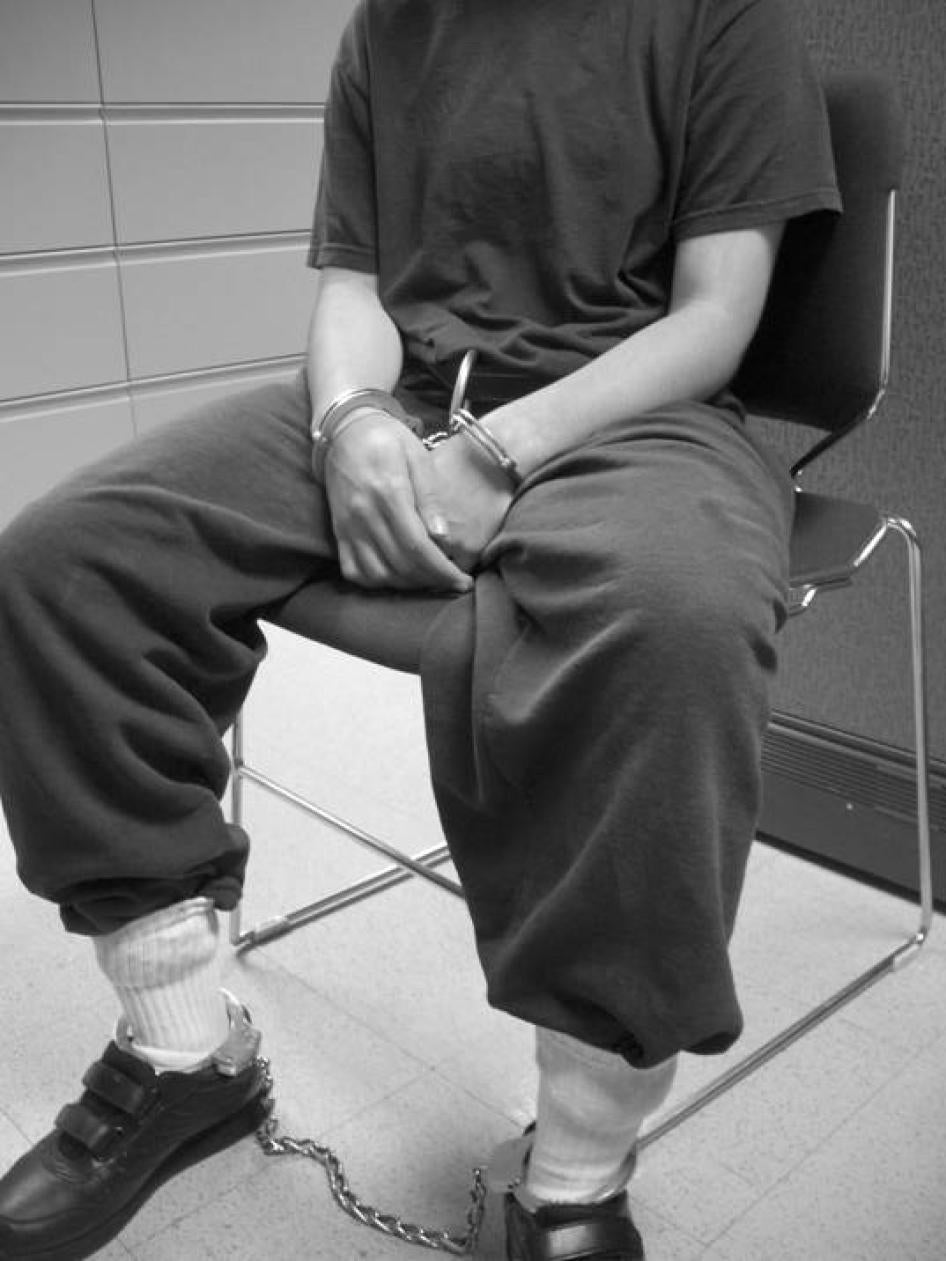
A girl is held in handcuffs, shackles, and a "restraint belt." The chain connecting the handcuffs runs through a metal loop connected to the leather belt fastened around the girl's waist, further restricting her ability to move. Girls typically are held in these devices during several hours of transport and while awaiting court hearings.
2006 Mie Lewis/Human Rights Watch/ACLU
International standards prohibit the transport of juveniles in conditions that in any way subject children to hardship or indignity.[265] They also prohibit the use of instruments of restraint outside of "exceptional cases, where all other control methods have been exhausted and failed, and only as explicitly authorized and specified by law and regulation," specifically, when a child poses an imminent danger of harm to herself or others.[266] When used, such restraints must not "cause humiliation or degradation, and should be used restrictively and only for the shortest possible period of time."[267]New York state regulations permit the use of such restraints only when children pose a threat to themselves or others, and during transport only where there exists a threat to public safety.[268] OCFS practice should be made consistent with these standards.
Sexual Abuse
Although OCFS and other New York child welfare agencies are occasionally the subject of scandals involving the sexual abuse and exploitation of children in their care,[269] it is difficult to gauge the extent of such abuse occurring in the facilities because of girls' understandable reluctance to discuss such issues, combined with OCFS's refusal to release even partial or redacted reports of abuse. Available evidence suggests that incarcerated girls are more commonly targeted for sexual abuse than their male counterparts.[270]
HRW/ACLU interviewed one girl, Ebony V., who was repeatedly sexually abused at the Lansing facility when she was held there in late 2002 and later at a non-secure residential facility. Ebony V. stated that girls at Lansing known to have previously been commercially sexually exploited, as she was, are at risk of being targeted by male staff members. When asked to describe this targeting, Ebony V., who was 16 at the time of her incarceration, described the conduct of male staff, including her abuser, who was her facility-assigned counselor:
The male staff would flirt with me, like [the abuser]. [The abuser] continually made me repeat my story in detail, he made me do things I did to them to him. He said what I was I would always be that. When I said: "I'm going home, I'm not doing this anymore." He said "You like doing this, you like having sex."[271]
The targeting of previously sexually exploited girls was also observed by Janine Y., who was not herself sexually abused. When asked whether staff flirted with girls, Janine Y. replied:
At Tryon [Reception] one staff did, because some of the girls were in there for like prostitution and stuff. . . . Most of the ones [girls] who got reported for doing stuff with the staff were like prostitutes or strippers.[272]
The increased vulnerability of previously exploited girls to abuse within juvenile facilities may arise from factors in addition to targeting by staff. In written testimony concerning sexual abuse of adult women prisoners by guards, Terry Kupers, a psychiatrist who specializes in prisoner's mental health, explained:
Women prisoners, because of the level of sexual and physical abuse in their backgrounds and their resulting psychological make-up, are less able than many other women to know when their boundaries are being violated or they are being harassed or disrespected. Often this is because they remain confused about who was responsible for the sexual assaults in their past. (Children tend to think that the bad things that happen to them are their own fault.) Because of early and repeated boundary violations, usually involving the people they should have been able to trust (for instance a father or close male relative), because of the resulting guilt, confusion and diminished self-esteem, and because of a lack of confidence that a man in a position of power might heed their wishes or commands, they do not have the confidence to give a clear message to halt in the early stages of an evolving sexual assault, privacy invasion or violation of bodily integrity-for example when a male officer makes a lewd or infantilizing comment or conducts an inappropriately sexualized pat search. Rather, they are just as likely to partially dissociate, become passive and let the abuse develop without angrily protesting. The offending staff take this as a signal, not of consent, but rather that this woman is unlikely to submit a grievance or sound an alarm when he assaults her, and consequently he may more confidently continue to make demeaning comments or move ahead with the evolving sexual assault.[273]
Ebony V. continues her account of her experiences in the Lansing facility:
It was very exploitative in there. I was living better than I was on the street but I was still living street life in there. I was still being sexually exploited by the staff there. A staff member had sex with me. . . . When I was there, it was at least three of us. And before I came there, he was on it. . . . Even when I was in there, he was under investigation for inappropriate behavior with girls on the unit.[274]
When asked about the facility's response to the abuse, Ebony V. stated that she did not report her abuse to other staff, but that the abuser was investigated for having sex with another girl:
He wasn't allowed to counsel us with the door closed, but that was just for about two weeks. But once the investigation ended he went back to counseling us with the door closed. They said he was not guilty. . . . The state protects their staff. So it's hard to convict him of anything.[275]
When asked how the staff person was able to isolate her, Ebony V. replied:
He was the YDC.[276] So when girls would make collect calls, they did it from his office. Or, if you're going home or had problems with anyone in the unit, you spoke to him.. . .[During the day,] he'd come pick me up from the lunchroom. He was allowed to take me back alone while the other staff and residents were in the cafeteria. He took me back to the unit and had sex with me. [At night,] most of the time we went to the schoolhouse right next door to the unit or we went to his office and said I had to make a phone call.[277]
When asked whether any other staff were aware of her abuse, Ebony V. replied:
We got caught one time by another YDA[278] from another unit. The way the office was set up, [the abuser's] office had two doors. He was leaning against the front door, the guy came in the back door. He said: "Oh, oh, oh, oh I'm sorry" and closed the door. It's crazy, isn't it?[279]
By failing to intervene or report the abuse, the YDA violated his duty under state law as a mandated reporter of child abuse. When asked why she herself had not reported the abuse, Ebony V. replied:
I was 16, I needed attention. At that time my body had been through so much trauma that it didn't matter. Having sex with me was the same as loving me.[280]
Court records describe a similar case at Tryon in 2001, in which a girl, Silvia N., was approached by her facility-assigned mentor as she left a bathroom, undressed, and taken back into the bathroom where they had sex. As she puts it, she "was surprised" but did not file a complaint.[281] After a second, similar, incident, Silvia N. became pregnant. Silvia N. then attempted to contact the facility director but the director "didn't come to work and didn't get the letter right." Later, Silvia N.'s mother called the facility and reported what had happened.[282]
Court records describe another alleged sexual assault at Tryon occurring in late 2002. Sandra Z. was 15 years old when, according to court pleadings, a Youth Division Aide (YDA) sexually assaulted her on six occasions in a common area of the facility during the evening when the YDA was on duty and other residents were confined to their rooms.[283] Sandra Z. alleges that on the first two occasions, the YDA touched her breast or breasts, on the second two occasions, he touched her vaginal area, and on the last two occasions, he had sexual intercourse with her. Sandra Z. made an "internal complaint" about the abuse. Of the five criminal charges brought against him, the YDA pled guilty to Official Misconduct.[284]
Sandra Z. alleges, among other things, that OCFS acted negligently, recklessly, and carelessly by failing to properly screen, train, and supervise its employees, to take proper precautions against the YDA, who had "entered into a meretricious relationship[] with one or more infant residents," and for failing to terminate or investigate the YDA when it "knew or should have known" of his relationships with girls at Tryon. OCFS denies Sandra Z.'s allegations.
According to interviewed girls and facilities records, sexual abuse short of intercourse occurs at the facilities. For example, facility records from Tryon describe allegations by a child of "kissing, hugging, touching and sexual contact" between a child and a staff member.[285] Another report describes the suspension of a staff member for "emailing [a girl] while she was in the community. . . It is also alleged that [the staff member] met [the girl] in the community and he gave her his cell phone number, e-mail address and home address. [The girl] further alleged that they have contacted each other on several occasions via e-mails and cell phone."[286] Other allegation of sexual contact are noted in facility reports.[287]
Devon A., who was incarcerated between the ages of 15 and 17, described her observations while held at Tryon:
Staff would really get into the kids' sex lives. They'd start a conversation about kids' sex lives. One girl kissed a staff and then he restrained her. I guess their talking went a little too far. He restrained her so bad she defecated on herself.[288] It was in the hallway where our rooms are at. There was a lot of ongoing investigations, but they came up not guilty or inconclusive, because nobody would snitch.[289]
Felicia H. described flirtatious behavior by staff: "The staff like playing with their hands too much with the females. They'll play-fight, or chase us around or put ketchup or paint on our clothes. They'll call you 'ugly' and 'fat-ass,' that's how they flirt."[290] Wendy M., who had been held at Tryon Reception and other state and local facilities said:
All over at every facility, staff flirts with girls. They have side conversations, they treat them better. They ask things like, have you ever had sex? How did it feel? The girls can't do nothing about it, because if you complain, you'll be overruled.[291]
Girls' grievances also suggest that staff sexually harass girls. One grievance reads:
Grieving the fact that she feels like she was being disrespected by [name redacted]. One day at the Gym, they were playing "Batman" and he had spanked her in the butt with a racket and she feels uncomfortable. She feels he is taking advantage. She wants [this] to be looked into and not ignored.[292]
Other examples of sexual talk include a staff person telling a girl that "she likes to be touched by men,"[293]or to "stop walking the way she is walking because she is not on the strip."[294]
Grievance records also indicate that male staff are sometimes present in the housing area when girls are showering, dressing after a shower, or changing their clothes. One girl complained that when one male and one female staff member are on duty, the male staff member watches the showers.[295] Other complaints suggest that male staff in the housing area are required to announce "man in hall," but that sometimes they do not, catching girls by surprise while they are undressed. One girl complained of a male staff member, "residents would be getting dressed, but he just says 'I won't look.'"[296]
According to grievance logs, peer-on-peer sexual harassment appears to occur at the facilities,[297] and as to some grievances it is not possible to tell whether the harassment is being carried out by a staff member or another girl because names have been redacted and the entries contain no gendered pronoun referring to the perpetrator. For example, one grievance from Lansing reads: "[name redacted] is touching her, slapped her butt, and made comments about chest."[298] Several such ambiguous grievances are present in the logs obtained by HRW/ACLU. Other complaints are vague, stating only that a child feels unsafe or uncomfortable in the presence of a staff member, or are exceedingly terse.[299]
The sexual abuse and harassment present in the facilities are likely to pose particular risks to the psychological well-being of incarcerated girls because of the high rate of sexual abuse in their pasts. The emotional impact of abuse at the facilities is suggested in a grievance entry which reads: "Is angry, flashbacks, cannot sleep, [name redacted] has come in when she/other peers showering. She feels unsafe with him,"[300] and another which reads: "grieving [name redacted] and his inappropriate comments. She feels he is a pervert especially watching showers and is having nightmares about it."[301] Available evidence suggests girls who have suffered sexual abuse prior to their incarceration are not only more vulnerable to abuse within facilities but also more likely to be retraumatized by such abuse and harassment. In his testimony concerning sexual assault against adult women prisoners, Dr. Terry Kupers stated:
When male officers treat women with disrespect it has a different impact than having women officers act disrespectfully to male prisoners. Disrespect towards women by male officers is more likely to be sexual in content or implication, and in women who were traumatized by sexual abuse perpetrated by males, it is more likely to be experienced as a "retraumatization." . . . Of course, in a prison setting, the picture is much more complicated and the possible sequelae are much more severe. The woman who is sexually harassed (for instance experiencing prurient and inappropriate observation or pat searches), assaulted or raped remains imprisoned in the same setting where the assaultive conduct occurred, and absent a complaint being sustained and the officer being terminated, the same officer who committed the traumatizing acts remains in total control of the woman.
Even if there is no grievable sexual misconduct, the mere presence of male officers in the housing units where the women toilet, shower, undress and sleep can constitute a retraumatization. The deprivation of privacy that is inherent in incarceration becomes much more of a deprivation than is necessary to accomplish the proper goals of incarceration. Previously traumatized women who might choose to avoid the gaze of males in order to create a safe place are forced to live in a situation where male officers are constantly present and might intrude on their most personal and private activities at any moment. The woman can develop a generalized fear, and this situation is quite likely to make her symptoms and disability worse and more long-lasting.[302]
Much of the physical abuse and almost all of the sexual abuse described by incarcerated girls appears to be perpetrated by male staff,[303] raising concerns about the supervision of girls' housing units by male staff. HRW/ACLU has been informed that OCFS policy requires that there be at least two staff members on each unit at all times, but at least one resident has alleged that her unit was left supervised by only one staff member.[304] Grievance logs contain specific requests by girls not to be left alone with male staff, or for female staff to be assigned.[305] It appears that OCFS administrators have previously considered "gender-based staffing" to address the problem of sexual relationships between girls and staff, but details of such discussions were withheld from HRW/ACLU.[306]
International standards prohibit the supervision of female inmates by male staff.[307]Implementing such a policy in the housing area of girls' facilities could decrease the incidence of sexual abuse in OCFS facilities, as well as the incidence of extreme use of force. OCFS's refusal to release documents to HRW/ACLU relating to sexual abuse makes evaluation of the facilities' response to individual allegations difficult.[308] Yet the allegations of both physical and sexual abuse at the Lansing and Tryon facilities points to failures of screening, training, and supervision, as well as the lack of oversight of the facilities by outside monitors.
The practices reported here run contrary to the United States' international legal obligations. In July 2006, the UN Committee Against Torture, an international body of experts, for the first time evaluated U.S. policies on imprisonment and concluded that, among other things, the U.S. needed to "design and implement appropriate measures to prevent all sexual violence" against incarcerated persons. The U.S. was called on to ensure that allegations are investigated promptly and independently, perpetrators are prosecuted, and appropriately sentenced and victims can seek redress, including appropriate compensation.[309]
Collective Punishment
Several girls interviewed by HRW/ACLU complained of collective punishment. The most common complaint concerned what is known as "retraining." As Devon A. put it, "If five, six, or seven kids do something, you [the unit of approximately 20 girls] go on 'retraining.' They're very strict, they follow all the procedures."[310] According to Felicia H., retraining consists of each girl being required to spend a substantial part of each day sitting on a chair placed in front of the door to her room. Girls may do nothing other than study the facility rulebook. Girls must take the rulebook with them wherever they go within the facility. During "retraining," girls must also attend meetings to discuss the misbehavior that has occurred.[311]
Girls subjected to retraining said they resented being held accountable for others' bad behavior. Girls also complained that they were not taken off retraining even though they exhibited good behavior.
Collective punishment contravenes the principle that a penalty should be imposed on an individual only for actions that he or she personally committed. Group punishment, defined as punishment "solely on account of the behavior or acts of other children" is prohibited under New YorkState regulations.[312]International standards also specifically prohibit collectively punishing incarcerated children.[313]
Verbal and Psychological Abuse
Verbal abuse by facilities staff takes several forms. According to both interviewed girls and grievance records, staff sometimes threaten girls with physical violence. Wendy M., who was 16 when interviewed and who had been held in several pre- and post-adjudication facilities, including Tryon Reception, for over 4 years, gave as examples of such statements:"I'm gonna fuck you up,""I'm gonna whoop your ass," and "I'm gonna put your lights out."[314] A staff member at Tryon told a girl that he would "knock her teeth out."[315] Several girls complained that staff threatened them with the restraint procedure.[316] For example, one girl said she felt threatened by a male staff member because he told her that he "[felt] a restraint coming on."[317]
In addition, facilities staff sometimes curse and raise their voices at girls. Grievance records contain complaints of girls being called names such as "asshole," "idiots," "slow," "thug," "bitch,""cry-baby," "witch," "stupid," "ignorant," "little bastards,""nobody," and "lazy" and for being "screamed" at, "cursed" at, "yelled" at, told to "shut the fuck up," and "insulted."[318] A girl confined in Lansing was told by a staff member that "I'm nothing, won't do nothing, and I'm about nothing."[319] Many girls complained of being told to "shut up," and generally to being treated disrespectfully. Some girls said they felt as if they were treated like a "dog" or "animal," or not "as human but as if slaves."[320]
Girls also reported being taunted and provoked by staff to fight with their peers. Wendy M. said, "Staff would purposely get in my face, because they knew I had an anger management problem. They knew because they saw my records."[321]Another girl complained, with respect to one of her peers, that the staff "are repeatedly telling her to fight them so she'll be put in jail [She d]oes not want staff to push her."[322] Another girl complained that a male staff member was "calling her a pussy because she will not fight another peer. She wants him to stop making comments that make her upset."[323] Yet another girl complained of a staff person "telling residents that they should fight."[324] OCFS did not provide HRW/ACLU with material indicating the extent to which facilities staff are disciplined for verbally abusing or taunting residents. We were provided one letter of reprimand that reveals a staff person was fined for telling a child, "Your breath smells like pussy, you need a tic tac."[325]
Violations of Privacy
[Staff members] shout them out, say private things about them. They said, "you know you're burning." That meant, you have a disease, like HIV or Chlamydia.[326]
Both interviewed girls and reviewed grievance logs reveal a widespread practice among facilities staff of disclosing residents' private information to other residents. The disclosed information consists of details of residents' medical and mental health conditions such as a diagnosis of sexually transmitted infections, medication, past abuse including sexual exploitation, family problems, and bed wetting. The evidence suggests that staff members sometimes revealed residents' private information to others when they were angry with the resident, but more commonly without apparent reason.
Grievance logs consistently contain entries in which girls complain that their confidentiality was violated. Some entries read:
[Name redacted] is grieving that staff in Unit 53 is throwing the fact that she was abused in her face Would like her personal business away from peers.[327]
[N]urse told peer she asked for an HIV [t]est[328]
[Name redacted] is grieving the fact that [name redacted] allows other residents to file residents' portfolios. Feels other residents shouldn't have access to this personal information.[329]
[Name redacted] is grieving [name redacted] as resident states that YDA[330] bribes residents w/information and tells residents personal information about other residents.[331]
[N]urse told personal business in front of staff, blame everything on rape [illegible].[332]
[D]isclosed personal business in front of unit.[333]
Ebony V., 16 at the time of her incarceration, had been subjected to commercial sexual exploitation and incarcerated under a charge of prostitution. This was widely known among staff members, but Ebony V. nevertheless felt ashamed when a staff member remarked on it in the presence of other residents:
Sometimes, if the YDA gets mad, they say it in front of the others: "You don't want to go back to where you were now, do you?" They try to embarrass you.[334]
Confined children still enjoy their right to privacy as guaranteed both under U.S. law and U.S. human rights obligations, although the right may be subject to some restrictions inherent in the fact of incarceration.[335] International standards require facilities staff to respect children's right to privacy, and specifically forbid staff from disseminating private information about children learned in the course of their duties.[336]
Girls at Lansing also complain that they are not allowed to keep a journal or are prevented from writing in their journal when they please, or that their journal is read by staff or confiscated.[337] These seemingly small restrictions are very significant limitations on girls who because of their incarceration already have limited scope for a private life and for self-expression. It is important that the environment within juvenile facilities should promote and support children's capacity for general self-development in a manner that facilitates their intellectual independence.[338]
Discrimination
Discrimination and Harassment against Lesbian and Gender Nonconforming Girls
The exact number of lesbian, bisexual, and transgender girls incarcerated in the Lansing and Tryon facilities is not known. One estimate places the percentage of lesbian, gay, bisexual, and transgender youth in the New YorkState juvenile justice system as a whole at 4 to 10 percent, and this may provide a rough gauge.[339] In addition, it appears that some girls who would not ordinarily identify as gay form romantic bonds with other girls when confined in single-sex environments.[340]
When asked whether she was aware of gay relationships while incarcerated, Alicia K., who was held at Tryon Reception and then at Tryon Secure for 7 to 8 months when she was 15 years old, then sent twice to Lansing when she was 16 and 17 years old, said, "That was common. It was like breathing air in there." Facilities records confirm that such relationships exist.[341] When asked whether sex occurred between residents, however, Alicia K. responded, "That was pretty much impossible, because staff was always around. It was mostly letter writing."[342] Selena B. confirmed that in the facilities "going out" means, "Talking, writing, and stuff."[343] Thus the treatment of girls in the facilities identified as lesbian appears to spring less from the enforcement of rules against sexual activity than the propensity to single out certain girls for harsh treatment because of their perceived sexual or gender identity or their nonconformity to gender norms. Devon A., who is lesbian and who was held at Tryon and Lansing between when she was 15 and 17 years old, told HRW/ACLU:
If you're gay they think you think you're a man, so they restrain you harder. They have an attitude of "If you want to be a man, I'll restrain you like a man." That place [Lansing] was unstable. I was restrained ten or twelve times.[344]
Selena B., a straight girl who had been held at Tryon Reception and Lansing, said about gay girls in the facilities:
They had to hide out, or they'd get in trouble. They'd get extensions of placement. That was at Tryon [Reception] and Lansing.[345]
Non-sexual behavior, such as letter writing between girls or blowing kisses is punished if it is perceived as lesbian.[346] Some girls reported that "special relationships" among residents are punished and can result in an "extension of placement," juvenile justice parlance for an increase in a child's sentence.[347] Devon A. said she was subjected to room confinement for being lesbian:
At Lansing I was restrained because I was gay, they couldn't trust me. If I was talking to another girl, they'd think something sexual was happening. Once I was put on isolation for two weeks, they thought I was getting too close to a female. It's not fun because there's no rec [free] time, it's supposed to be mandatory but you can't even interact with your peers. That made me feel real depressed.[348]
Girls' accounts of discrimination and harassment based on gender identity are consistent with the findings of a 2001 report on the experiences of gay, bisexual, and transgender youth in the New York juvenile justice system,[349] which concluded that the lack of policies protecting LGBT youth, combined with the lack of expertise among adults working with LGBT youth results in verbal and physical harassment of such youth by staff and peers.[350] Given the strict sex segregation maintained in the facilities, punishing girls perceived as lesbian for speaking to and otherwise communicating with other girls essentially guarantees the targeted girl's social isolation.
Racial Discrimination
Some girls also reported incidents of racial discrimination. Asked how she liked the staff at Tryon Reception, Miranda N. replied:
Some were friendly, really there was only one staff that no one liked because she was racist. She was white. She called girls "nigger." She made jokes. Once in the cafeteria the lights cut out by mistake. She said "when you cut out the lights I could only see 20 eyeballs, can't see any kids."[351]
One grievance from Tryon reads: "Grieving [name redacted]. Picks on her calling her white cracker & everyone laughs."[352] Other grievances appear to relate to discrimination of some kind but are too abbreviated to provide a clear understanding of what occurred.[353]
|
"Our Kids Can't Act Like That" The Missouri Model of Juvenile Correctional Facilities Amid the seemingly inevitable realities of New York's existing juvenile justice system, it is often difficult for both officials and reformers alike to imagine anything other than the status quo. According to reports, however, for over 20 years, juvenile facilities in the State of Missouri have pursued a sincere commitment to juvenile rehabilitation that disposes with corrections convention in favor of a higher quality of life for residents coupled with some of the lowest recidivism rates in the country.[354] The system, referred to as the Missouri Model, took shape in the late 1970s as the establishment of smaller facilities was slowly joined by a new approach to staffing and a working philosophy genuinely stressing treatment over punishment. From the outset, smaller, region-specific facilities ensured that residents were never too far from their homes. In these smaller group settings residents are far more likely to receive the specialized attention essential to rehabilitation.[355] According to Mark Steward, former director of Missouri's Division of Youth Services and one the primary architects of the Missouri Model, a state can only fully realize the benefits of the small facility model when those staff-resident relationships are of a high quality. Steward said in an interview with HRW/ACLU that this starts with a uniquely equipped and caring staff composed of college-degreed individuals with a level of ethnic diversity reflective of the children in their care.[356] Within the facilities, both residents and staff are individually accountable for the personal relationships they forge while in residence, offering an organic solution for both resident behavioral issues and the staff apathy and turnover that characterize larger facilities. To Steward, controlling staff makeup is essential for a staff-resident relationship that steers clear of the correctional-style interactions that dominate the juvenile justice experience in other states. Steward stresses that severing any philosophical or bureaucratic link between juvenile and adult corrections is a necessary first step in moving from a juvenile justice system that is an idle repository for rejected children to a refuge for kids who warrant renewed investment from their communities and governments. Often, says Steward, the transformation requires awakening a system and its politicians to the realization that "these kids are not demons."[357] This change of mindset is made easier when policymakers realize that the investment required by the Missouri Model is a question of attitude and technique, not a matter of increased financial investment. The smaller resident populations are divided into 9- to 11-member "teams" in which each child and staff member is authorized to initiate impromptu rehabilitative discussions and therapy sessions and any child can call the entire team together in a "circle" for a discussion at any point during the day.[358] These sessions allow residents to explore the underlying sources of turmoil in their lives, whether family history or bodily trauma. Physical and mechanical restraints are almost nonexistent in the Missouri Model; rather, when a conflict threatens to escalate, residents form a "trust circle," a simultaneous embrace of team members that calms residents whose outbursts endanger the group. The Missouri Model also requires a complete rejection of the opaqueness characteristic of the New York system and instead a simple commitment to outside oversight throughout all levels of administration. In Steward's view, abuses and neglect are simply less likely to happen in an "open system." In Missouri, active advisory boards review facilities practices and "liaison councils" bring legislators and other officials into facilities to interact with residents. In another measure to increase openness, Missouri has situated its facilities in uniquely visible and social environs, such as placing a girls' facility on an active college campus where residents regularly dine with the student population.[359] These measures simultaneously reduce the likelihood of abuse and increase public understanding of residents and the challenges they face. Looking ahead, Steward predicts that the most significant barrier to Missouri-style change in a situation like New York's may be on the agency level. "A lot of people [within the agencies] say, 'Well, our kids can't act like that,'" laments Steward.[360] The challenge ahead rests equally on the shoulders of administrators, legislators, and advocates to ensure that, while this state's most troubled children may not be identical to Missouri's, New York's juvenile justice system can indeed "act like that" and realize some of the lessons of the Missouri Model. |
IV. Conditions of Confinement: Inadequate Educational Opportunities
HRW/ACLU's research uncovered a number of areas in which facilities' educational offerings are deficient. Girls receive no schooling during the first two weeks of their incarceration. Many girls told us that a shortage of qualified staff combined with the grouping in a single classroom of girls of widely different educational levels and needs deprives them of necessary individualized instruction. The vocational training offered to girls embodies archaic gender stereotypes and does not measure up to what is offered to boys. Barriers to girls' transition back to regular schools upon their release from OCFS facilities adds an additional educational handicap.
It should be noted that, according to one New York education expert, many children feel that the education they receive in OCFS facilities is better than that provided in some New York City schools, because the classes are smaller and children feel that the teachers care more about them.[361] Although, in the expert's opinion, OCFS "could be doing a better job," its schools and aftercare services compare favorably to city schools, where the special education program in particular is "broken."[362] The accounts below in part contradict this rosy picture, at least with respect to Lansing and Tryon. But even assuming it is accurate, it says more about the failures of the New York City school system than about OCFS facilities. It should certainly not be cause for complacency.
Schooling
When a girl is remanded to OCFS custody, she is discharged from the public school in which she was enrolled.[363] OCFS is then responsible for providing the girl with an education.[364] As of 2003, there were 1,709 boys and girls in OCFS schools.[365]
During the first two weeks of their incarceration, girls do not receive schooling. They are placed initially at TryonReceptionCenter to receive assessments to determine in which facility they will ultimately be held, and in addition are provided "group" sessions on such topics as HIV awareness, drug use, and aggression, as well as some physical exercise. No formal education takes place at TryonReceptionCenter, and for much of the two-week period, girls are left alone and idle in cells. Many girls say the group sessions they attend are of little educational value. According to Miranda N., such sessions consisted of "watching movies from Lifetime."[366] When asked about the counseling offered to her, Stephanie Q., now 18, replied:
They have this whole wellness criteria, a wellness group. Like dealing with aggression. . . . It didn't help, because it's common sense. You know that automatically. Most of the people [incarcerated] there are smart. But if you look at the stuff, most of it is dumb, they just want to fill up the schedule.[367]
Girls placed at Lansing and Tryon attend facilities-operated schools on facility grounds. At Tryon, school consists of small classes of ten or twenty students, depending on whether half a unit or an entire unit is placed in a class together, and there is generally one teacher per class.[368] Incarcerated girls range in age from twelve to nineteen and exhibit a wide range of educational abilities.[369] Some girls enter the facilities with a high level of educational aptitude and achievement and the ambition of earning a high school diploma and going to college, while others have very limited reading ability, special educational needs, and may have been out of school for long periods of time.[370] Incarcerated children with learning disabilities have the right to specialized educational services administered according to individualized educational plans (IEPs).[371]
For all girls, the education offered at the Lansing and Tryon facilities is deficient, primarily because the facilities' schools lack the qualified staff necessary both to provide the scope of classes offered at regular schools and to provide the individualized attention many students need.[372] Girls of different grade levels are lumped together and frequently asked to study independently from a book or a worksheet without the help of a teacher. This arrangement compromises the educational progress both of girls with individualized educational needs, who complain that they do not receive enough individual attention to allow them to learn,[373] and those with stronger educational backgrounds, particularly older teenagers, who express frustration at being under-challenged in the facilities' schools.
Of school at Tryon, Devon A., who was held in OCFS facilities between the ages of 15 and 17, said:
It was a regular school, but it wasn't up to par. The atmosphere of the school wasn't real, the work was kindergarten, first grade type stuff. Like "What's 13 times 2?" I was a pre-GED student. They didn't have the materials. I felt very bored. I took the GED at Tryon and passed.[374]
Of school at Lansing, Ebony V., who was 16 at the time of her incarceration, said:
School was a setup. They teach you all this kindergarten or easy work. You'll come back in the world and not be able to survive in regular schools. Part of school was crochet! Come on, we're fourteen, fifteen, sixteen years old, that should not be part of our curriculum. I think it was every day, a significant amount of time was crochet, beading, or making blankets to sell.[375]
Several other girls expressed frustration at what they view as the lowest-common-denominator approach taken by the facilities schools. Some girls felt that the primary aim of schooling at the facilities is to prepare girls for the GED,[376] rather than preparing them to reenter and eventually graduate from regular high schools. One grievance reads: "Has been here ten months and has not gotten her proper studies to help her for her regents exam."[377] Indeed, residents sometimes do not receive homework or are barred from taking work out of the classroom.[378] An emphasis on the GED over high school graduation denies children not only a choice but a right: New YorkState law requires that every child be offered the opportunity to earn a high school diploma, and the right to schooling continues until a child earns a diploma or turns 21.[379]
In addition to the lack of appropriate and individualized instruction, other occasional factors interfere with girls' ability to gain an education at the facilities. Grievance logs contain complaints that teaching vacancies remain unfilled, teachers do not come to class or come late, girls are woken up late for school by staff, girls are not told what grade level they are in or are placed in the wrong grade level, and there are not enough books for the girls to read.[380]According to facility records, although the Tryon facility has some computers, they were malfunctioning and not usable for a period of over a month in 2005.[381]
The generally poor quality of facilities schools may be attributable in part to an apparent absence of outside monitoring. The New York State Department of Education is responsible for monitoring OCFS schools,[382] yet when in the course of litigation the Department of Education was asked for its most recent reviews of schooling at Lansing and Tryon, the department turned over reports dating back to the late 1990s.[383] Although its datedness renders its current value slight, a review of educational programs in the Lansing facility consisting of inspections in 1996 and 1998 found "problems of a serious nature," specifically incomplete and poorly maintained Individual Education Programs for special education students, a dysfunctional and ineffective Committee on Special Education, and teaching-related inadequacies.[384]
Children may also face administrative barriers when they are released from OCFS facilities and attempt to transition back into community schools. The nature and extent of such barriers is not clear, and OCFS did not return phone calls from HRW/ACLU seeking to verify allegations in this regard,[385] but New York City Department of Education statistics indicating that two-thirds of high school-age children leaving custody do not return to regular schools suggest that the barriers are substantial.[386] This problem is at issue in a pending class action lawsuit brought by formerly court-involved children against the New York City and State Departments of Education.[387] According to other sources, children leaving OCFS facilities are sometimes faced with unnecessary difficulty in reintegrating into regular schools because of the nature of the classes and credits awarded at facilities schools, combined with failure of coordination between OCFS and the city education departments, specifically, the absence of a memorandum of understanding governing the relationship between OCFS and the New York City Departments of Education.[388] Another possible barrier may be that OCFS high schools are not registered with the State of New York and, as a consequence, the principal of a school a child wishes to enter upon her release from OCFS has discretion to determine whether she is to receive credits for her past work.[389] The determination as to how many credits a student is permitted to transfer is "complicated by the fact that the student may have attended multiple schools, not completed a full semester of coursework, or have taken courses that do not satisfy graduation requirements."[390] According to OCFS literature "general education" consisting of a core curriculum and electives is provided to children held at Tryon and Lansing in addition to "remedial education" and "special education."[391] OCFS literature states that its electives are "comparable or equivalent to approved syllabi established by the NYS Education Department," but does not make a similar claim for its core curriculum.[392]
Some formerly incarcerated children report experiencing difficulty in transferring the credits earned in facility schools to regular high school. When Alicia K. was asked whether she was able to transfer her credits out of Tryon, she answered:
They transferred, but some of the grades and credits get lost between me coming home. I tried to contact the principal, but they never got back to me. I tried at least once a week for two months and my guidance counselor tried also. That's what I'm trying to patch up now. That's why I don't know if I will be able to graduate this year.[393]
According to one service provider at a non-residential facility, educational programming at all OCFS facilities has suffered under recent changes in agency policy:
It used to be a lot more of a therapeutic environment. . . . But now the state is mandating uniformity across facilities, so each has to have same things going on, the same standards are applied, and ACA [American Correctional Association] accreditation is considered more important than program[s] for the girls. It's obvious that they [the facilities] are really strapped for providing education and any additional programming. . .They're more concerned with the punishing aspects, like restraining girls.[394]
Under international standards, all children have the right to an education.[395] Incarcerated children, in particular, have a right to programs, including education and vocational training, calculated to help them achieve "socially constructive and productive roles in society."[396] As to the type of programs to be provided, research on girls counsels "strength-based," as opposed to "deficit-based" educational programming. This philosophy coincides with the standard in international law that children's education be directed to the development of children's "personality, talents and mental and physical abilities to their fullest potential . . . ."[397] The United Nations Rules governing juvenile facilities also stress the provision of quality education in facilities so that children may continue to pursue their education without difficulty upon release.[398]
Vocational Training
Recognizing the importance of vocational training in equipping girls for economic survival upon their release, international standards relating to juvenile facilities require that girls be offered vocational opportunities.[399] The paucity of vocational programs for girls in the Lansing and Tryon facilities, the barriers to accessing such programs even when they are offered, and the nature of the training offered are all matters of serious concern.
In December 2005, when attorneys from New York's Legal Aid Society visited the girls' units at Tryon, no vocational classes were being offered.[400] The Tryon facility has a culinary arts classroom but at the time of the visit the teacher had left and had not been replaced and the room stood idle.[401] Likewise, a former resident at Lansing said that the facility has a classroom for a cosmetology class, equipped with chairs, sinks, mannequin heads, and the like, but that during the time that she was held at Lansing the classroom was never used.[402]
Even when vocational training is offered, it may not be offered widely or it may be subject to prohibitive administrative prerequisites. This appears to be true of what at Lansing is called "OJT" or "On the Job Training," which consists of either working in the kitchen helping to prepare meals for residents or acting as a teacher's aide. Selena B., previously held at Lansing, said that she and a few other girls were allowed to perform OJT in the kitchen.[403] Alicia K. wanted to work as a teacher's aide but she was thwarted by rules limiting girls' eligibility for the position, and by the fact that demand for such positions far outstripped supply:
You have to go through so much. The unit staff has to agree. You also have to be at least at adjustment stage,[404] and you need signatures from the teachers, and you need good grades, and at least thirty days of good behavior. And then there's a waiting list. There are lots of people on it. Within Tryon Girls everyone, once they hit adjustment stage after three months, signs up to be a teacher's aide. You had to wait for someone to leave.[405]
Even when classes are offered and are, as a practical matter, available to girls at the facilities, the educational value of the classes appears to be questionable. For example, Lansing offers what it calls a "Career Class." When asked what she learned in the class, a former resident said, "Nothing really. They give you a book and tell you to do worksheets. They ask you to define 'part time' and 'internship' and stuff."[406] A provider of vocational services in a non-secure girls' facility complained that the job readiness curriculum provided by the state is unrealistic, employing examples such as "Johnny has a paper route," rather than realistic contemporary urban scenarios.[407] According to the provider, a more useful curriculum would include how to read want ads, information about legal and illegal questions potential employers may ask, job search strategies, and the social skills, often absent in girls who have been institutionalized for most of their lives, necessary to find and keep a job.[408]
The vocational training offered may also be problematic to the extent that the type of training given to girls is based on gender stereotypes and is for jobs that are of less economic value than the jobs for which boys are trained. Tryon ostensibly offers a "culinary arts vocational program," a "cosmetology vocational program," and an "office skills vocational program."[409] The basis for OCFS's choice of cooking, hairdressing, and clerical work as its vocational offerings is unclear, but does not appear to rest on research indicating that these fields offer the most viable and lucrative career options for young women, and may in addition perpetuate stereotyped cultural roles.[410]
The vocational training offered to girls also appears to be vastly inferior to that offered to boys. As described above, a significant amount of time at the facilities is apparently spent on crochet, beading, or making blankets.[411]In contrast, the boys facility at Tryon and other boys facilities across the state offer a range of vocational classes including "auto shop, culinary arts, sewing, typing/word processing and a computer distance learning center that uses 'Safety Net,' a web based educational program for incarcerated youth."[412] Boys at the Louis Gossett facility across the street from Lansing receive training in culinary arts, the building trades, automobile repair, building maintenance and property management, merchandising management, and office skills.[413] Similar courses are offered at TryonBoysResidentialCenter, located within the same complex as Tryon's girls' units, where vocational offerings include the above as well as a "career and financial management" class where students learn "job acquisition skills andhow to take care of your funds."[414] Each vocational class employs "hands-on"instruction facilitated by the extensive use of specialized equipment and staff training.[415] Auto shop is at Tryon is taught in a replica of a "genuine Midas auto shop."[416] Similar facilities exist or are planned at other boys' facilities where boys practice their skills on donated cars.[417]
Although boys at the Gossett facility are initially assigned to one or another vocational program, boys' requests to transfer to a different class are frequently granted, providing them with some freedom to pursue their individual interests.[418] In addition, all but two of the semester-long courses at Gossett provide passing students with a marketable national certification. Because each course is only a few months long, boys often leave Gossett with two or more certifications.[419] In addition to vocational classes, which meet three times per week, boys at Gossett attend a weekly "job readiness class" to prepare their employment "portfolios."[420] Regardless of which program they ultimately complete, however, incarcerated boys appear to benefit greatly from vocational offerings. According to a Gossett staff member, the job readiness class in combination with vocational training and certifications have helped many incarcerated boys find employment in skilled sectors shortly after their release. It is not uncommon for "quite a few" children certified in automotive repair to be "hired by Midas" or to go immediately into a "family business" upon their release.[421] Comparable opportunities do not exist for girls.
V. Conditions of Confinement: Mental Health
Mental health problems are widespread among children in the juvenile justice system.[422] In New York in 2004, of the children screened by OCFS for special needs when taken into custody, 52 percent were identified as having mental health needs.[423]This official figure is not disaggregated by gender. Some research, and the experience of practitioners, suggests that incarcerated girls generally have more mental health needs than boys,[424] and are also more likely than boys to be diagnosed with more than one mental health problem, often a mental health disorder together with a substance abuse disorder.[425]According to a knowledgeable source:
The girls are different than the boys. A boys' facility will have about 85% delinquents and 15% mental health kids. At a girls' facility, it will be the reverse. The reason is that the girls get adjudicated at a much higher rate for crimes like prostitution where they're actually victims. So you're going to have a higher percentage of mental health kids in the girls' system.[426]
Moreover, research outside New York suggests that a significant proportion of incarcerated adolescents suffer from post traumatic stress disorder (PTSD), and that girls are more likely than boys to develop PTSD when exposed to trauma.[427] Whether or not they suffer from PTSD, a high proportion of incarcerated girls have experienced past trauma and abuse, which contribute to mental health problems.
Seventy-seven percent of children admitted to OCFS custody in 2004 and screened by the agency were found to have substance abuse problems.[428] Substance abuse needs to be addressed as part of an effective treatment regimen, and as experts point out, must also be recognized in many cases as an effort by children to self-medicate for untreated mental illness.[429]As a knowledgeable source put it:
There aren't a whole lot of drug dealers in the girls' facilities. My opinion is that most girls who abuse drugs are self-medicating. That means you have to address the psychological underpinnings. The facilities have some substance abuse groups and they certainly could have more. But they need the mental health services, too. It shouldn't be an "either-or."[430]
As described earlier in this section and in Girls' Delinquency: Systemic Failures and Pathways to Incarceration, above, children entering the juvenile justice system, and many girls in particular, have serious mental health needs. As one source put it:
Twenty years ago OCFS was taking turnstile jumpers and car thieves, now they're getting kids getting kicked out of residential treatment centers because they're too violent and suicidal. But OCFS is still treated as a detention program.[431]
Lansing and Tryon face the difficult challenge of trying to help highly troubled girls acquire the skills and self-knowledge they need to be able to cope, and of accomplishing this with limited budgetary resources and consequent limitations in staff. Whether because of resource constraints, policy, or institutional culture, HRW/ACLU are concerned that the facilities may fail to give sufficient priority to the girls' needs for mental health interventions by professional mental health staff, including individual therapy and medication, as well as for a full range of psycho-social and therapeutic programs to provide girls with improved life skills. We are also concerned that the culture in the facilities may be too wedded to a punitive orientation. We were told by one source, for example:
Kids are looked at by this agency as either compliant or defiant. They look at kids as being one-dimensional. Really, anybody is a range of things. Mental health people talk about dynamics, and know that if you understand the dynamics, you can address the behavior. OCFS sees that as making excuses for the kid, and says knock off the bad behavior or you're going to get punishment.[432]
All OCFS facilities provide some form of mental health and substance abuse programming. At the Lansing and Tryon facilities, mental health services are provided by a combination of OCFS staff, staff of the state Office of Mental Health (OMH), and independent contractors. Pursuant to a memorandum of understanding between OCFS and OMH, "mobile mental health teams" of OMH staff work daily in certain OCFS facilities, including Lansing and Tryon.[433] Mental health services include psychiatric services, as well as psychological counseling provided by psychologists and social workers.
Official records for Lansing state that one psychiatrist visits the facility three days per month, and another visits Lansing's mental health unit at about the same frequency.[434] Tryon appears to have a similar system, but official records provided to HRW/ACLU by OCFS contained less information regarding the frequency of psychiatrists' visit to the facility.[435] Psychiatrists' duties are described in agency documents as providing "treatment" to children needing psychiatric services.[436] Agency records state that psychiatrists are available to children for "consult by phone," and that Lansing has "telepsychiatry equipment" connecting the psychiatrists from various facilities to each other.[437] According to an informed source, in practice, the psychiatrists' role is almost entirely limited to prescribing and administering psychotropic medication and periodically monitoring the progress of medicated children.[438]
OCFS describes psychologists' duties as diagnosing and treating residents with signs of "mental illness, poor adjustment, and/or emotional/learning problems," as well as consulting with staff, referring girls to the mental health unit, assisting in release planning and outpatient referrals, and administration.[439] According to an informed source, in practice, psychologists conduct diagnostic tests, refer children to other facilities, and determine special educational needs, among other things.[440] Psychologists also provide therapy to children. Therapy involves working with children to understand what mental dynamics are occurring, patient education to help children understand their own condition, and symptom management, for example, if a child expresses a wish to harm herself.[441] Social workers also provide therapy, but cannot conduct testing.[442]
OCFS administrators express pride in their achievements in providing mental health care to incarcerated girls. They point, for example, to the designated mental health units at each of the Lansing and Tryon facilities as evidence of their efforts.[443] Each of the two facilities has a unit to house children identified as having the most severe mental health needs, called the "mental health unit."[444] These mental health units are small, holding about 12 children rather than the 20-25 held in the "generic," or non-mental health units.[445] An OMH "mobile mental health team" is assigned to each mental health unit and provides intensive mental health treatment services on a daily basis.[446] According to OCFS documents, Lansing's mental health unit employs one psychologist, two psychiatric social workers, and a "treatment team leader."[447] Tryon's mental health unit is staffed by a psychologist and two social workers.[448] The establishment of the dedicated mental health units was unquestionably a step forward, especially since professional OMH psychiatrists, psychologists and social workers are now placed in the units to give care to the children housed there.[449] Nevertheless, the size of such specialized units is a concern. Grievance logs contain complaints by girls of not being allowed into such units despite believing that they require specialized care.[450]
OCFS documents provided to HRW/ACLU provide much less detail about substance abuse treatment than they do about mental health treatment. They indicate that, at Lansing, group sessions are held once per week by an outside contractor for girls "with the most severe abuse problems."[451] A staff schedule for Tryon indicates that a drug abuse counselor is available four full days per week.[452] Some interviewed girls told HRW/ACLU that they did not have substance abuse problems and therefore did not receive treatment. Others described group meetings in which addiction and other issues were discussed. For example, Bless L., who was 14 when she was incarcerated in the Lansing facility, said:
I was in S-unit, that's for substance abuse. Once a week, a lady named [ ] would come in to talk with us. On Friday, there was a little group on the unit. They showed the "Beat the Streets" video, which is about how to get away from people who use. . . . It didn't help. I knew most of the stuff the lady was telling me already and I didn't really care. If they want to help us, they should get closer to residents, to understand where we're coming from.[453]
Screening and assessment are important first steps in the provision of mental health care. HRW/ACLU have been told by informed sources that girls entering TryonReceptionCenter are screened by a mental health worker who administers psychometric "scales" for depression, IQ, and other values. These scores are combined with information about the girls' history, including for example, past mental illness and substance abuse, and the girl is assigned a score between one and four. A high score alerts the facility to which the girl is ultimately assigned that she requires a more detailed assessment.[454] The usefulness of this preliminary assessment is undermined by the absence of specific facilities that could provide treatment tailored to girls' specific mental health problems and needs. A knowledgeable source describes this problem as follows:
OCFS works like [adult] corrections, they classify the kids. The assessment is more relevant to the boys, because you have several facilities to choose from, for example, based on whether the boy is a regents student or has mental retardation. With the girls, they're assigned to a facility by security and there aren't many facilities, so there's not a whole lot of choice. So it's sort of a perfunctory process that's done.[455]
Once girls arrive at Lansing or Tryon, a more in-depth assessment may be performed. OCFS's facility operational guidelines for TryonGirlsCenter require that children placed there "receive a brief mental health screening by medical staff at admission via the Admission Screening Interview."[456] If significant problems such as "bizarre thought" or "suicidal intent" are observed during the screening, the facility administrator is to be notified "for further action."[457] If a girl receives a high "mental health screen score," a "mental health assessment" is performed.[458]
Whatever the screening and testing indicate, the mental health services at Lansing and Tryon remain limited because of a shortage of qualified staff.[459] The need for professional mental health services exceeds the beds in the mental health units. The extent of the need is indicated by the fact that over the last two years, an average of 53 percent of girls held at Lansing, and 64 percent of those held at Tryon were administered psychiatric medication.[460] Yet at Lansing, the approximately seventy girls who are not in the mental health unit receive psychological services from only one psychiatrist,one full-time psychologist, and two part-time social workers.[461] At Tryon, one psychiatrist, three psychologists and a single psychiatric social worker staff the non-mental health units.[462] OCFS administrators themselves acknowledge that more care is needed, citing budgetaryconstraints as the cause of deficiencies.[463] As explained to HRW/ACLU:
To assign two or three mental health people for all of the kids that aren't on the mental health unit, that's a band-aid approach. . . . Those therapists can meet with the kids maybe once or twice a month. And then they have to do the discharge planning for every kid. So OCFS really needs to provide more mental health staff.[464]
Another interviewee agreed, stating, "There aren't enough mental health providers, it's limited for the number of children."[465] At least some girls have also complained about not having access to mental health care when they feel they need it. In Lansing, over the course of one year, over twenty grievances were filed by girls saying such things as "has not been counseled, told someone would be available to talk to her,"[466] and "really needs to talk."[467] Other complaints state: "put in 2 sheets to contact social worker, no response,"[468] and "she feels she is about to blow/go crazy. Needs to talk to someone about her issues."[469] One grievance reads: "not on meds, needs to talk to someone about issues going on in her head."[470] According to Devon A., who is now 17 years old, access to mental health professionals is limited:
They're really picky about letting you get help from a psychologist. You have to go through [a supervisor], over staff, she'll set up an appointment with you. Usually it's okay, it's kind of helpful if you have the right person.[471]
Much of the "counseling" children receive at Tryon and Lansing is not provided by mental health professionals but by line staff who supervise the children day to dayas well as lead various group sessions addressing life skills, anger management, and victim awareness.[472] The counseling provided by line staff is a part of what OCFS calls its "behavior modification program," an effort to help change children's behavior through positive and negative reinforcement taking the form of rewards and punishments.[473] Professionally trained mental health staff also lead group sessions as well as provide individual therapy. We do not have data from OCFS regarding how many girls receive individual therapy, how long the sessions are, and the length of time girls remain in therapy. Based on the limited information we have, however, we are concerned that the girls mental health needs are shortchanged because of inadequate staffing.
Some girls find such programs helpful. For example, according to an OCFS administrator, girls in OCFS facilities are offered a program called "Adelante."[474]Adelante was developed at Lansing by facilities staff and addresses trauma from sexual abuse.[475] Devon A., who had been raped prior to her incarceration, did not describe participating in the Adelante program, but said she spoke with a "rape coordinator" at Tryon about having been raped, and that the conversations helped her to "become a survivor rather than a victim."[476] Yet, like the counseling performed by unit staff, these sessions do not constitute professional mental health interventions or therapy but are intended instead to offer support to the girls and to help them learn to modify concrete behaviors such as the expression of anger.[477] An expert explained:
They have groups where they teach certain topics like anger control and social skills, and the YDC[478] does, runs the groups. She counsels them, and they tell these people a lot of personal stuff, so these people who have no mental health training often find themselves being mental health service providers.. . . You can see what the job description is for a YDC, and it is not to provide mental health treatment. And some do seek out mental health providers when a child is having a particular difficulty, and they recognize they're not able to provide the service.[479]
Not surprisingly, line staff vary in their commitment to and ability to provide effective group sessions and individual support to the girls. Many direct service staff are inadequately prepared to help girls with their mental health needs. By incarcerating girls in facilities far from the girls' communities and families, the state effectively supplants the girls' individual social networks with facilities staff.[480] It is therefore unsurprising that the relationship between girls and the line staff who supervise them daily in their living quarters is a major determinant of how girls view their experience of incarceration. This close interaction, in combination with the relatively infrequent contact girls have with an overextended mental health staff, mean that the work of mental health professionals can be significantly enhanced or undermined by line staff.
The importance of a highly qualified staff in promoting rehabilitation and providing positive role models is reflected in detailed international guidelines regarding staff selection, qualifications, remuneration, and training.[481] Juvenile justice services, moreover, are to be conducted, "with a view to improving and sustaining the competence of personnel involved in the services, including their methods, approaches and attitudes."[482] Experts in juvenile development concur that to offer girls the possibility of changing self-destructive behavior, the facilities staff with whom girls interact day to day must be exceptionally skilled, nurturing, respectful, and non-judgmental.[483]
Yet nationwide, facilities staff often lack both the high level qualifications and the nurturing attitude necessary to promote troubled children's development and mental health. New York may be no exception. Informed sources have stated to HRW/ACLU that direct care staff in OCFS facilities frequently lack sufficient knowledge of mental health issues to handle the complex demands posed by girls with mental health problems, and, depending on the facility, are insufficiently supervised.[484] As a service provider in a non-secure girls' OCFS facility put it:
It's a punitive culture, not nurturing or therapeutic. Staff positions are not well paid, and you don't need any degree or much advanced education at all to hold them. The people who hold them, some staff are amazing, humane people. Most are grumpy, unhappy, overworked, underpaid adults who take it out on the girls. There's no motivation for empathy. They set the girls up, they pick favorites, they mock the girls, they set up cliques, they set up one girl against the others.[485]
That staff members, while generally well intentioned, are in many instances unqualified and insufficiently trained to maintain the difficult balance between compassion and professionalism necessary to work with girls with mental health problems is reflected in girls' reports of their interactions with staff. While some girls said that certain staff members listened to them and provided helpful advice about problems in the girls' lives, many girls complained of disrespectful or unfair treatment and of being singled out by certain staff.
OCFS grievance records are replete with allegations of staff venting aggression on girls, neglecting their job duties, targeting certain girls, and favoring others.[486] According to girls' complaints, targeting takes the form of addressing them rudely, limiting girls' access to the bathroom, holding a grudge against girls for a past conflict, allowing girls to fight with each other, and even playing tricks on targeted girls.[487] Some girls felt that staff took their anger out on the girls. For example, girls at Tryon reported that playing kickball during physical education isn't fun because the staff members play and hit the girls hard with the ball.[488] In their grievances, girls frequently describe staff as "rude," "nasty," and having an "attitude." Additionally, girls sometimes felt neglected by staff.
Conversely, girls also complained that staff were sometimes too familiar with them, or showed favoritism toward some girls. According to the girls' complaints, this favoritism takes the form of allowing some girls to physically touch staff in contravention of the rules, the giving of extra food, or allowing extra time for phone calls or showers. Devon A. complained that facilities staff "personalized" with girls. When asked what she meant, she replied:
Fall in love with the kids they're working with. Be soft on certain people but not others. It's not falling in love but starting to really care. I had a couple of staff that really cared about me and it got to the point where they'd give you candy or bring food from home for you. That gives the kid authority. It can get really serious to the point where they get a memo or get suspended. If they get a memo or suspended they come into the unit really pissed off, they don't leave their attitude at the door. They say, "I'm not in the f-ing mood," and they say we're "too needy." If they think you're too needy, they don't like you any more. It's permanent.[489]
Devon A.'saccount is corroborated by facilities grievance logs in which girls complain that staff members at the Lansing and Tryon facilities tell girls that they are "attention seeking," "too emotional, cries too much," a "cry baby," or "acting like a baby."[490] In fact, such attention seeking behavior may arise from a history of victimization.[491]
Girls complain that their direct care staff mentors or counselors ignore them, put words in their mouths, or avoid speaking to them for weeks at a time.[492] One girl at Tryon complained that she was told by her counselor that the counselor "washes her hands of her."[493] A possible remedy to this is increased staff training on mental health issues.[494]
In addition to depriving girls with mental health problems of the nurturance they need daily, insufficient knowledge among line staff of girls' mental health concerns can have additional consequences. As described in Violations of Privacy, above, poorly trained and supervised line staff may inadvertently or purposefully disseminate intensely personal information concerning girls' health and histories.[495] Staff may also interfere with treatment, for example, by failing to dispense psychotropic medications at the appropriate times,[496] or by disregarding recommendations made by mental health professionals.[497]
Staff insufficiently trained in mental health provision may also complicate the provision of mental health services upon a girl's release. According to facilities policies, psychological and regular staff are to "coordinate their efforts with the after care worker in securing appropriate services in the community" when children are released from the facility.[498] The development and execution of an aftercare plan for mental health care is crucial because after a stay often lasting for a period of months, psychological treatment is usually incomplete and must be continued. Yet HRW/ACLU was told that the coordination can be problematic, with the regular OCFS staff counselor making recommendations at odds with those of mental health providers, and with lax implementation by some OCFS aftercare workers.[499] In some cases, administrative confusion prevents Medicaid benefits from being reactivated for girls leaving facilities, blocking girls from obtaining prescribed psychiatric medication.[500]
Punishment for self-harm is also a concern. Confinement in a prison-like environment can aggravate mental health problems and increase the likelihood of self-mutilation and even suicide for some people.[501] When HRW/ACLU requested data from OCFS regarding the frequency of suicide attempts and self-harm among incarcerated girls, OCFS initially denied the request, and later stated in response to an administrative appeal that it "does not maintain cumulative statistical data regarding . . . suicide or self-harm."[502] HRW/ACLU are perplexed by OCFS's failure to maintain such statistics.There is no question that girls in these facilities have engaged in suicide attempts and self-mutilation. [503] The monthly reports for Lansing and Tryon reveal numerous instances.[504] For example, a Tryon monthly report stated:
There was an incident whereby during a room check, a staff noticed that a youth had a pillowcase over her head. After removing the pillowcase it was subsequently discovered that this youth had a shoelace tied around her neck. The shoelace was cut off and the youth was placed on suicide watch.[505]
An earlier report gives a similar account:
There was an incident where a youth went into the school bathroom, tied a shoelace around her neck and to the doorknob. When the door was opened by staff, it was necessary to cut this shoelace off of her neck. This same youth swallowed a staple apparently one week later.[506]
As for self-harm, when asked whether she had cut herself while at Tryon, Felicia H. stated:
Yeah, because it stressed me out. There's a lot of them that do that. I used a staple, you can do it in your room and they don't know what you're doing.[507]
When Alicia K. was asked whether she had ever witnessed it at Tryon she replied:
You see that a lot. They'd use an eraser to put their name on their arm. You go over it with an eraser until it burns. Then you leave it over night. Then you peel the scab so it scars. Other people use paper clips or staples. They'd write their name or their tag[508] or whatever.[509]
Children can harm themselves for psychiatric reasons or to gain attention or both.[510] Within as without institutional settings, self-cutting is more prevalent among adolescent girls than other groups, and is usually diagnosed as a symptom of an anxiety disorder or borderline character disorder, and in some cases may be traced to psychiatric medications such as Prozac or certain other antidepressants.[511] As explained by Terry Kupers, M.D., M.S.P.:
Some say they do it to see the blood and know they are alive, some to feel the pain, but in most there's a resolution of a certain amount of anxiety after they cut or self-harm. They are suffering emotional pain, and definitely need psychiatric attention.[512]
Staff must respond when they see a child trying to injure themselves, but the nature of the response should be calibrated to the situation.
If a kid's got a staple, sometimes it's "look what I got, look what I'm doing," but staff get involved in a power struggle in trying to get the staple away. A kid can't kill herself with a staple or a broken button, but kids have gotten restrained for having them.[513]
Girls in OCFS custody who attempt suicide or are otherwise believed to be a suicide risk are put on suicide watch, where they are constantly watched by staff and monitored by a psychologist.[514] Girls may also receive more counseling than usual.[515]
Girls who have engaged in lesser forms of self-harm, such as scarring themselves, may be put on "personal safety watch," in which staff must check up on the girl every 15 minutes. But in at least some cases, self-harm receives punishment as well as treatment. For example, a grievance report from Tryon, reads:
[Name redacted] is grieving because she received a Level 3 for self-mutilation - there were no witnesses to this and also resident states she carved herself 2 weeks ago. States counselor said if staff did not witness this, then she shouldn't have received a Level III.[516]
That girls are punished for mutilating themselves is also confirmed by Alicia K's experience:
If you got caught in the act, you got restrained. If they caught you later it was self-mutilation, a level three. It's written up like a referral in school, an automatic extra thirty days and disciplinary action. No extra counseling though. Everyone had to see the counselor once a month.[517]
International standards prescribe complete mental health assessments of incarcerated children as soon as possible after they are admitted to a facility, and provide details as to the kinds of reports and individualized treatment plans that should be generated for each child.[518] Children found to be suffering from mental illness should "be treated in a specialized institution under independent medical management."[519]New York case law recognizes a right under the United States Constitution to adequate rehabilitative treatment for all incarcerated children.[520] In addition, under international norms, juvenile facilities should offer treatment for drug abuse administered by qualified personnel and tailored to the age, sex, and other characteristics of the children served.[521] Delinquency court judges, moreover, place girls in facilities with the expectation that they will receive particular mental health care services, and often enter an explicit order to that effect.[522]
By incarcerating mentally ill children in prison-like facilities such as Lansing and Tryon, New York State is failing to meet the international standard requiring mentally ill children to be treated in specialized medical institutions. In addition, in those instances in which New York fails to provide adequate mental health care for children with mental health problems, the state is violating its duty under U.S. constitutional law to provide adequate rehabilitative services to all children.
General Health Concerns
Under international guidelines, every incarcerated child is entitled to receive adequate medical care.[523] The provision of care is especially important for a population of children who often lack adequate health care prior to their incarceration, a situation provoking complaints from public health experts that because aspects of the larger health care and welfare systems do not function effectively, the juvenile justice system has become a major provider of health care to indigent children.[524]
Although not all children admitted to OCFS custody are screened for health, mental health, substance abuse, and other needs,[525] girls do receive a health screening when they enter TryonReceptionCenter.[526] The girls that HRW/ACLU spoke to did not know or did not remember specifically what they had been tested for besides sexually transmitted infections, and did not appear to have received detailed information or counseling regarding the outcome of the screening.[527]
Most girls expressed satisfaction with the health care they received for routine problems such as colds and menstrual pain. That girls' physical health needs are met is corroborated by other sources whom HRW/ACLU interviewed.[528] Girls who need medical care while held in the facilities are required to fill out a form, called a "sick call," requesting a visit to medical staff.[529] An on-site nurse must evaluate the girl's needs, treat her if possible, and refer her to an outside provider if necessary. According to residents of Tryon, there is no physician, eye doctor, or dentist on-site, but they do visit the facility regularly.[530]
Some girls reported problems with various aspects of the provision of health care at the facilities. In their grievances, girls complain that their requests for medical care are ignored, even after they submit multiple sick call forms regarding the same medical complaint. Other girls complain that they had to wait for days, weeks, or even months before they receive care.[531] Yet others complain that the on-site nurse is only available until , rather than 24 hours a day, or that on-site staff is reluctant to refer girls' problems for specialist care, even when the problem cannot be treated effectively at the facility.[532]
VI. Conditions of Confinement: Isolation and Related Issues
Isolated Confinement
International norms prohibit subjecting children to "closed or solitary confinement or any other punishment that may compromise the physical or mental health of the juvenile concerned."[533]New York state regulations permit isolated confinement, known as "room confinement" or "lock-up," only when a child "constitutes serious and evident danger to himself or others."[534]
The facilities' monthly reports record only the relatively few instances in which room confinement is imposed because a girl poses a danger to herself or others.[535]In these official records, Tryon reported no use of isolated confinement for the period between January 2004 and January 2006.[536] For the same period, Lansing reported an average of 2 instances per month of room confinement for periods of less than an hour. Isolation for more than an hour occurred an average of 6 times per month, ranging between 0 and 19 times per month.[537]
Yet girls in both facilities described incidents of being confined to their rooms for long periods of time for seemingly arbitrarily reasons or because staff found it more convenient.[538]Girls complained most of isolation in TryonReceptionCenter, where all girls to be confined in an OCFS secure or non-secure facility are initially sent for two weeks for evaluation.[539] Although OCFS literature states that girls "receive thorough assessments e.g. medical, educational, psychological and mental health" in addition to formal orientation during the two week period,[540] girls held at Tryon Reception Center complained that little time was spent assessing their needs or providing them with services; rather, the bulk of their time was spent sitting alone in their cells. They reported that during the day they were not allowed to lie down on their bunks.
Such isolation also occurs in the regular housing units of Tryon and Lansing. Interviews and grievance logs suggest that girls view doing chores as a privilege, because it represents an opportunity to leave their rooms.[541] Girls complain that staff sometimes deny them the opportunity to do their chores, or start girls on their chores late, resulting in more time spent by the girls in their rooms.
Some girls confined at Tryon complained of confinement in Tryon's "mudroom." Felicia H., 17 at the time of her incarceration, described the "mudroom," which exists in each unit at Tryon:
You come in the unit, and to the right there's a big area with rooms off it, and to the left that's where we live, and in the middle there's a hallway with a booth in the middle, toward the outside. That's the mudroom. The mudroom is a regular hallway, it's small, when you get in trouble, they say, "Go to the mudroom, stand with your hands behind your back." You have to stand still and look straight forward.[542]
Asked how long she was made to stand in the mudroom, Felicia H. replied:
Three hours or so. I was mad about everything, I was always mad. Sometimes staff is in there with you, sometimes not. If they're confronting you, there's staff. Or they'll just come in and out to check on you.[543]
Alicia K. described her experience in the mudroom:
It's a little hall between the two sides of the unit. There is nothing in there. You stand, you can't sit. Sometimes a staff member is there, sometimes not. You're there an hour or longer sometimes. The mudroom usually leads to a restraint. You have to "assume a position." That's stand up with your hands behind your back in the shape of a diamond. If you move, it's an automatic restraint. They kind of egg you on, they yell at you. "If you move one inch, I'm going to drop you."[544]
Another girl held at Tryon complained that a staff person had spit in her face and told her to "shut up" when she was being held in the mudroom.[545]Such examples suggest that girls are made to stand alone in the mudroom as a form of punishment, although the staff members involved may view these incidents differently. As described elsewhere in this report, however, HRW/ACLU were not permitted access to the facilities nor to members of the line staff, and therefore could not obtain the staff's perspectives or other information to test the validity of these accounts.
A subtler form of isolation takes the form of restrictions on conversation among girls. Some girls complained that although not locked in their rooms, they were kept away from their peers.[546] Denise J. said that if a girl was caught talking to other girls at TryonReceptionCenter, she was punished.[547] Selena B., who had been held at Lansing, said that Christmas was fun in the facility because "we got to associate with each other."[548]
Social isolation can be expected to be especially damaging to girls because research reveals that connection with others is essential to their development.[549] In addition, when persons with any propensity to self-harm are placed in isolated confinement, they demonstrate a very high incidence of anxiety and are much more likely to harm themselves.[550]The following comments of the girls themselves, drawn from facilities grievance logs in which staff members summarize girls' complaints, suggest that isolation and prolonged lack of stimulation negatively impact girls' mental health. One grievance cites "having to stay in their rooms all the time. It affects her because she thinks about cutting herself."[551] Another complains that, "she is staying in her room for long periods of time and she begins to think about what her stepfather did to her."[552] Current understanding of the importance of a "relationship based" model of juvenile programming is contradicted by the practices of the Lansing and Tryon facilities.
Idleness
In addition, international standards require that incarcerated juveniles be provided with beneficial activities,[553] yet girls describe being subjected to lengthy periods of idleness at the facilities. Grievance log entries show complaints that girls are, for example, "sitting there and doing nothing,"[554] "sitting around doing nothing-wants something to do,"[555] and "tired of being bored."[556]
The problem of idleness in the Lansing facility appear to be most severe in the disciplinary "C-Unit," which was created to contain the most problematic girls. The threat of confinement in the "C-Unit" is also used to curb misbehavior by girls in other units. The girls held in the "C-Unit" have very little to do, must attend school in the unit, and are never allowed to attend assemblies or other facilities events.[557]
It's very boring. The kids don't have structured things to do for a great deal of their day. That's why the kids go crazy, get into fights. There's isn't enough to do. There aren't enough art supplies. They spend an inordinate amount of time indoors.[558]
Limitations on Contact with the Outside World
A number of factors converge to cut off girls incarcerated in New YorkState from the outside world. The remote location of the Lansing and Tryon facilities is a major factor effectively weakening or severing ties between girls and their families and communities. The sheer distance between the facilities and girls' homes is exacerbated by restrictions on contact and further yet by staff interference with girls' communications. Moreover, the attorneys who represent children during delinquency proceedings essentially cease to do so when children are sent to OCFS facilities, and are not even routinely informed as to which facility their client enters. The combination of these factors, along with the failure of grievance mechanisms and the absence of oversight, hide conditions within the facilities from the public eye.
Lack of Attorney Access upon Incarceration
Under international law, children are entitled to legal representation during delinquency proceedings as well as in post-adjudication proceedings, at the very least to appeal the incarceration decision itself.[559] Likewise, under U.S. law, children are entitled to legal representation during delinquency proceedings,[560]and professional standards require post-disposition representation to file appeals, conduct regular reviews of how the youth is faring, ensure receipt of services, and assess the continued appropriateness of placement, as well as address conditions of confinement.[561]
Children in New York receive little post-disposition representation. In New YorkState, about half of the children charged with offenses are represented by the Legal Aid Society or other institutional legal services providers and the other half are represented by state-funded, or "18-B" attorneys.[562] In New York City, between 65 and 70 percent of children charged with juvenile delinquency are represented by Legal Aid.[563] Factors such as the courts' and attorneys' overburdened caseloads and lack of resources contribute to a dilution of the quality of representation and delays in proceedings, and can make post-adjudication follow-up with youth impossible.[564]
Counsel is available for appeals of individual cases, but defense counsel are not funded to do follow-up representation concerning conditions of confinement once children are remanded to OCFS custody. Not surprisingly, the girls interviewed by HRW/ACLU reported not knowing who their lawyer was, having only seen their lawyer briefly in court, not being contacted by their lawyer after their case was adjudicated, and not attempting to contact their lawyer after being taken to the facility. Selena B., who was 12 years old when she was placed in OCFS custody, said, "I was supposed to appeal, I had a yellow slip to appeal, but I lost it in court."[565]Even those children who maintain contact with their attorneys once incarcerated are sometimes blocked from contacting their attorneys or from communicating with them in private. One Lansing resident filed a grievance stating that she received no help calling her lawyer.[566] Improved attorney contact would provide a means for incarcerated girls to communicate their concerns to the outside world, and the absence of this outlet makes it less likely that problematic facilities conditions will be addressed.
Family Visits
The geographical isolation of New York's girls' facilities poses an enormous barrier to girls' exercise of their right to family contact. Although the majority of children held at the Lansing and Tryon facilities come from New York City, both facilities are located in upstate New York. The Tryon facility is about 190 miles away from New York City. The Lansing facility is about 230 miles away. These long distances severely limit incarcerated girls' access to their families.
Often, family members do not have access to a car, or must rely on other relatives for transportation, or may have difficulty finding their way to the facilities even if they are able to find secure transport. The facilities offer no bus or other transportation services to families. In New YorkState, the percentage of children living in families without a car, 22 percent, is much higher than the national average of 6 percent.[567] In New York City, where many of the families of incarcerated children reside, over half of households have no car available to them.[568] Thus, despite the availability of weekend visiting hours, the location of the facilities and the failure of authorities to help families bridge the transportation gap denies children family visits. Janine Y. described her experience at Tryon Reception and at an upstate non-secure facility:
They lock us up so far from home. How are our parents supposed to come see us? They're not so fortunate to be able to go all the way upstate. My family never came. It was too far. And my aunt had a little baby.[569]
Restrictions on visitation may also interrupt girls' access to family. Family members may only visit on Saturdays and Sundays from to , a major barrier for family members who must work on weekends.[570] According to agency regulations, children have the right to receive "any and all visitors" during visiting hours, although facilities "may" act to exclude visitors unaccompanied by the child's parents, guardian, or "other suitable person."[571] The facilities themselves interpret these guidelines narrowly: According to facilities staff at Tryon, only relatives over the age of twenty-one who are on a list of approved visitors are allowed to visit the residents and, in practice, it sometimes takes months for residents to add visitors to the list.[572] Tryon's grievance logs contain complaints by girls that an aunt and uncle, and the father of a girl's child, were excluded from making personal visits.[573] One girl confined at Tryon complained that she was not allowed to see all of her family and "[w]ants to know who can really determine who 'immediate family' is. Wants to be able to see ALL of her family."[574]
The distance between the facilities and New York City not only affects families' ability to visit their children, but also impedes many outside service providers who would otherwise be available to work with girls incarcerated at Lansing and Tryon. According to a New York City service provider assisting girls exposed to commercial sexual exploitation, her group rarely makes contact with girls from Lansing or Tryon because the sheer distance to the facilities makes conducting outreach there impracticable. [575]
Girls, moreover, experience geographical isolation from their families at an early and determinative phase of their incarceration. During the two week evaluation period prior to their final placement, girls are held at TryonReceptionCenter, which is physically as well as administratively part of the Tryon complex. Boys, on the other hand, spend their two week evaluation period at the PyramidReceptionCenter, located in the Bronx, in New York City. Thus boys' families can more easily visit their child during a frightening and isolating period of initial incarceration. Although OCFS literature describes "[f]amily involvement" as a "key element" in the evaluation process,[576] such involvement may, as a practical matter, be impossible for the families of girls.
The U.S.'s international human rights obligations recognize the right to respect for the family, a duty which continues despite a child's incarceration.[577] International standards also recognize that each child "the right to maintain contact with his or her family through correspondence and visits, save in exceptional circumstances . . . ."[578] Specifically, incarcerated children have the right to "receive regular and frequent visits, in principle once a week" from family members.[579] In addition, experts in girls' development recognize the importance of promoting and sustaining family and other relationships to girls' psychological health.[580]
Telephone Calls and Mail
Under international standards, children deprived of their liberty have the right to communicate in writing or by telephone regularly with persons of their choice, and have the right to receive correspondence.[581] Girls held at Lansing and Tryon are allowed some access to the telephone. They are allowed to receive a certain number of calls per week, and may make one or two collect calls per week from a pay phone. Sometimes, girls are allowed to make a free call from a staff office. Calls are limited to ten minutes each, and must be made within a window of time during the day. The grievance logs of both Lansing and Tryon contain many complaints about staff interference with telephone calls in the form of denying calls,[582] cutting calls short,[583] and failures by staff to help girls receive calls.[584] One girl reported not being able to contact her family during the two weeks she was held at Tryon Reception.[585]In addition, girls reported that the line is often busy when their families call,[586] and that incoming calls are otherwise interfered with.[587]
Girls incarcerated at Tryon and Lansing are allowed to send and receive letters. To send letters, they buy stamps with money sent to them by relatives or from an account maintained by the state into which $1.25 is deposited per week for postage and commissary.[588] As with telephone calls, girls have lodged many complaints about interference with their ability to communicate with the outside world by mail. Typically, girls complain that staff fail to take out outgoing mail,[589] or do so only infrequently,[590] withhold incoming mail,[591] deny girls paper on which to write,[592] and read outgoing or incoming mail.[593] A girl held in room confinement was not allowed to write a letter to her mother.[594] Ebony V. said:
They don't want you to keep your relationship with your parents. They limit your calls and your mail. Your mail gets confiscated. My aunty wrote me a letter and it got confiscated, because she wrote 'aunty' on the envelope and not her real name.[595]
Sample letter from a girl incarcerated in the Lansing facility
Identifying information has been redacted to protect the author's privacy.
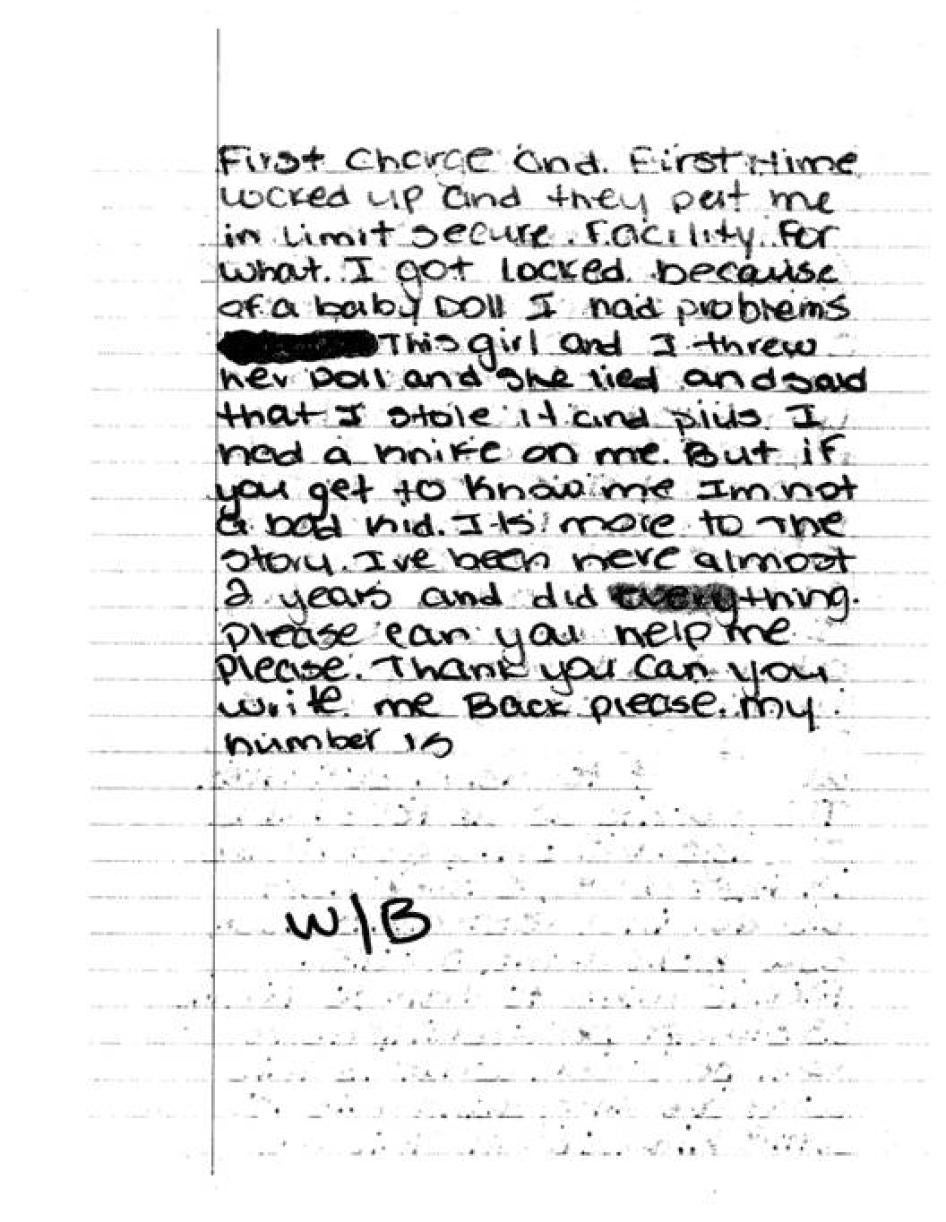
Library and Media Access
There is a small computer lab in the library at Tryon which does not allow access to the internet. Girls held at Tryon are allowed to check one book out of the library at a time but report that the books in the library are old and do not interest them.[596] A few incarcerated girls complain that they are not given enough access to books,[597] or are discouraged from reading.[598] Asked whether TryonReceptionCenter has a library, Janine Y. replied, "No, just a book shelf with a couple of books on it."[599]
International standards call for every juvenile facility to provide "access to a library that is adequately stocked with both instructional and recreational books and periodicals suitable for the juveniles, who should be encouraged and enabled to make full use of it."[600] In addition, incarcerated children have the right to access publications and broadcasts to keep themselves informed of goings on in the outside world.[601]
VII. Reentry and the Effects of Incarceration
Under international norms, children who find themselves in conflict with the law have the right to be treated in a way which promotes their social reintegration and their ability to take on a constructive role in society.[602] Upon releasing a child, facilities are responsible for making "arrangements designed to assist them in returning to society, family life, education or employment."[603] Facilities staff must coordinate with community service providers with a view to ensuring children a smooth return to the community upon release.[604] In particular, provisions should be made for mental health care to be continued beyond release.[605]
Reentry assistance is lacking for many girls released from OCFS custody and nonexistent for some. Felicia H. was taken from her mother's custody at the age of 8, and involved first in the child welfare system and then the juvenile justice system until being released in 2006 from Tryon on the day she turned 18.[606] Some post-release planning was attempted, but seemed to fall apart when Felicia H.'s mother and stepfather, with whom she has always had a troubled relationship, proved unprepared to accept her into their home. This rejection was entirely foreseeable.
They had a whole plan for me set up, but my home assessment kept coming back negative so they couldn't send me home. A month before going home I said I wanted to go to a group home and stay until I was twenty-one, until I was stable. [My lawyer] was trying, too. But they [the facilities staff] said it was too late.[607]
Felicia H. was not placed in any educational or job training programs, or even provided with written information concerning such programs. She was simply placed in a New York City homeless shelter:
They released me to Covenant House. It's not good in there. I saw a lot of junkies, it's cold and not homey, it's scary, girls are always fighting. I've been sleeping at friends' houses.[608]
Thus, after ten years enmeshed in the child welfare and later the juvenile justice system, Felicia H. found herself ejected from OCFS with a ninth grade education, no school or work plans, and no home. Devon A. had a similar experience. When asked what reentry assistance she had received when preparing to leave Tryon, she responded:
They didn't do anything.Sometimes, talking about this stuff makes me angry, that I allowed this to happen to me.I get some help through the foster care agency, Saint Christopher.All they do at Tryon is get you ready to leave, make sure your home is ready to accept you on such and such a date, then you're out the door.[609]
Post-release services are even more scant for children placed in contract residential facilities, rather than in state-run facilities. Children in privately-run contract facilities are required to spend their entire placement in the facilities, and the contract agencies are provided no state funding for post-release services.[610] Some contract agencies raise private funds to provide follow-up services while at least one simply releases children "with a bus ticket."[611]
While some children are unconditionally released after serving their entire placements, others are conditionally released to "aftercare," the juvenile equivalent of parole. These children often are provided with more services, but to avoid rearrest must comply with rules such as curfew, abstaining from drinking or doing drugs, regular school or work attendance, obeying parents and not running away, regular reporting to a case worker, and abstaining from contact with anyone who might exert a bad influence.[612] Aftercare workers are charged with supervising and serving children during the conditional release period, including enrolling children in school, helping them resolve personal problems, and referring children to community based services.[613] Children may receive one of three levels of supervision or they may be enrolled in one of a number of more intensive programs.[614] When asked what care she would receive after leaving BrooklynResidentialCenter, a non-secure OCFS facility, Amy F., now 14 years old, replied:
I'll be in aftercare for a couple of months. They're going to see how I do, good or bad. The aftercare worker helps you with things if you want help.[615]
Asked what assistance she received upon leaving OCFS, Janine Y. replied:
They just sent me to my aunt's house. And I went to a program called City Challenge. It's helpful, it is.[616]
A number of serious deficiencies have been identified in the aftercare services provided by OCFS. According to a children's advocacy group, aftercare counselors do not receive some children's case files or begin facilitating their transition until shortly prior to the children's release or even on the day of release. In addition, counselors' caseloads are too high, assessments of the ability of children's families to accept them are inadequate, post-release services to the family are lacking, children are not regularly reenrolled in Medicaid, leaving them uninsured, and it may take weeks or months to reenroll children in school. The group also asserts that children's school attendance is insufficiently monitored and their attendance at aftercare appointments not strictly required, and that counselors are left to compile their own, sometimes incomplete, lists of community resources to which to refer their clients.[617] Echoing some of these concerns, a service provider interviewed by HRW/ACLU was critical of the aftercare provided by OCFS:
Another problem is "aftercare." There's no such thing. . . . "Aftercare" is supposed to be the link, [the girls] are supposed to go to an office that gets them connected to public assistance, a job, an education. But it's a joke because just one aftercare worker handles a few boroughs. So the girl gets five minutes, then she gets a listing of jobs from two weeks ago. The limited and little support the girls get once they're out is horrendous. The state wants to wash its hands of the situation. . . . I've been in situations where staff in charge of aftercare will force a girl to reconcile with her parents or sign herself out at eighteen because it looks good if rolls are reduced. Every girl has an "expiration date" and it looks good to get them out by then. The girls don't want to be there, they're missing out on their adolescence, they have a lot of fantasies about what it'll be like, but when they get out it's hard for them to survive.[618]
Facilities staff say that they find it hard to help girls transition back to the communities because they are not in touch with services in the communities.[619]OCFS has recently established a Bureau of Aftercare Services charged with providing post-release reintegration assistance to children, which it hopes will help close the services gap.[620]
Maintaining the continuity of mental health care provision is especially problematic for girls leaving OCFS facilities. OCFS attempts to provide transitional services directly and through partnerships with other agencies and by contracting with outside providers. At its most effective, aftercare involves a team of professionals who get to know a child and her family prior to her release and provide psychological counseling in anticipation of the turbulent process of reintegration.[621] The provision of such services to girls is hampered by the paucity of programs specific to girls.[622] In addition, while programs frequently apply facially gender-neutral criteria when determining eligibility-such as the severity of crime the potential participant committed, the severity of the child's mental health problems, and the stability of their families-girls are disproportionately affected because girls on average commit higher level offenses before they are committed, exhibit more mental health needs, and come from more volatile families.[623] Appearing to recognize this problem, OCFS has in some cases urged service providers to follow special intake rules for girls.[624]
VIII. Lack of Accountability, Oversight, and Transparency in OCFS
I just want to tell people before someone gets really hurt.[625]
As already noted, the Tryon and Lansing facilities are closed to outside scrutiny by virtue of walls and fences and restrictions on residents' contact with the outside world, and by virtue of their isolation in rural areas hundreds of miles from children's families and attorneys. They are also closed institutions unresponsive to the complaints of their wards and shielded from public scrutiny by failures of oversight and barriers to outside monitoring.
International standards relating to incarceration recognize that abuses occur and persist in such closed environments, and that the protection of the rights of incarcerated children in particular depends on meaningful oversight.[626]Given the potential for abuse of children when they are placed in isolated, confined settings, the incidence of abuse known to occur at OCFS facilities, and the agency's refusal to curb abuse internally, independent monitoring is urgently needed. Yet in New York, means of potential scrutiny are systematically inadequate or underutilized, and efforts at fact gathering stymied.
Grievance Procedures and Staff Accountability
Too often we found that the grievance system . . . was not working, in some cases actually sabotaged.[627]
At OCFS facilities, a grievance procedure is in place in which girls make written complaints on a form that they place in a grievance box located in their unit. Their grievance is initially reviewed by unit staff members, and in theory, if it cannot be resolved in this first "step," the girl can proceed up the administrative chain by filing "step 2" and "step 3" grievances. Interviewed girls unanimously described the grievance procedure as frustrating and ineffective. Their major complaint was that grievances are simply ignored.[628] At times, submitted forms are simply not responded to at all. At other times, girls receive confirmation that their grievance has been received, but no subsequent communication. Girls who attempt to follow up on their grievances are told by staff that a response is forthcoming, but often do not receive any follow up communication.
Girls sometimes attempt to have their grievances heard through alternative channels, by speaking directly with staff, or writing directly to the facility director.[629] Some girls reported having attempted to address complaints to the OCFS ombudsman but having received no response.[630] (The intended role of the ombudsman is described below.) Other girls were not put in contact with the ombudsman, or were told explicitly that they could not speak to the ombudsman.[631]
Girls reported that the unresponsiveness of the process drove them to give up on filing grievances after a few attempts, and to give up pursuing filed grievances at the first "step." Other factors may also result in underutilization of grievances. A few girls reported being blocked from filing grievances, or feeling retaliated against by the staff about whom they filed complaints.[632] Fifteen-year-old Lana S., held at Tryon, told HRW/ACLU that she was never told about the grievance process and did not know how to file a grievance.[633]Other girls reported that, because the grievances are handled at the initial step by the very staff against whom grievances are filed, responding staff typically protect their colleagues and make the complainant feel at fault. Devon A.'s assessment of the grievance process is representative:
They'd try to solve the problem to their best interest. I grieved because I was being screamed at and called out of my name.[634] I grieved. They denied it. I don't know what happened. No one knows what happens to their grievances.[635]
The ineffectiveness of the grievance process is particularly dangerous in light of the physical and sexual abuse that occurs at the facilities. One grievance, for example, reads: "Wants someone to listen to them (residents) when they complain about a male doing 'stuff' to them."[636] Nevertheless, OCFS does not appear to track its responsiveness to grievances filed by children.[637]
The ineffectiveness of the grievance process also may be undermining effective internal response to abuses against incarcerated girls. Agency records disclosed to HRW/ACLU do indicate that many incidents of physical or sexual abuse are responded to with calls to the state's Child Abuse Hotline, and some facility records note that an allegation is being investigated, either internally or by a county sheriff's department. The outcome of these investigations is unclear, but disclosed records suggest that little criminal or disciplinary action against is taken against implicated staff. In one month in Tryon, for example, allegations of sexual contact were made against two separate staff members.[638] Both allegations were reported to the Child Abuse Hotline but "neither of these reports were accepted."[639] No action appears to have been taken against one staff member, and the other was simply transferred temporarily from one unit to another within the Tryon facility.[640] Further reference to these allegations in subsequent reports is missing.
HRW/ACLU requested information from OCFS regarding facilities administrators' response to specific allegations of abuse, particularly their investigations of such claims and any disciplinary or corrective action taken.[641] The request for information was denied except as to letters containing charges against staff and subsequent letters settling the charges. Of only 9 such charges issued by the Lansing and Tryon facilities combined for the period from November 2002 to November 2005, only 4 concerned the improper physical restraint of girls, and the dispositions were lenient.[642] Although OCFS's limited response to our request might not tell the whole story, the evidence it provided suggests that its enforcement of children's rights against its own facilities administrators and staff is weak.
International law provides detailed guidance about appropriate complaints procedures for incarcerated children.[643] Children must be given the right to complain directly to the facility director or her representative,[644] and to a central administrative or judicial authority and to receive a prompt response.[645] Children also have a right of access to an independent office established to receive complaints,[646] and to assistance in accessing all of these channels.[647] In particular, where a child has a complaint about an incident such as physical and sexual abuse, the United States has a binding treaty obligation to ensure a prompt and impartial investigation into such allegations.[648]
Absence of Internal Oversight
No one's ever seen the ombudsman. We don't know whether he exists or not.[649]
New York law provides for some internal facilities oversight. By state regulation, there must exist within OCFS an Office of the Ombudsman staffed by attorneys.[650] The ombudsmen are entitled to visit facilities, hear children's grievances, investigate alleged violations, and otherwise represent the rights of incarcerated children vis--vis OCFS.[651] According to the regulations, the ombudsman is to report to, among others, an Independent Review Board (IRB) comprised of between nine and fifteen people outside of OCFS, at least one of whom is to be a former resident or the parent of a resident, and another of whom is to be a psychologist or other clinician.[652] In addition, the superintendent of each facility is to be advised by a board of visitors composed of a cross-section of lay people in the community.[653] Both the IRB and the boards of visitors are entitled to access the facilities and speak to residents and staff.[654]
The OCFS Ombudsman's Office was created in 1973 as a federally funded project of the Legal Aid Society and what was then called the Division for Youth.[655] In its original form, the Ombudsman's Office had five attorneys who regularly made unannounced visits to juvenile facilities, spoke freely with residents in private, represented children in administrative proceedings, investigated alleged abuses, and had direct access to senior agency administrators.[656] According to Vincent O'Brien, an attorney who served as an OCFS ombudsman for thirty years, the key to the office's effectiveness was the aggressive involvement of the Independent Review Board whose members both visited the facilities whenever possible and mediated between the Ombudsman's Office and the agency administration.[657]
In 1991, the ombudsman program was eliminated as part of a statewide administrative reduction, and shortly thereafter one attorney was rehired and placed within OCFS's Office of General Counsel.[658] Although the state regulations concerning the ombudsman's power were not withdrawn, the general counsel imposed restrictions on the ombudsman, prohibiting unannounced visits, reducing and at times prohibiting access to the agency's administration, and drastically curtailing the operation of the IRB.[659] There is no evidence that the boards of visitors contemplated in the regulations were ever established for any facility.[660]
Since 1991, the Ombudsman's Office, consisting of at most one attorney and one non-attorney, has been so understaffed that it cannot exercise meaningful oversight. At best, the ombudsman has been able to visit each of the over thirty OCFS facilities once every two years and therefore can only rarely meet with confined children in person, and cannot seriously investigate complaints. The ombudsman no longer represents children in hearings. Even to the extent that the Ombudsman's Office is able to function, its location within OCFS and specifically within the General Counsel's Office makes independence impossible.[661]
The Independent Review Board is also moribund, consisting only of four persons, none of whom is a former resident or a psychologist, and has not held a meeting or visited a facility for several years.[662]According to former ombudsman Vincent O'Brian, "What I witnessed was the gradual and deliberate erosion of the independent nature of the operation. I often felt that the remnants of the office were maintained primarily for 'window dressing.'"[663] In short, OCFS has all but eliminated the Ombudsman's Office and IRB as originally conceived, in violation of its own regulations. In August 2005, the single ombudsman resigned, and no replacement was hired for almost seven months, until March 2006.[664] Without any meaningful form of internal oversight, children confined in OCFS facilities have often had no one to advocate on their behalf.
This state of affairs stands in contrast to the requirements of international standards which specifically prescribe "regular inspections and other means of control carried out . . . by a duly constituted body authorized to visit the juveniles and not belonging to the detention facility,"[665] and who specifically ensure facilities' comply with international standards.[666] To comply with international guidelines, such monitoring should be frequent, regular, unannounced, and unrestricted,[667] and every child in the facility "should have the right to talk in confidence to any inspecting officer."[668] In addition, qualified medical officers must monitor the "physical environment, hygiene, accommodation, food, exercise and medical services, as well as any other aspect or conditions of institutional life that affect the physical and mental health of juveniles."[669] Investigations should be accompanied by thorough public reporting.[670]
Inadequacy of External Governmental Monitoring
Other state agencies have had some involvement in juvenile conditions concerns but their effectiveness is uncertain. Since its creation in the 1980s, the state's Child Protective Services (CPS) office has investigated some allegations of abuse within state juvenile facilities,[671] but girls interviewed by HRW/ACLU were not aware of the existence of CPS and consequently had never attempted to contact CPS.[672] Indeed, it appears that the mediation of the Ombudsman's Office (mostly ineffectual, as described above) is required for girls' complaints to reach CPS,[673] and at any rate the Child Abuse Hotline is operated by New York's Child Protective Services offices, a division of OCFS. Likewise, the State Inspector General's Office is empowered to inquire into allegations of mistreatment at juvenile facilities. In response to reports by facilities staff of physical abuse of boys, the Inspector General recently investigated the Louis Gossett Residential Facility, located across the street from the Lansing facility.[674]The Inspector General's Office cannot, however, be relied upon to exercise meaningful ongoing oversight of OCFS facilities because its mandate is broad, encompassing fraud and abuse by both individuals and agencies as to over 200 state entities as well as private persons and business operating in New York.[675] The office conducts no regular monitoring visits to OCFS facilities. In the absence of such visits, allegations of abuse rarely come to light except in extraordinary cases in which staff act as whistleblowers.[676] Moreover, incarcerated girls and their families are not routinely informed of the existence of the office nor provided with its contact information.
Effective external oversight of juvenile facilities exists in other states in the United States. For example, facilities in Connecticut, New Jersey, and Rhode Island are monitored by independent state Offices of the Child Advocate. A bill to create such an office in New York is currently pending.[677] The absence of an effective, independent complaints mechanism to investigate abuse, particularly serious allegations of physical or sexual abuse, is a violation of the U.S.'s international legal obligations.
Barriers to Monitoring by Civil Society
The big black hole in New York seems to be when kids are sent upstate. We don't know what's going on in the juvenile justice system, there's that black hole. We get a few reports from people, anecdotes, then some conversations with people at Legal Aid, who see juveniles only at the point they emerge for an extension hearing.[678]
Civil society organizations that might be expected to act as watchdogs and assist in monitoring conditions in New York's juvenile facilities cannot effectively do so. For example, there exists no external agency with legislative authority to inspect juvenile prisons, although the Correctional Association of New York has had such authority as to adult prisons since the nineteenth century.[679]There exists no juvenile equivalent of Prisoners' Legal Services of New York, a state funded civil legal services office serving adult inmates in New York prisons. The Legal Aid Society (LAS), which represents about half of New York children in delinquency proceedings, is not even informed of the facility in which its clients are ultimately placed, and except in hearings to determine whether a child's placement in an OCFS facility is to be extended, does not continue representing children or maintain contact with children once they are incarcerated.[680]Statewide, no defense attorney or independent agency is funded to conduct oversight or advocacy concerning the conditions of confinement of children in OCFS facilities.
International standards specifically preserve the right of juveniles to communicate freely not only with family and friends but also with "other persons or representatives of reputable outside organizations."[681] Furthermore, children have the right to "request assistance from family members, legal counselors, humanitarian groups or others where possible, in order to make a complaint."[682] Yet OCFS is often actively hostile to such outsiders.
The institutional culture within OCFS is remarkably closed and self-protective, and OCFS has blocked efforts by outside investigators attempting to research conditions in its facilities. For example, a 2004 study of girls' experiences in New YorkState's juvenile justice system identified the stubborn refusal of OCFS to permit any outside scrutiny of its operations as a "major issue" affecting incarcerated girls.[683] The researchers were denied access to all but one OCFS facility and even there were prohibited from interviewing confined children.[684] They concluded: "The system is not open to inquiry and it is nearly impossible to investigate issues and create viable solutions."[685] Likewise, researchers investigating the unmet needs of gay and lesbian children in foster care for a 2001 report found New York to be the "least responsive" of 14 states to their requests for information, adding that OCFS's "failure to respond to our requests is emblematic of its inattention to the needs of LGBT foster care youth."[686] The agency's culture has been described this way:
Explicitly they have said do not speak to the media, it must go through us, the higher ups. And there are on occasion people who are whistleblowers and they'll pay for it. . . . OCFS is one big family and they all protect each other. It's insidious.[687]
As already noted at the outset of this report, HRW/ACLU has met with a similar institutional culture of secrecy. OCFS repeatedly denied HRW/ACLU researchers access to the Lansing and Tryon facilities.[688] OCFS also delayed for months before responding to HRW/ACLU's request for documents under New York's Freedom of Information Law, and disclosed documents containing thousands of complaints by incarcerated girls only after losing an administrative appeal made by HRW/ACLU to the agency's unfounded denial. It later produced approximately 6,000 additional pages of documents partially responsive to HRW/ACLU's requests, but only after a lengthy delay. Compromising information is redacted from these documents. Almost all attempts by HRW/ACLU to interview OCFS administrators and staff were refused, and several attempts to contact knowledgeable OCFS employees were followed by calls from the agency's Office of Public Affairs insisting that all communications be directed to that office only.
OCFS has also acted to prevent girls in its custody from communicating their concerns to HRW/ACLU. Felicia H. received a flyer from HRW/ACLU regarding HRW/ACLU's research while she was being held at Tryon. She shared the flyer with other girls and wrote to HRW/ACLU about aspects of her experiences, including having been subject to the restraint procedure. A sympathetic staff member helped her to compose her letters, but shortly after her release from Tryon, Felicia H. told HRW/ACLU:
They caught on to the first one that you sent me, the flyers and stuff, they thought you were trying to "set them up," get them in trouble. What we [the girls] tell you about getting restrained and stuff, you think that's what they [OCFS] tell people?[689]
Felicia H. was questioned by a staff person about her contact with HRW/ACLU:
I gave the [HRW/ACLU informational] flyer to three or four other girls. They were interested but [a staff member] told me not to show any more girls the flyers and not to communicate any more with you. I said someone has to let people know what's going on in this place, I might as well do it. It's not even just me, there's a lot of them, they're scared to talk. If we rat on [staff], they make our stay there bad, they've got the keys, you understand? It makes it real bad for us.[690]
Felicia H. feels that she was "restrained and treated bad" by a staff member for communicating with HRW/ACLU and with a Legal Aid Society attorney about conditions at Tryon.[691] In addition to contravening international standards concerning confined children's contact with the outside world, the staff member's attempt to limit Felicia H.'s communication with HRW/ACLU violated agency regulations permitting children to "correspond with persons or organizations" subject only to "limitations necessary to maintain facility order and control."[692]
The pattern that emerges is an almost complete lack of transparency within OCFS as to its facilities. In comparison with other states' juvenile justice agencies, and other agencies within New YorkState, OCFS is a profoundly secretive institution. This culture of "heavy paranoia"[693] runs contrary to the important goals of transparency, accountability, and cooperation as well as international standards and, most importantly, the interests of the girls and boys confined behind the walls of OCFS facilities.
Appendix: Facilities Investigated
Tryon
TryonGirlsCenter is located in Johnstown, New York, not far from Albany. Opened in 1987, it is classified overall as a maximum security institution for girls of up to 21 years of age who were found to have committed crimes. Its capacity is 87 girls and its average daily population is 75 girls. It has a staff of 120.[694]
The girls held at Tryon are divided into units numbered from 50 to 55. Units 50 and 51 are "secure," and the others are "non-secure." The housing units are arranged in a semi-circle around a large open area with a gravel track and tennis courts. On the grounds are also an administration building, a gym, and a cafeteria.
Each housing unit contains a centrally located staff office. To one side of the office are small cinder block rooms for each girl with a metal-reinforced window to the outside and enclosed by a solid metal door with a small plexi-glass window, and to the other are a common area, bathrooms, and the so-called "mudroom."[695]
TryonReceptionCenter is a part of the Tryon complex. Girls are held in Tryon Reception for two weeks for assessment prior to final placement in an OCFS facility or program. Also located in the same complex is TryonResidentialCenter, a medium security facility holding 217 boys between the ages of 14 and 18 classified as juvenile delinquents.[696]
A boys unit in the Tryon compound. The girls units look similar. 2005 Mie Lewis/Human Rights Watch/ACLU
Lansing
LansingResidentialCenter is located in Lansing, New York, near Ithaca. The facility was opened in 1968. It is classified as a medium security or limited secure facility. OCFS documents describe limited secure facilities as "the most restrictive service settings for the Juvenile Delinquent population."[697]Lansing has a capacity of 113 and its average daily population is 80 girls of up to 18 years of age who were found to have committed crimes. It has a staff of 89.[698]
Like Tryon, Lansing is divided into units. Girls in one unit can see girls in other units but are not allowed to be in contact with them. Across the street from Lansing stands Louis Gosset, Jr. Residential Center, a medium security 150-bed boys' facility holding boys of up to 18 years of age.[699]
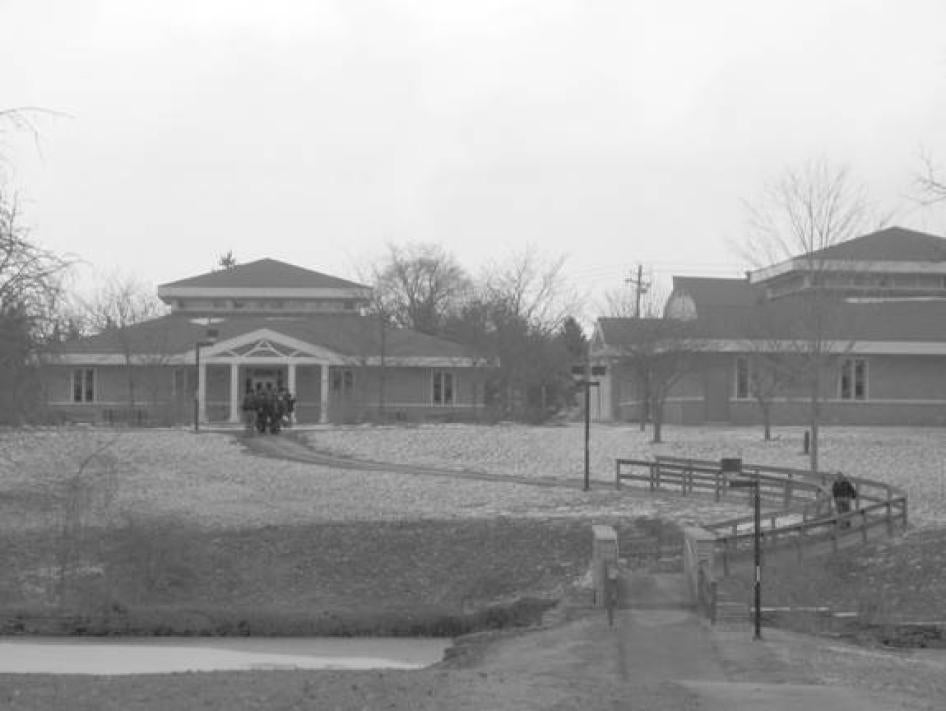
Girls prepare to move from one area of the Lansing facility to another. 2005 Mie Lewis/ Human Rights Watch/ACLU
Acknowledgements
This report was researched and written by Mie Lewis, Aryeh Neier fellow for Human Rights Watch and the American Civil Liberties Union. The project manager was Jamie Fellner, U.S. Program director for Human Rights Watch, and the principal editors were Alison Parker, senior researcher in the U.S. Program, and Joseph Saunders, deputy program director at Human Rights Watch. Lenora Lapidus, director of the American Civil Liberties Union Women's Rights Project, Aisling Reidy, senior legal advisor for Human Rights Watch, and Michael Bochenek, deputy director for the Children's Rights Division of Human Rights Watch, also reviewed and edited this report. Andrea Holley of Human Rights Watch and Todd Drew of the American Civil Liberties Union provided production assistance. Keramet Reiter, former U.S. Program associate, and Sarah Tofte, researcher in the U.S. Program, provided research assistance for the report. Ashoka Mukpo, U.S. Program associate, assisted in proofreading the report.
Human Rights Watch and the American Civil Liberties Union wish to express our deep appreciation to the children who spoke with us and to the many direct service providers, juvenile rights advocates, lawyers, and other who made invaluable contributions to our understanding of the operation of New York's juvenile facilities. The names of all of the children we interviewed have been changed to protect their privacy. Because of the refusal of New York's Office of Children and Family Services to permit human rights monitoring of its facilities, making contact with currently and formerly incarcerated girls and others with first-hand knowledge of facilities conditions was a difficult endeavor, made possible only with the help of many people, including: Mishi Faruqee and Asadullah Mohammed of the Correctional Association of New York, Marsha Weissman of the Center for Community Alternatives, and many others.
Human Rights Watch and the American Civil Liberties Union are grateful to the Open Society Institute for its support of the Aryeh Neier Fellowship. We would also like to give special thanks to Gara LaMarche, vice president of the OSI for initiating the fellowship. We would also like to thank the Butler Family Fund for its support of our work on the conditions of confinement experienced by incarcerated girls. Human Rights Watch is grateful to Peter Lewis for his support of the U.S. Program, and Jonathan Lopatin for his support of our work on the issue of prison rape.
[1]The first report, "Witness to Abuse: Human Rights Abuses under the Material Witness Law since September 11," was published in June 2005.
[2] Specifically, on October 27, 2005, HRW/ACLU contacted Roberta Dael of the OCFS Ombudsman's Office seeking access to OCFS facilities. OnOctober 31, 2005, HRW/ACLU sent separate written requests for access to the directors of the Tryon and Lansing facilities. No response was received. After a follow-up call to the Lansing facility, HRW/ACLU was telephoned by Brian Marchetti of the OCFS Public Affairs Office insisting that HRW/ACLU no longer contact the facilities directly but contact only him instead. HRW/ACLU made a follow-up call to the Tryon facility, and in response, on November 15, 2005, was referred to Dianne Deacon of the OCFS Legal Department. In a letter dated November 23, 2005, Ms. Deacon denied the request for access based on "confidentiality considerations," citing two provisions of New York law that, in fact, concern document confidentiality and are therefore inapplicable to a request for facilities access. Six senior OCFS administrators were sent copies of the letter by Ms. Deacon. On November 30, 2005, HRW/ACLU contacted Ms. Deacon to discuss her letter. In subsequent discussions, Ms. Deacon approved arranging a meeting between HRW/ACLU and OCFS facilities administrators to discuss access to the facilities, but indicated that the approval of Brian Marchetti of the Public Affairs Office was also required. HRW/ACLU contacted Brian Marchetti and requested access to the facilities.In a telephone conversation of December 15, 2005, Brian Marchetti stated that HRW/ACLU's request for access was denied, citing as his reason the desire not to distract OCFS administrators and staff from their daily tasks. HRW/ACLU requested that Mr. Marchetti put his refusal in writing. He refused to do so.
On December 22, 2005, HRW/ACLU sent a written request for facilities access to OCFS Commissioner John Johnson. When a follow-up call was made, Mr. Johnson's assistant stated that the letter had never been received. On January 3, 2006, HRW/ACLU faxed and resent the letter. When HRW/ACLU made a follow-up call on January 9, 2006, Mr. Johnson's assistant stated that the request had been delegated to Inez Nievez, the Associate Deputy Commissioner for Programs and Services of OCFS's Division of Rehabilitative Services, and that Ms. Nievez would contact HRW/ACLU later that day. Ms. Nievez never contacted HRW/ACLU. When, on January 10, 2006, HRW/ACLU called the OCFS Commissioner's office seeking Ms. Nievez's contact information, OCFS staff refused to provide this information. On January 11, 2006, HRW/ACLU again telephoned the OCFS Commissioner's office seeking to speak with Ms. Nievez.HRW/ACLU was informed that Ms. Nievez had referred the request for access to Sandra Brown of the OCFS Public Affairs Office. Later on January 11, 2006, HRW/ACLU was telephoned by Sandra Brown and Brian Marchetti who stated that the request for access to the facilities was denied. In that conversation, Ms. Brown stated that she was initially inclined to treat the request as a proposal to conduct academic research by forwarding it to the OCFS Bureau of Evaluation and Research, "but then I looked at the FOIL [i.e. a request for documents submitted by HRW/ACLU under New York's Freedom of Information Law] and decided, 'She's working on something.'"
On February 28, 2006, HRW/ACLU sent a written request to OCFS Commissioner John Johnson requesting a meeting to discuss the ongoing research and the issue of facilities access. Only after the intervention of two concerned state assemblymembers did a one hour meeting take place on April 18, 2006 between HRW/ACLU and eight senior OCFS administrators including Commissioner Johnson. At that meeting, HRW/ACLU provided information about our research and again requested access to the facilities. Mr. Johnson replied, "We'll get back to you. There are some strong measures of confidentiality." On May 2, 2006, HRW/ACLU telephoned Mr. Johnson's to follow up on the request for access. The following day, HRW/ACLU received a call from Sandra Brown of the OCFS Public Affairs Office. Ms. Brown stated that HRW/ACLU should not contact the OCFS Commissioner's office and should direct inquiries to the Public Affairs Office. When HRW/ACLU reiterated its request for access, Ms. Brown stated that she would "talk to the Commissioner and two other people" who had attended the April 18, 2006 meeting, and would then, "let you know." On May 5, 2006, Ms. Brown telephoned HRW/ACLU and stated that the request for access was denied. Ms. Brown then directed HRW/ACLU to submit a research proposal to the OCFS Bureau of Evaluation and Research, the office to which Ms. Brown had originally contemplated directing HRW/ACLU's request for access before concluding that HRW/ACLU were "working on something." HRW/ACLU explained that this would not be an appropriate course of action because the Bureau of Evaluation and Research evaluates proposals for social scientific research, but Ms. Brown insisted that this was the only course of action available.
On May 12, 2006, HRW/ACLU sent a written request to OCFS Commissioner Johnson urging him to reconsider his denial of HRW/ACLU's request for access to the facilities. On May 22, 2006, Mr. Johnson responded by letter directing HRW/ACLU to submit a request for access to OCFS's Bureau of Evaluation and Research. HRW/ACLU contacted the Bureau and was informed that the Bureau evaluates only proposals for scientific research conducted "through a university," containing a "research hypothesis," and approved by a formal Institutional Review Board. Likewise, the "Instructions to Researchers for Submitting a Research Proposal for OCFS Review" provided to HRW/ACLU by the Bureau contemplates social scientific research, requiring "an approval letter from a federally recognized Institutional Review Board," as well as submissions, such as a "sampling approach" and an "analytic approach," characteristic of academic research. On June 12, 2006, HRW/ACLU sent a letter to OCFS Commissioner Johnson detailing the history of contacts between HRW/ACLU, explaining again the nature of HRW/ACLU's research, and urging Mr. Johnson to reconsider his rejection of HRW/ACLU's request for facilities access. The letter requested in the alternative that Mr. Johnson provide HRW/ACLU with assurance that, given the nature of HRW/ACLU's research, a request for access would properly be directed to the Bureau of Evaluation and Research and that the qualitative nature of the research would not preclude approval. Mr. Johnson responded in a letter providing no assurances but simply repeating the instruction that HRW/ACLU submit a request to the Bureau of Evaluation and Research.
[3] The number of entries per year, per facility, is as follows: Tryon: 435 in 2003, 452 in 2004, 411 in 2005; Lansing: 976 in 2003, 1082 in 2004, 1385 in 2005. The 2005 numbers for each facility are slightly low because the logs provided by OCFS extend only until December 8, 2005 (for Tryon), and December 19, 2005 (for Lansing).
[4] Two of the thirty interviewees also corresponded with HRW/ACLU by mail prior to their release, and were interviewed upon their release.
[5] International Covenant on Civil and Political Rights (ICCPR), adopted December 16, 1966, 999 U.N.T.S. 171, entered into force March 23, 1976, ratified by the United States of America on June 8, 1992.
[6] International Covenant on Economic, Social and Cultural Rights (ICESCR), adopted December 16, 1966, 993 U.N.T.S. 3, entered into force January 3, 1976, signed by the United States of America on October 5, 1977.
[7] Convention against Torture and Other Cruel, Inhuman or Degrading Treatment or Punishment (CAT), adopted December 10, 1984, G.A. Res. 39/46, U.N. Doc. A/39/51, entered into force June 26, 1987, ratified by the United States of America on October 21, 1994.
[8] Convention on the Rights of the Child, (CRC) adopted November 20, 1989, G.A. Res. 44/25, U.N. Doc. A/RES/44/25, entered into force September 2, 1990, signed by the United States of America on February 16, 1995.
[9] Convention on the Elimination of All Forms of Discrimination against Women (CEDAW), 1249 U.N.T.S., entered into force September 3, 1981, signed by the United States of America on July 17, 1980.
[10] United Nations Standard Minimum Rules for the Administration of Juvenile Justice ("Beijing Rules"), adopted November 29, 1985 by General Assembly Resolution 40/33.
[11] United Nations Rules for the Protection of Juveniles Deprived of their Liberty ("U.N. Rules"), adopted December 14,1990 by General Assembly Resolution 45/113.
[12] United Nations Guidelines for the Prevention of Juvenile Delinquency ("Riyadh Guidelines"), adopted and December 14, 1990 by General Assembly Resolution 45/112.
[13] United Nations Standard Minimum Rules for the Treatment of Prisoners ("Standard Minimum Rules"), U.N. ECOSOC Res. 663C and 2076, adopted July 31, 1957 and May 13, 1977.
[14] ICCPR, art. 9.
[15] Ibid., arts. 9, 14.
[16] Ibid., art. 10.
[17] Ibid., art. 7.
[18] In this context it is of little relevance that the U.S. stated in connection with its ratification of the ICCPR that the treaty is not "self-executing" or that the U.S. did not create a private right of action allowing individuals to rely directly on provisions of the ICCPR. In any event, the laws of the U.S. and its states as well as their implementation must be consistent with the ICCPR. This follows directly from Article 6 section 2 of the U.S. Constitution. As a matter of international law as well, reservations to treaties may not contradict the object and purpose of the treaty at issue. Vienna Convention on the Law of Treaties, adopted May 22, 1969, 1155 U.N.T.S. 331, entered into force January 27, 1980, signed by the United States of America on April 24, 1970, art.19(3). The U.N. Human Rights Committee, responsible for interpreting and monitoring compliance with the ICCPR, has stated that reservations or interpretive declarations should not "seek to remove an autonomous meaning to Covenant obligations, by pronouncing them to be identical, or to be accepted only in so far as they are identical, with existing provisions of domestic law." U.N. Human Rights Committee, General Comment 24, on Reservations to the ICCPR, para. 19, U.N. Doc. CCPR/c/21/Rev. 1/Add. 6 (1994).
[19] Article 6 section 2 of the U.S. Constitution provides: "This Constitution, and the Laws of the United States which shall be made in Pursuance thereof; and all Treaties made, or which shall be made, under the Authority of the United States, shall be the supreme Law of the Land; and the Judges in every State shall be bound thereby, any Thing in the Constitution or Laws of any State to the Contrary notwithstanding." (Emphasis added.) See also Hamdan v. Rumsfeld, 126 S. Ct. 2749, 2797, n. 66 (2006) (explaining that the right of an accused "to be tried in his presence, and to defend himself in person or through legal assistance of his own choosing" also follows from article 14 of the ICCPR "to which the United States is a signatory").
[20] ICCPR, art. 24, para. 1. See Human Rights Committee's General Comment No. 17: Article 24, Rights of the Child, adopted April 7, 1989.
[21]Toonen v. Australia, Communication No. 488/1992, U.N. Doc CCPR/C/50/D/488/1992 (1994).
[22] ICCPR, art. 10, para. 3. When the United States ratified the ICCPR, it attached a limiting reservation that stipulates: That the policy and practice of the United States are generally in compliance with and supportive of the Covenant's provisions regarding treatment of juveniles in the criminal justice system.Nevertheless, the United States reserves the right, in exceptional circumstances, to treat juveniles as adults, notwithstanding paragraphs 2 (b) and 3 of article 10 and paragraph 4 of article 14." United Nations Treaty Collection, International Covenant on Civil and Political Rights, United States of America:Reservations, para. 5(emphasis added).
[23] ICCPR, art. 17, para. 1.
[24] In Roper v. Simmons, 543 U.S. 551, 576 (2005), the United States Supreme Court specifically noted that the ICCPR contains certain prohibitions that are also contained in more specific instruments (in that case the Convention on the Rights of the Child).
[25] CAT, art. 10.
[26] Ibid., art. 11.
[27] Ibid., arts. 12, 13.
[28]Conclusions and Recommendations of the Committee against Torture: United States of America, CAT/C/USA/CO/2, July 25, 2006, para. 33.
[29] As the Supreme Court noted in Roper, 543 U.S. at 576, the CRC has been ratified "by every country in the world save for the United States and Somalia."
[30] Roper, 543 U.S. at 576. In addition, the U.S. has ratified the Optional Protocol to the Convention on the sale of children, child prostitution and child pornography and is thus specifically bound to protect the rights and interests of incarcerated girls who were previously commercially sexually exploited. Optional Protocol to the Convention on the Rights of the Child on the sale of children, child prostitution and child pornography, adopted May 25, 2000, U.N. Doc. A/54/49, entered into force January 18, 2002, ratified by the United States of America Dec. 23, 2002, art. 9 ("States Parties shall take all feasible measures with the aim of ensuring all appropriate assistance to victims of such offences, including their full social reintegration and their full physical and psychological recovery.").
[31] CRC, preamble.
[32] Ibid., arts. 2, 13, 16, 19, 24, 28, 34.
[33] Ibid., art. 3, para. 3.
[34] Ibid., art. 37, sec. c. This includes the right to maintain contact with family members.
[35] Ibid., art. 37, sec. a.
[36] CEDAW, preamble, 10, 12.
[37] CEDAW, art. 2; ICCPR art. 2; CRC, preamble, art. 2; ICESCR, art. 2, para. 2.
[38] ICESCR, arts. 10, 12, 13.
[39] Regional treaties and arrangements also contain standards and provisions similar to those described herein. See, for example, Petition Alleging Violations of the Human Rights of Juveniles Sentenced to Life Without Parole in the United States of America to the Inter-American Commission on Human Rights (Feb. 21, 2006), http://www.aclu.org/images/asset_upload_file326_24232.pdf, (retrieved September 3, 2006), concerning children's specific rights under the American Declaration of the Rights and Duties of Man.
[40]U.S. Constitution, Art. 6, sec. 2 (emphasis added). For an early case confirming the supremacy of treaties over state law, see Ware v. Hylton, 3 U.S. (3 Dall.) 199, 236-37 (1796) (Chase, J.).
[41] HRW/ACLU interview with Janine Y., New York, New York, May 24, 2006.
[42] United Nations Standard Minimum Rules for the Administration of Juvenile Justice ("Beijing Rules"), adopted November 29, 1985 by General Assembly Resolution 40/33, rule 13;United Nations Rules for the Protection of Juveniles Deprived of their Liberty ("U.N. Rules"), adopted December 14,1990 by General Assembly Resolution 45/113, rules 1, 2.
[43] In 2004, 2,104 children were taken into OCFS custody; 392 of these were girls. New York State Office of Children and Family Services, Division of Rehabilitative Services, "Youth in Care: 2004 Annual Report," ii, 2 (Table 2) ("OCFS Annual Report (2004)"). This figure includes children remanded for residential services as well as a relatively small number remanded for non-residential services.
[44] Percentages calculated from OCFS Annual Report (2004), p. 2 (Table 1). OCFS did not release its 2004 Annual Report until 2006, and no further reports have been released to date.
[45] Percentages calculated from OCFS Annual Report (2004), p. 2 (Table 1) and "Table 1: Characteristics of Admissions to Selected OCFS Facilities, 2003-2005," obtained through the New York Freedom of Information Law and on file with HRW/ACLU.
[46] Percentage calculated from OCFS Annual Report (2004), p. 6 (Table 2).
[47] Ibid.
[48] Annie E. Casey Foundation, "Kids Count: State-Level Data Online," http://www.aecf.org/kidscount/sld/profile_results.jsp?r=34&d=1&c=a&p=5&x=153&y=16 (retrieved May 6, 2006)("Kids Count Database"). In 2004, 21 percent of children in New YorkState lived in poverty and 35 percent lived in families where no parent had full-time, year-round employment, compared with a 33 percent national average for children whose parents lack full-time, year-round employment. New York rates over the past five years are similar.
[49] See, for example, United States Office of Juvenile Justice and Delinquency Prevention, "Juvenile Offenders and Victims: 2006 National Report," 7 (describing the association between juvenile poverty, family disruption, and juvenile crime). An overview of girls' pathways to delinquency is provided in Marty Beyer, "Delinquent Girls:A Developmental Perspective," Kentucky Children's Rights Journal, pp. 9, 17-25 (2001).
[50] For example, one study found that girls and women with histories of childhood abuse or neglect were 73 percent more likely than those without such histories to be arrested for property, alcohol, drug, and misdemeanor offenses and that, unlike boys, girls with abuse and neglect histories are also more likely to be arrested as a juvenile or adult for a violent offense than those without.Cathy S. Wisdom and Michael G. Maxfield, "An Update on the 'Cycle of Violence,'" in Research in Brief, U.S. Department of Justice, Office of Justice Programs, National Institute of Justice (2001). Girls in the general population are more likely to experience childhood sexual abuse than boys, and in addition are abused from a younger age and over a longer period of time. Meda Chesney-Lind, The Female Offender: Girls, Women and Crime (Thousand Oaks, California: SAGE Publications, 1997), pp. 25-26. It is important to note, however, that this difference may arise in whole or in part from gender differences in willingness to admit past abuse. Email message from Terry Kupers, M.D., M.S.P., to HRW/ACLU, June 22, 2005.
[51] Laura Prescott, "Adolescent Girls with Co-Occurring Disorders in the Juvenile Justice System," The NationalGAINSCenter for People with Co-Occurring Disorders in the Juvenile Justice System, (December 1997), p. 3. Sexual assault, along with early puberty, has been found to increase the likelihood that girls will engage in violence, theft, truancy, and vandalism. Margaret A. Zahn, RTI International, "New Findings from the Girls Study Group," presentation at National Institute of Justice Annual Conference (July 2005).
[52] Inez Nievez, Associate Deputy Commissioner for Programs and Services for the Division of Rehabilitative Services, in HRW/ACLU meeting with OCFS senior administrators, Albany, New York, April 18, 2006. According to the information made available to HRW/ACLU, OCFS has not collected information on this feature of the girls in its care since the 1980s. In response to an April 21, 2006 Freedom of Information Law request for "[a]ny and all documents relating to or arising from data collection conducted by any government agency on the rate of past abuse (physical, sexual, or otherwise) experienced by girls, boys, and/or girls and boys in OCFS custody," OCFS responded that it "does not maintain records in the manner you request." Letter from Sandra A. Brown, Assistant Commissioner, Public Affairs, to HRW/ACLU, June 28, 2006.
[53] See National Mental Health Association, "Mental Health and Adolescent Girls in the Justice System," (1999) (estimating that over 70 percent of girls incarcerated in the U.S. have experienced sexual and physical abuse).
[54] National Mental Health Association, "Mental Health and Adolescent Girls in the Justice System," (1999); Nancy Rosenbloom, Legal Aid Society, testimony before the Council of the City of New York, Committee on Women's Issues and Youth Services and Subcommittee on Juvenile Justice, April 18, 2000 ("Legal Aid Society Testimony (2000)"); HRW/ACLU telephone interview with Legal Aid Society attorney, September 28, 2005. Leslie Acoca, "Investing in Girls: A 21st Century Strategy," p. 5.(describing "serious physical health problems" and need for "psychological services" in 88 percent and 53 percent respectively of a sample of "girls in the California juvenile justice system").
[55] United Nations Guidelines for the Prevention of Juvenile Delinquency ("Riyadh Guidelines"), adopted and December 14, 1990 by General Assembly Resolution 45/112, para. 45.
[56] Riyadh Guidelines, paras. 11-13, 32-39. See also International Covenant on Civil and Political Rights (ICCPR), adopted December 16, 1966, 999 U.N.T.S. 171, entered into force March 23, 1976, ratified by the United States of America on June 8, 1992, art. 23, para. 1; International Covenant on Economic, Social and Cultural Rights (ICESCR), adopted December 16, 1966, 993 U.N.T.S. 3 (entered into force January 3, 1976, signed by the United States of America October 5, 1977), art. 10, para. 1.
[57] Riyadh Guidelines, para. 51.
[58] Convention on the Rights of the Child, (CRC) adopted November 20, 1989, G.A. Res. 44/25, U.N. Doc. A/RES/44/25, entered into force September 2, 1990, signed by the United States of America on February 16, 1995., art. 19, paras. 1, 2.
[59] Legal Aid Society Testimony (2000).
[60] Legal Aid Society Testimony (2000). In a discussion of girls' entry to the New York juvenile justice system, Ms. Rosenbloom describes a "shocking picture of failure of the responsible government agencies to help and treat these vulnerable young people," and points out that "the many public agencies that touch children's lives in New York City fail to work together and prevent young girls from becoming involved in criminal behavior." See also M.L. Armstrong, "Adolescent Pathways: Exploring the Intersections Between Child Welfare and Juvenile Justice, PINS, and Mental Health," Vera Institute of Justice (May 1998) (citing failures in the special education, mental health, and child welfare systems). For an in-depth study of the distinct pathways to juvenile justice involvement traveled by girls in Florida, see Vanessa Patino et al., "A Rallying Cry for Change: Charting a New Direction in the State of Florida's Response to Girls in the Juvenile Justice System," National Council on Crime and Delinquency (July 2006).
[61] Legal Aid Society Testimony (2000).
[62] Administration for Children's Services, the primary child welfare agency in New York City.
[63] HRW/ACLU telephone interview with Legal Aid Society attorney, September 28, 2005.
[64] About one in ten children in New YorkState lack any form of health insurance, as do 14% of those living below the poverty line. Kids Count Database.
[65] Chris Koyangi and Rafael Semansky, "Assessing Child Mental Health Services in New York," Bazelon Center for Mental Health Law (Winter 2003), pp. 11-14 (tracing the pathway between lack of access to mental health services and juvenile offenses, and arguing that children offend as a result of the emphasis on crisis-oriented care).
[66] Chesney-Lind, Female Offender, 5. See also Anne Marie Ambrose and Sandra Simpkins, "Improving Conditions for Girls in the Justice System: The Female Detention Project," American Bar Association, http://www.abanet.org/scripts/printview.jsp?Ref=http://www.abanet.org/crimjust/juvjus/gji.httml (retrieved October 7, 2005). Theresa E.'s description of her entry into the child welfare system is typical: "I was taken from home because at twelve I ran away from home, was disrespecting my family, drinking, smoking, fighting. All that stuff." HRW/ACLU interview with Theresa E., New York, New York, February 3, 2006.
[67] See, for example, Jonann Brady, "Legal Aid: "Everything is Blown out of Proportion," in On the Downlow: The Lowdown, http://www.jrn.columbia.edu/studentwork/children/downlow/legalaid.shtml (retrieved May 15, 2006).
[68] Francine Sherman, Annie E. Casey Foundation, "Detention Reform and Girls: Challenges and Solutions," in series Pathways to Juvenile Detention Reform, 2005, pp. 36-37. Recognizing the link between foster care and incarceration, international standards require states to establish foster care and other alternative placements that "replicate, to the extent possible, a stable and settled family environment, while, at the same time, establishing a sense of permanency for children, thus avoiding problems associated with 'foster drift.'" Riyadh Guidelines, para. 14.
[69] Administration for Children's Services, the primary child welfare agency in New York City. Stephanie Q. refers to ACS foster care group homes.
[70] A New York City detention facility, now known as "Bridges."
[71] A New York City detention facility.
[72] HRW/ACLU telephone interview with Stephanie Q., May 15, 2006. By "upstate," Stephanie Q. means a long-term juvenile commitment facility located in upstate New York.
[73] M.L. Armstrong, "Adolescent Pathways: Exploring the Intersections Between Child Welfare and Juvenile Justice, PINS, and Mental Health," Vera Institute of Justice, May 1998, pp. 18-19.
[74] Dylan Conger and Timothy Ross, "Reducing the Foster Care Bias in Juvenile Detention Decisions,"Vera Institute of Justice, June 2001, pp. 9-10.
[75] Ellen Lyons Miller, "Information Packet: Adolescents in Residential Treatment and Foster Care," National Resource Center for Foster Care and Permanency Planning at the Hunter College School of Social Work, May 2002, p. 3. A glance at news headlines shows that a heightened risk of juvenile incarceration due to poor intra-agency coordination is only one symptom of broader failings in New York's foster care system. Administrative disorganization and cripplingly large caseloads throughout all levels of OCFS in New York have been cited by both government officials and outside observers as contributors to tragedies in recent years. One example is the well-publicized case of Nixmary Brown, a seven-year old who was beaten to death by her stepfather only weeks after contact with city workers. According to TheNew York Times, preliminary internal evaluations of OCFS's response to initial indications of abuse lacked "urgency." Alan Feuer and Thomas J. Lueck, "Long Chain of Alarms Preceded Death of Girl, 7," The New York Times, January 13, 2006, p. A1. See also Rachel Swarns, "3 Years After a Girl's Murder, 5 Siblings Lack Stable Homes," The New York Times, August 4, 1998, p. A1; Graham Rayman and Melanie Lefkowitz, "Children Go Unprotected: Reports Detail Caseworker Errors Before and After City Kids Die," Newsday, February 26, 2006, p. A06 (listing a number of cases involving caseworker error and raising systemic concerns); Lauren Terrazzano, "Awash in Abuse: Child Welfare Caseworkers Unable to Keep Up with Surge in Reports," Newsday, February 28, 2006, p. A05.
[76] HRW/ACLU interview with Selena B., New York, New York, February 14, 2006.
[77] Margaret A. Zahn, RTI International, "New Findings from the Girls Study Group," presentation at National Institute of Justice Annual Conference (July 2005).
[78] Riyadh Guidelines, paras. 5(a), 24-27, 30. Based on the importance of education and community involvement in preventing delinquency,standards require states to "develop conditions that will ensure for the juvenile a meaningful life in the community, which, during that period in life when she or he is most susceptible to deviant behavior, will foster a process of personal development and education that is as free from crime and delinquency as possible." Beijing Rules, para. 1.2. See also Riyadh Guidelines, paras. 20-21.
[79] "High-stakes testing" is not precisely defined, but refers generally to statewide or national testing on the basis of which promotion in grade, eligibility to graduate, and other decisions profoundly affecting students' lives, are made.
[80] Elysa Hyman, "School Push-Outs: An Urban Case Study," Clearinghouse REVIEW Journal of Poverty Law and Policy, Jan-Feb 2005, pp. 684-689.
[81] David M. Herszenhorn, "BrooklynHigh School Is Accused Anew of Forcing Students Out," The New York Times, October 12, 2005, p. B1. Elissa Gootman, "Students' Suit on Special Ed Becomes Class Action," The New York Times, July 30, 2004, p. B4. Susan Saulny, "StudentsSueSchool System, Claiming Denial of Education," The New York Times, December 21, 2004, p. B3.
[82] For a critique of zero tolerance policies see Ralph C. Martin, II, "Report: Zero Tolerance Policy, American Bar Association, Juvenile Justice Committee, February 2001, http://www.abanet.org/crimjust/juvjus/zerotolreport.html (retrieved June 29, 2006).
[83] See, for example, Mercer Sullivan and Nancy Vorsanger, "Understanding Adolescent Violence: An Ethnographic Approach," Vera Institute for Justice (January 2000).
[84] Susan Saulny, "Metro Briefing New York: Manhattan: Students Protest The Police," The New York Times, August 2, 2005, p. B6.
[85] Susan Saulny, "Metro Briefing New York: Manhattan: Students Protest The Police," The New York Times, August 2, 2005, p. B6; Natasha Bannan, et al., "The Impact School Initiative: A Critical Assessment and Recommendation for Future Implementation," A Report for the Prison Moratorium Project by the PMP Capstone Team, Wagner School of Public Service, New York University, April 2006, p. 2.
[86] Riyadh Guidelines, paras. 31, 54.
[87] Monica Davey, "A Child Held Behind," The New York Times, January 16, 2005, p. A1.
[88] Philip Harris, "The Female Delinquent," Crime and Justice Research Institute (1998); Sherman, "Detention Reform," p. 24.
[89] In New York City, the number and percentage of the population represented by girls held in city detention facilities and OCFS commitment facilities has increased steadily since the 1980s. Legal Aid Society Testimony (2000). This is consistent with national figures. Christy Sharp and Jessica Simon, "Girls in the Juvenile Justice System: The Need for More Gender-Responsive Services,"Child Welfare League of America(2004), p. 4 (citing arrest figures between 1980 and 2000, and stating that in 2000 28% of juvenile arrests nationwide were of girls.). See also Eileen Poe-Yamagata, and Jeffrey A. Butts, "Female Offenders in the Juvenile Justice System: Statistics Summary," Office of Juvenile Justice and Delinquency Prevention (1996), p. 1.
[90] Meda Chesney-Lind and Randall G. Shelden, Girls, Delinquency, and Juvenile Justice, (Belmont, California: Wadsorth, 2004), pp. 161-162. The historical development of the juvenile justice system in relation to girls is surveyed at pp. 158-182. For a critique of the ungovernability statute in New York, including its disproportionate effect on girls, see R. Hale Andrews and Andrew H. Cohn, "Ungovernability: The Unjustifiable Jurisdiction," 83 Yale Law Journal, pp. 1383-1409 (1974). See also Steven Schlossman and Stephanie Wallach, "The Crime of Precocious Sexuality: Female Juvenile Delinquency in the Progressive Era," Harvard Educational Review, 48(1) (February 1978) pp. 65-94 (describing the relatively harsh treatment of girls in juvenile courts and reformatories).
[91] Under New York law, children who commit status offenses are designated as "persons in need of supervision" or "PINS." FCA 712(a). A PINS is: "[a] person less than eighteen years of age who does not attend school in accordance with the provisions of part one of article sixty-five of the education law or who is incorrigible, ungovernable or habitually disobedient and beyond the lawful control of a parent or other person legally responsible for such child's care, or other lawful authority, or who violates the provisions of section 221.05 of the penal law." Ibid. Section 221.05 of the penal code prohibits the possession of marijuana.
[92] United States Office of Juvenile Justice and Delinquency Prevention, Census of Juveniles in Residential Placement Databook, 2004, www.ojjdp.ncjrs.org/ojstatbb/cjrp/ (retrieved May 15, 2006).
[93] See, for example, American Bar Association and National Bar Association, "Justice by Gender: The Lack of Appropriate Prevention, Diversion and Treatment Alternatives for Girls in the Justice System," p. 17.
[94] Chesney-Lind, Female Offender, pp. 25-26.
[95]New York Penal Code 130.25-130.35.
[96]New York Penal Code 230.
[97] See Aina Hunter, "The Children's Hour: The Fight for Legislation to Help Young Prostitutes," The Village Voice, May 2, 2006.
[98] HRW/ACLU interview with Ebony V., New York, New York, March 16, 2006.
[99] HRW/ACLU interview with Ebony V., New York, New York, March 16, 2006.
[100] See Girls Incorporated, "Prevention and Parity: Girls in Juvenile Justice," Office of Juvenile Justice and Delinquency Prevention and Girls Incorporated (1996), p. 30. Indeed, a 2005 Florida study found that incarcerated girls used more types of illegal drugs than their male counterparts, including illegally obtained prescription medication. Vanessa Patino and Barry Krisberg, "Reforming Juvenile Detention in Florida," National Council on Crime and Delinquency (August 2005), pp. 15-16.
[101] HRW/ACLU interview with Bless L., New York, New York, March 22, 2006.
[102] HRW/ACLU telephone interview with Legal Aid Society attorney, September 28, 2005.
[103] Chesney-Lind, Female Offender, pp. 15-21, 23-28.
[104] Meda Chesney-Lind and Katherine Irwin, "Still 'The Best Place to Conquer Girls,'" in Women, Law and Social Control, Jocelyn M. Pollock and Alida V. Merlo, eds., (Allyn and Bacon 2005). International standards also specifically prohibit the criminal punishment of status offenses: "In order to prevent further stigmatization, victimization and criminalization of young persons, legislation should be enacted to ensure that any conduct not considered an offence or not penalized if committed by an adult is not considered an offence and not penalized if committed by a young person." Riyadh Guidelines, para. 56.
[105] Chesney-Lind and Irwin, "Best Place"; Sherman, "Detention Reform," pp. 30-5;; United States Department of Justice, Office of Justice Policy, "Women in Criminal Justice: A Twenty Year Update," Chapter 2: Female Juvenile Offenders, http://www.ojp.usdoj.gov/reports/98Guides/wcjs98/chap2.htm, (retrieved June 30, 2006).
[106] Sharp and Simon, "Gender-Responsive Services," p. 6. International standards permit incarceration only when a child "is adjudicated of a serious act involving violence against another person or of persistence in committing other serious offenses and unless there is no other appropriate response." Beijing Rules, para. 17.1(c). See also Riyadh Guidelines, para. 5. ("Delinquency prevention policies . . . should avoid criminalizing and penalizing a child for behavior that does not cause serious damage to the development of the child or harm to others.").
[107] See In the Matter of Naquan J., 284 A.D.2d 1 (N.Y. App. Div. 2001), in which an appeals court acknowledges that family court judges faced with PINS who disobey court orders are "caught between a rock and a hard place" because they are (rightly) forbidden by the Family Act from engaging in "illegal bootstrapping," i.e., using the court's inherent contempt power to order PINS into secure facilities.
[108] Sharp and Simon, "Gender-Responsive Services," 5; Chesney-Lind, "Best Place." Status offenses and larceny theft (shoplifting) combined account for 28% of girls' arrests nationally, and girls continue to be arrested in significant numbers for curfew and loitering law violations. Chesney-Lind, Female Offender, p. 12.
[109] Gilberto Valdes, "Briefing Paper of the Human Services Division," City Council Committees on Women's Issues, Youth Services, and the Subcommittee on Juvenile Justice, Council of the City of New York (2000), pp. 2-3.
[110] "Table 1: Characteristics of Admissions to Selected OCFS Facilities, 2003-2005," obtained through the New York Freedom of Information Law and on file with HRW/ACLU. Under the organizational scheme employed by OCFS, crimes against persons comprise assault, homicide, kidnapping, robbery, and sex offenses. Thirty-two percent were incarcerated for property crimes, mainly larceny and criminal mischief. (Under the organizational scheme employed by OCFS, crimes against property consist of arson, burglary, criminal mischief, and larceny.) Two percent had committed drug offenses, and one girl is a status offender. A large number of girls, 43 of 326 total admittees, are categorized as having committed unspecified "other crimes."
[111] SeeMeda Chesney-Lind, "Girls and Violence: Is the Gender Gap Closing?", National Electronic Network on Violence Against Women (August 2004), http://www.vawnet.org/DomesticViolence/Research/VAWnetDocs/AR_GirlsViolence.pdf (retrieved September 3, 2006).
[112]Darrell Steffensmeier, et al., "An Assessment of Recent Trends in Girls' Violence Using Diverse Longitudinal Sources: Is The Gender Gap Closing?", Criminology, 43(2), 355, pp. 387-390 (May 2005).
[113]Howard Snyder and Melissa Sickmund "Juvenile Offenders and Victims: 2006 National Report," Washington, DC: Office ofJuvenile Justice and Delinquency Prevention, 128-129.
[114] Chesney-Lind, "Best Place," (describing arrests trends in California). The Family Protection and Domestic Violence Intervention Act of 1994, as amended, requires police officers to arrest a person whom they believe to be the "primary physical aggressor" in cases of felony domestic violence and violations of protective orders. For misdemeanor family offenses, an arrest must be made unless the victim, of her own accord, requests otherwise. New York Criminal Procedure Law 140.10(4).
[115] Seeboxed text: "Case Study: Marisol U."
[116] HRW/ACLU interview with Felicia H., New York, New York, May 4, 2006.
[117] Chesney-Lind, "Best Place."
[118] HRW/ACLU interview with Marisol U., New York, New York, May 25, 2006.
[119] HRW/ACLU interview with Janine Y., New York, New York, May 24, 2006.
[120] Ibid.
[121] HRW/ACLU interview with Amy F., New York, New York, March 22, 2006.
[122] HRW/ACLU interview with Naomi R., New York, New York, March 10, 2006.
[123] HRW/ACLU interview with Melissa D., New York, New York, March 22, 2006.
[124] HRW/ACLU interview with Devon A., Albany, New York, February 28, 2006.
[125] See Beijing Rules, paras. 18.1, 19; New York Family Court Act 342.1(2)(a), (requiring that children be placed according to the "least restrictive available alternative . . . which is consistent with the needs and best interests of the respondent and the need for protection of the community"). New York courts must impose a restrictive placement only as a last resort after other options have been explored. In the Matter of Cecil L., 71 A.D.2d 917, 917-18, (N.Y. App. Div. 1979) (subsequent history omitted).
[126] Somini Sengupta, "Despite Falling Arrest Rate, More New York Juveniles Go to Jail to Await Trial," New York Times, April 16, 2000, p. 37.
[127] Stacey Block et al., "Gender Equity: The New YorkState Juvenile Justice System," New YorkUniversityRobertF.WagnerGraduateSchool of Public Service, (2004), p. 20.
[128] Juvenile offenders, accused of the most serious crimes, had an average stay of 65 days in 1998, and juvenile delinquents stayed an average of 16 days. Somini Sengupta, "Despite Falling Arrest Rate, More New York Juveniles Go to Jail to Await Trial," New York Times, April 16, 2000, p. 37.
[129]New YorkState Office of Children and Family Services, Division of Rehabilitative Services, "Youth in Care: 2004 Annual Report," p. 2 (Table 1). Girls made up 392 of 2,104 total "admissions."
[130] CRC, art. 40, paras. (3)(b), (4); U.N. Rules, rule 17. See also Beijing Rules, para. 11.4. (To facilitate informal disposition of children's cases, efforts must be made to make available, "community programs, such as temporary supervision and guidance, restitution, and compensation of victims."). Incarceration merely because alternative avenues are lacking also violates the international standard requirement of proportionality in responding to juvenile crime, and the requirement that decision makers in the system, such as judges, enjoy discretion in making determinations as to individual children. Beijing Rules, paras. 5.1, 6.1.
[131] ICCPR, art. 2, para. 1.
[132] Testimony of Marsha Weissman, Executive DirectorCenter for Community Alternatives, April 18, 2000, before City Council Committees on Women's Issues, Youth Services, and the Subcommittee on Juvenile Justice, Council of the City of New York,("Young women tend to fall out of the program at twice the rate than the young men. Many of the options are co-ed and are thus not designed specifically around the needs of young women. This is particularly problematic for large numbers of young women whose history of sexual abuse or other traumas can render their participation and success in co-ed programs very challenging.").
[133] Poe-Yamagata and Butts, "Statistics Summary," p. 18.
[134] Email message from Legal Aid Society attorney to HRW/ACLU, July 14, 2006; Somini Sengupta, "Despite Falling Arrest Rate, More New York Juveniles Go to Jail to Await Trial," New York Times, April 16, 2000, p. 37; C. Feldman, "Youth Lockup Soars," City Limits Weekly (June 12, 2006); Open Letter from New York Juvenile Justice Coalition to Mayor Michael Bloomberg protesting the closure of the New York City Department of Probation Alternative to Detention program (January 9, 2006).
[135] Legal Aid Society Testimony (2000); email message from Nancy Rosenbloom, Director of Special Litigation andLaw Reform, Legal Aid Society, Juvenile Rights Practice to HRW/ACLU, July 14 2006.
[136] Beijing Rules, para. 13.2. The Legal Aid Society brought suit against the New York City detention agency and obtained a consent decree intended to ensure that the agency maintains sufficient group home space and prohibiting the City from jailing any child who is eligible for a group home placement.Jamie B. et al. v. Hernandez, Sup. Ct. N.Y. County, Index No. 401872/98.
[137] Testimony of Mishi Faruqee, Director of the Juvenile Justice Project, Correctional Association of New York, Public Hearing on the Establishment of an Independent Office of a Child Advocate, Before the New York State Assembly Committee on Children and Families, May 12, 2005.
[138] Legal Aid Society Testimony (2000). This conforms to the national trend in which many fewer community-based programs exist for girls than for boys. Chesney-Lind, Female Offender, 88.
[139] Legal Aid Society Testimony (2000); email message from Nancy Rosenbloom, Director of Special Litigation andLaw Reform, Legal Aid Society, Juvenile Rights Practice to HRW/ACLU, July 14 2006.
[140] Ibid.
[141] HRW/ACLU telephone interview with social service provider in the Staten Island Residential Facility, November 21, 2005.
[142] See for example, "2006 Presentation of Commissioner John A. Johnson Office of Children and Family Services to the Joint Legislative Fiscal Committee," January 24, 2006, http://www.ocfs.state.ny.us/main/news/2006/2006_01_24_CommissionerTestimony.asp (retrieved July 7, 2006).
[143]OCFS 2004 Annual Report, p. 32 (Table 8).
[144]Ibid., p. 34 (Table 9). The Annual report contains the caveat: "Not all EbCI are Day Programs. Other EbCI are included in Residential Services and Aftercare categories." Yet enrollment numbers for other EbCI programs do not appear in the report.
[145] According to OCFS literature the program, "[c]ombined with a declining facility population . . . has allowed OCFS to reduce its facility capacity by approximately 290 beds." Office of Children and Family Services. According to a union representing facilities' staff, which opposes EbCI, "only 50 youth have been diverted from OCFS residential placement" since EbCI's inception. New YorkState Public Employees Federation, AFL-CIO, "PEF Opposes the Elimination of 115 Youth Facilities Beds and 98 Positions in the Office of Children and Family Services."
[146]U.S. Const., Amend. XIV; ICCPR, art. 26.
[147] Chesney-Lind, "Best Place."
[148]ABA/NBA, "Justice by Gender," pp. 20-21.
[149] Girls Incorporated, "Girls and Juvenile Justice," (August 2002), http://www.girlsinc.org/ic/content/GirlsandJuvenileJustice.pdf (retrieved July 6, 2006) (internal citations omitted).
[150] Kids Count Database.
[151] This figure includes girls categorized as Hispanic African-American, Hispanic-White, and Hispanic-Other.
[152] These figures are calculated from "Table 1: Characteristics of Admissions to Selected OCFS Facilities, 2003-2005," obtained through the New York Freedom of Information Law and on file with HRW/ACLU.
[153] OCFS, " 2004 Annual Report," p. 4.
[154] See, for example, New York State Office of Children and Family Services, "Facility Programs: Brief Descriptions of Office of Children and Family Services Residential Facilities and Their Programs," (December 2003).
[155] See, for example, Legal Aid Testimony (2000) ("Both girls and boys are shortchanged when in custody because the existing system provides inadequate mental health, education, vocational training, and life skills training . . . .").
[156] See, for example, Lansing Grievance #4953 (1/04)("feels unsafe after attack by her peer"); Lansing Grievance #5170 (4/04)("peers confronting her, staff not saying anything"); Lansing Grievance #6459 (3/05); Lansing Grievance #7235 (10/05)("peers put hands on her and nothing was done about it"); Lansing Grievance #7301 (11/05)("was threatened by 2 peers and was put on shut down"); Tryon Grievance #9050 (2/05). These and subsequent citations refer to grievance logs maintained by the facilities and obtained by HRW/ACLU through a request under the New York Freedom of Information Law. The logs contain abbreviated summaries of grievances filed by incarcerated girls. The citations herein contain the unique number assigned to each grievance and the month and year in which the grievance was submitted.
[157] Among their requests under the New York Freedom of Information Law, HRW/ACLU requested: "incident reports including, but not limited to, reports regarding inmate death, problems with providing medical care to inmates including delayed provision of medical care, sexual contact between inmates and staff or among inmates, escape, use of force, use of physical or chemical restraints, use of isolation, and use of chemical sprays, inmate medical emergencies, and fights or other disturbances." This request was denied, and a subsequent appeal from the denial was rejected. In addition, OCFS redacted information concerning excessive and unnecessary use of force, as well as other compromising information, from documents it did disclose to HRW/ACLU.
[158] HRW/ACLU interview with Denise J., New York, New York, February 13, 2006.
[159] Performing the "restraint" procedure is also known among girls and staff as "flooring" or "dropping" girls.
[160] See, for example, Convention against Torture and Other Cruel, Inhuman or Degrading Treatment or Punishment (CAT), adopted 10 December 1984, G.A. Res. 39/46, U.N. Doc. A/39/51, entered into force June 26, 1987, ratified by the United States of America on October 21, 1994.CAT prohibits the use of cruel, inhuman, or degrading treatment or punishment, and specifically requires that law enforcement personnel and others involved in the custody of any person be trained as to the prohibition. CAT, arts. 10, 16. See also Convention on the Rights of the Child, (CRC) adopted November 20, 1989, G.A. Res. 44/25, U.N. Doc. A/RES/44/25, entered into force September 2, 1990, signed by the United States of America on February 16, 1995, art. 37, para. a; United Nations Rules for the Protection of Juveniles Deprived of their Liberty ("U.N. Rules"), adopted December 14,1990 by General Assembly Resolution 45/113, rule 87(a).
[161] International Covenant on Civil and Political Rights (ICCPR), adopted December 16, 1966, 999 U.N.T.S. 171, entered into force March 23, 1976, ratified by the United States of America on June 8, 1992, art. 10, para. 1.
[162] CRC, art. 19, para. 1.
[163] Under paragraph 67 of the Riyadh Guidelines, "[a]ll disciplinary measures constituting cruel, inhuman or degrading treatment shall be strictly prohibited, including corporal punishment, placement in a dark cell, closed or solitary confinement or any other punishment that may compromise the physical or mental health of the juvenile concerned." United Nations Guidelines for the Prevention of Juvenile Delinquency ("Riyadh Guidelines"), adopted and December 14, 1990 by General Assembly Resolution 45/112. See also Riyadh Guidelines, para. 54; United Nations Standard Minimum Rules for the Administration of Juvenile Justice ("Beijing Rules"), adopted November 29, 1985 by General Assembly Resolution 40/33, para. 17.3.
[164] Riyadh Guidelines, paras. 63, 64; U.N. Rules, rules 66-67. Even the standard applied to adults is very restrictive, permitting physical force only in "self-defense or in cases of attempted escape, or active or passive physical resistance to an order based on law or regulations." United Nations Standard Minimum Rules for the Treatment of Prisoners, U.N. ECOSOC Res. 663C and2076, adopted July 31, 1957 and May 13, 1977, para. 54(1).
[165] Riyadh Guidelines, para. 64.
[166] American Correctional Association, "Standards for Juvenile Correctional Facilities," 3-JTS-3A-31 (Feb. 2003) ("Use of Force: Written policy, procedure, and practice restrict the use of physical force to instances of justifiable self defense, protection of others, protection of property, and prevention of escapes, and then only as a last resort and in accordance with appropriate statutory authority. In no event is physical force justifiable as punishment. . . ").
[167] 9 NYCRR 168.1, 179-1.2(b)(2) (2006).
[168] 9 NYCRR 168.3(a),168.2(b). "Physical restraints" under OCFS regulations refer to handcuffs and footcuffs.
[169]Office of Children and Family Services, Policy and Procedures Manual, "PPM 3247.13: Use of Physical Force," July 11, 1997, p. 4.
[170] HRW/ACLU interview with Denise J., New York, New York, February 13, 2006; HRW/ACLU interview with Anne C., New York, New York, March 17, 2006; HRW/ACLU interview with Wendy M., New York, New York, November 16, 2005; HRW/ACLU interview with Devon A., Albany, New York, February 28, 2006; HRW/ACLU interview with Janine Y., New York, New York, May 24, 2006; Tryon Grievance #8753 (7/04); review of Legal Aid Society attorney's redacted notes of visit to the Tryon facility on December 28, 2005 ("Legal Aid Society site visit").
[171] HRW/ACLU interview with Devon A., Albany, New York, February 28, 2006.
[172] HRW/ACLU telephone interview with Stephanie Q., May 15, 2006.
[173] HRW/ACLU interview with Alicia K., Syracuse, New York, February 21, 2006.
[174] HRW/ACLU interview with Devon A., Albany, New York, February 28, 2006.
[175] For example, a June 6, 2003, notice to a staff member reads in part: "On the above occasion, you used an improper restraint that resulted in injury to the Resident." A November 10, 2004, notice to a staff member reads in part: "On August 2, 2004 . . . you used an improper restraint technique on resident [name redacted]. . . you used unnecessary physical force on resident [name redacted] . . . ." A May 18, 2005 notice describes a restraint as having "resulted in resident [name redacted] receiving abrasions to her chin and shoulder areas."
[176] OCFS Notice of February 16, 2005 to staff member (name redacted).
[177] Tryon Monthly Report, October 2002, 14.
[178] HRW/ACLU interview with Selena B., New York, New York, February 14, 2006.
[179] Letter from Felicia H., to HRW/ACLU, January 24, 2006. Some punctuation added for ease of reading.
[180] HRW/ACLU interview with Devon A., Albany, New York, February 28, 2006.
[181] HRW/ACLU interview with Denise J., New York, New York, February 13, 2006. OCFS refused requests by HRW/ACLU for incident reports and statistical information regarding the precise nature of injuries inflicted on girls during use of the restraint procedure, preventing an exact assessment of the nature and severity of such injuries. Letter from Kathleen R. DeCataldo, Records Access Appeals Officer, to HRW/ACLU, March 9, 2006; Letter from Sandra A. Brown, Assistant Commissioner, Public Affairs, to HRW/ACLU, January 11, 2006.
[182] Tryon Grievance #8716 (6/04).
[183] Tryon Monthly Report, January 2004, p. 13 ("One resident had an emergency room visit after sustaining injury during a restraint. She was treated for a laceration above her left eye, requiring 4 stitches. She also had a mild concussion."); Tryon Monthly Report, February 2004, p. 2 (during a restraint, a girl "sustained a cut to her chin which required transporting her to the emergency room and she received sutures." During another restraint, the same girl "sustained an injury to her eyebrow area and steri-strips had to be applied."); Tryon Monthly Report, April 2004, p. 2 (a girl "alleged that a male staff her face into the floor. The youth sustained a cut to her eyebrow which required stitches from the emergency room."); Tryon Monthly Report, May 2004, p. 2. (during a restraint, a "pop" sound is heard and the restrained girl experiences "severe swelling of her hand and wrist"); Tryon Monthly Report, July 2005, p. 13 ("We had one resident receive sutures as a result of a restraint."); Tryon Monthly Report, August 2005, p. 1 ("There was an incident where a youth was restrained while at the gym. This youth alleged she was retrained for no reason. Additionally, this youth sustained a cut to her chin."). Although more restraints occur on average at Lansing than at Tryon, the nature of the injuries inflicted on girls during these restraints cannot be discerned because Lansing's administrators do not include such information in their monthly reports.
[184] HRW/ACLU interview with Alicia K., Syracuse, New York, February 21, 2006.
[185] HRW/ACLU interview with Anne C., New York, New York, March 17, 2006.
[186] See, for example, Tryon Grievance #9561 (11/05)("[R]esident feels she got restrained by [name redacted] for no reason. Wants something done about this."), Tryon Grievance #8265 (6/03)("Does not want to be on the same unit with [name redacted]. Wants him to take training and to be written up for restraining her and broke open her lip."). Among eleven specifically restraint-related complaints filed at Lansing in 2005 was Lansing Grievance #7383 (12/05) ("[name redacted] hit head on floor during restraint and still has headache.").
[187] HRW/ACLU interview with Alicia K., Syracuse, New York, February 21, 2006.
[188] HRW/ACLU telephone interview with Stephanie Q., May 15, 2006.
[189] HRW/ACLU interview with Alicia K., Syracuse, New York, February 21, 2006.
[190] Tryon Monthly Reports, June 2005, p. 6. The employee was "formally counseled" for his misbehavior.
[191] In the Tryon facility, girls are issued colored shoe laces according to their status.
[192] The "mudroom," whose use is further described below, is a section of hallway between the living and common areas of each unit in the Tryon facility.
[193] Girls held in OCFS facilities are frequently required to stand with their hands held in a diamond shape behind their backs.
[194] HRW/ACLU interview with Dana G., New York, New York, May 24, 2006. Other formerly incarcerated girls reported having seen pregnant girls subjected to the restraint procedure outside of Tryon and Lansing, in pre-adjudication facilities and an OCFS non-secure facility.
[195] There were seven grievances filed in 2005 relating to non-restraint physical abuse. Complaints involved staff hitting, punching in the face, and throwing a boot at a girl.
[196] Tryon Monthly Report, April 2003, p. 2 (girl alleges being choked and kicked in the face by staff).
[197] Tryon Grievance #9522 (10/05)("[name redacted] is grieving [name redacted] because resident claims that 8th period, she was supposed to leave w/secure & she stepped out of classroom, & he tried to choke her. Wants him to stay away from her."); Tryon Monthly Report, December 2002, p.1 (girl alleges being choked by staff).
[198] Tryon Grievance #9291 (6/05)("[name redacted] is grieving because on 6/27/05, while resident was in the hallway, resident claimed that [name redacted] grabbed her by the head and threw it against the wall and laughed about it. Does not feel safe around him."); Tryon Monthly Report, December 2004, p. 2 (a girl alleged being "slammed against the wall").
[199] Tryon Grievance #9343 (7/05)("[name redacted] is grieving [name redacted], because she states that he is constantly using pressure points & inappropriate tactics even through hard-playing in itself is wrong, especially w/ "professionals". Would like to see staff be more professional & protect the well-being of children instead of hurting them.").
[200] Tryon Monthly Report, August 2005, p.2. See also Tryon Monthly Report, November 2005, p. 1 ("One youth was sen[t] to Urgent Care for precautionary measures when she injured her hand during a restraint.").
[201] See footnotes 52 and accompanying text, above. Some estimates of the rate of past abuse among incarcerated girls are higher.
[202] HRW/ACLU telephone interview with Joseph Mullen, President, JKM Training, Inc., April 11, 2006.
[203] Speech by Marty Beyer, Psychologist/Juvenile Justice and Child Welfare Consultant, in panel "Girls and their Unique Needs in the System," at "Beyond These Walls: Promoting Health and Human Rights of Youth in the Justice System, April 8, 2006; see also Marty Beyer, "Fact Sheet: What Does It Mean To Design Services To Fit Girls?".
[204] Ibid.
[205] HRW/ACLU telephone interview (name withheld), June 2006.
[206]Lansing Monthly Reports, January 2004 - January 2006. This and subsequent citations refer to monthly reports generated by the director of each OCFS facility and submitted to the OCFS central office. The reports were obtained by HRW/ACLU through requests made under the New York Freedom of Information Law. These numbers may be low, depending on the threshold employed for a reportable injury. The reason for the higher number of reported staff injuries than child injuries is unclear. It may reflect an actual disparity in the incidence of injuries or may reflect differences in the way injuries to girls and staff are measured and reported.
[207] Tryon Monthly Reports, January 2004 - January 2006.
[208] Tryon Monthly Report, September 2005, p. 6; "Tryon Monthly Report, October 2002, p.6 (reporting facility administrators' attendance at "six-month CMPR Refresher trainings.").
[209] Lansing Monthly Report, May 2005, p.12. For reasons that are hard to understand in light of New York's Freedom of Information Law, OCFS frequently, but not always, blacked out these general descriptions of what was done when it provided the reports to us.
[210] Monthly reports for each facility were obtained by HRW/ACLU via requests made under the New York Freedom of Information Law.
[211] HRW/ACLU telephone interview (name withheld), June 2006.
[212] Ibid. When HRW/ACLU attempted to reach Ms. Nievez for comment, telephone messages were not returned and instead, HRW/ACLU was contacted by Brian Marchetti of the OCFS Office of Public Affairs, who insisted that HRW/ACLU refrain from contacting any OCFS employee outside the Office of Public Affairs.
[213] Letter from Sandra A. Brown, Assistant Commissioner, Public Affairs, to HRW/ACLU, January 11, 2006. Specifically, OCFS cited N.Y. Pub. Off. Law 87(2)(a), "in support of" N.Y. Soc. Serv. Law 372, 422, N.Y. Pub. Health Law 18, and N.Y. Ment. Health Law 16, 33.13." In fact, N.Y. Pub. Off. Law 87(2)(a) states simply that "[e]ach agency shall ... make available for public inspection and copying all records, except that such agency may deny access to records or portions thereof that are specifically exempted from disclosure by state or federal statute"; N.Y. Soc. Serv. Law 372 requires institutions with custodial care of minors to keep detailed records of persons placed in their care and provides that these records remain confidential, limiting the detailed records to: personal information about the child such as name and demographic institution and information about the child's disposition, commitment, and custody; N.Y. Soc. Serv. Law 422 creates a repository and register for statewide child abuse reports; N.Y. Pub. Health Law 18 merely requires certain nonprofit organizations to notify the Commissioner of Social Services of the names of the board of directors and/or trustees of such organizations; and N.Y. Mental Health Law 33.13 and 33.16 refer to records maintained by the State for the care of patients with mental disorders.
[214] Letter from Kathleen R. DeCataldo, Records Access Appeals Officer, to HRW/ACLU, March 9, 2006.
[215] Calculated from the facilities' monthly reports.
[216] See, for example, Lansing Monthly Report, December 2005, p. 3 ("Generally CSEA [Civil Service Employees Association] and PEF [Public Employees Federation] Committees are working together well. Both parties concerned with vacancies and need to fill positions."); Lansing Monthly Report, September 2005, p. 4 ("Overtime only issue that keeps coming up; Staff are stating though that they do like our overtime procedures").
[217] See, for example, Lansing Monthly Report, January 2005, p. 10 ("Continue to struggle with amount of overtime and getting training accomplished.").
[218] See, for example, Tryon Monthly Report, January 2006, p. 6 ("Our vacancy list continues to grow as a result of actual vacancies, administrative leave, reassignments, workers' compensation and extended sick leave."); Tryon Monthly Report, November 2005, p. 6 ("Staffing remains an on-going issue. Although we are filling some senior staff positions, there are still leadership gaps that do affect program."); Tryon Monthly Report, June 2005, p. 6 ("Mandatory overtime is high once again due to vacancies, worker's compensation and long-term illness. This is a constant source of stress and frustration for YDAs [Youth Division Aides]. Numerous YDAs complain about being tired and not feeling 100% while on duty.").
[219] HRW/ACLU telephone interview (name withheld), June 2006.
[220] See, for example, Tryon Monthly Report, September 2005, ("Staffing continues to be a problem on Secure due to the numerous vacancies . . . Mandates have been occurring for staff, particularly the 7-3 shift, approximately three times a week. Staff continue to express how tired and 'burned' out they are due to these circumstances."). Lansing Monthly Report, February 2005, p. 4 ("Staffs [sic] are tired."). Much text in the facilities' monthly reports concerning staff shortages was redacted by OCFS before releasing the documents to HRW/ACLU.
[221] HRW/ACLU telephone interview (name withheld), June 2006. ("They get paid pretty well for just a high school diploma. The ones that should be screened out aren't." ).
[222] Youth Division Counselor, who supervises staff on a unit.
[223] HRW/ACLU telephone interview (name withheld), June 2006. Lansing's director, Theresa Rodgers, refused to be interviewed by HRW/ACLU.
[224] HRW/ACLU telephone interview (name withheld), June 2006.
[225] An excerpt from a typical monthly report illustrates the challenges faced by facilities staff and staff's attempts to provide diverting activities for incarcerated girls: "Mental Health Unit: One youth put a staple in her wrist. She was placed on a special program. Residents made a training bulletin board. Staff continue to do Core Interventions. Currently doing ART [Aggression Replacement Therapy] and then going to Victim Awareness. During April we had our annual spring cleaning contest. Each unit was scored on the cleanliness of their own unit, as well as assigned facility chore. Unit 55 (Mental Health Unit) won the contest." Tryon Monthly Report, April 2005, p. 2.
[226] Under the Convention on the Rights of the Child, state facilities housing children should conform to certain standards, "particularly in the areas of safety, health, in the number and suitability of their staff, as well as competent supervision." CRC, art. 3, para. 3.
[227] The Convention on the Rights of the Child, as well as each of the other international instruments enumerating the rights of children, contains an anti-discrimination provision requiring, among other things, that the enumerated protections be extended equally to boys and girls. See, for example, CRC, art. 2 ("States Parties shall respect and ensure the rights set forth in the present Convention to each child within their jurisdiction without discrimination of any kind, irrespective of the child's or his or her parent's or legal guardian's race, color, sex, language, religion, political or other opinion, national, ethnic or social origin, property, disability, birth or other status.") The United Nations Standard Minimum Rules for the Administration of Juvenile Justice ("Beijing Rules") specifically prescribe that "[y]oung female offenders placed in an institution deserve special attention as to their personal needs and problems. They shall by no means receive less care, protection, assistance, treatment and training than young male offenders. Their fair treatment shall be ensured." Beijing Rules, para. 26.4. Other international law instruments, including the Convention on the Elimination Against all forms of Discrimination Against Women (CEDAW) prohibit state agencies from engaging in acts or practices constituting sex discrimination. CEDAW, art. 2(d).
[228] HRW/ACLU interview with Janine Y., New York, New York, May 24, 2006.
[229] United Nations Standard Minimum Rules for the Administration of Juvenile Justice ("Beijing Rules"), adopted November 29, 1985 by General Assembly Resolution 40/33, paras. 18.1, 19; New York Family Court Act 342.1(2)(a), requiring that children be placed according to the "least restrictive available alternative . . . which is consistent with the needs and best interests of the respondent and the need for protection of the community."
[230] United Nations Standard Minimum Rules for the Treatment of Prisoners ("Standard Minimum Rules"), U.N. ECOSOC Res. 663C and2076, adopted July 31, 1957 and May 13, 1977, para. 63(1).
[231] The other two sub-facilities are Tryon Girls Reception Program and TryonResidentialCenter. Tryon Residential is classified as a boys limited-secure facility.
[232] See, for example, New York State Office of Children and Family Services, "Facility Programs: Brief Descriptions of Office of Children and Family Services Residential Facilities and Their Programs," (December 2003).
[233] Ibid.
[234] Review of Legal Aid Society attorney's redacted notes of visit to the Tryon facility on December 28, 2005 ("Legal Aid Society site visit").
[235] Ibid.
[236] Ibid.
[237] Ibid.
[238] Office of Children and Family Services, "Resident Manual: Prescriptive Programming and Youth Development Systems," pp. 13-33. The "stages" are orientation, adjustment, transition, and honors. Examples of the few differences in the rules between facility types are the number of stuffed animals or dolls a girl may have (one fewer in secure than in limited secure and non-secure) and whether field trips are allowed (not at all in secure facilities, and in other facilities only as approved by the facility and the Associate Commissioner). Ibid.
[239] In a February 17, 2006 request under the New York Freedom of Information Law, HRW/ACLU requested, among other things, "Records describing the security measures and procedures employed at each of: TryonGirlsSecureCenter, LansingResidentialCenter, and TryonGirlsResidentialCenter." This request was denied based on unelaborated safety concerns. Letter from Sandra A. Brown, Assistant Commissioner, Public Affairs, to HRW/ACLU, April 27, 2006.
[240] Standard Minimum Rules, para. 63(1).
[241] Children enjoy the "freedom to seek, receive and impart information and ideas of all kinds." Convention on the Rights of the Child, (CRC) adopted November 20, 1989, G.A. Res. 44/25, U.N. Doc. A/RES/44/25, entered into force September 2, 1990, signed by the United States of America on February 16, 1995, art. 13.
[242] Each child enjoys "the right to maintain contact with his or her family through correspondence and visits, save in exceptional circumstances . . . ." CRC, art. 37, sec. c.
[243] HRW/ACLU interview with Lana S., New York, New York, February 14, 2006.
[244] Ibid.
[245] Office of Children and Family Services, Policy and Procedures Manual, "PPM 3247.18: Contraband, Inspections and Searches," November 1, 1998, pp. 6-7.
[246] The mouth search is described separately: "A visual inspecting of a resident's mouth. A resident shall be required to open his/her mouth, remove any dentures, move the tongue up and down and from side to side and suing (the resident's) fingers pull down the lower lip and then pull the upper lip exposing the gums." Office of Children and Family Services, Policy and Procedures Manual, "PPM 3247.18: Contraband, Inspections and Searches," November 1, 1998, p. 6.
[247] Office of Children and Family Services, Policy and Procedures Manual, "PPM 3247.18: Contraband, Inspections & Searches," November 1, 1998, pp. 6-7.
[248] HRW/ACLU interview with Alicia K., Syracuse, New York, February 21, 2006.
[249] Legal Aid Society site visit.
[250] Office of Children and Family Services, Policy and Procedures Manual, "PPM 3247.18: Contraband, Inspections and Searches," November 1, 1998, p. 7. ("A strip search shall be conducted after a visit, community visit (including funeral and death bed visits) medical visit, court trip," and upon arrival of a new resident.) (emphasis in original).
[251] HRW/ACLU interview with Lana S., New York, New York, February 14, 2006; HRW/ACLU interview with Devon A., Albany, New York, February 28, 2006.
[252] HRW/ACLU interview with Selena B., New York, New York, February 14, 2006.
[253] HRW/ACLU interview with Devon A., Albany, New York, February 28, 2006.
[254] HRW/ACLU interview with Alicia K., Syracuse, New York, February 21, 2006.
[255] International Covenant on Civil and Political Rights (ICCPR), adopted December 16, 1966, 999 U.N.T.S. 171, entered into force March 23, 1976, ratified by the United States of America on June 8, 1992, art. 7.
[256] CRC, art. 37(a).
[257] Rule 67 of the United Nations Rules for the Protection of Juveniles Deprived of their Liberty ("U.N. Rules"), adopted December 14,1990 by General Assembly Resolution 45/113, prohibits all disciplinary measures constituting cruel, inhuman or degrading treatment, "including corporal punishment . . . or any other punishment that may compromise the physical or mental health of the juvenile concerned." (emphasis added).
[258] The practice of routinely strip searching girls upon their return from a doctor's or dentist's office may discourage them from seeking medical care. HRW/ACLU interview with Francine Sherman, Director of the Juvenile Rights Advocacy Project, BostonCollegeLawSchool, December 22, 2005.
[259] HRW/ACLU interview with Felicia H., New York, New York, May 4, 2006.
[260] Handcuffs may sometimes later be removed, such as during a court appearance. Citing security concerns, OCFS refused HRW/ACLU's request for OCFS security protocols. Letter from Sandra A. Brown, Assistant Commissioner, Public Affairs, to HRW/ACLU, April 27, 2006.
[261] 9 NYCRR 168.3(a) (2006).
[262] 9 NYCRR 168.3(a) (2006) provides that "[p]ermissible physical restraints" consist "solely of handcuffs and footcuffs."
[263] Jenny P. and Kevin S. v. John Johnson, Index No. 37784//2005, Supreme Court of the State of New York, County of Kings, Part 36. (First Amended Complaint on file with HRW). The name plaintiff is a girl held at a non-secure OCFS residential facility. The suit concerns OCFS policy as to all of its facilities.
[264] Fernanda Santos, "Challenging State Shackles on Juveniles," New York Times, December 14, 2005, p. B10.
[265] U.N. Rules, rule 26; Standard Minimum Rules, para. 45(2).
[266] U.N. Rules, rules 63, 64.
[267] U.N. Rules, rule 64.
[268] 9 NYCRR 168.3(a)("Permissible physical restraints, consisting solely of handcuffs and footcuffs, shall be used only in cases where a child is uncontrollable and constitutes a serious and evident danger to himself or others. . . . Use ofphysical restraints shall be prohibited beyond one-half hour unless a child is being transported by vehicle and physical restraint is necessary for public safety.").
[269] Specifically, BrooklynResidentialCenter, Brentwood Residential Facility, the Salvation Army's WaysideResidentialSchool and PleasantvilleCottageSchool, which are overseen by OCFS, and some foster care placements administered by the New York Administration for Children's Services (ACS). Elissa Gootman, "Aide is Held in Sex Abuse at Girls Home," New York Times, April 10, 2003, p. D6.; Bruce Lambert, "Security Tightened after Abuse Inquiry at Nassau Girls' Center," New York Times, February 22, 2002, p. B9 (noting complaints of physical attacks and sexual harassment by some girls against others, and sexual activity among them, and the indictment of a counselor at Pleasantville Cottage on charges of raping a student); email message from Legal Aid Society attorney, to HRW/ACLU, November 7, 2005. BrentwoodResidentialCenter is a 25-bed girls' facility located in Dix Hills, New York. WaysideHomeSchool for Girls is a Salvation Army-run girls' placement. PleasantvilleCottageSchool is a residential treatment center in WestchesterCounty run by the Jewish Child Care Association.
[270] Meda Chesney-Lind and Katherine Irwin, "Still 'The Best Place to Conquer Girls,'" in Women, Law and Social Control, Jocelyn M. Pollock and Alida V. Merlo, eds., (Allyn and Bacon 2005).
[271] HRW/ACLU interview with Ebony V., New York, New York, March 16, 2006.
[272] HRW/ACLU interview with Janine Y., New York, New York, May 24, 2006.
[273] Excerpt from testimony of Terry Kupers, M.D., M.S.P., in Everson v. Michigan Department of Corrections (case no. 00-73133, Feb. 16, 2001, U.S. Dist. Court, E. Dist. of Michigan, Hon. Avern Cohn, Judge) (citations omitted).
[274] HRW/ACLU interview with Ebony V., New York, New York, March 16, 2006.
[275] Ibid.
[276] Youth Division Counselor; the head of a unit within an OCFS facility.
[277] HRW/ACLU interview with Ebony V., New York, New York, March 16, 2006.
[278] Youth Division Aide; a staff person within an OCFS facility.
[279] HRW/ACLU interview with Ebony V., New York, New York, March 16, 2006.
[280] Ibid.
[281] Silvia N., in FultonCounty Sheriffs Dept., Supporting Deposition, Case Number 03-000248.
[282] Ibid.
[283] The information concerning Sandra Z.'s allegations is drawn from court filings obtained by HRW/ACLU subject to a confidentiality agreement.
[284] The other charges were Sexual Abuse in the Second Degree, Rape in the Third Degree (two counts), and Endangering the Welfare of a Child.
[285] Tryon Monthly Report, July 2005, p. 6. The staff member was placed on leave pending an investigation, but the investigator "doesn't think they have a case/sufficient information against Mr. (name redacted) to make an arrest." Tryon Monthly Report, August 2005. This and subsequent citations refer to monthly reports generated by the director of each OCFS facility and submitted to the OCFS central office. The reports were obtained by HRW/ACLU through requests made under the New York Freedom of Information Law.
[286] Tryon Monthly Report, November 2005, p. 6. The same month, a girl "alleged that she had 'sexual contact'" with a staff member at TryonReceptionCenter, but an investigation's findings "were negative." Ibid., p.2.
[287] For example, Tryon's Monthly Report for December 2005 states as to its secure units: "Allegations were made of a sexual nature toward a staff member," and as to its non-secure units: "Another youth accused two male staff of being sexually inappropriate and threatening her." pp. 1-2. See also Tryon Monthly Report, April 2003, p. 2 ("inappropriate sexual contact with a male [staff member]" alleged); Tryon Monthly Report, July 7, 2004, p. 1 ("One youth alleged that a male staff made a 'cupping' action near her breast and hit her with a book across her backside. There was also a youth who reported that she saw her peer 'rubbing' the lower back of a male staff as well as other inappropriate actions."); Tryon Monthly Report, December 2004, p. 2 (a girl complains that a male staff member hugged her and "touched her buttocks and made a sexual comment to her."). The nature and extent of such abuse in the Lansing facility cannot be discerned because Lansing's administrators do not include such information in their reports.
[288] This may be the same incident referred to in Tryon's December 2005 Monthly Report, p. 2: "Another youth kissed a male staff and was restrained by that staff for his safety." The report does not describe how the girl's kiss jeopardized the staff person's safety.
[289] HRW/ACLU interview with Devon A., Albany, New York, February 28, 2006.
[290] HRW/ACLU interview with Felicia H., New York, New York, May 4, 2006.
[291] HRW/ACLU interview with Wendy M., New York, New York, November 16, 2005.
[292] Tryon Grievance #9524 (10/05). This and subsequent citations refer to grievance logs maintained by the facilities and obtained by HRW/ACLU through a request under the New York Freedom of Information Law. The logs contain abbreviated summaries of grievances filed by incarcerated girls. The citations herein contain the unique number assigned to each grievance and the month and year in which the grievance was submitted.
[293]Lansing Grievance #5209 (4/04).
[294] Tryon Grievance #8221 (4/03).
[295] Tryon Grievance #9189 (5/05).
[296] Tryon Grievance #9541 (11/05).
[297] See, for example, Lansing Grievance #6714 (5/05)("peers touched her butt, doesn't feel safe), Lansing Grievance #5776 (11/04) ("peer is contin[u]ously touch[ing] her, makes nervous and uncomfortable").
[298]Lansing Grievance #6688 (5/05).
[299] See, for example, Tryon Grievance #8963 (12/04)("Wants to be moved to another unit. Her safety is in jeopardy. [name redacted] back on her unit."); Lansing Grievance #5999 (3/05)("[name redacted] is being very inappropriate and making her feel uncomfortable"); Lansing Grievance #6166 (1/05)("using it as sexual pleasure/revenge")(this notation is lengthy and mostly illegible).
[300] Tryon Grievance #8639 (2/04).
[301] See also Tryon Grievance #8760 (7/04).
[302] Excerpt from testimony of Terry Kupers, M.D., M.S.P., in Everson v. Michigan Department of Corrections(case no. 00-73133, Feb. 16, 2001, U.S. Dist. Court, E. Dist. of Michigan, Hon. Avern Cohn, Judge) (citations omitted).
[303] There are exceptions, See, for example, Lansing Grievance #6943 (7/05) ("staff grabbed left [b]reast, feels unsafe to be on unit with her").
[304] Office of Children and Family Services, "Guidelines for Male Staff in a Female Institution," revised December 29, 2005; Lansing Grievance #5883 (12/04) ("staff leav[e] unit single coverage.").
[305] Tryon Grievance #8713 (6/04)("she does not want to be left with male staff, she does not feel safe with them"); Tryon Grievance #8759 (7/04)("grieving that male staff is going over to supervise [unit] 51 residents: it is not safe"); Tryon Grievance #8884 (10/04) ("wants a female staff for the 3-11 shift, male staff sometimes make them feel uncomfortable").
[306] See Tryon Monthly Report, January 2003, p. 18. A large portion of this page was redacted, but some text remains partly visible and indicates that OCFS administrators held several discussions about what is termed "a possible crossing of boundaries." See also Tryon Monthly Report, February 2003, p. 6.
[307] United Nations Standard Minimum Rules for the Treatment of Prisoners ("Standard Minimum Rules"), U.N. ECOSOC Res. 663C and2076, adopted July 31, 1957 and May 13, 1977, para. 53(3) ("Women prisoners shall be attended and supervised only by women officers. This does not, however, preclude male members of the staff, particularly doctors and teachers, from carrying out their professional duties in institutions or parts of institutions set aside for women.") In cases concerning adult women prisoners, U.S. courts have acknowledged the risks of cross-gender supervision and have also recognized that exact parallels cannot be drawn between circumstances in which males guard female inmates and those in which females guard male inmates. See Jordan v. Gardner, 986 F.2d 1521, 1527 (9th Cir. 1993), Everson v. Mich. Dep't of Corr., 391 F.3d 737 (6th Cir. 2004).
[308] On April 21, 2006, HRW/ACLU requested "[a]ny and all documents relating to staff sexual abuse of girls at the Tryon or Lansing facilities, including but not limited to policy and procedures of the agency, and documents relating to specific instances of abuse." This request was denied.
[309] Conclusions and Recommendations of the Committee against Torture: United States of America, CAT/C/USA/CO/2, July 25, 2006, para. 32.
[310] HRW/ACLU interview with Devon A., Albany, New York, February 28, 2006.
[311] HRW/ACLU interview with Felicia H., New York, New York, May 4, 2006. Another vehicle of collective punishment is called a "shut down." When a shut down occurs, girls in the entire unit are not allowed to have free time or to go outside. Lansing Grievance #5326 (6/04). This and subsequent citations refer to grievance logs maintained by the facilities and obtained by HRW/ACLU through a request under the New York Freedom of Information Law. The logs contain abbreviated summaries of grievances filed by incarcerated girls. The citations herein contain the unique number assigned to each grievance and the month and year in which the grievance was submitted.
[312] 9 NYCRR 168.8 (2006).
[313] United Nations Rules for the Protection of Juveniles Deprived of their Liberty ("U.N. Rules"), adopted December 14,1990 by General Assembly Resolution 45/113, rule 67.
[314] HRW/ACLU interview with Wendy M., New York, New York, November 16, 2005.
[315] Tryon Grievance #8451 (10/03).
[316] See, for example, Tryon Grievance #8702)(5/04)("[S]taff threatening to drop her on the floor."); Tryon Grievance #8267 (6/03)(". . . he said if he had to restrain her one more time she wouldn't do the things she is doing now."); Lansing Grievance #5600(10/04)("Staff put (illegible) in head lock and dropped to floor"); Tryon Grievance #9370 (8/05)("every day, staff keeps threatening to restrain her or hit her."); Tryon Grievance #9332 (7/05)(a resident is told: "it was a good thing her shift was over or resident would have been dropped to the floor.").
[317] Tryon Grievance #9558 (11/05).
[318] Facilities Grievance Logs, passim.
[319]Lansing Grievance #6157 (1/05).
[320]Lansing Grievance #6965 (8/05); Lansing Grievance #5065 (2/04); Lansing Grievance #6522 (4/05).
[321] HRW/ACLU interview with Wendy M., New York, New York, November 16, 2005.
[322] Tryon Grievance #9174 (5/05).
[323] Tryon Grievance #9013 (1/05).
[324] Tryon Grievance #8418 (9/03).
[325] Redacted letter of June 3, 2004. A "tic tac" is a breath mint. On another occasion, a staff member "received a counseling memo for using inappropriate language toward residents." Tryon Monthly Report, May 2005, p. 6.
[326] HRW/ACLU interview with Wendy M., New York, New York, November 16, 2005.
[327] Tryon Grievance #9175 (5/05).
[328]Lansing Grievance #6352 (2/05).
[329] Tryon Grievance #9303 (7/05).
[330] Youth Division Aide; a staff person within an OCFS facility.
[331] Tryon Grievance #9537 (11/05).
[332]Lansing Grievance #6279 (2/05).
[333]Lansing Grievance #7058 (9/05).
[334] HRW/ACLU interview with Ebony V., New York, New York, March 16, 2006.
[335] Covenant on Civil and Political Rights (ICCPR), adopted December 16, 1966, 999 U.N.T.S. 171, entered into force March 23, 1976, ratified by the United States of America on June 8, 1992, art. 17.
[336] U.N. Rules, rule 87(e).
[337] See, for example, Lansing Grievance #6643 (5/05); Lansing Grievance #5105 (3/04); Lansing Grievance #6631 (5/05); Lansing Grievance #5119 (3/04).
[338] U.N. Rules, rule 12 ("Juveniles detained in facilities should be guaranteed the benefit of meaningful activities and programs which would serve to promote and sustain their health and self-respect, to foster their sense of responsibility and encourage those attitudes and skills that will assist them in developing their potential as members of society."), rule 48 ("Every juvenile should have the right . . . to decline religious education, counseling or indoctrination.").
[339] Randi Feinstein et. al, "Justice for All? A Report on Lesbian, Gay, Bisexual, and Transgender Youth in the New York Juvenile Justice System," (2001), p. 1. A group of girls not considered in this report consists of male to female transgendered youth, whom OCFS holds in boys' facilities according to their biological sex. These girls experience severe harassment and discrimination by staff and their peers. See "Voices for Justice: An Oral History Project Capturing the Experiences of Lesbian, Gay, Bisexual and Transgender Youth in the Juvenile Justice System," Urban Justice Center, Peter Cicchino Youth Project audio CD (2006).
[340] Regarding an Arizona commitment facility,seeABC News, "Saving Troubled Teens Through 'Safe Schools': Arizona Gives Juvenile Offenders a Last Chance to Learn and to Change," 8/4/05, (describing a phenomenon termed by one incarcerated girl as "gay for the stay.").
[341] Tryon Monthly Report, March 2003, p. 2, states: "There were some incidents of youth and the 'gay game,' that had to be addressed in group and during problem-solving sessions." An attempt had been made by OCFS to redact this text.
[342] HRW/ACLU interview with Alicia K., Syracuse, New York, February 21, 2006.
[343] HRW/ACLU interview with Selena B., New York, New York, February 14, 2006.
[344] HRW/ACLU interview with Devon A., Albany, New York, February 28, 2006. Devon A.'s account of frequently being restrained is corroborated by that of Bless L., who was incarcerated with Devon A.: "I didn't like the restraints at Lansing. Like even though you brought it on yourself, the way they do it, they just drop you on your face. You should ask Devon A. about [name of Lansing staff member]. He dropped people for nothing, and I mean nothing. He dropped Devon A. every day." HRW/ACLU interview with Bless L., New York, New York, March 22, 2006.
[345] HRW/ACLU interview with Selena B., New York, New York, February 14, 2006.
[346] See, for example, Lansing Grievance #4574 (7/03) ("[name redacted] gave her Level III for blowing kisses").
[347] See, for example, HRW/ACLU interview with Selena B., New York, New York, February 14, 2006.
[348] HRW/ACLU interview with Devon A., Albany, New York, February 28, 2006.
[349] Randi Feinstein et. al, "Justice for All? A Report on Lesbian, Gay, Bisexual, and Transgender Youth in the New York Juvenile Justice System," (2001).
[350] Ibid., p. 2; see also Testimony of Mishi Faruqee, Director of the Juvenile Justice Project, Correctional Association of New York, Public Hearing on the Establishment of an Independent Office of a Child Advocate, before the New York State Assembly Committee on Children and Families, May 12, 2005.
[351] HRW/ACLU interview with Miranda N., New York, New York, February 14, 2006.
[352] Tryon Grievance #9136 (4/05).
[353] See, for example, Lansing Grievance #6261 (2/05)("felt this was discrimination"), Lansing Grievance #5141 (3/04)("feels threatened and mistreated-racial comments"); Lansing Grievance #5411(8/04)("staff-racist-unfair-Be treated equal").
[354] Dick Mendel, "Small is Beautiful: The Missouri Division of Youth Services." ADVOCASEY, p. 30, http://www.aecf.org/publications/advocasey/spring2003/pdf/small.pdf, retrieved July 10, 2006.
[355] Ibid.
[356] HRW/ACLU interview with Mark Steward, July 7, 2006.
[357] Ibid.
[358] Mendel, "Small is Beautiful," p. 32.
[359] HRW/ACLU interview with Mark Steward, July 7, 2006.
[360] Ibid.
[361] HRW/ACLU telephone interview with education expert (name withheld), May 16, 2006.
[362] HRW/ACLU telephone interview with education expert (name withheld), May 16, 2006.
[363] J.G. et al. v. Mills et al., The New York City Department of Education Defendants' Memorandum of Law in Opposition to Plaintiffs' Motion for a Preliminary Injunction, 1:04-cv-05415 (ARR)(SMG), United States District Court, Eastern District of New York (November 11, 2005), p. 10, fn. 5.
[364] The University of the State of New York and The State Education Department, "The State of Learning: A Report to the Governor and the Legislature on the Educational Status of the State's Schools," (July 2004), Appendix D: Incarcerated Youths.
[365] Ibid.
[366] HRW/ACLU interview with Miranda N., New York, New York, March 29, 2006.
[367] HRW/ACLU telephone interview with Stephanie Q., May 15, 2006.
[368] A Legal Aid Society attorney reported that the classrooms are too small for the number of girls and are crowded. Review of Legal Aid Society attorney's redacted notes of visit to the Tryon facility on December 28, 2005 ("Legal Aid Society site visit").
[369] HRW/ACLU telephone interview with social service provider in the Staten Island Residential Facility, November 21, 2005.
[370] Ibid.
[371] IEPs are required under the federal Individuals with Disabilities Education Act, passed in 1997 and reauthorized and amended in 2004 as P.L. 108-446. For discussion of the applicability of IDEA to juvenile facilities, see Donnell C. v. Illinois State Board of Education, 829 F. Supp. 1016 (N.D. Ill. 1993); Green v. Johnson, 513 F. Supp. 965 (D. Mass. 1981).
[372] In addition to a the inadequate number of teaching staff, the facilities schools appear to suffer from a lack of properly trained and credentialed teachers. A facilities service provider told HRW/ACLU:"The quality and conditions of educational programs in these facilities are really bad. . . .They don't have certified teachers, even though it's supposed to be a regular school. They call them "tutors" but they're teaching regular classes and they'renot trained to deal with anything that happens." HRW/ACLU telephone interview with social service provider in the Staten Island Residential Facility, November 21, 2005.
[373] See, for example, Lansing Grievance #7324 (12/05)("teachers in (illegible) not working with her, not enough help"); Tryon Grievance #9009 (1/05). These and subsequent citations refer to grievance logs maintained by the facilities and obtained by HRW/ACLU through a request under the New York Freedom of Information Law. The logs contain abbreviated summaries of grievances filed by incarcerated girls. The citations herein contain the unique number assigned to each grievance and the month and year in which the grievance was submitted.
[374] HRW/ACLU interview with Devon A., Albany, New York, February 28, 2006.
[375] HRW/ACLU interview with Ebony V., New York, New York, March 16, 2006. According to a Felicia H., who was held at Tryon, crocheting was taught after school and on weekends. HRW/ACLU interview with Felicia H., New York, New York, May 4, 2006.
[376] The GED, or General Educational Development test, is available to adults who have not graduated from high school who wish to demonstrate their attainment of high-school level academic skills. GED students complete a less extensive academic program than those pursuing a conventional diploma. Four-year colleges generally do not accept students with GEDs unless a student's scores on standardized tests are superior, although some GED students initially attend community colleges then transfer to four-year colleges.
[377] Tryon Grievance #9260 (6/05). Regents Examinations are a series of standardized tests that must be passed, with some exceptions, to earn a diploma from a New YorkState high school.
[378] Lansing Monthly Report, December 2005, p. 8 "Several Lansing employees have raised the issue of assigning homework for the residents and assuring time in the evening to complete it. We will look at this next month and discuss with all parties concerned." This and subsequent citations refer to monthly reports generated by the director of each OCFS facility and submitted to the OCFS central office. The reports were obtained by HRW/ACLU through requests made under the New York Freedom of Information Law. Legal Aid Society site visit.
[379]New York Education Law 3202.
[380] Tryon Grievance #9022, 9023 (1/05); Lansing Grievance #6318 (2/05)("not getting any help in school, teachers come (illegible) late (happening) every-day;" Lansing Grievance #6163 (1/05)("science teach. was absent for a week"); Lansing Grievance #7086 (9/05); Tryon Grievance #9191 (5/05); Tryon Grievance #9433 (9/05).
[381] Facilities Grievance Logs, passim.
[382] 8 NYCRR 116.1(b)("The educational programs and services conducted or supervised by a State department, agency or political subdivision, pursuant to this Part, shall be subject to review by the Commissioner of Education.").
[383] Specifically, the most recent report for Lansing dates to 1996. The most recent report obtained for Tryon covers only the boys' side of the facility and dates to 1998. Jean Wood and Andrew Jackowski, Division for Youth: Program Review Report (Tryon Residential Center), June 6, 1996; Jean Wood and Andrew Jackowski, Office of Children and Family Services: Program Review Report (Lansing Residential Center), May 18, 1998.
[384] Jean Wood and Andrew Jackowski, Office of Children and Family Services: Program Review Report (Lansing Residential Center) May 18, 1998, p. 1.
[385] Repeated telephone calls to OCFS education officials were unanswered. HRW/ACLU were ultimately directed to contact Inez Nievez, the Associate Deputy Commissioner for Programs and Services for the Division ofRehabilitative Services. Upon attempting to contact Ms. Nievez, HRW/ACLU were contacted by Brian Marchetti of the OCFS Office of Public Affairs, who insisted that HRW/ACLU refrain from contacting any OCFS employee outside the Office of Public Affairs. When asked about OCFS schools, Mr. Marchetti replied, "Certainly, educational services are provided within our facilities, but I don't know if you'd call them 'schools' per se." HRW/ACLU telephone conversation with Brian Marchetti, OCFS Office of Public Affairs, June 26, 2006. Mr. Marchetti directed HRW/ACLU to submit questions regarding facilities schools to him via email. HRW/ACLU complied. The questions remain pending.
[386] Cora Roy-Stevens, "Fact Sheet: Overcoming Barriers to School Reentry," U.S. Department of Justice, Office of Juvenile Justice and Delinquency Prevention (October 2004).
[387] J.G. et al. v. Mills et al., 1:04-cv-05415, United States District Court, Eastern District of New York.
[388] HRW/ACLU telephone interview with education expert (name withheld), May 16, 2006. According to the interviewed expert, an agreement is currently being negotiated, possibly in response to a currently-pending lawsuit challenging the absence of a system for conveying students' educational information from New York City to OCFS facilities upon children's incarceration, and for transferring the credits earned by children during their incarceration back to regular schools. See J.G. et al. v. Mills et al., Second Amended Class Action Complaint, 1:04-cv-05415 (ARR)(SMG), United States District Court, Eastern District of New York (February 8, 2005).
[389] This was revealed by the New York City Department of Education during the J.G. lawsuit concerning the Department's responsibilities toward formerly incarcerated youth. J.G. et al. v. Mills et al., The New York City Department of Education Defendants' Memorandum of Law in Opposition to Plaintiffs' Motion for a Preliminary Injunction, 1:04-cv-05415 (ARR)(SMG), United States District Court, Eastern District of New York (November 11, 2005), pp. 9, 14 (citing 8 NYCRR 100.5(d)(5)(b)).
[390] J.G. et al. v. Mills et al., The New York City Department of Education Defendants' Memorandum of Law in Opposition to Plaintiffs' Motion for a Preliminary Injunction, 1:04-cv-05415 (ARR)(SMG), United States District Court, Eastern District of New York (November 11, 2005), p. 15. It has further been alleged by some but not substantiated by HRW/ACLU that all children held at the Lansing and Tryon facilities are considered special education students, whether because of learning disabilities or behavioral problems, and the credits they earn are therefore not equivalent to those earned at regular schools. HRW/ACLU interview with Legal Aid Society attorney, New York, New York, May 4, 2006.
[391]New YorkState Office of Children and Family Services, "Facility Programs: Brief Descriptions of Office of Children and Family Services Residential Facilities and Their Programs," (December 2003).
[392] Ibid.
[393] HRW/ACLU interview with Alicia K., Syracuse, New York, February 21, 2006.
[394] HRW/ACLU telephone interview with social service provider in the Staten Island Residential Facility, November 21, 2005.
[395] International Covenant on Economic, Social and Cultural Rights (ICESCR), adopted December 16, 1966, 993 U.N.T.S. 3, entered into force January 3, 1976, signed by the United States of America on October 5, 1977, art. 13; Convention on the Rights of the Child, (CRC) adopted November 20, 1989, G.A. Res. 44/25, U.N. Doc. A/RES/44/25, entered into force September 2, 1990, signed by the United States of America on February 16, 1995, art. 28.
[396] United Nations Standard Minimum Rules for the Administration of Juvenile Justice ("Beijing Rules"), adopted November 29, 1985 by General Assembly Resolution 40/33, paras. 26.1, 26.2; see also United Nations Standard Minimum Rules for the Treatment of Prisoners ("Standard Minimum Rules"), U.N. ECOSOC Res. 663C and2076, adopted July 31, 1957 and May 13, 1977, paras. 65-66. This requirement is directly linked to the United States' obligations under ICCPR, art. 10(3): "The Penitentiary system shall comprise treatment of prisoners the essential aim of which shall be their reformation and social rehabilitation."
[397] CRC, art. 29.
[398] United Nations Rules for the Protection of Juveniles Deprived of their Liberty ("U.N. Rules"), adopted December 14,1990 by General Assembly Resolution 45/113, rule 38; see also Standard Minimum Rules, para. 77.
[399] See, for example, Standard Minimum Rules, para. 71.
[400] Legal Aid Society site visit. Facilities records indicate that the defunct culinary arts class was replaced in October 2005 with a "Commercial Arts" class, and this report seems to conflict with girls' report in December 2005 that vocational classes were not available. Tryon Monthly Report, October 2005, p. 12.
[401] Legal Aid Society site visit.
[402] HRW/ACLU interview with Alicia K., Syracuse, New York, February 21, 2006.
[403] HRW/ACLU interview with Selena B., New York, New York, February 14, 2006.
[404] Children held in OCFS facilities are assigned "stages" based on the length of time they have spent at a facility and their behavior. The stages are orientation, adjustment, transition, and honors. Office of Children and Family Services, "Resident Manual: Prescriptive Programming and Youth Development Systems," pp. 13-33.
[405] HRW/ACLU interview with Alicia K., Syracuse, New York, February 21, 2006.
[406] Ibid.
[407] HRW/ACLU telephone interview with social service provider in the Staten Island Residential Facility, November 21, 2005.
[408] Ibid.
[409] OCFS, "Facility Programs."
[410] Convention on the Elimination of All Forms of Discrimination against Women (CEDAW), 1249 U.N.T.S., entered into force September 3, 1981, signed by the United States of America on July 17, 1980, art. 5 (charging States Parties with taking steps toward the elimination of practices based on stereotyped roles for men and women).
[411] HRW/ACLU interview with Ebony V., New York, New York, March 16, 2006.
[412]Nancy Rosenbloom, Legal Aid Society, testimony before the Council of the City of New York, Committee on Women's Issues and Youth Services and Subcommittee on Juvenile Justice, April 18, 2000 ("Legal Aid Society Testimony (2000)").
[413] HRW/ACLU telephone interview with Charles Olson, Educational Director, GossettResidentialCenter, July 21, 2006. HRW/ACLU's repeated attempts to interview OCFS Bureau of Education and Employment Director Tana Flagg regarding vocational services were ignored.
[414] HRW/ACLU telephone interview with Paul Fiori, Educational Director, TryonBoysResidentialCenter.July 21, 2006.
[415] HRW/ACLU telephone interview with Charles Olson, Educational Director, GossettResidentialCenter, July 21, 2006.
[416] HRW/ACLU telephone interview with Paul Fiori, Educational Director, TryonBoysResidentialCenter.July 21, 2006.
[417] OCFS Press Release."OCFS Commissioner, Midas Executives Announce Partnership: New program Will Offer Valuable Training to Youth in Juvenile Facilities."December 11, 2002; OCFS Press Release."OCFS Commissioner Announces Expanded Automotive Center: Midas Partnership Provides Valuable Training to Youth at Allen Residential Center."October 12, 2005.
[418] HRW/ACLU telephone interview with Charles Olson, Educational Director, GossettResidentialCenter, July 21, 2006.
[419] Ibid.
[420] Ibid.
[421] Ibid.
[422] See generally "Healing Girls in the Juvenile Justice System: The Challenge to Our Community," Proceedings of the July 2003 conference of the Health and Medicine Policy Research Group. Similarly, in a 2002 report, researchers documented the high rates of psychiatric disorders in youth in juvenile detention throughout the country, Linda Teplin et al., "Psychiatric Disorders in Youth in Juvenile Detention," Archives of General Psychiatry, 59 (2002), pp. 1133-1143.
[423] OCFS, "2004 Annual Report." This figure may be low, as OCFS does not necessarily perform screening on every child it takes into custody.
[424] See Bonita M. Veysey, "Adolescent Girls with Mental Health Disorders Involved with the Juvenile Justice System," Research and Program Brief, NationalCenter for Mental Health and Juvenile Justice (July 2003) (summarizing existing research on mental health disorders among incarcerated girls). A 2005 study of children in Florida detention facilities found that 36 percent of girls, compared with only 10 percent of boys, reported having "five or more emotional issues in the previous two months," and a larger proportion of girls reported taking medication for an emotional condition. Vanessa Patino and Barry Krisberg, "Reforming Juvenile Detention in Florida," NationalCenter on Crime and Delinquency, August 2005, 15.
[425] See Veysey, "Adolescent Girls with Mental Health Disorders Involved with the Juvenile Justice System." For information specific to New York, see "Arrested Development: Substance Abuse and Mental Illness Among Juveniles Detained in New York City," Vera Institute of Justice (December 2000). According to other authorities, although girls in the general population have a higher prevalence than boys of certain disorders, such as depression, the rates of some conditions such as PTSD, schizophrenia and bipolar disorder are approximately the same in boys and girls. In addition, boys may act out their conflicts aggressively, resulting in a higher prevalence of antisocial personality and conduct disorders in the male population. Email message from Terry Kupers, M.D., M.S.P., to HRW/ACLU, June 22, 2006.
[426] HRW/ACLU telephone interview (name withheld), August 2006.
[427] Marianne Hennessey, et al., "Trauma Among Girls in the Juvenile Justice System," National Child Traumatic Stress Network, Juvenile Justice Working Group (2004); Steiner, H., I. Garcia and Z. Matthews. "Posttraumatic Stress Disorder in Incarcerated Juvenile Delinquents," Journal of the Academy of Child and Adolescent Psychiatry, 36(3)(1997) (concerning children confined by the California Youth Authority), 357-365.
[428] OCFS, "2004 Annual Report."
[429] HRW/ACLU telephone interview with Legal Aid Society attorney, September 28, 2005. HRW/ACLU telephone interview (name withheld), August 2006.
[430] HRW/ACLU telephone interview (name withheld), August 2006.
[431] HRW/ACLU telephone interview (name withheld), August 2006.
[432] HRW/ACLU telephone interview (name withheld), August 2006.
[433] "Blueprint for Change: A Comprehensive Model for the Identification and Treatment of Youth with Mental Health Needs in Contact with the Juvenile Justice System: Program Description, Mobile Mental Health Teams, New York State," National Center for Mental Health and Juvenile Justice, (Draft January 2006), http://www.ncmhjj.com/Blueprint/programs/MobileMentalHealths.html (retrieved August 4, 2006).
[434] Office of Children and Family Services, "OCFS Mental Health Staff Roster," document dated March 29, 2006, obtained by HRW/ACLU under the New York Freedom of Information Law. The psychiatrist for the facility as a whole is scheduled to visit "three Wednesdays per month." The mental health unit's psychiatrist is scheduled for "Mon., 6pm," and is listed as a 0.1 full time equivalent, as is the psychiatrist for the facility as a whole.
[435] Ibid. Under the heading "schedule," the words "Patriot Contract" appear for one psychiatrist and "Thurs/Fri fluctuates with Boys MHU" appears for the other.
[436] Ibid; Office of Children and Family Services, "Facility Operational Guidelines: TryonGirlsCenter," document dated December 20, 2005, obtained by HRW/ACLU under the New York Freedom of Information Law.
[437] Office of Children and Family Services, "1. Mental Health Services offered at LansingResidentialCenter," undated document obtained by HRW/ACLU under the New York Freedom of Information Law.
[438] HRW/ACLU telephone interview (name withheld), August 2006.
[439] Office of Children and Family Services, "1. Mental Health Services offered at LansingResidentialCenter," undated document.
[440] HRW/ACLU telephone interview (name withheld), August 2006.
[441] Ibid.
[442] Ibid.
[443] Inez Nievez in HRW/ACLU meeting with OCFS senior administrators, Albany, New York, April 18, 2006.
[444] "Blueprint for Change: A Comprehensive Model for the Identification and Treatment of Youth with Mental Health Needs in Contact with the Juvenile Justice System: Program Description, Mobile Mental Health Teams, New York State," National Center for Mental Health and Juvenile Justice, (Draft January 2006), http://www.ncmhjj.com/Blueprint/programs/MobileMentalHealths.html (retrieved August 4, 2006).
[445] Ibid.
[446] Ibid.
[447] Office of Children and Family Services, "OCFS Mental Health Staff Roster," document dated March 29, 2006. One psychologist position is vacant.
[448] Ibid.
[449] Nevertheless, facilities reports suggests that serious problems may also exist within the mental health units. In one month, for example, 15 of the 28 uses of physical force against girls in Tryon's non-secure portion occurred in the mental health unit. Tryon Monthly Report, December 2002, p.2.
[450] See, for example, Lansing Grievance #7291 (11/05).
[451] Office of Children and Family Services, "1. Mental Health Services offered at LansingResidentialCenter," undated document. The sessions are conducted by an "OASIS provider from Tompkins County Council on Alcoholism." See, for example, Lansing Monthly Report, March 2005 December 2005. This and subsequent citations refer to monthly reports generated by the director of each OCFS facility and submitted to the OCFS central office. The reports were obtained by HRW/ACLU through requests made under the New York Freedom of Information Law.
[452] Office of Children and Family Services, "Tryon Girls: Week#1, Week#2," untitled, undated document obtained by HRW/ACLU under the New York Freedom of Information Law.
[453] HRW/ACLU interview with Bless L., New York, New York, March 22, 2006.
[454] The bulk of this description was provided by individuals interviewed by HRW/ACLU who requested that their names be withheld due to concern for negative repercussions for taking part in the research. In response to HRW/ACLU's request for records "describing in detail the mental health services offered" by Tryon Reception Center, OCFS produced only a brief, general description of the center stating that "Youth receive thorough assessments e.g. medical, educational, psychological and mental health during the fourteen (14) day stay." Office of Children and Family Services, "GirlsReceptionCenter at Tryon," document dated December 2003.
[455] HRW/ACLU telephone interview with (name withheld), August 2006.
[456] Office of Children and Family Services, "Facility Operational Guidelines: TryonGirlsCenter Mental Health Services," document dated December 20, 2005.
[457] Ibid.
[458] Ibid. The "psychological assessment" is described in this way: "While assessing cognitive, affective and behavioral domains, they are used to measure intellectual functioning, academic achievement, socio-emotional functioning, visual motor, auditory perception, learning disabilities, minimal brain dysfunction, personality, and neurological dysfunction."
[459] Shortages of direct service staff can also affect mental health service provision. See Tryon Monthly Report, May 2005, p. 14 ("Some non-OCFS clinical staff []are continuing to have difficulties having youth transported to their office for treatment due to lack of OCFS staff to do transport").
[460] Calculated from monthly reports for each facility obtained by HRW/ACLU via requests made under the New York Freedom of Information Law. Tryon's monthly reports provide no figures for 8 of the months in question.
[461] Office of Children and Family Services, "OCFS Mental Health Staff Roster," document dated March 29, 2006. Social workers, rather than psychologists, are generally used to fill out the counseling staff because they are cheaper to employ than psychologists. When properly trained, social workers can in some ways provide therapy as effectively as psychologists.
[462] Ibid.
[463] HRW/ACLU meeting with OCFS senior administrators, Albany, New York, April 18, 2006.
[464] HRW/ACLU telephone interview (name withheld), August 2006.
[465] HRW/ACLU telephone interview (name withheld), June 2006.
[466]Lansing Grievance #6759 (6/05). This and subsequent citations refer to grievance logs maintained by the facilities and obtained by HRW/ACLU through a request under the New York Freedom of Information Law. The logs contain abbreviated summaries of grievances filed by incarcerated girls. The citations herein contain the unique number assigned to each grievance and the month and year in which the grievance was submitted.
[467]Lansing Grievance #6539 (4/05).
[468]Lansing Grievance #7309 (11/05).
[469] Tryon Grievance #9276 (6/05).
[470]Lansing Grievance #5713 (10/04).
[471] HRW/ACLU interview with Devon A., Albany, New York, February 28, 2006.
[472] Facilities Monthly Reports, passim.
[473] Legal Aid Society site visit.
[474] Inez Nievez in HRW/ACLU meeting with OCFS senior administrators, Albany, New York, April 18, 2006.
[475]The Adelante program is not always provided. See, for example, Lansing Monthly Report, March 2005 ("Would like to see Adelente provided again as a group curriculum.").
[476] HRW/ACLU interview with Devon A., Albany, New York, February 28, 2006. On the other hand, Ebony V., who was incarcerated on a prostitution charge at the age of 16 and sexually abused within the facility, explained that she received no sex abuse or trauma counseling at all. HRW/ACLU interview with Ebony V., New York, New York, March 16, 2006. Ebony V.'s experience of sexual abuse at Lansing is described above.
[477] HRW/ACLU telephone interview (name withheld), August 2006.
[478] Youth Division Counselor, who supervises staff on a unit.
[479] HRW/ACLU telephone interview (name withheld), June 2006.
[480] Recent scholarship, moreover, emphasizes the importance of human relationships to girls' development and sense of well being. Speech by Marty Beyer, Psychologist/Juvenile Justice and Child Welfare Consultant, in "Girls and their Unique Needs in the System," at "Beyond These Walls: Promoting Health and Human Rights of Youth in the Justice System," April 8, 2006.
[481] United Nations Rules for the Protection of Juveniles Deprived of their Liberty ("U.N. Rules"), adopted December 14,1990 by General Assembly Resolution 45/113, rules 81-83, 85; United Nations Standard Minimum Rules for the Treatment of Prisoners ("Standard Minimum Rules"), U.N. ECOSOC Res. 663C and2076, adopted July 31, 1957 and May 13, 1977, paras. 46-48.
[482] United Nations Standard Minimum Rules for the Administration of Juvenile Justice ("Beijing Rules"), adopted November 29, 1985 by General Assembly Resolution 40/33, para. 1.6.
[483] Beyer, "Girls and their Unique Needs in the System"; see also Marty Beyer, "Fact Sheet: What Does It Mean to Design Services to Fit Girls?," p. 5.
[484] HRW/ACLU telephone interview (name withheld), August 2006.
[485] HRW/ACLU telephone interview with social service provider in the Staten Island Residential Facility, November 21, 2005. Additionally, Legal Aid Society attorneys visiting the Tryon facility observed a cultural gap separating staff from the girls: "The staff we met were from the Albany area and seemed to be completely removed/unfamiliar with New York City and the reality of the girls' lives at home. While the staff seemed well-intentioned, there seemed to be an obvious divide between staff and residents." Legal Aid Society site visit.
[486] For example, well over a hundred such complaints were filed in Tryon in 2005. It is important to note, however, that because girls' names are redacted from the grievance logs provided to HRW/ACLU by OCFS, it is impossible to discern how many grievances were filed by a single girl.
[487] See, for example, Lansing Grievance #4678 (9/03).
[488] Legal Aid Society site visit.
[489] HRW/ACLU interview with Devon A., Albany, New York, February 28, 2006.
[490] Facilities Grievance Logs, passim.
[491] Beyer, "Girls and their Unique Needs in the System."
[492] Tryon Grievance #9424 (8/05); Tryon Grievance #9245 (6/05).
[493] Tryon Grievance #9428 (9/05).
[494] Some training does appear to occur at the facilities. See, for example, Lansing Monthly Report, January 2006 (reference to staff receiving "[T]rauma training"); Lansing Monthly Report, December 2005 (training on "Suicide Risk, Reduction and Response with Signs and Symptoms of Mental Illness"); Tryon Monthly Report, January 2006 ("Understanding Traumatized and Maltreated Children, Core Con[c]epts" training conducted by clinical staff for line staff of one unit).
[495] That this occurs was confirmed by in an HRW/ACLU telephone interview with a knowledgeable source (name withheld), August 2006.
[496] Tryon Monthly Report, January 2006, p. 14.
[497] HRW/ACLU telephone interview (name withheld), August 2006. Examples given by the interviewee are staff telling girls that they do not need prescribed medication, and staff interfering with protocols such as providing a self-mutilating girl with an ice cube to use on her arm rather than a sharp object.
[498] Office of Children and Family Services, "Facility Operational Guidelines: TryonGirlsCenter Mental Health Services," document dated December 20, 2005.
[499] HRW/ACLU telephone interview (name withheld), August 2006.
[500] Tryon Monthly Report, February 2005, p. 15; Tryon Monthly Report, April 2005, p. 14. ("There is an ongoing problem that occurs when youth are released to the community and their Medicaid accounts are not activated." Further detail and descriptions of specific instances appear in each report.).
[501] This phenomenon has been documented in particular with respect to adult prisoners subjected to isolated confinement. See, for example, Human Rights Watch, Ill-Equipped: U.S. Prisons and Offenders with Mental Illness (New York: Human Rights Watch, 2003), pp. 53-60, 145-169.
[502] Letter from Sandra A. Brown, Assistant Commissioner, Public Affairs, to HRW/ACLU, January 11, 2006. Letter from Kathleen R. DeCataldo, Records Access Appeals Officer, to HRW/ACLU, March 9, 2006.
[503] According to some experts, girls more frequently manifest their mental health problems through self- destructive behavior, such as suicide attempts and lesser forms of self-harm, whereas boys are more inclined toward outwardly violent behavior. Speech by Marty Beyer, Psychologist/Juvenile Justice and Child Welfare Consultant, in "Girls and their Unique Needs in the System," at "Beyond These Walls: Promoting Health and Human Rights of Youth in the Justice System," April 8, 2006.
[504] See, for example, Tryon Monthly Report, January 2005, p. 15-16 ("One resident had an Urgent Care visit because of inserting staples into her arm. She has a history of doing this on many occasions in the past .. . One resident inserted another staple into her calf."); Tryon Monthly Report, April 2005, p. 2 ("One youth put a staple in her wrist."). Tryon Monthly Report, October 2005, p.2 (a girl "plac[ed] a staple beneath her skin). The nature and extent of self-harm among girls at Lansing cannot be discerned because Lansing's administrators do not regularly include such information in their reports.
[505] Tryon Monthly Report, August 2004, p. 1. The nature and extent of suicidal behavior at the Lansing facility cannot be discerned because Lansing's administrators do not include such information in their reports.
[506] Tryon Monthly Report, January 2003, p. 2. Shortly thereafter, the girl ran away from Tryon. She was apprehended and confined in a county jail for a two month period. Ibid. See also Tryon Monthly Report, March 2003, p. 2 ("There were numerous youth who remained on suicide watch for prolonged periods of time . . . [T]here was a youth who tied a phone cord around her neck."); Tryon Monthly Report, April 2004, p. 2 (""There was a though who was discovered with shoelaces tied around her neck. Fortunately, this youth was found conscious and it was necessary for the staff to cut the shoelaces from her neck and the youth was subsequently placed on suicide watch."). The nature and extent of suicidalbehavior among girls at Lansing cannot be discerned because Lansing's administrators do not regularly include such information in their reports.
[507] HRW/ACLU interview with Felicia H., New York, New York, May 4, 2006.
[508] A "tag" is a street name.
[509] HRW/ACLU interview with Alicia K., Syracuse, New York, February 21, 2006.
[510] HRW/ACLU telephone interview (name withheld), August 2006.
[511] Email message from Terry Kupers, M.D., M.S.P., to HRW/ACLU, June 22, 2006.
[512] Ibid.
[513] Ibid.
[514] Review of Legal Aid Society attorney's redacted notes of visit to the Tryon facility on December 28, 2005 ("Legal Aid Society site visit").
[515] HRW/ACLU interview with Tanya T., Albany, New York, February 28, 2006.
[516] Tryon Grievance #9510 (10/05). The "Level" designation refers to the system of rules employed in OCFS facilities. Rules are categorized as Level I, II, or III. Violations of Level III rules are considered the most serious and result in one of a range of penalties including loss of privileges for 120 days and delayed release, home visit, or transfer to a lower security level facility. Office of Children and Family Services, Resident Rule Book, pp. 47, 64.
[517] HRW/ACLU interview with Alicia K., Syracuse, New York, February 21, 2006. Facilities records indicate that a staff member "attempted to restrain a youth for scratching herself with a comb." Tryon Monthly Report, February 2005, p. 2.
[518] U.N. Rules, rule 27.
[519] U.N. Rules, rule 53.
[520]Pena v. New YorkState Div. for Youth, 419 F.Supp. 203, 206-07 (S.D.N.Y.1976) (recognizing constitutional right to rehabilitative treatment); Martarella v. Kelley, 349 F.Supp. 575, 585 (S.D.N.Y.1972) ("Where the State, as parens patriae, imposes such detention, it can meet the Constitution's requirement of due process . . . if, and only if, it furnishes adequate treatment to the detainee."). Model practice guidelines prescribe, among other things, gender-specific screening and assessments of mental health issues such as suicide risk Specifically, "gender-specific screening of pertinent health and mental health issues, including immediate issues such as intoxication, suicide risk, and pregnancy status; family information; education/special education status; delinquency history; and history of violence." Detention Conditions of Confinement through a Gender Lens, an addendum to Annie E. Casey Foundation, "Gender Lens," Self-Inspection Instrument, p. 1.
[521] U.N. Rules, rule 54.
[522] Girls are sometimes aware of the existence of a court order and attempt to enforce it. See, for example, Lansing Grievance #7054 (9/05)("Has not been seen by [name redacted] for counseling - court ordered").
[523] U.N. Rules, rule 49.
[524] See generally, "Healing Girls in the Juvenile Justice System: The Challenge to Our Community," Proceedings of the July 2003 conference of the Health and Medicine Policy Research Group.
[525] OCFS, "2004 Annual Report," p. 4 (Table 2) ("Screening was not performed for every admission, and youth may have more than one need."); see also Anthony Ramirez, "Offender Program Criticized," New York Times, February 1, 2001, p. B2 (citing findings by the state comptroller that 27 percent of youths with special needs were not evaluated upon entering the state juvenile justice system).
[526] HRW/ACLU interview with Francine Sherman, Boston College School of Law, December 22, 2005.
[527] See, for example, Tryon Grievance #9091 (3/05)("Grieving Medical for not getting back to her on her results."); Tryon Grievance #9100 (3/05)("Wants her results back.").
[528] HRW/ACLU telephone interview (name withheld), June 2006.
[529] Review of Legal Aid Society attorney's redacted notes of visit to the Tryon facility on December 28, 2005 ("Legal Aid Society site visit").
[530] Ibid.
[531] See, for example, Lansing Grievance #6001 (1/05)("med. forms submitted in late November and December, not seen"); Lansing Grievance #6041 (1/05)("Been at Lansing for 4 months and has not seen dentist yet").
[532] See, for example, Lansing Grievance #6281 (2/05)("needs (illegible) asthma pump on the unit, had attack no pump, nurse off duty").
[533] United Nations Guidelines for the Prevention of Juvenile Delinquency ("Riyadh Guidelines"), adopted and December 14, 1990 by General Assembly Resolution 45/112, para. Rule 67. ("All disciplinary measures constituting cruel, inhuman or degrading treatment shall be strictly prohibited, including corporal punishment, placement in a dark cell, closed or solitary confinement or any other punishment that may compromise the physical or mental health of the juvenile concerned.").
[534] 9 NYCRR 168.2 (2006). A child may be confined for up to 24 hours with the approval of the facility director, and indefinitely with the approval of a high level OCFS administrator. 9 NYCRR 168.2(f) (2006).
[535] Office of Children and Family Services, Policy and Procedures Manual, "PPM 3247.15: Room Confinement," July 8, 1997, p. 2 (defining "room confinement" to mean confinement of a child "who constitutes a serious, evident and immediate danger to him/herself or others. . .").
[536] Tryon Monthly Reports, January 2004 - January 2006. Monthly reports generated by the director of each OCFS facility and submitted to the OCFS central office were obtained by HRW/ACLU through requests made under the New York Freedom of Information Law. Two such reports from Tryon did not contain any information about the use of room confinement; the remaining reports stated that room confinement had not been used.
[537]Lansing Monthly Reports, January 2004 - January 2006.
[538] See, for example, Lansing Grievance #6697 (5/05)("[name redacted] had locked her in her room. Without permission for 3 hours"), Lansing Grievance #6248 (2/05)("[name redacted] pushed her in room, locked her in, not time to go to bed"). These and subsequent citations refer to grievance logs maintained by the facilities and obtained by HRW/ACLU through a request under the New York Freedom of Information Law. The logs contain abbreviated summaries of grievances filed by incarcerated girls. The citations herein contain the unique number assigned to each grievance and the month and year in which the grievance was submitted; Tryon Monthly Report, October 2005, p.1 ("There were an inordinate number of grievances submitted by residents. A common theme voiced is the excessive amount of time spent in residents' rooms.").
[539]New YorkState Office of Children and Family Services, "Facility Programs: Brief Descriptions of Office of Children and Family Services Residential Facilities and Their Programs," (December 2003).
[540] Ibid.
[541] HRW/ACLU interview with Alicia K., Syracuse, New York, February 21, 2006.
[542] Human Rights Watch interview with Felicia H., New York, New York, May 4, 2006.
[543] HRW/ACLU interview with Felicia H., New York, New York, May 4, 2006.
[544] HRW/ACLU interview with Alicia K., Syracuse, New York, February 21, 2006.
[545] Tryon Grievances #8151, #8153 (2/03).
[546] See, for example, Lansing Grievance #3982 (1/03)("staff keeping her away from peers sitting in hall").
[547] HRW/ACLU interview with Denise J., New York, New York, February 13, 2006 ("If you got caught talking to people, you got a level."). Denise's comment refers to the three "levels" of punishment meted out at OCFS facilities.
[548] HRW/ACLU interview with Selena B., New York, New York, February 14, 2006.
[549] Speech by Marty Beyer, Psychologist/Juvenile Justice and Child Welfare Consultant, in "Girls and their Unique Needs in the System," at "Beyond These Walls: Promoting Health and Human Rights of Youth in the Justice System, April 8, 2006.
[550] Email message from Terry Kupers, M.D., M.S.P., a psychiatrist specializing in prisoners' mental health, to HRW/ACLU, June 22, 2005.
[551] Tryon Grievance #8798 (8/04).
[552] Tryon Grievance #8245 (5/03); see also Lansing Grievance #4195 (3/03) ("made to sit at end of hall. Drives you crazy"); Lansing Grievance #6014 (1/05).
[553] United Nations Rules for the Protection of Juveniles Deprived of their Liberty ("U.N. Rules"), adopted December 14,1990 by General Assembly Resolution 45/113, para. 12, ("Juveniles detained in facilities should be guaranteed the benefit of meaningful activities and programs which would serve to promote and sustain their health and self-respect, to foster their sense of responsibility and encourage those attitudes and skills that will assist them in developing their potential as members of society.").
[554]Lansing Grievance #6014 (1/05).
[555]Lansing Grievance #5377 (7/04).
[556]Lansing Grievance #5370 (7/04).
[557] HRW/ACLU telephone interview (name withheld), June 2006.
[558] Ibid.
[559]International Covenant on Civil and Political Rights (ICCPR), adopted December 16, 1966, 999 U.N.T.S. 171, entered into force March 23, 1976, ratified by the United States of America on June 8, 1992, art. 14. Rights to a fair hearing includes the right to representation which is particularly relevant when the consequences are significant for the individual and in light of the vulnerability of the individual. Specifically, Convention on the Rights of the Child, (CRC) adopted November 20, 1989, G.A. Res. 44/25, U.N. Doc. A/RES/44/25, entered into force September 2, 1990, signed by the United States of America on February 16, 1995, art. 37(d) addresses the rights of children to representation.
[560] In re Gault, 387 U.S. 1 (1967).
[561] Seegenerally, Robert E. Shepherd, Jr., IJA-ABA Juvenile Justice Standards, Annotated (1996).
[562] Under Article 18-B of the New York Family Court Act and Article2 of the Judiciary Law, New York State delegated some of its responsibility to operate and fund a system of assigned counsel for children and indigent adults to New York City.
[563] Email message from Legal Aid Society attorney to HRW/ACLU, June 27, 2006.
[564] Ibid. New York County Lawyers' Association v. State of New York and City of New York, 763 N.Y.S. 2d 397 (Feb. 5, 2003) (NYCLA brought suit on behalf of indigent children charging a lack of sufficient funding for legal representation by 18-B attorneys. The court granted injunctive and declaratory relief in form of a rate increase for state-funded attorneys.).
[565] HRW/ACLU interview with Selena B., New York, New York, February 14, 2006.
[566]Lansing Grievance #7071 (9/05). This and subsequent citations refer to grievance logs maintained by the facilities and obtained by HRW/ACLU through a request under the New York Freedom of Information Law. The logs contain abbreviated summaries of grievances filed by incarcerated girls. The citations herein contain the unique number assigned to each grievance and the month and year in which the grievance was submitted.
[567] Annie E. Casey Foundation, "Kids Count: State-Level Data Online," http://www.aecf.org/kidscount/sld/profile_results.jsp?r=34&d=1&c=a&p=5&x=153&y=16 (retrieved May 6, 2006)("Kids Count Database").
[568] According to the 2000 Census, of 3,021,588 occupied housing units in New York City, 1,682,946 have no vehicle available. See http://factfinder.census.gov/ (retrieved June 27, 2006).
[569] HRW/ACLU interview with Janine Y., New York, New York, May 24, 2006.
[570] See, for example, Tryon Grievance #9487 (9/05)("she is unable to visit with her mother due to her mother's job. Wants to know if she can have special visit set up to see her mother").
[571] 9 NYCRR 171-1.7 (2006).
[572] Review of Legal Aid Society attorney's redacted notes of visit to the Tryon facility on December 28, 2005 ("Legal Aid Society site visit").
[573] Tryon Grievance #9309 (7/05)("aunt has been able to visit her for a year and a half now all of a sudden she is not allowed to"); Tryon Grievance #9281 (6/05)("in the past, her aunt and uncle were able to visit her: now they aren't allowed to visit-would like to see her aunt and uncle"); Tryon Grievance #9341(7/05)("mother told her that [name redacted] baby's father could not come to a visit unless [name redacted] mother did (per asst. dir.) would like for her baby's father to be able to come to visits alone so she can talk to her personally"). There is also an entry which reads "Pregnant - wants to be able to have the baby's father approved to visit her," and is marked as having been denied. Tryon Grievance #9262 (6/05).
[574] Tryon Grievance #9416 (9/05).
[575] HRW/ACLU telephone interview with Nakiyah Hayling, case worker with Girls Education and Mentoring Service (GEMS), March 16, 2006.
[576]New YorkState Office of Children and Family Services, "Facility Programs: Brief Descriptions of Office of Children and Family Services Residential Facilities and Their Programs," (December 2003).
[577] ICCPR, art. 17.
[578] CRC, art. 37(c); see also United Nations Standard Minimum Rules for the Administration of Juvenile Justice ("Beijing Rules"), adopted November 29, 1985 by General Assembly Resolution 40/33, para. 26.5 ("In the interest and well-being of the institutionalized juvenile, the parents or guardians shall have a right of access.") See also United Nations Standard Minimum Rules for the Treatment of Prisoners ("Standard Minimum Rules"), U.N. ECOSOC Res. 663C and2076, adopted July 31, 1957 and May 13, 1977, para. 79.
[579] United Nations Rules for the Protection of Juveniles Deprived of their Liberty ("U.N. Rules"), adopted December 14,1990 by General Assembly Resolution 45/113, rule 60; see also Standard Minimum Rules, para. 37.
[580] Detention Conditions of Confinement through a Gender Lens, an addendum to Annie E. Casey Foundation, "Gender Lens," Self-Inspection Instrument, p. 1.
[581] U.N. Rules, rule 61.
[582] See, for example, Lansing Grievance #6309 (2/05).
[583] See, for example, Lansing Grievance #4043 (1/03) ("only 3 minutes to speak to her mom went over day before").
[584] See, for example, Lansing Grievance #6168 (1/05).
[585] HRW/ACLU interview with Selena B., New York, New York, February 14, 2006.
[586] Review of Legal Aid Society attorney's redacted notes of visit to the Tryon facility on December 28, 2005 ("Legal Aid Society site visit").
[587] See, for example, Tryon Grievance #9031 (1/05).
[588] Legal Aid Society site visit.
[589] See, for example, Lansing Grievance #6072 (1/05).
[590] See, for example, Tryon Grievance #9214 (5/05).
[591] See, for example, Lansing Grievance #6102 (1/05); Tryon Grievance #9028 (1/05).
[592] See, for example, Lansing Grievance #6066 (1/05).
[593] See, for example, Lansing Grievance #7076 (9/05).
[594]Lansing Grievance #5951 (12/04).
[595] HRW/ACLU interview with Ebony V., New York, New York, March 16, 2006.
[596] Legal Aid Society site visit.
[597] Tryon Grievance #9172 (5/05)("her unit [unit 53] needs to be provided with more books. They are getting bored."); Lansing Grievance #5049 (2/04)("wanted books mom sent her couldn't get on morning call").
[598] Tryon Grievance #9375 (8/05)(staff member treated a resident "with a nasty attitude," and "acting [m]ad funny" to her for bringing a book outside"); Tryon Grievance #8860 (10/04)("She rec'd a level from [name redacted] because she was looking at a book that was on her table."); Tryon Grievance #8387 (9/03)("Wants Orientation Stage people to be able to have books to read in their rooms").
[599] HRW/ACLU interview with Janine Y., New York, New York, May 24, 2006.
[600] U.N. Rules, rule 41; Standard Minimum Rules, para. 40.
[601] U.N. Rules, rule 62; Standard Minimum Rules, para. 39.
[602] Convention on the Rights of the Child, (CRC) adopted November 20, 1989, G.A. Res. 44/25, U.N. Doc. A/RES/44/25, entered into force September 2, 1990, signed by the United States of America on February 16, 1995, art. 40(1); United Nations Standard Minimum Rules for the Treatment of Prisoners ("Standard Minimum Rules"), U.N. ECOSOC Res. 663C and2076, adopted July 31, 1957 and May 13, 1977, para. 60(2).
[603] United Nations Rules for the Protection of Juveniles Deprived of their Liberty ("U.N. Rules"), adopted December 14,1990 by General Assembly Resolution 45/113, rule 79. See also Standard Minimum Rules, para. 64 ("The duty of society does not end with a prisoner's release. There should, therefore, be governmental or private agencies capable of lending the released prisoner efficient after-care directed towards the lessening of prejudice against him and towards his social rehabilitation.").
[604] U.N. Rules, rule 80.
[605] Standard Minimum Rules, para. 83.
[606] HRW/ACLU interview with Felicia H., New York, New York, May 4, 2006.
[607] Ibid.
[608] Ibid.
[609] HRW/ACLU interview with Devon A., Albany, New York, February 28, 2006.
[610] "Returning Home: A Look at Aftercare Services Provided to Delinquent Youth," Citizens' Committee for Children of New York, Inc., (2000), pp. 21-22.
[611] Ibid.
[612] "Conditions of Release/Grounds for Release Revocation," OCFS form reprinted in "Returning Home: A Look at Aftercare Services Provided to Delinquent Youth," Citizens' Committee for Children of New York, Inc., (2000), p. 26.
[613] "Returning Home: A Look at Aftercare Services Provided to Delinquent Youth," Citizens' Committee for Children of New York, Inc., (2000), p. 8.
[614] Ibid., pp. 6-8.
[615] HRW/ACLU interview with Amy F., New York, New York, March 22, 2006.
[616] HRW/ACLU interview with Janine Y., New York, New York, May 24, 2006.
[617] "Returning Home: A Look at Aftercare Services Provided to Delinquent Youth," Citizens' Committee for Children of New York, Inc., (2000), pp. 11-20.
[618] HRW/ACLU telephone interview with social service provider in the Staten Island Residential Facility, November 21, 2005.
[619] Review of Legal Aid Society attorney's redacted notes of visit to the Tryon facility on December 28, 2005 ("Legal Aid Society site visit").
[620] Statement of OCFS staff member to Legal Aid Society, Legal Aid Society site visit.
[621] HRW/ACLU telephone interview with anonymous aftercare service provider, December 27, 2005.
[622] Ibid.
[623] Ibid.
[624] Ibid.
[625] HRW/ACLU interview with Felicia H., New York, New York, May 4, 2006.
[626] United Nations Rules for the Protection of Juveniles Deprived of their Liberty ("U.N. Rules"), adopted December 14,1990 by General Assembly Resolution 45/113, rule 14. See also Convention against Torture and Other Cruel, Inhuman or Degrading Treatment or Punishment (CAT), adopted December 10, 1984, G.A. Res. 39/46, U.N. Doc. A/39/51, entered into force June 26, 1987, ratified by the United States of America on October 21, 1994, arts. 12 and 13 on the right to lodge allegations of ill-treatment and obligations regarding prompt and impartial investigations into such allegations.
[627] Testimony of Vincent O'Brien, Public Hearing on the Establishment of an Independent Office of a Child Advocate, before the New York State Assembly Committee on Children and Families, May 12, 2005. Vincent O'Brien served as the facilities ombudsman for OCFS and its predecessor agency for a thirty year period between 1973 and 2003.
[628] See, for example, Lansing Grievance #6077 (1/05)("takes too long, nothin[g] being done about anything"). This and subsequent citations refer to grievance logs maintained by the facilities and obtained by HRW/ACLU through a request under the New York Freedom of Information Law. The logs contain abbreviated summaries of grievances filed by incarcerated girls. The citations herein contain the unique number assigned to each grievance and the month and year in which the grievance was submitted.
[629] See, for example, Lansing Grievance #7152 (9/05)("staff doing nothing when an issue is brought to them"); Lansing Grievance #6100 (1/05)("(illegible) Facility Director, not responding to letters").
[630] See, for example, Lansing Grievance #6772 (6/05).
[631] See, for example, Lansing Grievance #6037 (1/05)("has not spoken to ombudsman since 2004, asked frequently (illegible)"); Lansing Grievance #5327 (6/04)("Staff won't let her call the Ombudsman"); Lansing Grievance #6966 (8/05).
[632] See, for example, Lansing Grievance #4932 (1/04)("[staff on the] 3-11 [shift] won't let them get grievances or put them in Box."); Tryon Grievance #8604 (2/04)("grieving [name redacted] would not allow her to fill out a grievance during rec. time and then yelled at her for no reason"); Lansing Grievance #4196 (3/03)("[name redacted] get angry when she gri[e]ves him"); Lansing Grievance #4954 (1/04)("[name redacted] confronting her because of grievances"); Lansing Grievance #5188 (4/04)("[name redacted] rude with her since father called about him").
[633] HRW/ACLU interview with Lana S., New York, New York, February 14, 2006.
[634] Calling another "out of [his or her] name" means addressing a person by anything other than his or her true name; this expression is frequently used in reference to disrespectful forms of address.
[635] HRW/ACLU interview with Devon A., Albany, New York, February 28, 2006.
[636] Tryon Grievance #8556 (1/04).
[637] Letter from Sandra A. Brown, Assistant Commissioner, Public Affairs, to HRW/ACLU, January 11, 2006, ("As to your request for statistical information [regarding grievances], I certify that OCFS does not maintain this information.") Letter from Kathleen R. DeCataldo, Records Access Appeals Officer, to HRW/ACLU, March 9, 2006, ("OCFS does not maintain cumulative statistical data regarding grievances filed by youth.").
[638] Tryon Monthly Report, July 7, 2004, p. 1 ("One youth alleged that a male staff made a 'cupping' action near her breast and hit her with a book across her backside. There was also a youth who reported that she saw her peer 'rubbing' the lower back of a male staff as well as other inappropriate actions.").
[639] Ibid.
[640] Ibid.
[641] In identical letters of November 1, 2005 to the directors of the Lansing and Tryon facilities, HRW/ACLU requested "records regarding staff reassigned, otherwise disciplined, or terminated because of misconduct involving inmates."
[642] Imposed penalties consisted of: for June 6, 2003 charges of failure to de-escalate an altercation, improper restraint resulting in injury to a resident, and a third, redacted charge - a letter of reprimand and a $100 fine; for February 16, 2005 charges of failing to wait for assistance and inappropriate and excessive physical force in the form of punching a resident in the leg during a restraint - a letter of reprimand, forfeiture of four days of leave, and a $500 fine paid in $50 installments; and for a May 18, 2005 charge of failing to call and wait for assistance and instead restraining a girl alone, resulting in abrasions to her chin and shoulder - a letter of reprimand and forty hours of leave. The proposed penalty for a fourth charge, on November 10, 2004, was suspension without pay for six weeks, but as only the charge letter and no subsequent settlement letter was provided to HRW/ACLU, it is not possible to know what penalty was ultimately imposed.
[643] U.N. Rules, rules 75-78.
[644] Ibid., rule 75.
[645] Ibid., rule 76.
[646] Ibid., rule 77.
[647] Ibid., rule 78, see also United Nations Standard Minimum Rules for the Treatment of Prisoners ("Standard Minimum Rules"), U.N. ECOSOC Res. 663C and2076, adopted July 31, 1957 and May 13, 1977, para. 36.
[648] CAT, arts.12, 13.
[649] HRW/ACLU interview with Alicia K., Syracuse, New York, February 21, 2006.
[650] 9 NYCRR 177.2 (2006).
[651] 9 NYCRR 177.4 (2006).
[652] 9 NYCRR 177.5(f), 177.17 (2006).
[653] 9 NYCRR 168.5 (2006).
[654] 9 NYCRR 168.5(g), 177.17(e) (2006).
[655] Testimony of Vincent O'Brien, former OCFS ombudsman, Public Hearing on the Establishment of an Independent Office of a Child Advocate, before the New York State Assembly Committee on Children and Families, May 12, 2005.
[656] Ibid.
[657] Ibid.
[658] Ibid.
[659] Ibid.
[660] HRW/ACLU telephone interview with Robert Dodig, former OCFS ombudsman, May 11, 2006; HRW/ACLU telephone interview with Robert Kilburn, current OCFS ombudsman, May 11, 2006. Neither had any knowledge of the boards of visitors.
[661] Telephone interview with Robert Dodig, former OCFS ombudsman, May 11, 2006 ("[I]t was a very, very awkward situation, because you were dealing with kids and advocating for them, but the attorneys in the office right next door were doing things to prosecute them, keep them incarcerated longer, that was the physical location. But that's the nature of that office. Even if you're not in the legal division, you're walking a tightrope between advocating for children, but you're working for the agency that's holding them.").
[662] Telephone interview with Robert Dodig, former OCFS Ombudsman, May 11, 2006; Testimony of Mishi Faruqee, Director of the Juvenile Justice Project, Correctional Association of New York, Public Hearing on the Establishment of an Independent Office of a Child Advocate, before the New York State Assembly Committee on Children and Families, May 12, 2005.
[663] Testimony of Vincent O'Brien, former OCFS ombudsman, Public Hearing on the Establishment of an Independent Office of a Child Advocate, before the New York State Assembly Committee on Children and Families, May 12, 2005.
[664] Telephone interview with Robert Dodig, former OCFS ombudsman, May 11, 2006; interview with Robert Kilburn, current OCFS ombudsman, May 11, 2006.
[665] U.N. Rules, rule 14. See also U.N. Rules, rules 72-74 which provide detailed guidance as to the independence required by the inspector, as well as the nature of inspections to be conducted.
[666] United Nations Guidelines for the Prevention of Juvenile Delinquency ("Riyadh Guidelines"), adopted and December 14, 1990 by General Assembly Resolution 45/112, para. 57.
[667] Ibid, rule 72; see also Standard Minimum Rules, para. 55.
[668] Ibid., rule 73.
[669] U.N. Rules, rule 73.
[670] Ibid, rule 74.
[671] Testimony of Vincent O'Brien, former OCFS ombudsman, Public Hearing on the Establishment of an Independent Office of a Child Advocate, before the New York State Assembly Committee on Children and Families, May 12, 2005.
[672] For example, when asked whether it was possible to make reports to CPS, Alicia K. responded, "No. Maybe you could use a grievance." HRW/ACLU interview with Alicia K., Syracuse, New York, February 21, 2006.
[673] HRW/ACLU telephone interview with Vincent O'Brien, former OCFS ombudsman, January 5, 2006.
[674] The Inspector General preliminarily concluded that no evidence of abuse could be found. Jennie Daley, "State Looks into Abuse Claims at JuvenileCenter," Press and Sun-Bulletin, January 20, 2006. Jennie Dailey, "Inspector: Early Probe Fails to Reveal Gossett Abuse," Ithaca Journal, April 14, 2006. This investigation continues, and has broadened into a facility-wide investigation of Gossett Residential.
[675] Office of the Inspector General of the State of New York, "Annual Report: 2005-2006," http://www.ig.state.ny.us/ANNUAL%20REPORT%202005-06.pdf (retrieved September 2, 2006).
[676] HRW/ACLU telephone interview with Vincent O'Brien, former OCFS ombudsman, January 5, 2006.
[677]2005-6 New YorkStateAssembly Bill A.6334/S.6877.
[678] HRW/ACLU telephone interview with Mishi Faruqee, Director of the Juvenile Justice Project, Correctional Association of New York, May 22, 2006.
[679] Testimony of Mishi Faruqee, Director of the Juvenile Justice Project, Correctional Association of New York, Public Hearing on the Establishment of an Independent Office of a Child Advocate, before the New York State Assembly Committee on Children and Families, May 12, 2005.
[680] HRW/ACLU interview with Legal Aid Society attorney, November 16, 2005.
[681] U.N. Rules, rule 59.
[682] Ibid., rule 78.
[683] Stacey Block et al., "Gender Equity: The New YorkState Juvenile Justice System," New YorkUniversityRobertF.WagnerGraduateSchool of Public Service, (2004), p. 4.
[684] Ibid.
[685] Ibid.
[686] Colleen Sullivan et al., "Youth in the Margins: A Report on the Unmet Needs of Lesbian, Gay, Bisexual, and Transgender Adolescents in Foster Care," Lambda Legal Defense and Education Fund (Summer 2001), p. 125.
[687] HRW/ACLU telephone interview (name withheld), June 2006.
[688] For details of HRW/ACLU's attempts to gain access to OCFS facilities, see note 2, above. OCFS is unique in its refusal to permit Human Rights Watch to conduct human rights monitoring. Over years of conducting juvenile conditions research, Human Rights Watch researchers have received full access to juvenile correctional facilities in several U.S. states and foreign countries.
[689] HRW/ACLU interview with Felicia H., New York, New York, May 4, 2006.
[690] Ibid.
[691] Ibid.
[692] 9 NYCRR 171-2.2 (2006).
[693] Vincent O'Brien, who served as ombudsman for a thirty year period between 1973 and 2003, used this phrase to describe the agency's current attitude toward oversight of its facilities. HRW/ACLU telephone interview with Vincent O'Brien, former OCFS ombudsman, January 5, 2006.
[694] American Correctional Association, Adult and Juvenile Correctional Departments, Institutions, Agencies, and Probation and Parole: 2005 Directory, p. 553.
[695] Review of Legal Aid Society attorney's redacted notes of visit to the Tryon facility on December 28, 2005.
[696] ACA, 2005 Directory, p. 553.
[697]New YorkState Office of Children and Family Services, "Facility Programs: Brief Descriptions of Office of Children and Family Services Residential Facilities and Their Programs," (December 2003).
[698] ACA, 2005 Directory, p. 552.
[699] Ibid., p. 551.