"No One Has the Liberty to Refuse"
Tibetan Herders Forcibly Relocated in Gansu, Qinghai, Sichuan, and the Tibet Autonomous Region
Map of Tibet
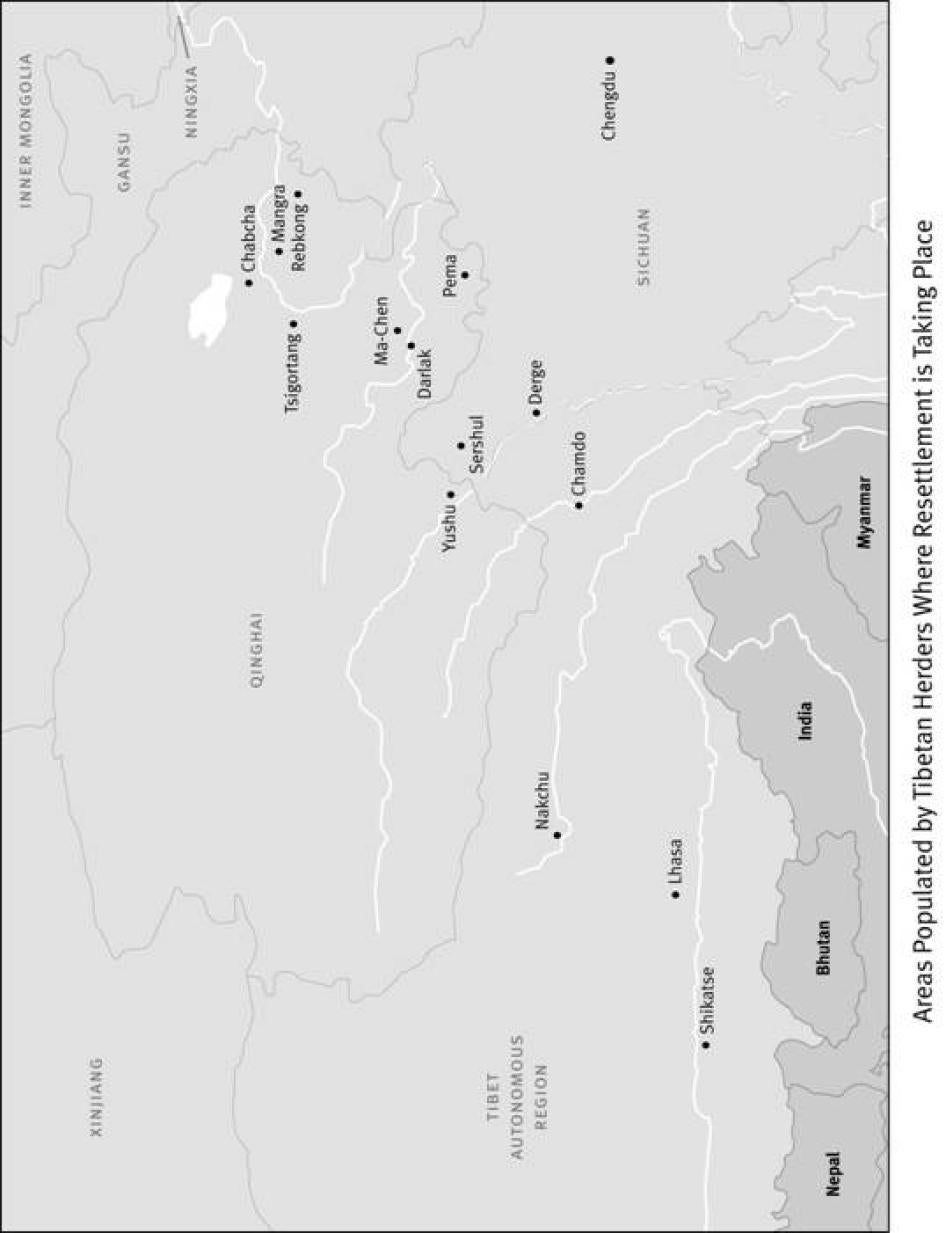
2007 John Emerson
Glossary
TACTibetan Autonomous County
TAPTibetan Autonomous Prefecture
TARTibetan Autonomous Region
A note on definitions and use of names
Tibetans often use the term Tibet to refer to a large Tibetan ethnic, linguistic, cultural, and historical area that includes what is now known as the Tibet Autonomous Region (TAR) and Tibetan areas in four neighboring provinces-Gansu, Qinghai, Sichuan, and Yunnan.It is these Tibetan areas outside the TAR-home to more than 50 percent of all ethnic Tibetans-that are primarily affected by the resettlement policies discussed in this report.
For Chinese authorities and most Chinese-speaking ethnicities in China, the term Tibet (Xizang) is reserved for the Tibet Autonomous Region. The Chinese government has designated the Tibetan-inhabited areas of Gansu, Qinghai, Sichuan, and Yunnan as Tibetan autonomous prefectures (TAP) or Tibetan autonomous counties (TAC). All of these Tibetan-inhabited areas more or less cover the distinctive geographic area known as the Tibetan plateau, which in contemporary Chinese sources is referred to as the Qinghai-Tibetan plateau (Qingzang gaoyuan).
Geographical names of prefectures, counties, towns, and villages are given in this report in Tibetan, with the Chinese variant given in parentheses. A table of geographical names mentioned in this report is included as an appendix to this report.
A mu is a Chinese unit of land measurement equal to 0.16 acres, or 0.067 hectares.
A gyama is a Chinese unit of weight measurement equal to 0.5 kilograms or 1.1 pounds.
I. Summary
They are destroying our Tibetan [herder] communities by not letting us live in our area and thus wiping out our livelihood completely, making it difficult for us to survive in this world, as we have been [herders] for generations. The Chinese are not letting us carry on our occupation and forcing us to live in Chinese-built towns, which will leave us with no livestock and we won't be able to do any other work...
-F.R., Tibetan from Machen (Maqin), Qinghai province, November 2004[1]
At meetings in the "People's Hall" in the county town the officials always tell that people have a right to land, but they must obey government orders and respect the law, and not to do so is no different from separatism and destroying national unity, so no one dares to oppose [governmental policy] directly.
-D.P., Tibetan from Pasho county, TAR, July 2006[2]
Since 200o the Chinese government has been implementing resettlement, land confiscation, and fencing policies in pastoral areas inhabited primarily by Tibetans, drastically curtailing their livelihood. The policies have been especially radical since 2003 in Golok (Guoluo) and Yushu prefectures of Qinghai province, but have also been implemented in Gansu, Sichuan, and Yunnan provinces and the Tibetan Autonomous Region (TAR). Many Tibetan herders have been required to slaughter most of their livestock and move into newly built housing colonies in or near towns, abandoning their traditional way of life.
These requirements are part of a broader policy drive associated with the "Western Development" campaign.[3] Since this campaign got underway in 1999 many Tibetan agricultural communities have had their land confiscated, with minimal compensation, or have been evicted to make way for mining, infrastructure projects, or urban development.
The Chinese government gives several explanations for its actions, principally invoking concerns for environmental protection but also citing the objectives of "bringing development" and "civilizing" the areas and the people. Resettled herders and dispossessed farmers are encouraged to take up more "modern" livelihoods and integrate with the new economy. Chinese officials and development experts also take the view that these policies will make it much easier for the formerly herding populations to get access to social and medical services. The policy coincides with an economic theory that is favored in Chinese government circles, according to which development is best stimulated by creating conditions which will lead to members of the rural labor force moving to towns or cities, where they will supposedly become workers and consumers in a new, expanding urban economy.
Chinese authorities also explain their actions as a necessary response to environmental crises on the plateau and in other parts of the country, and refer to those resettled as shengtai yimin, or "ecological migrants." In 2005 Du Ping, director of the Western Development Office under the State Council, China's cabinet, stated that 700,000 people in western China had been resettled since 2000 because it is "the most effective way to restore land to a healthy state."[4] Du went on to stress that "relocations are voluntary [and] carried out in a way that fully respects public opinion and minority cultures."
That China is facing multiple environmental crises is not in dispute, nor is the reality that poverty remains significantly higher in the western part of the country. But the causes of those crises and the validity of official measures supposed to address them certainly are. And the commitment to environmental protection must be questioned, given the government's enthusiasm for infrastructure development projects, such as mining, in the very same areas. Even assuming the government has had valid environmental or other reasons for relocating Tibetan populations in certain circumstances, moreover, the relocations often have not been carried out transparently, with the advance consultation and post-relocation compensation required under both domestic and international law.
Interviews conducted by Human Rights Watch suggest that for the affected populations current government policies often result in greater impoverishment, and-for those forced to resettle-dislocation and marginalization in the new communities they are supposed to call home. At a minimum, what is happening to these Tibetan communities is a further example of China's economic development drive taking place with scant regard for the interests of individuals and communities, including the rights of the affected individuals.
Indeed, some Chinese studies obtained by Human Rights Watch acknowledge that the interests of herders have often been harmed through the loss of their original land rights:[5]
Before resettlement started, the herders had enjoyed their land rights under the responsibility system for about 30 years. But after the prohibition of [herding] and restoration of ecology [policies], there was absolutely no way for them to enjoy these benefits.[6]
A number of similar studies also criticize the general lack of legality surrounding resettlement of herders, noting that the transfer of land rights often "is not explicit."[7] In particular, they observe that resettlement policies have been marked by "insufficient legal involvement,"[8] "a lack of legal knowledge from all the parties,"[9] and that "government departments have an insufficient knowledge of the law."[10]
Some studies also suggest that the policies may contribute to unrest in the region a study in 2006 by Chinese scholars Li Jiacaidan and Yang Hude concluded that, "If we cannot find an effective method for solving these problems, then the disputes over grassland brought by the worsening of the environment may redouble, and could severely influence the social and political stability of Qinghai and even of the entire Northwest regions."[11]
It is also conceivable that ethno-political motives are at work: that these policies are in part designed to further an integrationist agenda aimed at weakening Tibetan cultural distinctiveness and further extending Chinese control over Tibetan lives. Some observers believe that the resettlements signal an aggressive new turn of policy in Tibetan areas. Tibet remains a source of anxiety for the Chinese government, which is eager to suppress any impulses toward independence or true autonomy, and to ensure its hold on a key strategic region. Similar resettlement projects carried out in the 1990s in Inner Mongolia and Xinjiang have more often than not resulted in considerable impoverishment, and China's attempts to refashion cultural identity, most notably in Xinjiang, have ultimately been attempts to defuse ethno-nationalism.[12]
The range of Chinese policies addressed in this report includes the overt compulsory resettlement of herders. Chinese authorities have decided that it would be better for Tibetan herders to enter the urban economy as, for example, shopkeepers, drivers, or construction workers. The authorities claim to have granted the herders housing opportunities and interim cash or food handouts. Other policies entail compulsory livestock herd reduction or compulsory change of farmland use. In some cases, these negatively impact the viability of herders' and farmers' making a living where they reside, so that they are effectively forced to relocate in order to seek alternative livelihoods. People are being resettled in uniform, shoddily built new towns and villages. Deprived of their conventional livelihood, the affected populations are unable to participate in urban, commercial economies, and are thus facing bleak futures.
According to official media reports, since the launch in 2003 of what are termed the "ecological migration policies," the government in the Three Rivers Area of Qinghai has resettled 28,000 people and constructed 14 "migrant urban districts" to carry out the policy of "concentrated settlements" (jizhong anzhi).[13] In late 2004 the government announced that it planned to move 43,600 people out of the same area, to turn its central zone into a "no-man's land" (wurenqu).[14] Other data about the affected population numbers are scarce, but overall in the areas discussed in this report, the number of Tibetans who have been resettled or who have had to relocate likely runs to many tens of thousands.
Tibetans have suffered and continue to suffer civil, cultural, economic, and political repression and discrimination under the rule of the People's Republic of China. Land confiscation and resettlement therefore occur under the implicit threat of force derived from earlier decades when repression was explicit. In addition, there is effectively no legal recourse available to those affected.[15] Although China's 1982 constitution in principle guarantees minorities' rights, including to cultural preservation, and outlaws discrimination, in reality these protections are not accessible and have little bearing on Tibetans' everyday lives. In the international language of human rights, the practices described in this report are a classic violation of indigenous peoples' rights to land use and livelihood.[16]
Methodology
Human Rights Watch gathered testimony outside China from about 150 Tibetans who had recently left the areas directly affected by the issues covered in this report. The interviews were conducted between July 2004 and December 2006. The information has been supplemented by academic research, media reports, and government documents and official statements. Except where stated, information from interviews has been used only where it could be corroborated by other interviews or secondary sources. To protect their identities, each interviewee's name has been replaced with indicative initials (which are not the interviewee's actual initials), and the location where they were interviewed has been withheld, although wherever possible the interviewee's place of origin is indicated.
In researching this report, Human Rights Watch also had access to a number of Chinese academic studies which support our conclusions. As expressly noted at relevant points in the text below, these studies confirm and verify the existence of widespread problems in the design and implementation of resettlement policies in Qinghai's Tibetan areas, including the incidence of ethnic unrest.
Because China does not allow independent, impartial organizations to freely conduct research or monitor human rights concerns inside the country, obtaining and verifying credible information can be difficult. Human Rights Watch believes that the abuses documented here are indicative of larger problems in the areas covered by this report.
II. Key Recommendations
To the government of the People's Republic of China (PRC)
- Impose a moratorium on all resettlements until a review mechanism can be established. That mechanism should entail independent experts assessing policies that require or produce displacement and resettlement of Tibetan herders and other rural populations in Tibetan areas, the confiscation of their property, or imposed slaughter of their livestock. This review should also evaluate the compliance under Chinese, such as the new Property Rights Law 2007, and international law with the rights of Tibetan herders.
- In instances in which consultation and compensation have not been adequate, undertake steps including offering the opportunity to return, to be resettled in an area nearby or like the one from which people were moved, and/or provide additional appropriate compensation as dictated by Chinese law.
- Where those affected by resettlement are unable to provide for themselves, take all appropriate measures to ensure that adequate alternatives are available, including the ability to return to a herding livelihood.
- To comply with the recommendations of the United Nations Committee on Economic, Social, and Cultural Rights and other human rights treaty obligations, review the Property Rights Law 2007 to ensure it provides the greatest possible security of tenure to occupiers of houses and land.
- Uphold the rights to freedom of expression, assembly, and association.Recognize the rights of herders to speak out publicly on resettlement, legal regulations, and other issues of concern.
To international donors
- Ensure that funds lent for development projects in the areas described in this report are not resulting in forced resettlement.
- Urge the Chinese government to conduct resettlements in accordance with laws regarding consultation and compensation and international standards of transparency and accountability.
To the United Nations
- The U.N. Special Rapporteurs on Adequate Housing and on Human Rights and the Fundamental Freedoms of Indigenous People should write to the Chinese government raising concerns about forced resettlement and the treatment of Tibetans, and should request an invitation to conduct a mission to Tibetan areas.
- The Human Rights Council and the United Nations Committee on Economic, Social and Cultural Rights should raise questions about China's policy of forced resettlement.
To Chinese and international infrastructure companies investing in Tibetan areas
- Before entering into any partnerships or contractual dealings with the national or local governments of China, demand assurances that the land for projects was acquired in a manner consistent with human rights obligations, and that former residents were adequately notified and compensated for their loss of land, property, and income.
- Adopt explicit policies in support of human rights and establish procedures to ensure that the financing of projects, or participation in projects, does not contribute to, or result in, human rights abuses. At a minimum, implement a policy to conduct a "human rights impact assessment" in coordination with local civil society groups.
Detailed recommendations are presented in Chapter VIII, below.
III. Background
Human Rights in Tibet
Tibetans have suffered and continue to suffer repression and discrimination under PRC rule. Their rights to freedom of religion, association, speech, and assembly have been systematically violated, and those who challenge Chinese authority-particularly by expressing their loyalty to the Dalai Lama, who has lived in exile since 1959 and whom most Tibetans are believed to regard as their spiritual and political leader-are subject to detention, torture in custody, and other arbitrary abuses.Security agencies are quick to treat even minor expressions of discontent as a disguised form of nationalist or separatist sentiment.[17]
Despite guarantees enshrined in China's constitution and its law on nationality autonomy, which mandate protections for ethnic minorities, Tibetans' basic freedoms are chronically violated.The media is almost wholly state-controlled, and there is no freedom of association.[18] Tibetan civil servants are forbidden to practice their religion, and powerful political institutions, such as the Communist Party's Lhasa Committee, are dominated by Han Chinese.[19]In addition, institutional limitations imposed on the Tibetan language, religious practices, and other traditions, coupled with an influx of Han Chinese-the country's dominant ethnic group-into Tibetan areas, particularly towns and along main roads, have created concerns amongst Tibetans that their separate identity and distinct culture may become insignificant or even vanish. Indeed, the government candidly admits its ambition to refashion the culture of ethnic minorities so as to further the assimilation of the regions they inhabit with the rest of China and defuse a perceived risk to China's national integrity.
In a landmark article published in January 2007 in the theoretical journal of the Communist Party, Li Dezhu-head of the government's Ethnic Affairs Commission-called for renewed efforts toward the "cultural construction of a colorful and unique ethnic culture," so as to protect China's "cultural security" (wenhua anquan) and border stability. The article signals an important ideological shift from the traditional state discourse that emphasized the "preservation" of minority cultures. Instead, it clearly states the government ambition to refashion the cultures of ethnic minorities as part of an "advanced socialist culture" to strengthen "state interests":
Most of China's ethnic minorities inhabit border areas, and border areas have always been sensitive areas where different cultural and ethno-national ideologies blended and collided, and are the forefront of the infiltration of foreign culture. Western enemy forces are using economic globalization to step up cultural infiltration, and attempt to "westernize" and "divide" our ethnic areas. This constitutes a threat to China's cultural security and border stability. Therefore we must vigorously carry forward the fine traditional culture of ethnic minorities and effectively resist the infiltration of Western, negative and decadent cultures. It is an increasingly urgent and important task to consolidate and expand the advanced socialist culture to protect cultural security and state interests.[20]
Much of what has been written by environmentalists and anthropologists[21] on the Tibetan and other ethnic minority herders in the present-day PRC emphasizes the perceptual schism between official and non-official thinking regarding the proper role of subsistence herders. From the official point of view, subsistence herders are seen as destitutes, and any step that gives them better access to the cash economy, road network, or urban housing is an improvement. For example, a recent media account described a local official in charge of a Chinese effort to start a meat-packing industry in Tibet, who stated that traditional herding practices have "contained the economic development in [the] region [and] will have to be changed."[22] This view conflicts with those of some international scholars who have argued that Tibetan herders are efficient custodians of the high plateau grasslands and the most able managers of its fragile ecology.
China has consistently claimed that its policies in Tibetan areas and toward Tibetans are a function of the historical effort to "liberate" them from a theocratic feudal system, and to develop and modernize their economy and customs.
Nationwide Land and Eviction Problems
Land disputes across China have skyrocketed over the past decade as a consequence of economic development. Forced evictions are increasingly a systematic problem across the country, for example in peri-urban areas to accommodate growth, and in rural areas for infrastructure development and construction. In Beijing populations of whole neighborhoods have been forced to relocate out of the capital as their homes are demolished to make way for new Olympic sites. According to official Chinese government reports, many of the 74,000 protests nationwide in 2004 were sparked by forced evictions.
These problems are particularly acute for rural Tibetans, given their relatively minimal access to the Chinese justice system, and their general dependence on land and undeveloped areas for their livelihood. It is telling that several older interviewees for this report recalled a historical precedent for mass rural resettlement by referencing Mao's 1958 collectivization campaign in Qinghai.
Communities Described in this Report
All the people interviewed for this report were Tibetans from the Tibetan autonomous prefectures and counties of Gansu, Qinghai, and Sichuan provinces, and from the TAR.
An estimated 2.25 million Tibetan herders[23] live with their herds in the northern and eastern regions of the plateau. They have a unique way of life, adapted to a harsh and challenging environment and reflected in their language, beliefs, and attitudes. They are traditionally more affluent and independent than the herders and farmers of the valleys, and have prospered more conspicuously through the partial reassertion of their way of life following Deng Xiaoping's economic reforms of the 1980s, which promoted the establishment of a market, rather than a command, economy throughout the PRC. They have tended to resist attempts to commercialize production, however, especially the farming of animals principally for meat rather than dairy produce. Such activities go against not only their religious beliefs[24] but also the well documented subsistence practice of maximizing herd size as an insurance against natural calamities, such as the devastating blizzards of 1997-98, which wiped out livestock in large numbers.[25]
Policies Affecting Tibetan Herders
The resettlements being reported from Tibetan areas of Gansu, Qinghai, and Sichuan provinces and the TAR are to some extent connected to policies associated with the "Western Development" campaign, a national project designed to close the economic and infrastructure gap between the impoverished western interior and the rapidly-developing east coast. By the end of 2004 these policies had been applied to at least 7 million hectares of land throughout the western part of the country.[26]Also at work are policies designed to preserve and promote economic advances locally and in China's east.
A half century of policies undermining Tibetan herders' livelihoods
Over the past 50 years several key policies have affected the Tibetan herders' ability to maintain their livelihood. From 1957 to 1979 collective farming and herding practices imposed by the central government, rather than traditional methods of pasture management, led to famine, greatly degraded grasslands, and therefore put pressure on herders' ability to sustain their herds.[27] Under the "household responsibility system"-a key element of Deng's early 1980s economic reforms, in which families were allowed to sell surplus produce and goods in open markets-Tibetan herders were granted custody, though not ownership, of state farmland or pasture.
The 1985 Grasslands Law was adopted for the purposes of "improving the protection, management and development of grasslands and ensuring their rational use; protecting and improving the ecological environment; modernizing animal husbandry; enhancing the prosperity of the local economies of the nationality autonomous areas; and meeting the needs of socialist construction and the people's life."[28] In effect, the law sought to concentrate and integrate pastoral production, to enable it to move from subsistence toward commodification. In the 1980s Chinese ecologists and policy makers became concerned about the degradation of grasslands in the Inner Mongolian Autonomous Region, which also has a significant population of grassland herders. They attributed this degradation to overstocking by the herders, a view that has not been endorsed by all foreign scholars,[29] and introduced policies requiring each household to fence off areas of pastureland. These were not seen by all scholars as effective.[30] Subsequently, additional policies were introduced that set a quota for the number of animals that could be held by each herder, and compulsory livestock slaughter was brought in to meet these quotas. Compulsory resettlement of pastoral communities in Inner Mongolia was introduced in the 1990s.[31]
In the 1990s these policies were gradually introduced in Tibetan areas as well. For Tibetan herders, fencing the grassland into individualized plots represented a further constraint on herders' right to livelihood and to key minority rights. The new policies were accompanied by shifts in the language used in state documents that articulated grassland policy. These increasingly referred to the benefits of fencing off pastureland, of "scientific" breeding, of the development of meat production for the market, and of sedentarization of mobile populations. Yet the underlying rationale remained, as per the 1985 Grasslands Law, to fix herd numbers on designated pasture land. Grassland fencing in particular has proved deeply unpopular, and led to an upsurge of local territorial conflicts over grazing rights, including major conflicts that have led to fatalities.[32]
Recent policies with declared environmental and "scientific" objectives
Two policies put in place since 1999 are particularly relevant to understanding the current abuses. Both policies appear to have been designed for ecological purposes, but are reported to have been implemented in ways that are opaque and generally lack due process and compensation in Tibetan pastoral areas. The best known and most widely implemented was called "convert farmland to forest" (tuigeng huanlin).[33] It envisaged tree planting on marginal farmland to reduce the threat of soil erosion, but in Tibetan areas it has been used to justify arbitrary land confiscation, requiring farmers both to provide labor and other inputs for tree planting, and to seek alternative livelihood.The second policy, known as "revert pasture to grassland" (tuimu huancao), was aimed at reversing degradation in pastoral regions by imposing total, temporary, or seasonal bans on grazing.[34] The largest area selected for a total ban was the Three Rivers Area (Sanjiangyuan) in Qinghai's Golok (Guolou) and Yushu prefectures.The ban led to compulsory resettlement and herd slaughter in Golok beginning in 2003. In other Tibetan pastoral areas of Qinghai, Sichuan, Gansu, and the TAR, less drastic measures such as reduction of herd numbers and state confiscation of pasture have been implemented in the same period.
The explicitly environmental turn in central government policy started with the forestry ban in the Yangtse catchment region following the 1998 floods in China,[35] the first tacit official acknowledgement that deforestation in eastern Tibet since the 1960s had significantly increased the vulnerability of downstream regions to serious summer flooding.
In the local context, the policies present resettlement and livestock limitation as a necessary response to an environmental crisis of pasture degradation and overgrazing. Official policy has in essence blamed this crisis on the "backward" and "unscientific" behavior of Tibetan herders-language similar to that used to justify the "liberation" and "emancipation" of Tibetans in the 1950s. In the Communist Party's terminology, the term "scientific" carries strong political undertones. An article on the economy of Qinghai Tibetan areas explains, "The concept of scientific development is distilled from the practical experience of China's reform and opening building by the party's central authorities."[36] The practical implication of this concept is that whoever opposes the policies of the party is "unscientific."
"The education level of herders in our province is relatively low, they cannot scientifically cultivate land and raise livestock. They don't know how to use fertilizer and chemicals, even less how to scientifically develop their household economy," writes a typical study from the National Statistics Bureau.[37]
The most recent piece of relevant legislation, the revised 2003 Grassland Law, explicitly provides for the government's right to radically limit herds and resettle people.[38] In addition, it criminalizes any use of grasslands deemed to be "illegal," a vague designation likely to discourage any violations.[39]The constraints these policies impose, and the specificity of the people they affect, make it difficult for them not to be seen as opposed to herders and their way of life in general and opposed to Tibetans or Mongolians or other non-ethnic Chinese herding peoples in particular. Interviews conducted by Human Rights Watch show that policies to divide and fence pastureland, to cut the size of herds, and to relocate herders to new housing have been intensified in these areas in recent years. This was reportedly presented in the name of "modernizing" the herders in order to "solve the difficulties of Tibetans."[40]
Water management is central to the policies designed to preserve and promote economic advances locally and in China's east.The dual objectives are flood control and the maintenance of stable water levels for hydroelectric power generation. Interview with L.S., from Sanchu (Xiahe) county, Gannan prefecture of Gansu province told Human Rights Watch, "They said that if the Tibetan plateau is converted into forest it would decrease the risk of flooding in cities in China."[41] F.H., from Pema (Banma) county, Golok (Guolou) prefecture in Qinghai echoed this: "The [officials] said resettlement is to promote harmony between humans and nature, the policy of protecting and improving the physical environment of Golok prefecture should be implemented and flooding downstream should be brought under control."[42]
Golok prefecture seems to have been targeted because it is at the source of the Machu (Yellow) river, protection of which has become a focus of national concern. F.R. described the reasons given for the so-called MaDriZaSum [Machu, Drichu, and Zachu] Rivers Source Protection Scheme, which had meant removal of herder families in Golok TAP (see also below):
The water flow of the [Yellow] river to the Lungyang hydroelectric station's dam reservoir in the upper Machu area has decreased a lot.Not only that, the water level of the Yellow river of Tibet is decreasing day by day and for the past few years the wet areas of the Yellow river source area in Mato county in Golok TAP have decreased
The strength of the river source is depleted; the water flow in between Kyareng lake and Ngoreng lake has stopped six times and the water flow in some other streams has also been dry for the past half year.Because of low flow of water in these rivers, many hydroelectric stations built by the Chinese government in Kham and Amdo region [most of Qinghai province and the western part of Sichuan province] cannot produce energy.[43]
F.R., from Qinghai, told Human Rights Watch that the Tibetan herders feel that they are being forced to resettle without reason, without due regard to their rights and in violation of them, in order to suit policy goals of the PRC administration.
That policy was announced in August or September 2003 from the provincial government to Golok prefecture and then down to the counties and then down to the township level. Then the township leaders came to the pastoral areas to make the announcement. They said that the relocation of the [Tibetan herders] from the grasslands was in order to stop the erosion of the source area of the Machu [Yellow river], and to protect the environment, and wasn't this of benefit to the local [Tibetan herders] themselves? They said that they were protecting and monitoring the environment of the upper Machu in Qinghai, and they said the main thing is that the hydroelectric stations powered by the Machu can no longer produce electricity, which is causing hardship to the Chinese people who are the consumers, and so we the Tibetan [herders] have to leave our land.[44]
Even in areas where the environmental arguments for relocation are compelling, the Chinese government is still required to respect herders' rights in determining, formulating and implementing solutions to environmental problems. Compounding alleged environmental crises with human rights abuses only worsens already fragile ecological and political situations in Tibetan areas of China.
IV. International Standards
At issue in this report is the failure to take into account and respect the basic rights of Tibetan's effected by the PRC's relocation policies and the absence in practice of due process to protect those rights when relocation decisions affecting their rights are made. Such due process includes transparency, consultation in advance of planned relocations, and the right to challenge proposed relocations before an independent arbiter. When relocations do go ahead, those affected are also entitled to adequate compensation, and the conditions in the new location must be no worse than those enjoyed prior to the relocation, including culturally adequate and with access to essential services and economic opportunities.[45]
China ratified the International Covenant on Economic, Social and Cultural Rights (ICESCR) in 2001. Article 1 of the treaty prohibits depriving people of their own means of subsistence and Article 11 provides that everyone has a right to "an adequate standard of living for himself and his family, including adequate housing, and to the continuous improvement of living conditions." Article 2 prohibits all forms of discrimination based on several grounds including national or social origin, property, or other status. The ICESCR also spells out states' obligations to protect people's livelihood, including the right to work and an adequate standard of living. The overarching obligation in the Treaty to "progressive realization" of rights means that as governments acquire the resources necessary to improve rights, they are obliged to do so. At a minimum, states must refrain from policies which have a regressive impact on individuals and communities capacity to realize and exercise basic economic and social rights.
In ratifying the ICESCR China voluntarily accepted specific obligations with respect to how it develops and implements policies that will have an impact on the enjoyment of the rights protected by the treaty. One of those obligations is that any resettlement project must include a genuine opportunity for those affected to participate in that decision, and an effective means of challenging the relocation decision. Where a resettlement project takes place against the wishes of the affected population and without consultation, adequate compensation, provision of appropriate alternative housing, or access to legal remedies, such a relocation amounts to a forced eviction and violates the ICESCR.
The United Nations Committee on Economic, Social and Cultural Rights, established to oversee compliance with the treaty, has on a number of occasions provided guidance to states party to the ICERSCR on the human rights issues and due process obligations which arise in relation to forced displacements: General Comment No. 4 and No. 7[46] and the matter has also been extensively addressed by the UN Special Rapporteur on Adequate Housing as a Component of the Right to an Adequate Standards of Living.[47] The Rapporteur has elaborated a set of human rights guidelines on development-based displacement.[48] The guidelines offer several prescriptions, which render more clear the obligations of States in respect of compliance with human rights standards when forcibly removing population due to large scale development projects. They reflect and detail the principles contained in General Comments Nos. 4 and 7 referred to above.Although not yet formally adopted by states, the guidelines recommended by the special rapporteur constitute an important framework for the protection of individuals and communities against human rights violations arising from forced evictions.Amongst other issues, the guidelines:
- Lay down stringent criteria under which displacement can occur in "exceptional circumstances", with "full justification" and procedural guarantees (para. 21);
- Enumerate detailed steps to be taken by States to protect human rights prior to, during, and after evictions (paras. 37-58);
- Call for comprehensive "eviction-impact assessments" to be carried out prior to displacement (paras. 32, 33);
- Call for provision of compensation, restitution and adequate rehabilitation consistent with human rights standards (paras. 42, 60-63);
- Establish a "right to resettle" consistent with the right to adequate housing for displaced communities living in adverse conditions (paras. 16, 52-56).[49]
A second set of international standards of relevance to Tibetans appear in the International Labour Organization's Convention 169 Concerning Indigenous and Tribal Peoples in Independent Countries (1989). China has not ratified this Convention, but it is still significant insofar as it establishes basic international guidelines.
The central aim of Convention 169 is to protect indigenous communities from discrimination, while preserving their right to maintain their distinct identity and their place and way of living. The Convention calls upon governments to take steps as necessary to identify the lands of indigenous peoples and to guarantee effective protection, and advocates that authorities establish processes to provide indigenous communities full participation in decisions regarding the use and ownership of land.
Under Convention 169, indigenous peoples can be relocated from the lands they occupy only when necessary and as an exceptional measure. Such a relocation must take place with "their free and informed consent" or, when their consent cannot be obtained, "only following appropriate procedures established by national laws and regulations, including public inquiries where appropriate, which provide the opportunity for effective representation of the peoples concerned." Those relocated are to receive full compensation for loss or injury. As soon as the grounds for the relocation cease, indigenous peoples are entitled to return to their traditional lands. When this is not possible, they are to be provided with "lands of quality and legal status at least equal to that of the lands previously occupied by them, suitable to provide for their present needs and future development," or compensation, as they choose.[50]
The UN Human Rights Council has recently adopted the Declaration on the Rights of Indigenous People.[51]China was one of the members of the council that voted for the declaration.[52] The Declaration provides that states are to provide effective mechanisms for prevention of, and redress for any action that has the effect of dispossessing indigenous peoples of their lands, territories, or resources; any form of forced population transfer that has the effect of violating or undermining any of their rights; and any form of forced assimilation or integration by other ways of life imposed on them by legislative, administrative, or other measures.[53] The Declaration also provides that indigenous peoples shall not be forcibly removed from their lands or territories. It states that no relocation shall take place without the free, prior, and informed consent of the indigenous peoples concerned, and only after agreement on just and fair compensation and, where possible, with the option of return.[54]
V.Experiences of Compulsory or Forced Resettlement
Land suitable for forest should be planted with trees and land suitable for grass should be planted with grass and the policy of giving up farming for forest and giving up animal husbandry for grass should be diligently continued and carried forward. The traditional livelihood of the [herders] should be exchanged for market economy and prosperity should be embraced.
-F.H., from Pema (Banma) county, Golok prefecture, describing Chinese policy in his home district, January 2006.[55]
Because there are no Chinese living in the remote pastoral areas of Tibet, many of our local people believe that the policy of putting Tibetan herders in the towns is in order to control those areas, and after the older generation passes away, we will gradually be assimilated into the towns...
-A.M., from Machen county, QinghaiProvince, September 2005[56]
On the basis of the policies described above, and in a variety of ways, tens of thousands of Tibetan herders have been required to give up their homes and traditional practices and to resettle, generally into urban or township settings where they struggle to establish themselves; in many cases the displacement and forced resettlement resulted in hardship and lower standards of living. Resettlement often entails the compulsory slaughter of livestock. Detailed below are the range of recent experiences with which Human Rights Watch is aware.
The accounts given to us by those forcibly resettled indicate some variation in the quality of the housing to which they were moved and the number of livestock they were forced to slaughter. But almost uniformly the interviewees recounted how the policies that led to their compulsory resettlement were implemented in a manner that gave them no effective opportunity to object, and little or no compensation (the issue of required consultation and compensation is discussed in more detail in Section VII).
Some of the affected people and communities have had to relocate more than once. E.A. told Human Rights Watch, "Our township is near the Tsa-nga hydropower station on the Yellow river, which was built by the government in 1988. Many villages had to migrate due to the damming of the river, and the Rabge Dewa [village community] was moved [near our township] at that time, and now they are being moved to another place called Tang Karma "[57] (Tang Karma is described in more detail below).One villager, N.M., said, "First they said that grass and willow trees were to be planted on the fields of our village to give protection against flooding. Then they said that [we have to move] to make the townships and county towns bigger..."[58]
Grassland Division, Compulsory Livestock Reduction, Bans on Herding
The most extreme accounts of resettlement of herder communities come from the high pastures of Golok (Guolou) prefecture in Qinghai province. In 2003 a total ban on grazing was imposed, and herders were required to sell off their herds and move into government-built housing, mainly in the county capitals or newly constructed townships. After leaving the area in 2004 and 2005, several of the interviewees for this report, independently of one another, provided similar accounts of resettlement or expropriation campaigns already under way in Machen (Maqin), Darlak (Dari), Chikdril (Jiuzhi), and Pema (Banma) counties of Golok prefecture.
Some Tibetan herders said that officials had told them their relocation was only a temporary measure to allow for rejuvenation of the pasture. F.R. reported to Human Rights Watch, "They said they will protect, prevent, guard, and manage the land and water by growing grasses and trees on the pasturelands for 10 years, after which they said they will let the herders return to their pasturelands and buy livestock to restart herder lives."[59]Yet there is no indication that such returns will eventuate.
Human Rights Watch's discussions with Tibetans also suggest that policies designed to sedentarize herding communities, reduce their herds and curtail their access to pastureland have also been implemented in other parts of Qinghai[60], Gansu[61], Sichuan[62], and Yunnan[63] provinces and the eastern prefectures of the TAR.[64]
Most of those herders to whom Human Rights Watch spoke reported that the new policies stipulate a limit of five livestock per household member and require the rest of the livestock to be slaughtered or allowed to die. This compares with a usual holding in the region of anything up to a hundred or more yaks, sheep, and goats per household member. Other interviewees noted that they were allowed to keep 30 percent of their herds.[65] One 29 year-old man, K.Y., explained,
The government sets a limit of cattle numbers per household member and if you exceed that limit, you have to kill off the extra.... [T]he village leader comes to check, and there is no way that you could hide from him...[66]
Some interviewees told Human Rights Watch that people are free to sell the animals for higher prices to private butchers, while others report that they must accept the fixed prices from government slaughterhouses (the issue of private slaughterhouses as an object of Tibetan opposition is discussed in Chapter VI). In principle, the proceeds from the sale of livestock are to be spent on investing in new urban livelihoods, such as shops or vehicles. According to H.D., from Tulan (Dulan) county, Tsonub (Haixi) prefecture, in Qinghai province,
It was said that from this year all the livestock of the Guri township herders would be destroyed, and they would be moved to that place and turned into town dwellers. The county and township governments announced many things about it, and the [Tibetan herders] are very worried [67]
Those households who have livestock were told they have to fence their pasture and can keep only 30 percent of their animals under a campaign launched in 2004, and that is causing much hardship. The rest of their animals must be sold to the slaughterhouse.[68]
Some interviewees mentioned that local officials warned people that if they tried to avoid selling off their animals by entrusting them to friends or relatives elsewhere, they would be fined and the animals confiscated, and several such cases have occurred. One man, F.H., told Human Rights Watch,[69]
Each person is allowed to keep only five or six cattle, but we keep more in secret... They say that cattle are overgrazing and damaging the environment, that the land belongs to the government, and that it is too much work for herders to keep big herds, but in our place more cattle means better livelihood, and no cattle means no livelihood. At the end of the year the township and village leaders come with a list to check the number of animals kept by each household, and they also list the household items and income. For one yak [over the limit] it's [a fine of] about 1,000 yuan [US$130].[70]
The principal effect of grassland division is to make pastoral life unviable and fraught with conflicts. Local officials are now collecting fines for livestock that stray beyond the fenced areas, and disputes amongst Tibetan herders are on the rise as grazing areas become increasingly scarce.
People of our area were saying that if the pasture were divided it would create discord between neighbors because animals would always stray out of their patch into someone else's. There were many disputes in Kham and Amdo after the pasture was divided, and so people were worried...[71]
In the past, if cattle from different villages grazed on each others' land no one said anything, but since they introduced a new regulation dividing land between villages, if your animals stray onto another village's land, there will be a dispute, and such things are happening now. With the grazing land divided up, the animals don't get enough to eat [72]
Compulsory Change of Land Use
According to people interviewed by Human Rights Watch, Tibetan agricultural communities in Qinghai, Sichuan, and Gansu started to be told in 2002 and 2003 that they were contributing to soil erosion and that planting grass, thorn bush, and willow trees on their land was the only way to prevent flooding downstream in the watershed. Consequently, land has been confiscated or its use compulsorily reassigned for planting, restricting land available for grazing or farming, and Tibetans have been forced to plant and tend the thorns and willows. One man in his early twenties told us,
The campaign of planting thornbush on farmland is being implemented in every village. Each village has to plant 100 mu. In most villages, thornbush was planted on good land....[73]
In some instances the reassignment of the land means overt compulsory removal orders to herders. For example, F.R., from Machen county, described how the Qinghai provincial government announced in August-September 2003 that the area was to be included in the so-called MaDriZaSum [Machu, Drichu, and Zachu] Rivers Source Protection Scheme, entailing the compulsory reassignment of pastureland. He claimed herders were required to sell all their livestock within a year and relocate to new government-built homes, with promises of material assistance and a monthly stipend-which appears not to have ever materialized-but also with the threat that livestock of any family refusing to migrate would be subject to confiscation.[74]
In other cases, herders and farmers are not ordered off their land or have not had livestock confiscated, but the compulsory change of use of some or all of their former pastureland or of fields formerly given over to crops makes it unsustainable for them to remain. Most of the interviewees who reported this experience to Human Rights Watch said that compulsory change of land use involved up to 50 percent of a household's fields. Villagers were initially compensated for the loss of grain-producing land, households being allocated some 50-100 kilograms of grain or flour annually for the first year or two,[75] or in some cases cash. But several complained that they received less than initially promised. F.R. from Machen county in Qinghai, for example, said "Households who lost the use of farmland were given 100 gyama as promised in the first year, but the next year they got nothing, and it seems like there is no place to complain."[76]
In some cases areas of formerly common land were fenced and planted, depriving villagers of grazing for their sheep and goats.
The grass seed or willow saplings were usually provided free, at least initially, and it was up to the farmers to plant them and ensure that they grew well. "You have to fence your land with the barbed wire and plant grass, a kind called mosotse. If it does not grow, you have to plant it again every year and look after it, otherwise you do not get any aid from the government," F.S., from Chentsa (Jianza) county, Malho TAP (Huangnan prefecture) in Qinghai told Human Rights Watch, adding, "It is village duty, there is no wage, every person in the village between 18 and 50 has to go do that for 10-15 days every year in spring."[77]Others told of having to appoint and pay a few of their own people to watch the saplings and thorns in order to ensure that the deliveries of grain in compensation, dependent on successful growth, were forthcoming.[78] Some villages failed, "Not a single tree planted on the farmland has grown well because sheep and goats eat them and no one waters or takes care of them. So there are just weeds and no trees on the empty fields."
Villagers were expected to find alternative means of income, something that interviewees found to be a struggle. M.U., from TawuCounty, Kandze prefecture, told Human Rights Watch,
We are farmers, but since we were obliged to plant grass and trees on our land our [cultivatable] land has been reduced and people have become poor as a result. After that I did some goods trading but the local government collects many taxes on businesses and it is difficult to prosper. It is hard to make a living and I have two children who need to go to school.[79]
Z.R., from Rigmon township in Chabcha county, Qinghai, told Human Rights Watch about a village into which Tibetans had moved. Lasilwa, in Yulung, was also experiencing an influx of Han Chinese migrants, who worked primarily in mines and factories. In addition, they have built on the farmland of the village, leaving the villagers unable to farm and unable to secure jobs in the mines or factories.[80]
In the context of the compulsory removals associated with the MaDriZaSum Rivers Source Protection Scheme, some herders were moved to agricultural areas, which were useless to them. One person from Dulan county, Tso-nub (Haixi)prefecture, Qinghai, told Human Rights Watch that herder households in his area had been allocated farmland in a new settler colony near Guri township, but that "so far, this land has remained unplanted because the [herders] do not know how to farm "[81]
E.A., from Chabcha county, described a project to develop what appears to be a new mixed farming settlement on the site of a disused prison at Tang Karma, Qinghai province, using forced resettlement-including of former herders-to what are currently very unwelcoming conditions:
They say there is a plan to move 2,000 households there, and 500 have already been moved from various counties in Qinghai . Those households with livestock do not like it because there is no pasture there, and they have not moved yet . Sometimes officials come and tell them to sell their animals and move out, but they don't use force. In the end they will definitely have to go. There are a couple thousand mu of farmland at Tang Karma and there are plans to convert more grassland into farmland. Over 600 households, Chinese, Tibetan and Hui have already moved. Each household is given two or three rooms that used to be prison cells. They say in future each household will be given land to build on.[82]
The Tang Karma project illustrates another aspect of relocation-the Chinese government's policy of "support" to the rural poor by selective resettlement of the poorest members of some Tibetan herders communities. E.A. said that relocatees to Tang Karma were so far mainly those without livestock who would "move anywhere if there is farmland."[83] Z.R. told Human Rights Watch how around 30 poor households from his herding village in Rigmon township of Chabcha country, Qinghai, had been required to give up the former livelihood as herders to move to Tang Karma:
According to the Chinese government, they talk about the need to cultivate farmland there. But Tang Karma is a desert where there is no electricity and drinking water, so it is hard to grow grain well. Not only that, those herders also don't have any experience of cultivating fields and growing crops, so for sure they will have a difficult life.[84]
Z.R. also commented of Tang Karma,
No new houses have been built, they have just put new doors and windows in the old prison buildings. The government made a lot of publicity about bringing electric and water facilities, but those who moved there say there is no such facility. The government talks about providing food subsidy eventually, but so far they got nothing...[85]
Similar relocations to other former government facilities were reported by T.L. and S.Z. in Shasang Tang in Chentsa county[86] (see text box, below), also by H.C.in Batsang Tang in Mangra (Guinan) county,[87] and in Qinghai by C.P. in Tang Karnak in Derong County, Kandze (Ganzi) prefecture, in Sichuan.[88] Relocations to other similar facilities have also taken place at Kartse Tang in Triga (Guide) county, Hainan prefecture, in Qinghai province.[89]
In some instances, people from farming villages have had to move altogether into new urban accommodation and find alternative livelihood, just like some of the herders. Officials cited environmental justifications, but also the sheer imperative to enlarge the towns to speed up development. N.M., a villager from Nangchen county, Yushu prefecture in Qinghai, told us,
In 2002 officials came and held a meeting where they announced that we have to move out. They were leaders from the county government and Nyakla township government. Then the leader of our Nyagon village announced that we have to move from our place to near the county town, saying that this is a direct order from central government and not something made up [at lower levels]. Not a single household can stay behind. We should listen to the decision of the county government carefully, and it will benefit us. All villages in Nyakla township have to move to the town, to make the town bigger, and that we will not face any problem. Each household would be given a new house and 11,000 yuan (US$1,423) according to the number of household members, and the move has to be completed by 2004 . [T]hey said that they have to make the villages, townships, and county towns bigger [to promote development] . I did not move to the county town, but I watched my neighbors moving. They just loaded their household possessions onto horses or carried them on their back. There was no help from the government, they did it by themselves.[90]
Urbanization is central to current development strategies in the Tibetan areas. The TAR government announced in 1996 that the number of towns in the region would increase from 31 to 105 by the year 2010.[91]
Evictions for Public Works Schemes
Relocations are also taking place as a result of public works schemes, typically large-scale infrastructure projects such as roads and dams. The Chinese government insists that these large-scale infrastructure projects benefit the local population. The White Paper on Regional Autonomy for Ethnic Minorities in China, for instance, states, "Since 1999, the Chinese government has launched large-scale transport infrastructure construction programs that were intended to benefit all ethnic autonomous regions."[92] Another White Paper, on Regional Ethnic Autonomy in Tibet, makes a similar point:
With the leapfrogging of stages of development as the target of economic and social development and the improvement of the infrastructure and the people's living standard as the key, it has independently arranged its economic and social development projects, and has thus guaranteed the rapid and healthy progress of Tibet's modernization drive and the development of Tibet's society and economy in line with the basic interests of the Tibetan people.[93]
But a Chinese academic study obtained by Human Rights Watch contradicts these claims, at least in the case of Qinghai and Inner Mongolia:
Some of the ethnic minorities displaced because of infrastructure projects have not benefited at all from the opportunities for development coming from the exploitation of natural resources. It is in fact the opposite, after having been displaced their life environment worsened, and therefore there have been very big problems in raising their living standards and bettering their quality of life. This led some to protest under the slogan: "Give me back my land."[94]
The study also points out that Tibetans are seldom employed in these infrastructure projects:
These infrastructure projects themselves are fairly advanced technologically, and there is no choice but to employ people coming from the relatively developed areas of China.[95]
The Shawo (Shao) Dam Power Station on the Machu (Yellow) river in Qinghai province is one of the "Western Development" mega-projects. The project reached completion with the damming of the river in 2004 and the flooding of prime agricultural land. One of those affected in Chentsa county, Malho TAP in Qinghai, S.G., told Human Rights Watch how more than 300 households in Nangra township, and around 200 others from other parts of Chentsa county, lost their homes and lands without prior notification that the land was to be flooded, and were rendered homeless.[96] Some found shelter with family and friends, but for over 100 homeless families it took a complaint to the provincial government to secure them temporary accommodation in tents:
Those families have many members and they face difficulties such as insufficient space as they live together in one tent. Not just that, this winter they are facing lots of difficulties due to cold . The Qinghai provincial government has given them3,000 yuan [for the winter] . It is pitiful to see the hardship of the winter cold and wind faced by those living in tents. [97]
Unlike many other resettlements, the people displaced by the flooding of Nangra township were not ordered into urban areas, but were given an area of previously unused dry pasture 20 kilometers away at a former prison camp called Shasang Tang. It had not been made ready for them in any way: aside from the lack of housing, the land was unready to be farmed, and work began on giving it a water supply and a road only after the displaced from Nangra were supposed to have taken up residence there; at the time we interviewed S.G., he said no one had moved there. The displaced were given financial compensation for their submerged houses and orchards, but the only compensation for lost farmland was the greatly inferior land at Shasang Tang.[98]
Consequences for Livelihood, and Common Concerns for the Future
Policies adopted in an effort to protect the environment and modernize the region, have in reality increased the difficulties many Tibetans face in sustaining their livelihood. In situations where relocation to urban areas was not overtly forced on them, herders from several areas whom we interviewed said that fencing and herd restrictions are in effect forcing them to seek alternative income.[99] Compulsory change of land use in agricultural areas produces the same result as fencing and resettlement in pastoral areas, but it affects a larger and less remote population. As one interviewee commented, "In the past there were very few, but nowadays the number of people going for wage labor is increasing because the difficulty of earning a living is getting worse, and there are strong indications that the living standards of Tibetans are poor." The most common experience appears to be relocation (seasonal or permanent) to seek casual employment in urban areas or on construction sites.
The Chinese authorities portray this kind of relocation as positive, with one government-run newspaper concluding,
Following implementation, the numbers of those going outside their native places for work steadily increased The implementation of "give up farmland for forest" was a powerful factor encouraging the growth of engagement in formal employment and of rural industries, providing a source of continual and stable income for farmers and herders.[100]
But in stark contrast with glowing accounts in the official media, a number of academic studies of the ecological migration policies in Qinghai obtained by Human Rights Watch confirm the reality of the livelihood difficulties recounted by resettled herders. Employment opportunities are often lacking. "Because they are not skilled enough upon resettlement, ethnic minority laborers don't find job easily," acknowledges one study.[101] Interviewees told us that taking up business or other forms of income generation is impractical or even impossible without any background skills or experience, especially as the market for labor and commerce has become highly competitive in Tibetan areas in recent years. As one person explained,
My father says that... the government is destroying the wealth of the [herders] and eliminating their livelihood. Even if we become town dwellers and try to do business, we don't have the education or the experience to succeed. We don't even know how to live from farming. So in future we will face great difficulty.[102]
Another study blames the fact that "financial investments are insufficient," in particular funds for resettlements and for easing migrants into their new life.[103] Corroborating this, an interviewee from Chentsa county in Qinghai, F.S., described his experience of being forcibly relocated from a farming village to a makeshift town:
About 300 households from different villages in our township had to migrate to a place called Tsogenkhug. The township leaders came to the villages and announced how many had to leave, and then it was decided by lottery which households had to go. My household was given about 20,000 yuan (US$2,588) in compensation, calculated according to the size of the house and the quality of the timber. Tsogenkhug is about 30 kilometers away near the Yellow River. Each household was given one square room accommodation for the time being, and nowadays they are all building their own separate houses. No money is given for this apart from what they received in compensation. Each person regardless of age was allotted half a mu of farmland. The land was prepared by the government and they installed water pumps (for irrigation), but there is not much production because the land is so small. We have to pay 30 yuan a year for water and 0.4 yuan per unit of electricity, but they said farmland tax will not have to be paid for a few years. Conditions are poor because the land is so small and we have no livestock. People go for part-time work like roads and construction. My household has become poor compared to the past.[104]
F.R. told us how payments to help families make the transition to their new livelihood in the urban economy are similarly insufficient:
They didn't give food or money allowance. Relocated families complain that their life is hard because now they have to buy everything, even meat and dung fuel for the stove.[105]
Official statements on the resettlement policy claim that "ecological migrants" will benefit from the loss of their land in the long term, by making the transition to a new improved livelihood as shopkeepers or entrepreneurs in the urban economy. However few of those "migrants" themselves shared this optimism. M.U. was among the Tibetan herders who articulated their concerns about their inability to succeed in monetized, urban economies:
The township leaders encourage people to do business and change their way of life but many Chinese have come to Tawu county town [in Sichuan] and the township centers, have opened shops and restaurants, and are overseeing house and road construction. Tibetans cannot match them in competition because first they have more capital and second they have experience and know well how to deal with government leaders. Tibetans have to give in to the Chinese in their own land.[106]
Some of the households who resettled near our township centre have opened shops and restaurants, and since there are many people traveling through who buy goods and eat, they manage to earn a living, but in the future they will have problems, because so many Chinese migrants are settling in the county town and the townships also, and since they have far better skills, I think the Tibetans will lose out... The Chinese run restaurants, shops, bars, video game parlors, movie halls and so on, and they probably have good business because most of the young Tibetan school graduates are unemployed and go to such places to pass their time.[107]
One young man, P.T., made it clear that the "happy life" promised by local authorities remained elusive:
The government says that if we sell our animals and start businesses like shops and restaurants we would have a happy life and not have to work so hard. In our village at present, about 100 households still have cattle, and 100 have none left. Of those, about 50 opened shops and restaurants, but they don't know how to do good business or how to prepare food very well, so naturally they became poor. The other 50 have no shops, no restaurants, and no cattle.[108]
The concerns expressed by Tibetan interviewees are echoed by a comprehensive Chinese study of the results of ecological migration policies, stressing "unimaginable problems and difficulties" for herders resettled in urban areas:
In the present situation, the majority of migrants of ethnic areas do not migrate to big or medium cities, but are set into the surroundings of little towns. This of course is beneficial to the goal of urbanizing the ethnic population, but at the same time also causes a series of problems that deserve consideration. New migrants who have moved to the cities find the use of their mother tongue deeply challenged, and are confronted to profound changes in their environment and way of live, as well as to a radical change in the way social relations between people are conducted...The future that awaits them presents unimaginable problems and difficulties.[109]
B.U. told Human Rights Watch,
If all [the herder families] are obliged to move to the city, they are bound to become impoverished, as there is no income for them there at all. Because of this, there are very many among the herders who are anxious about the future.[110]
Numbers
Human Rights Watch is not able to determine the size of the Tibetan population affected by forced resettlement, but the numbers clearly run into the tens, if not hundreds, of thousands.
The most detailed official data comes from the Three Rivers Area of Qinghai, According to official media reports, since the launch in 2003 of what are termed the "ecological migration policies," the Three Rivers Area has resettled 28,000 people (6,156 households), and the government has constructed 14 "migrant urban districts" to carry out the policy of "concentrated settlements" (jizhong anzhi).[111] In late 2004 the government announced that it planned to move 43,600 people (7,921 households) out of the Three Rivers Area, to turn its central zone into a "no-man's land" (wurenqu).[112]
VI. Flaws in the Environmental Policy Arguments
This report does not question the fact that China is suffering multiple environmental crises. However, there are grounds for disputing both who is responsible for those crises and the consequent actions taken by the government in the name of protection in Tibetan areas. Tibetan herders had pursued their way of life for centuries without causing harm to the grassland; damage emerged only after the imposition of policies such as collectivization.[113] Forestry is still practiced, albeit generally under stricter control especially in the areas that feed the headwaters of the Yangtse and the Yellow rivers, though it has not been curtailed in the southeastern TAR, where the Brahmaputra, Mekong, and Salween rivers flow into south and southeast Asia rather than China.[114]
The wholesale deforestation, under state auspices, of the eastern Tibetan areas from the 1960s until at least 1998 was one of the great environmental tragedies of the last century, perhaps comparable to the deforestation of the Amazon, given the importance of the Tibetan plateau to the climate and hydrology of south, southeast, and east Asia.[115] For the state to blame the environmental problems in Tibetan areas on subsistence farmers and herders seems a tenuous argument.
The government's commitment to environmental protection in Tibet is also undermined by its willingness to promote the expansion of heavy industry in these areas; after all, the 1985 Grasslands Law also forbids that activity on grasslands. For example, mining activity has increased since the launch of the Western Development campaign. In Qinghai and Sichuan, private entrepreneurs built mines, which caused environmental havoc. In 2000 provincial authorities in both provinces banned this type of mining, and similar measures were adopted in the TAR in 2005.However, there is apparently no intention to limit organized, licensed mining by state corporations and private investors, including foreign mining companies. Encouraging investment is one of the main objectives of "Western Development," and preferential terms such as exemptions from taxes and fees are on offer.[116]Mining is one of the "five pillar industries" singled out as the main force for economic growth in the TAR.[117]
Although the Chinese government claims that "industrial projects are selected carefully, and pollution prevention and control are strengthened,"[118] the reality is sometimes markedly different. This account from Tsigortang county in Qinghai is typical of many collected by Human Rights Watch:
The place is called Serkhok and there are more than 20 [Tibetan herder] households there. The gold-mining is on the hill and the Chinese are living on the grassy plain... In 1997 houses and roads were built in preparation and from 1999 the actual mining started. It is said that the mining company came from mainland China. There are many people from places like Zhejiang and Shanghai. More than 10 households of our community had to move. Now the mining takes up all the best pasture in our Sertang community and the [herder] households that used to live there had as many as 100 Yak and 600 sheep each. It is said each household was paid 40-50,000 yuan (US$5,177-6,472) and allocated smaller pastures in our area Our local herders do not like mining in our area because we lost more than 10,000 mu of pasture and this mining site is a sacred hill and they are destroying it A road was built connecting the site with Chungon township 100 km away which has destroyed a lot of pasture land The Serchu river has become a place for the Chinese miners to dump waste and sewage and it is polluted Some cattle have died after eating waste on the plain near the mine. Because of the pollution the grass does not grow The pasture has been ruined by the digging of soil, the dumping of rock, and road construction.[119]
State mining companies rarely pay compensation to Tibetan herders, but private companies occasionally make ad hoc payments, usually to local officials, to dampen hostility to their operations. In at least one instance, Human Rights Watch was told that a mining company paid compensation to the local authorities, but none of that was passed on to Tibetan herders:
In 2003 [herders] tried to stop the Chinese by saying they would not allow mining, but county and township leaders came and told them they should allow mining because the grasslands belong to the nation. Nowadays the pasture of those households has been ruined. The mining trucks don't use just one road but drive everywhere, so the grass doesn't grow and the livestock have been reduced. The miners paid compensation to the county and prefecture governments but nothing was given to the [Tibetan herder] households . Last year many animals from the Kebo household on the edge of the mine died, and they wrote a petition to the mining company and the township government but they didn't receive any compensation. The miners told them, "We are paying thousands of yuan to the provincial and prefecture governments to mine here, so why should we pay you as well? If you want money, go ask those governments," and there was nothing they could do.[120]
Human Rights Watch was not able to document a single case in which Tibetan herders were able to obtain redress in such circumstances. M.S. questioned why only Tibetans were being blamed and asked to sacrifice for environmental protection:
Scarcity of rainfall and pollution is caused [not by us but] by the government. They are the ones who destroyed all the wildlife on the grasslands [in the past] and who are mining there now. Many Chinese and Muslims are allowed to settle there and build all kinds of houses [121]
Although the Chinese government strongly repudiates criticisms of its environmental record in Tibet,[122] a number of Chinese studies have questioned the validity of the rationale for ecological migration policies. A survey of studies on the subject by the Chinese government itself notes tersely that "the knowledge about ecological migrations is insufficient" and that the local authorities are often guilty of "blindness and impetuousness" in carrying out these policies:
At present, in all ethnic minority areas-and in particular in pasture areas that are subjected to ecological migration policies-scientific environmental guiding principles are lacking, and all related projects are marked by a degree of blindness and impetuousness [xiamuxing he jizaoxing].[123]
The main source of income for many of those who no longer herd has become not trade or business, but collecting and selling caterpillar fungus (cordyceps sinensis, known locally as yartsa ganbu, or bu), a medicinal root that is found on the Tibetan grasslands and that has a very high market value. This outcome undermines the stated policy objectives of environmental protection and pasture renewal in Tibetan areas. Judging from reports Human Rights Watch has received, virtually the entire working population of large parts of these areas now spends the summer months scouring the grassland for this plant.
Nowadays, unless you try making a living by collecting yartsa ganbu, it's like there's no other kind of income.[124]
The response from the authorities has been mixed. In some instances they have tried to prevent yartsa ganbu collecting, resorting to highly aggressive measures in the process. An interviewee from Sichuan province told us,
In March-April 2003 people of three townships in Sershul [county, Sichuan] all agreed that they don't have pasture to herd their animals which are their livelihood, so they took up swords and axes and went to the grassland andcut the fences and went in there to collect yartsa ganbu... When the county authorities heard about it they immediately sent six or seven trucks of police and soldiers from the county town. There were probably 50-60 soldiers. People confronted the soldiers saying that if we are not allowed to collect bu today we would not give in easily. This is our land and they are bullying us by fencing it and not letting our animals graze. There were some Tibetans among the soldierswho urged people not to do this but to discuss the issue [peacefully]. Had they not done so, some people might have died fighting the soldiers. Even so, someelder people pleaded with the soldiers that we would not do this if we could do what we need to live. Later that day policemen from Sershul Public Security Bureaucame and investigated for three days to find the leaders of the protest. They could not find any but they arrested some people and scolded us, saying that the Lama ofSershul monastery and the village leaders were responsible.... [T]hey arrested about 50 people from the three townships and beat them severely to find out who were the leaders, but no one identified any leader. They were imprisoned for almost one month. I actually saw people who had been beaten by the soldiers, and some of them had to spend about 15 days in hospital.[125]
Elsewhere the response of local officials is reportedly not to suppress but to profit from the trade, with licensing and taxation. For example, the county government in Tengchen (Dingging), Chamdo prefecture, TAR was among the first to issue passbooks to locals, which are now in general use (see appendix). The purpose of such regulations, which were extended throughout the TAR in May 2006, was to prevent migrants and others from crossing county borders to search for the herb and limit local people gathering the crop, but the use of such passbooks and the new regulations may in reality only contribute to further corruption and discrimination, rather than using the revenue to benefit the population as a whole.Some claimed that local officials sell the local passbooks to outside collectors for profit,[126] and there were similar accounts from Ngaba and Kandze[127]prefectures in Sichuan and Tso-nub (Haixi) prefecture in Qinghai.[128]
In the past they used to announce that we cannot harvest yartsa ganbu because it damages the environment. But nowadays, maybe because the local government is getting revenue from it, they don't say so any more. Now it seems that you can harvest anywhere you like if you pay the tax. It goes without saying that the environment gets damaged. These days it's not just a few collectors but thousands... In our county, which is the main source of income, so no one tries to stop it.[129]
In some areas there have been violent conflicts over the trade. Three young people from Qinghai were killed in a dispute over collection in April 2004.[130] Clashes between itinerant collectors and law enforcement officers monitoring yartsa ganbu collecting were reported from the Sanjiangyuan reserve area in Qinghai by Radio Free Asia in May 2005.[131]
VII. Lack of Consultation and Compensation, and Limited Options for Complaint
No one has the liberty to refuse.
-F.H., Tibetan from Pema (Banma) county, Qinghai province, January 2006.[132]
There is no one in our township who does not want to live on the grassland and rear livestock. But the grassland and the cattle belong to the state and the ordinary herders were only given responsibility to look after them and don't have any authority over them. That is why the township forced them to reduce their herds.... Not a single household could oppose the Chinese government and its policy.
-F.W., displaced herder from Sangchu (Xiahe), Gansu province, July 2006.[133]
The [herders] have complaints in their minds, but no one can complain to the government and no one thinks it would do any good.
-M.S., from Tsigorthang (Xinghai) county, Qinghai province, June 2005[134]
Chinese law requires that those who are to be moved off their land or are to have their property confiscated must be consulted, and, if they are moved, compensated for their losses. Articles 41 and 111 of China's constitution guarantee the right to consultation, as does the 1989 Administrative Procedure Law.[135]That law and the 1986 General Principles of the Civil Law of the PRCalso stipulate compensation for property seized illegally. The 1998/1999 Land Administration Law spells out the process by which property can be requisitioned, processes by which compensation should be paid, and amounts, but indications are that these are rarely followed.[136]
Article 13 of China's constitution was amended in 2004, and stipulates that the right to "lawful private property is inviolable," and that "[t]he State may, in the public interest and in accordance with law, expropriate or requisition private property for its use and shall make compensation for the private property expropriated or requisitioned."[137]However, the guarantees set out in the new constitutional provision amendment were incorporated in ordinary legislation via the Property Rights Law, which was only adopted on March 16, 2007 and is not scheduled to come into effect until October 2007. The Property Rights Law provides protection of the right to property,[138] including housing and means of livelihood,[139] and while it makes provision for expropriation of property and houses, in the "public interest" such expropriation must comply with procedures "prescribed by the relevant Law" and "relocation compensation shall be paid under the law, and the lawful rights and interests of the person subject to expropriation shall be safeguarded; where an individual's dwelling unit is expropriated, the dwelling condition of the person subject to expropriation shall also be assured."[140]
During the debate preceding the adoption of the law one commentator noted, "The calls for defining public interest derive from the truth that [it is] an excuse [that is] too vulnerable to abuse an umbrella of protection for abusive public servants.Many worried about such abuse are citing forced evacuation in land requisitions by government departments."[141]
The Chinese government has repeatedly stated that herders are not forced to move, but had "the right to chose" whether they wanted to resettle.[142]According to a state media article in December 2004, "Under the policy principle, 'The government shows the way, the masses chose freely,'" 7,366 households had already signed a "contract to stop herding livestock."[143]
More recently, in one of many similar articles, the official Xinhua news agency quoted a local official in October 2006 as guaranteeing that the government would respect and not interfere with the decision of herders to go back to the grassland if they chose to do so:
Relocation greatly transforms the life of herders, but if they want to go back to the grasslands to continue raising livestock, there won't be any interference. The government respects the right to chose of herders.[144]
However, interviews conducted by Human Rights Watch detailed below paint a markedly different picture, of an experience characterized not by choice and consultation, but often by coercion and arbitrary action.
Lack of Consultation
[County officials] told the protesters "If you don't listen to us when we explain it politely, then we will implement the policy [of herd reduction] by force of law." Our people are humble and fear the law, they said we have to listen to whatever the government says, and we were compelled to accept it.
-L.P., a herder from Tengchen county, TAR, August 2006.[145]
The interviews conducted by Human Rights Watch make clear that there is little evidence of meaningful participation by the affected communities in the decisions to resettle people. As some of the accounts show, even those who have tried to advance their complaints through the relevant local authorities have had no success.This account came from a farmer in Drakgo county in Sichuan whose fields had been confiscated:
Confiscation of farmland started in March 2001. Beforehand, the township leader called a meeting and told everyone, "Now we don't have to work hard anymore. The government will calculate and give us grants of grain annually according to our annual produce. The Communist Party is very kind to us and we should be grateful." I remember my neighbor [name withheld] spoke at the meeting saying, "We all know that the Communist Party is very kind, but we have to farm because that has been our livelihood for generations, and if we are not to encounter problems or face hardship, we need to keep our small farmland. As the Party always say that they listen to the peoples' opinions and grievances, couldn't you write an application to the concerned authorities requesting them not to confiscate our land?" The leader replied, "I think this is a good thing. As farmers our work is never-ending and as that is all we think about, we do not learn about and catch up with present day developments, we are too conservative, and if we didn't have to do farming all the time we could use the extra time to make handicrafts and do business. But I can inform the higher authorities of your opinion." Younger people agreed that with the government grain subsidy we would have opportunities to do different things, but the older people said that if our farmland was confiscated it would be like drawing the blood from our body and we would not be able to earn our living. I don't know whether he wrote an appeal in the end, but our opinions did not help and our land was confiscated [146]
Others described their inability to influence the decisions to confiscate land. Many reported that local officials announced the land confiscation and resettlement policies as orders from the central government, and therefore not to be questioned.
First the county government decides which township should be moved and then the township government carries out that order. The township government decides which "Ruka" [unit] should be moved and then they count the number of livestock of that Ruka, take away pasture, force people to sell livestock, allocate houses for resettlement and force [Tibetan herder] households to move one by one ... Since the land and water belong to the Nation, one can only follow government orders, and there is no one who can refuse and stay back. There is no room for discussion with the Communist Party.[147]
Many interviewees expressed anxiety about the arbitrary policy shifts with respect to land access and use, and the absence of transparency about developments that fundamentally affect their communities. B.U., from Machu in Gansu, told us,
A long time back our pasture land was all divided up by the PRC government and allotted to individual households, who were told to put up fences. Not only that, but all the fences were to be paid for by the people themselves. As for the cost, say a household had 100 cattle then 50 would have to be sold to pay for the fence. Now what they are doing these days is dismantling the fences and re-possessing the pasture land. Having done so, what they do is, if the land is alongside the motor road, they say they are making tourist facilities there. All those repossessed lands are being (re-)fenced by the Chinese government.Although what they will actually do there in future I don't know.[148]
Despite the government's claim to the contrary, some Chinese studies obtained by Human Rights Watch acknowledge that the interests of herders have often been harmed through the loss of their original land rights:[149]
Before resettlement started, the herders had enjoyed their land rights under the responsibility system for about 30 years. But after the prohibition of [herding] and restoration of ecology [policies], there was absolutely no way for them to enjoy these benefits.[150]
A number of similar studies also criticize the general lack of legality surrounding resettlement of herders, noting that the transfer of land rights often "is not explicit."[151] In particular, they observe that resettlement policies have been marked by "insufficient legal involvement,"[152] "a lack of legal knowledge from all the parties,"[153] and that "government departments have an insufficient knowledge of the law."[154] Underlining the arbitrary character of relevant decisions by local authorities, one study notes that in many cases, "administrative orders have superseded the law," and stand "in contradiction with laws and regulations."[155]
In addition, a number of Chinese authors note the persistence of "conflicts between government departments,"[156] a factor that helps explain the variation in policies experienced by some of the interviewees cited in this report.
Lack of Compensation
One day I met with [county officials] and complained that the tax is high, but they reacted aggressively, saying, "Don't you know who owns this land in the first place?"
-S.O., a Tibetan from Jomda county, TAR, Interviewed by Human Rights Watch, May 2006.[157]
Although China's 2004 White Paper on human rights said that 14.77 billion yuan had been paid out in compensation to farmers across the country whose land had been requisitioned,[158] the standard of compensation provided to the Tibetan herders is clearly inadequate (the standards according to international law are discussed in Chapter IV, above).Claims of nonpayment are endemic, and there are also allegations of corruption and discrimination in the compensation process.
The amounts paid in compensation in Tibetan areas vary considerably. At one end of the spectrum, in 2004 the Qinghai government pledged that each household would receive 80,000 yuan (US$10,000) as "production and construction" subsidies, and that over five years each household would receive 8,000 yuan (US$1,000) in grain subsidies.[159] At the other, there are cases in which there has been no compensation at all.
The failure to adequately compensate those resettled is most clearly seen with respect to housing.In some instances, local authorities have provided alternative housing for those resettled, though it is clear from the testimonies that this is generally regarded as inadequate. In at least one instance-the case of the Shawo Dam evictees described above-no housing was provided.
Newly built accommodations in semi-urban centers-typically, the local township or county-are low quality, unfurnished, two-room dwellings, and often in larger compounds of identical dwellings. Families are relocated to these irrespective of family size. Some of the people interviewed by Human Rights Watch said that some of the new houses were so small that occupants had to pitch tents in the small yard in front, but were not permitted to build themselves new houses adjacent to the government-built structures. N.M., from Nangchen (Nangqian) county, Yushu prefecture, in Qinghai province, commented to us about families crammed into these uniform two-room houses, "I went to see them when they were moving in, and I felt that they would not really be able to stay in such a place."[160]
F.R., from Machen county in Golok prefecture, Qinghai province, described the trend this way:
Actual construction of urban housing ["gya-drong," for resettled Tibetan herders] began this year in Kyareng township in Ma-to county, Changma-he township in Ma-chen county, Gongma township in Gabde county, Sangruma township in Darlak county, and others. Most of the resettled [herders] are moving to [newly built housing on] the edge of their own county town. They say they are moving 100 [herder] families a year from each township in each county ... For each family the government provides a two-room building with a small entrance yard, about 5-6 square meters.[161]
Many households had built houses for themselves at their winter grazing sites in recent years, but these also had to be abandoned when they were re-settled.[162]
According to at least one interviewee, the housing allocation process is also arbitrary:
As soon as the new houses are built, the households are moved according to the sequential numbers given to them by the local government. Then, if you can give reasons for preferring a certain location, like having relatives or friends there, it seems like you might be able to move there. But even for that, it is difficult if you don't know any officials personally.[163]
Some said the accommodation is provided free,[164] but most said they had to at least split the cost for house construction with the government or provide a down payment.[165] For example, if the government says it is giving 10,000 yuan (US$1,294) per house in a resettlement colony, which is supposedly half the cost, it would ask each family to give the other half. However, some people complained that after the construction was complete, it was evident that the house could not have cost what the government claimed:[166]
The government provided houses, but said that a lot of money had been spent to build them, and so half the cost had to be paid by the household. They said each house cost 20,000 yuan (US$2,588). They are two-room houses, and I think it only cost 10,000 yuan (US$1,294) to build each one. For that reason, this year the affected households in PemaCounty strongly resisted the resettlement plan, but the government forced them to move.[167]
Some suggest that they are in fact being asked to pay high costs in addition to those of the actual house. As B.U., from Machu (Maqu) county, Kanlho (Gannan) prefecture in Gansu province, remarked,
They are saying that the herders must become urbanised, and therefore they are building houses in the urban area which will be given to the herders. We have to pay more than 6,000 yuan (US$776) for the house, as well as monthly rent, water, and electric charges.[168]
Another person questioned why the government needed any additional revenue contributions from those relocated:
[Because herders were forced to sell their livestock to government slaughterhouses below the market price] when the Chinese government first implemented the policy, they said new housing would be provided free of cost, but we Tibetans suspect that the cost of the houses could easily have been covered by the profit from the livestock sold to the state.[169]
In some instances local officials have threatened to withhold compensation as a tool to expedite resettlement among those who tried to resist.
All villages in Nyakla township have to move to the town, to make the town bigger, and [we were told] that we would not face any problem. Each household would be given a new house and 11,000 yuan cash according to the number of household members, and the move had to be completed by 2004. At first people were worried. Then in 2003 the leaders held another meeting and announced, "You have to move. If you register now you will be provided with a house in the county town, but if you don't register you will not be housed later on." After that, many households decided to move out.[170]
Compensation payments were also promised ostensibly to help families make the transition to their new livelihood as shopkeepers or entrepreneurs in the urban economy. Amounts reported to us ranged from one-time cash payments of 7,0008,000 yuan[171] (US$900-US$1000) to handouts of a few sacks of rice or wheat flour over the first year or two.[172] Interviewees said that larger sums had been promised initially but do not appear to have materialized.[173] One interviewee acknowledged that annual payments of around 2000 yuan were being made, but also said that recipients were resorting to sifting trash to supplement their income.[174] Some who spoke to Human Rights Watch also contradicted statements in the official media that state assistance was available to help relocated households retrain or start businesses.[175]
Even those who received some compensation received less than the amount they ought to have been given, which led to disputes. As T.L., from Chentsa (Jianza) county, Malho (Huangnan prefecture), Qinghai province, told Human Rights Watch, "Our family also has to move. We received 11,000 yuan in compensation for our house, orchard, and trees. We had over 200 apple trees altogether and more than 2,000 trees." According to T.L., they were supposed to have been paid 28 yuan for a big tree, 20 yuan for a medium-sized one and 15 yuan for a small one, but the prices they got ranged from 4 yuan for a large tree to 1.5 yuan for a small tree. He continued,
Our house is 11 pillars in size and made of wood. They paid us 3,000 yuan for it. More was paid for houses made of cement. The highest amount of compensation was 20,000 yuan but most families got 6-7,000 yuan, and most have about 5,000 yuan in savings. We have 12 people in our household, and our 7 mu of land only gave us grain to eat, not to sell. Our income was from selling fruit and vegetables ... There have been disputes between ordinary people and the Relocation Office (of Chentsa county government). In Lamo village for example there is a commonly owned Mani temple which is quite big and has many statues and scriptures. They offered only 3,000 yuan for it, the people didn't accept and urged them to reconsider, but they won't give much for a religious building. There have been big disputes between households which have to move and those that don't over the remaining farmland of the former. The county government just leaves people to argue without solving such disputes constructively.[176]
In 2005 in Sangchu county in Kanlho prefecture, Gansu, an area used for military training by the People's Liberation Army North-West Command (based in nearby Lanzhou) was fenced off, apparently for construction of a military airfield, with no direct compensation for locals. This led to protests in the county town in May 2005 which were forcefully suppressed.[177]Another example was given by P.O., who said that land in a formerly pastoral area of Chabcha (Gonghe), the capital of Tso-lho (Hainan) prefecture, including some converted to agriculture since the fencing policy was enforced, was confiscated by the military in 2004, without compensation.[178] Locals were told they could work as laborers on the military farm for a minimal wage if they wished, and heavy fines were imposed on households if their cattle grazed inside the fence.
Although reports of unpaid compensation to resettled herders almost never surface in state media reports, some official sources suggest that the problem is endemic.In one study, a Chinese expert notes that even in the cases where the state itself allocates funds for resettlement programs, "The funds do not reach their destination on time, and many resettled herders can not lead a normal life. Some herders return to their original pastures or carry on with their pastoral activities."[179] An official account from the Qinghai Land Resources Bureau attests to large scale "unpaid compensation problems." In one single district, a drive to "rectify land management" led to the payment of 3.14 million yuan (US$400,000) in "unpaid compensation for herders, resettlement expenses and other unpaid compensation for land confiscation."[180]
Some of the people we interviewed made direct allegations of corruption in the relocation agencies.
The Relocation Office does not work honestly and is marred by bribery and corruption. They decide disputes between villages and households on the basis of partiality, which leads to bigger disputes and chaos in society. Some people took cases to court but they can never win against the Relocation Office because the judges have relations with the leaders and support the government. People have been given land at the relocation site but they have to build houses themselves and the money is not enough. It has been embezzled by local offices before reaching the beneficiaries. People are given 200 gyama of grain in aid which is not enough to feed a household for a year when they have no house and no land. Some say it will take several years to prepare the fields at Shasang Tang, and if so, people will not have enough.... The Relocation Office never gives aid to match the actual need, and they have used deception to move us out, so we have to fight a battle of wits with them and it is hard on ordinary people.[181]
In an article published in March 2004, Zhang Yuanqing, an official from the Qinghai provincial land resources bureau, recounts that many infrastructure projects he has examined simply did not include any budgetary provisions for the payment of compensation for land use and land confiscation:
I have participated this year [2003] in 13 preliminary hearings for construction projects. 12 out of 13 had had no provisions . for land use cost and related fees. Construction projects involving land confiscation . must include when and where the confiscation will take place, and this must be reflected in the budgetary estimation.
When these expenses are not itemized in the provisional budget it violates administrative legality All this led to illegal and unapproved land use.[182]
Complaints and Protests
Chinese officials and state media claim that resettlement policies are welcomed by Tibetan herders, and generally deny incidents of unrest.One typical article states,
For 50 years Guoluo Tibetan Autonomous Prefecture of Qinghai province [has been] politically stable and economically developing The society is progressing, ethnic groups are united and people's living standards improve continuously. Delightful achievements have been made in various causes.[183]
But local surveys by Chinese researchers paint a markedly different picture. According to one such study, ecological migration policies are fostering ethnic unrest in Qinghai and other Tibetan areas.
For instance in 2005, the Qinghai provincial government decided to build fixed dwellings for resettled migrants from the Guoluo Tibetan autonomous prefecture, Maduo township. But because there had been no prior careful examination of the herders' interests, this program provoked dissatisfaction among them. In addition, local residents of Tongde and Zeku township caused a series of incidents that blocked the implementation of the project. [184]
In fact, despite official claims to the contrary, the Chinese authorities are well aware of the extent of dissatisfaction among Tibetans targeted by the resettlement projects. In 2005 the central authorities appeared sufficiently concerned to commission through the National Science Foundation a series of studies on "Social Stability in Qinghai Tibetan Autonomous Region."[185]
One of the resulting studies, carried out by the Qinghai Minorities Institute, acknowledged that ecological migration policies suffered from serious problems in design and implementation, and that they were fueling ethnic strife. If these problems were not addressed "in a timely manner," the authors of the studies warned, this could "severely influence the social and political stability of Qinghai and even of the entire Northwest regions." The study recognized that "in the concrete implementation of the [ecological migration] process, contradictions and disputes arise between out-migrants, in-migrants, and the government.
Of course the rush of a skilled labor force helped the region. But at the same time this led to increased frictions because of the many instances of offensive behavior toward the religious beliefs and the customs of Tibetans. If these frictions are ignored, they might have very negative influence on ethnic relations.[186]
The authors called the authorities to address the defects of the resettlement policies:
If we cannot find an effective method for solving these problems, then the disputes over grassland brought by the worsening of the environment may redouble, and could severely influence the social and political stability of Qinghai and even of entire the Northwest regions.[187]
These findings are not isolated. Another study conducted at the same time also concluded that, if not correctly addressed, "then the economic problems could evolve into a nationalities relations problems"-or, in other words, ethnic unrest.[188]
The legacy of repression and poor education in Tibetan areas means that few Tibetans have a sense that they have any rights to object at all, let alone the right to participate in these decisions. Some see their inability to advance grievances as a direct result of discrimination. "Whatever local Tibetans say it won't have any effect. There are no Tibetan officials in higher positions of authority," noted Z.R., a Tibetan from Chabcha (Gonghe) county, Qinghai province.[189]
Yet, there have been cases of defiance toward the resettlement and associated developments including mining and the construction of slaughterhouses. At its mildest, defiance has taken the form of refusing compensation for fear that doing so would be used to justify permanent withholding of land from use by the herders. As one interviewee told Human Rights Watch,
No money has been given so far [as compensation for the loss of pasture], but all the locals say that "the land still belongs to us, and if we take money and in future the Chinese claim that the land belongs to them and that they have paid money for it, it will be difficult for us to claim the land." The local elders advised that even though we are not allowed to collect yartsa ganbu and have many problems of income, we should never take money from the Chinese.[190]
The same interviewee told Human Rights Watch about a 2003 mass wire-cutting protest by local people in Sershul, Sichuan, who were angry at being excluded from their former pastures and livelihood, resulting in a confrontation with the army and arrests of alleged ringleaders. In this case, local leaders subsequently announced a compromise, according to which they agreed to a reduction of the fenced area in 2005.[191]
However, in other instances there have been more violent responses. Human Rights Watch has been told about two local protests against mining operations in Tibetan areas, which have involved physical attacks on mine workers, and arrests.[192]
Recently constructed slaughterhouses in pastoral areas of northwestern Sichuan have been the focus of the most concerted protests. Local people in areas where these incidents took place claim that they have been ordered to donate animals for slaughter on a per household basis. In some cases, local protests have been led by religious figures, and have led to arrests and violence. Clearly slaughterhouses are offensive to Buddhist beliefs, and these have provided some sanction for the protest, but to Tibetan herders it appears that the slaughterhouses also represent the influx of Han Chinese entrepreneurs. Protests have happened primarily at privately owned slaughterhouses because their demands for livestock, unlike those of state-owned facilities, are not legally enforceable.
Three young interviewees spoke to Human Rights Watch about a slaughterhouse near Sershul. They gave varying accounts about the numbers of people arrested for mounting a petition against it. One interviewee, L.U., said that there had been an attempt to bomb the facility.[193] R.A. told Human Rights Watch of threats of unspecified punishment by local officials if herders refused to comply with the order to slaughter animals.
The highest-ranking county leader is a Chinese, secretary Ten, who was appointed last year. His views toward Tibetans are worse than the past leader who was a Tibetan. Secretary Ten gave an order that those who don't deliver their livestock to the slaughterhouse would be punished.[194]
R.A., from Sershul (Shiqu) county, Kandze (Ganzi) prefecture in Sihuan, provided a remarkably complete account of the petition protest mounted against this particular slaughterhouse, and its consequences:
Construction of the slaughterhouse was announced in spring 2004 and it was completed by the beginning of winter. During that time locals of Bumnyak village and other villages in Bumnyak township appealed many times to the township and county governments, but the leaders said that it was the order of the prefectural government and they could not stop it ...
After the appeal was [rejected] about 30 locals went to the prefecture level to appeal, and when the prefecture did not accept their appeal, some monks of Bumnyak monastery and about 100 locals wrote an appeal letter. The main point was "There is no greater harm to the Buddhist religion than this. Even if we don't protect living creatures, slaughtering them without mercy is against Buddhism. This is the heartfelt wish of the people, please give it consideration." Three people went to deliver that letter, and as a result seven of our locals were arrested by the prefecture authorities. Two of them were monks and the rest were laymen
At first they were detained in the county, and then they were taken to the prefectural court. Anyway they were detained for eight months. They were the ones who wrote the appeal letter and they were said to be the leaders of the protest against the government, so they were accused and arrested. At present they have been released but were fined 10,000 yuan per person It seems like they were not beaten, and were warned that this was a very light punishment and in future they have to obey the orders of the government. If they protest they will be punished more severely. During their detention, locals requested their release, then after their release three of them were detained again in the county town for two months. They were said to be the main people encouraging protest against the government. They were released again one month before Tibetan new year [in early 2005]. They are still watched nowadays, they cannot travel anywhere without permission from the county and they were told that if they protest again they will be arrested and imprisoned. One is a monk and he is not allowed to return to the monastery....
The county leader announced, "The opening of a slaughterhouse is the order of the prefecture government and the public must respect it. It is a matter of importance for both Tibet and China, the government always does what is beneficial for the people and never does anything against the public interest, so if anyone protests against government policy, it is against the law."[195]
Human Rights Watch was also given an account of the development of Denma township in Sershul into a county town and the construction of a slaughterhouse there, also with a household quota. This development was also protested by local religious leaders.[196]
The most dramatic incident to have been reported so far was a mass attack by locals on a slaughterhouse in Manigango in Derge county in August 2005. The slaughterhouse, located in a predominantly Tibetan part of Sichuan province, had been a point of contention with local herdsmen since its construction in 2004. Local officials had reportedly been paid bribes equivalent to US$11,000 to facilitate the construction of the privately-owned slaughterhouse. After its construction, local Tibetans reportedly came under pressure from these officials to sell their livestock to the new slaughterhouse.The herders also claimed that the theft of their livestock increased, driven by the opportunity of selling the stolen animals to the slaughterhouse. The slaughterhouse told them it was taking steps to avoid acquiring stolen livestock, but authorities of the Derge County Public Security Bureau allegedly failed to respond to the herders' complaints.[197]
In late July or early August 2005, some 300 Tibetans reportedly burned down the privately-owned slaughterhouse.[198] The legitimacy of their grievances does not justify such violence, and Human Rights Watch believes that the perpetrators should be prosecuted. However, the events over the following days and months entailed additional violations of-rather than greater respect for-due process.
On the day after the slaughterhouse was burned, police and army units detained several dozen people, many of whom had been identified from a videotape taken by slaughterhouse staff during the attack. Most detainees were released later that day, but several were kept in detention. According to an eyewitness with whom Human Rights Watch spoke, those held in custody were beaten and tortured. Some who were badly injured were taken to a hospital in Kandze. Local citizens registered a complaint with the provincial government, which sent an investigation team to the hospital. When local Public Security Bureau officials learned of the team's visit, those injured during the protests were reportedly moved out of the hospital. At this writing, in June 2007, five men thought by local officials to be the "ringleaders" of the Manigango protest remain in custody. The charges against them have not been made public, and they have reportedly had no access to relatives, legal counsel, or medical professionals. Their last known location was reportedly in the Public Security detention facility in Derge county. The five include Sherab Yonten (60 to 70 years old), Sonam Gyelpo (50) and Dawa (30). The names of the other two men are not known. Soepa (40 to 50 years old) was released after going blind allegedly as a result of beatings and lack of access to medical care.[199]
VIII. Detailed Recommendations
To the government of the People's Republic of China (PRC)
- Impose a moratorium on all resettlements until a mechanism can be established whereby independent experts carry out a review of policies that require or produce displacement and resettlement of Tibetan herders and other rural populations in Tibetan areas, the confiscation of their property, or imposed slaughter of their livestock.This review should entail assessing the compliance under Chinese law, such as the new Property Rights Law 2007, and international law with the rights of Tibetan herders.
- In instances in which consultation and compensation have not been adequate, undertake steps including offering the opportunity to return, to be resettled in an area nearby or like the one from which people were moved, and/or provide additional appropriate compensation as dictated by Chinese law.
- Prior to future resettlements, local authorities should:
- Conduct surveys of affected herders, their assets, and their socio-economic conditions, and use this information in determining the location to which they will be moved and ensuring that their standard living there will be the same or better.
- Determine whether resettlement will render individuals vulnerable to violation of other human rights.
- Provide adequate and reasonable notice for all affected persons.
- Inform communities of available legal remedies to challenge a demand to resettle, so that individuals who wish to challenge the resettlement concerns are able to do so and have a fair adjudication of such a challenge.Provide legal assistance for such claims.
- In order to ensure transparency and accountability in the process of resettlement, institutionalize genuine community consultation that facilitates participation from all those effected by the policies.
- Implement mechanisms by which low-income citizens can easily access information on proposed resettlements.
- If the government wants to offer alternative land, aim to use land as close as possible to the original area, and ensure that alternative sites offer residents adequate opportunities to continue existing livelihood activities.
- Where those affected by resettlement are unable to provide for themselves, take all appropriate measures to ensure that adequate alternatives are available, including the ability to return to a herding livelihood.
- To comply with the recommendations of the United Nations Committee on Economic, Social, and Cultural Rights and other human rights treaty obligations, review the new Property Rights Law 2007 to ensure it provides the greatest possible security of tenure to occupiers of houses and land.
- Uphold the rights to freedom of expression, assembly, and association.Recognize the rights of herders to speak out publicly on resettlement, legal regulations, and other issues of concern.
To international donors
- Ensure that funds lent for development projects in the areas described in this report are not resulting in forced resettlement.
- Urge the Chinese government to conduct resettlements in accordance with laws regarding consultation and compensation and international standards of transparency and accountability.
- Urge the Chinese government to allow local NGOs and civil society groups to monitor resettlements and report on whether they were carried out in compliance with the law.
- Particularly for those international donors funding anti-corruption and environmental protection projects in China, raise the concerns addressed in this report.
To the United Nations
- The U.N. Special Rapporteur on Adequate Housing should write to the Chinese government raising concerns about forced resettlement, and should request an invitation to conduct a mission to Tibetan areas.
- The U.N. Special Rapporteur on Human Rights and the Fundamental Freedoms of Indigenous people should write to the Chinese government raising concerns about the treatment of Tibetans in general and Tibetan herders in particular, and should request an invitation to conduct a mission to Tibetan areas.
- The Human Rights Council should endorse the Basic principles and guidelines on development-based evictions and displacement presented by the Special Rapporteur on Adequate Housing in his 2006 report to the Council, and invite all States to approve guidelines for such displacement as soon as possible.
- The Human Rights Council and the United Nations Committee on Economic, Social and Cultural Rights should raise questions about China's policy of forced resettlement.
- Advocate that the Chinese government adopt the recommendations listed in this report.
To Chinese and international infrastructure companies investing in Tibetan areas
- Before entering into any partnerships or contractual dealings with the national or local governments of China, demand assurances that the land for projects was acquired in a manner consistent with human rights obligations, and that former residents were adequately notified and compensated for their loss of land, property, and income.
- Conduct an analysis of the process of forced resettlement in project areas, including an examination of persons currently living on the site, and the background and prior conduct of contractors and the local government actors.Based on this analysis, develop policies that will minimize negative impact on residents.
- Adopt explicit policies in support of human rights and establish procedures to ensure that the financing of projects, or participation in projects, does not contribute to, or result in, human rights abuses.At a minimum, implement a policy to conduct a "human rights impact assessment" in coordination with local civil society groups.
- Ensure that your infrastructure projects do not result in forced resettlement.
Appendix I: Glossary of Geographic Names in Chinese
EnglishChinese Pinyin, Location
Qinghai-Tibetan plateau Qingzang gaoyuan
"Three River source area" Sanjiangyuan, Golok prefecture in Qinghai
Tibetan Names of CountiesChinese Pinyin, Location
Chabcha countyGonghe, Hainan prefecture in Qinghai province
Chentsa countyJianza, Huangnan prefecture in Qinghai province
Chikdril countyJiuzhi, Golok prefecture in Qinghai province
Damshung countyDangxiong, LhasaMunicipality in TAR
DarlakcountyDari, Golok prefecture in Qinghai province
Driru countyBiru, Nagchu prefecture in TAR
Dzorge countyRuo'ergai, Ngaba prefecture in Sichuan province
Gepasumdo countyTongde, Hainan prefecture in Qinghai province
Machen countyMaqin, Golok prefecture in Qinghai province
Nagchu countyNagqu, Nagchu prefecture in TAR
Nangchen countyNangqian, Yushu TAP in Qinghai province
Pema countyBanma, Golok prefecture in Qinghai province
Sangchu countyXiahe, Kanlho TAP in Gansu province
Sershul countyShiqu, Kardze TAP in Sichuan province
Sok countySuo, Nagchu prefecture in TAR
Tewu countyDiebu, Sichuan province
Tsigorthang countyXinghai, Hainan prefecture in Qinghai province
Tulan countyDulan, Haixi prefecture in Qinghai province
Tibetan Names of PrefecturesChinese Pinyin, Location
Golok prefectureGuolou, TAP
Kandze prefectureGanzi TAP, Sichuan province
Malho prefectureHuangnan, TAP
Ngaba prefectureAba, Sichuan province
Tsolho prefectureHainan, TAP
Acknowledgements
This report was edited by Sophie Richardson, deputy director for the Asia Division of Human Rights Watch; Brad Adams, executive director for the Asia Division; Nicholas Bequelin, researcher for the Asia division; Ian Gorvin, consultant in the Program Office; and Joseph Saunders, deputy director of the Program office. Aisling Reidy, general counsel for Human Rights Watch, provided legal review.
Dominique Chambless, associate for the Asia Division, provided administrative and technical assistance. Production assistance was provided by Andrea Holley, Grace Choi, Fitzroy Hepkins, Anna Lopriore, and Veronica Matushaj.
Human Rights Watch is deeply grateful to the Tibetan men and women whom we interviewed for this report and who assisted us in our investigations.For security reasons, none can be named here. We also wish to thank the many Tibetans and other experts who were crucial in the preparation of the report but prefer to remain anonymous.
Human Rights Watch also wishes to thank the Isdell Foundation and the Gere Foundation for all its support.
[1] Human Rights Watch interview with F.R., from Machen (Maqin) county, Golok TAP (Guolou) prefecture, Qinghai province, November 24, 2004. Interviewees' names have been withheld throughout this report and replaced with initials (which are not the interviewees' actual initials); the locations where the interviews were conducted are also not disclosed.
[2]Human Rights Watch interview with D.P., from Pasho county, Chamdo prefecture, TAR, July 20, 2006.
[3] A detailed analysis of the Great Western Development Campaign can be found in David S.G. Goodman, ed., China's Campaign to "Open Up the West:" National, Provincial and Local Perspectives, (Cambridge: Cambridge University Press, 2004).
[4]"The Ecological Migration Policy in Western China has Already Resettled 700,000 People" ("Wo guo xibu diqu shengtai yimin yi da 70 wan ren") speech by Du Ping, director, Western Development Office, State Council, People's Republic of China, report in Xinhua, http://news.xinhuanet.com/newscenter/2005-06/21/content_3116128.htm (accessed May 11, 2007). See also "Over one million Qinghai farmers and herders participate in 'give up farmland for trees' policy over last 5 years," Qinghai News, July 2006, www.tibetinfor.com/qh-tibetan.com (accessed August 2006), which notes that "the provincial government's plan to 'give up farmland for trees' and the development of [the] natural environment through peaceful coexistence between people and environment, has been successfully and successively implemented in Qinghai."
[5] Meng Linlin, Bao Zhiming, "Survey of Ecological Migration Studies," Journal of the CentralUniversity for Nationalities , p. 49.
[6] Ibid.
[7] Ibid.
[8] Ibid.
[9] Yang Weijun, "Study of the development polices of the ecological migration of ethnic areas of Western China," Journal of the Second Northwest University for Nationalities, Issue 4, 2004, p. 7 [杨维军, "西部民族地区生态移民发展对策研究", 西北第二民族学院学, 报2005年第4期, 第7页].
[10] Ibid.
[11] Li Jiacaidan, Yang Hude, "Analysis of current ethnic relations in Qinghai's Tibetan Autonomous Areas," Nationalities Research in Qinghai, Vol. 17, No. 3, July 2006, p. 50.
[12] Human Rights Watch, China Devastating Blows: Religious Repression against Uighurs in Xinjiang, vol. 17, no.2(C), April 12, 2005, http://hrw.org/reports/2005/china0405/, p. 7-8.
[13] "The urban population of the Three rivers area increases rapidly,"Xinhuanet (www.news.cn), November 3, 2006 ["三江源城镇人口快速增长", 新华网(www.news.cn), 2006年11月3日], http://www.qh.xinhuanet.com/misc/2006-11/03/content_8428768.htm (accessed February 24, 2007).
[14] "40,000 pastroralists from Qinghai to migrate because of environmental degradation: Three rivers area to be turned into a no-man's-land," Qinghai News Network, October 31, 2004 ["青海4万牧民因生态恶化转移三江源将成无人", 青海新闻网, 2004年08月31日], http://news.sina.com.cn/c/2004-08-31/11194186362.shtml (accessed February 17, 2007);"Ecological migration in the Three rivers area ought to have a compensation system," Xinhuanet, December 21, 2004 ["三江源地区生态移民应有补偿机制", 新华网, 2004年08月11日], http://210.51.184.11/561/2004/12/21/62@63920.htm (accessed February 17, 2007).
[15] For other Human Rights Watch discussions of international legal standards on resettlement, please see, Burma - "They Came and Destroyed Our Village Again" The Plight of Internally Displaced Persons in Karen State, Vol. 17, No 4(C), June 2005, http://hrw.org/reports/2005/burma0605/6.htm; and, Indonesia - Condemned Communities: Forced Evictions in Jakarta , Vol. 18, No 10(C), September 2006, http://hrw.org/reports/2006/indonesia0906/.
[16]The term "indigenous" is not generally used in advocacy by or on behalf of Tibetans, however, as it implies acceptance of PRC sovereignty.
[17] See, for example, Human Rights Watch, Trials of a Tibetan Monk: The Case of Tenzin Delek, vol. 16, no. 1, February 2004, http://hrw.org/reports/2004/china0204/index.htm.
[18] See, for example, "China: Tibetan Intellectual's Blogs Shuttered," Human Rights Watch news release, October 9, 2006, http://hrw.org/english/docs/2006/10/09/china14364.htm.
[19] See, for example, "China: Fewer Tibetans on Lhasa's Key Ruling Body," Human Righs Watch news release, November 7, 2006, http://hrw.org/english/docs/2006/11/07/china14522.htm.
[20] Li Dezhu, "Vigorously developing ethnic minority culture - Actively promoting the building of a harmonious society," Seeking Truth, Issue 446, January 1, 2007 [李德洙, "大力发展少数民族文化积极推进和谐社会建设", 求是, 2007年第1期 ( 总446期)], http://www.qsjournal.com.cn/qs/20070101/GB/qs%5E446%5E0%5E4.htm (accessed February 19, 2007).
[21]For a general bibliography, see http://www.cwru.edu/affil/tibet. On the disparagement of traditional herding knowledge by official science, see M. Fernandez-Giminez, "The role of ecological perception in indigenous resource management," Nomadic Peoples 33 1992; D.M. Williams, "Representations of nature on the Mongolian steppe: an investigation of scientific knowledge construction," American Anthropologist 102 (3) 2000; D. Miller, "Looking back to move ahead: integrating indigenous nomadic knowledge into the modern range profession" in China Society for Range Management 2001. See also M. Goldstein, C. Beall, R. Cincotta, "Traditional nomadic pastoralism and ecological conservation on Tibet's northern plateau," National Geographic Research, 6 (2) 1990; C. Richard and N. Wu, "Privatisation of rangeland and impacts on pastoral dynamics: the case of western Sichuan," in D. Eldridge, D. Freudenberger, eds., "People and rangelands: proceedings of the 6th International Rangelands conference, Townsville, Australia" July 19-23, 1999; D.M. Williams, "Grassland enclosures, Catalysts of Land Degradation in Inner Mongolia, Human Organisation, vol. 55, no. 3, 1996; "The barbed walls of China: a contemporary grassland dilemma," Journal of Asian Studies 55 (3) 1996; C. Richard, "The potential for rangeland management in Yak-rearing areas of the Tibetan plateau," in H. Jianlin, C.Richard, O.Hanotte, C. McVeigh, J.E.O. Rege, eds., "Proceedings of the 3rd International conference on the Yak, Lhasa, September 2000"; D. Sheehy, "Rangelands, land degradation and black beach: a review of research reports and discussions," in N. van Wageningen, S. Wenjin, eds., "The living plateau: changing lives of herders in Qinghai," International Centre for Integrated Mountain Development (Icimod), Kathmandu, 2001; "The barbed walls of China: a contemporary grassland dilemma," Journal of Asian Studies, 55(3), 1996; Z. Yan, W. Ning, C. Richard, "Nomad people should be the major concern in grassland policy: a case study from the north-eastern Tibetan plateau," in C. Richard, K. Hoffmann, eds., "The changing face of pastoralism in the Hindukush Himalaya, Proceedings of an Icimod workshop in Lhasa, May 2002."
[22] James T. Areddy, "On Other Fronts Dispatch: Western frontier: China's big push to stoke economy rattles Tibet," The Wall Street Journal Europe, August 25, 2006.
[23] "Resettled Tibetans 'can't live on charity forever'," China Development Brief, May 1, 2006.
[24] See, for example, Alexa Olesen, "Rural People Are Reluctant to Modernize," Associated Press, November 12, 2006: "Lawang, the 23-year-old son of nomadic herders from Naqu, said his family doesn't want to slaughter animals en masse, even for more money. Lawang said sheep and yaks are like family members, grazing close by the family's tents and providing milk, wool and meat. 'Once a year we slaughter some of our animals, but just as many as we need to,' said Lawang, who, like many Tibetans, goes by one name. 'And when we kill them, we cry and the animals cry too.'"
[25]See, for example, R.B. Ekvall, "Tibetan nomadic pastoralists: environments, personality, ethos," Proceedings of the American Philosophical Society, vol. 118, no. 6, December 1974; M.C. Goldstein and C.M. Beall, "The impact of China's reform policy on the nomads of western Tibet," Asian Survey , 26:6, 1989; Ning Wu and C. Richard, "The privatization process of rangeland and it's impacts on pastoral dynamics in the Hindu-Kush Himalaya: the case of western Sichuan, China," in "6th International rangeland congress proceedings 1: 14-21" 1999; M. Nori, "Hoofs on the roof: pastoral livelihood on the Qinghai-Tibet plateau. The case of Chengduo co., Yushu pref.," ASIA 2004; D. Miller, "Restocking and pastoral development among Tibetan nomads after a severe winter on the Tibetan plateau in western China," China Development Brief , vol. 1. No. 2, 1998; B. Horlemann, "Modernisation efforts in Golog: a chronicle 1970-2000," in T. Huber, ed., Amdo Tibetans in transition, 2002.
[26]"Resettled Tibetans can't live on charity forever," World Tibet Network News, May 5, 2006.
[27]See International Commission of Jurists, "Tibet: human rights and the rule of law," December 1997, p. 175: "Factors contributing to this degradation include compulsory collectivisation, imposition of production quotas and the ongoing state price fixing of herder products well below market rates, all failures of state policy. The combination of population explosion, command economy, collectivisation, and diminution of personal responsibility for environmental impacts, stifling of all dissent, artificially low prices for Tibetan timber and grassland produce, the availability of exploitable new frontier resources, and officially sponsored migration of Chinese into Tibet also help explain the steady degradation of the grasslands." See also J. Longworth and G. Williamson, China's pastoral region: sheep and wool, minority nationalities, rangeland degradation and sustainable development (Oxford: University Press Books, 1993), p. 332:"The major blame is laid at the feet of policy. The policy environment in China since 1949 has created the incentives and uncertainties which have induced pastoralists to behave in an exploitative manner. Furthermore, the availability of modern technology has facilitated and intensified the 'mining' of natural pastures in China's pastoral region." See also Sheehy, "Rangelands, land degradation and black beach," and J. Becker, Hungry Ghosts: China's secret famine (London: John Murray, 1996).
[28]"Grasslands Law of the People's Republic of China," art. 1 of the 1985 Grasslands Law, which was later updated in 2003, hence the 2003 Grasslands Law.
[29] See Goldstein, Beall, Cincotta, "Traditional nomadic pastoralism and ecological conservation on Tibet's northern plateau."
[30] Williams, "Grassland Enclosures: Catalyst of Land Degradation in Inner Mongolia," p. 307-312: "Since decollectivization, Chinese government policies have promoted household enclosures as the best solution to maximize pastoral productivity and control desert expansion in grassland areas.Data and participant observation reveal that enclosures, as implemented through village level social context, actually compound grazing problems for most residents and the wider ecosystem." (p. 307).
[31] See, for example, D. Sheehy, "Grazing management strategies as a factor influencing ecological stability of Mongolian grasslands," Nomadic Peoples 33 1993; D.M. Williams, Beyond Great Walls: Environment, Identity, and Development on the Chinese grasslands of Inner Mongolia, Stanford University Press 2002. The human rights aspect of ecological migration in Inner Mongolia were addressed by participants in a panel at the annual meeting of the Association for Asian Studies in Chicago on April 3, 2005, chaired by Professor C. Atwood.More information can be accessed via the Southern Mongolian Human Rights Information Center website (www.smhric/hada/evict).
[32]On local conflict in pastoral areas see E. Yeh, "Tibetan Range Wars: spatial politics and authority on the grasslands of Amdo," Development and Change, 34 (3) 2003; biography of Dolkyar Kyap in HRW profiles vol. 2/5 September 1999; "Nomads killed in pasture fights," Tibet Information Network June 21, 1999. Human Rights Watch interviews with B.U., from Machu County, Kanlho TAP prefecture, Gansu province, October 6, 2004; L.C., from Nyakrong county, Kandze TAP prefecture, Sichuan province, October 29, 2004; T.R., from Sogpo county, Qinghai province, October, 15 2004; K.B., from Dzoge county, Ngaba TAP prefecture, Sichuan province, June 17, 2005.
[33] The State Council adopted the "Regulations on Reverting Pasture to Grassland" on December 6, 2002. SeeState Council Order No 367 "Regulations on Reverting Farmland to Forest," adopted December 6, 2002, effective from January 2, 2003 [ 中华人民共和国国务院令 (第367号) : 《退耕还林条例》, 2002年12月6日国务院第66次常务会议通过,自2003年1月20日起施行], http://news.xinhuanet.com/zhengfu/2002-12/25/content_669840.htm (accessed February 23, 2007).
[34] "Notice on Transmitting to Lower Levels the Tasks for theReverting Pastures to Grassland Policy," March 18, 2003 ["关于下达2003年退牧还草任务的通知", 国西办农〔2003〕8号], http://gov.ce.cn/home/gwygb/2003/16/200606/13/t20060613_7326543.shtml (accessed February 23, 2007).
[35]See "Yangtze Floods and the Environment: An August 1998 report from U.S. Embassy Beijing," http://www.usembassy-china.org.cn/sandt/fldrpt.htm; and "China moves to curb deforestation," Reuters, August 19, 1998.
[36] "The concept of scientific development and the economy of Qinghai Tibetan areas," Qinghai Finance, November 6, 2006 ["科学发展观与青海藏区经济", 青海金融, 2006年11月6日], http://www.qhswdx.com/theory_show.asp?Id=555 (accessed February 23, 2007).
[37] National Bureau of Statistics of China, "Qinghai: How to strengthen the coordinated development of cities and countryside from the perspective of urban-rural economic disparities," May 20, 2004 [中华人民共和国国家统计局, "青海:从城乡差距问题看如何加强城乡协调发展" 2004年05月20日], http://www.jrj.com.cn/NewsRead/Detail.asp?NewsID=616372 (accessed February 19, 2007).
[38] Grasslands Law of 2003, art. 18, 45, and 48.
[39]Grasslands Law of 1985, art. 63, 65, and 66.
[40]Human Rights Watch interview with T.S., from Tarri (Darlak) county, Golok TAP (Guolou) prefecture, Qinghai province, January 21, 2005.
[41] Human Rights Watch interview with L.S., from Sangchu (Xiahe) county, Gannan prefecture, Gansu province, January 2006.
[42] Human Rights Watch interview with F.H., from Pema (Banma) county, Golok TAP (Guolou) prefecture, Qinghai province, January 16, 2006.
[43] Human Rights Watch interview with F.R., from Machen (Maqin) county, Golok TAP (Guolou) prefecture, Qinghai province, November 24, 2004.
[44]Human Rights Watch interview with F.R., from Machen (Maqin) county, Golok TAP (Guolou) prefecture, Qinghai, November 24, 2004.
[45]See general comment No. 4 on the right to adequate housing, adopted by the Committee on Economic, Social and Cultural Rights in 1991, E/1992/23.
[46] See The Committee on Economic, Social and Cultural Rights, "The Right to Adequate Housing," United Nations doc E/1992/23, 1991 and "Forced Evictions", United Nations doc.E/1998/22, Annex IV, 1997.
[47] Established by the United Nations Commission on Human Rights Resolution 2000/9 of April 17, 2000. Held by Mr. Miloon Kothari since 2000.
[48]United Nations Comprehensive Guidelines on Development-Based Displacement, A/HRC/4/18, Annex 1, February 5, 2007.
[49] See Report of the Special Rapporteur on adequate housing as a component of the right to an adequate standard of living, February 5, 2007, A/HRC/4/18, para. 23.
[50] See Article 16, sections 2 and 4, ILO Convention 169, Concerning Indigenous and Tribal Peoples in Independent Countries (1989).
[51]Human Rights Council Resolution 2006/2, adopting the text of the Declaration and recommending the adoption of the Declaration by the General Assembly, June 29, 2006.
[52]The Resolution was adopted by a recorded vote of 30 votes to 2, with 12 abstentions.
[53]United Nations Declaration on the Rights of Indigenous People, document E/CN.4/Sub.2/1993/29/, Annex I, art. 8, http://www.cwis.org/drft9329.html, August 23, 1993.
[54] Ibid, art. 10.
[55]Human Rights Watch interview with F.H., from Pema (Banma) county, Golok TAP (Guolou) prefecture, Qinghai province, January 16, 2006.
[56]Human Rights Watch interview with A.M., from Machen (Maqin) county, Golok TAP (Guolou) prefecture, Qinghai province, September 16, 2005.
[57]Human Rights Watch interview with E.A., from Chabcha (Gonghe) county, Tsolho TAP (Hainan) prefecture, Qinghai province, March 18, 2005.
[58] Human Rights Watch interview with N.M., from Nangchen (Nangqian) county, Yushu TAP, Qinghai province (Amdo), January 25, 2005.
[59]Human Rights Watch interview with F.R., from Machen (Maqin) county, Golok TAP (Guolou), Qinghai province, November 24, 2004.
[60]Human Rights Watch interviews with J.H., from Mangra (Guinan) county, Tsolho TAP, Qinghai province, June 27, 2005; T.L., from Mangra (Guinan) county, Tsolho TAP, Qinghai province, January 14, 2007; F.T., from Thriga (Guide) county, Tsolho TAP, Qinghai province, January 8, 2007); M.J., from Tsigortang (Xinghai) county, Tsolho TAP, Qinghai province (Amdo), May 30, 2006; H.A., from Gepasumdo (Tongde) county, Tsolho TAP, Qinghai province, November 11, 2005; P.O., from Rebkong (Tongren) county, Tsolho TAP, Qinghai province, October 25, 2006; Y.T., from Rebkong (Tongren) county, Malho TAP, Qinghai province, October 7, 2005; H.D., from Dulan county, Tsonub TAP, Qinghai province, July 8, 2005; L.J., from Dulan county, Tsonub TAP, Qinghai province (Amdo), June 16, 2006.
[61]Human Rights Watch interviews with T.R., from Sangchu (Xiahe) county, Kanlho TAP, Gansu province (Amdo), April 25, 2006; F.W., from Sangchu (Xiahe) county, Kanlho TAP, Gansu province (Amdo), July 26, 2006; N.G., from Sangchu (Xiahe) county, Kanlho TAP, Gansu province, December 14, 2006; W.C., from Luchu county, Kanlho TAP, Gansu province (Amdo), May 2, 2006; R.J., from Machu (Maqin) county, Kanlho TAP, Gansu province, April 18, 2005.
[62]Human Rights Watch interviews with K.K., from Sershul county, Kandze TAP, Sichuan province, April 22, 2005; B.E., from Sershul county, Kardze TAP, Sichuan province, September 30, 2005; D.K., from Sershul county, Kandze TAP, Sichuan province, February 9, 2006; R.T., from Sershul county, Kandze TAP, Sichuan province, January 23, 2007; K.B., from Dzoge county, Ngaba TAP, Sichuan province, June 17, 2005; Z.U., from Dzoge county, Ngaba TAP, Sichuan province, March 29, 2006; G.G., from Dzoge county, Ngaba TAP, Sichuan province, July 8, 2006.
[63] Human Rights Watch interviews with P.U., from Dechen (Diqin) county, Dechen TAP, Yunnan province, July 15, 2005; P.M., from Dechen (Diqin) county, Dechen Tap, Yunnan Province, January 25, 2007.
[64]Human Rights Watch interviews with M.J., from Tsigortang (Xinghai) county, Tsolho TAP, Qinghai province (Amdo), May 30, 2006; J.M., from Riwo-che (Leiwuqi) county, Chamdo prefecture, TAR, October 20, 2006; L.A., from Drakyab (Zuogang) county, Chamdo prefecture, TAR, January 10, 2007; R.A., from Dzogang (Zuogang) county, Chamdo prefecture, TAR, January 6, 2007; S.P., from Driru (Biru) county, Nagchu prefecture, TAR, August 17, 2005; J.B., from Driru (Biru) county, Nagchu prefecture, TAR, November 10, 2006; P.O., from Driru (Biru) county, Nagchu prefecture, TAR, September 17, 2005; A.P., Nagchu (Nagqu) county, Nagchu prefecture, TAR, June 9, 2006; L.B., from Sok (Suo) county, Nagchu prefecture, TAR, December 1, 2005; W.M., from Damshung (Dangxiong) county, Lhasa Municipality, TAR, February 3, 2006; C.H., from Damshung (Dangxiong) county, Lhasa Municipality, TAR, November 24, 2006.
[65] Human Rights Watch interviews with Z.R., from Chabcha (Gonghe) county, Tsolho TAP (Hainan),Qinghai province, January 14, 2005; T.S., from Tarri (Darlak) county, Golog TAP, Qinghai province (Amdo), January 21, 2005.
[66] Human Rights Watch interview with K.Y., from Damshung county, TA R, May 26, 2006.
[67]Human Rights Watch interview with H.D., from Tulan (Dulan) county, Tsonub (Haixi) prefecture, Qinghai province, July 8, 2005.
[68]Human Rights Watch interview with Z.R., from Chabcha (Gonghe) county, Tsolho (Hainan) TAP, Qinghai province, January 14, 2005.
[69] Human Rights Watch interview with F.H., from Pema (Banma) county, Golok (Guolou) TAP, Qinghai province, January 16, 2006.
[70] Human Rights Watch interview with J.B., from Driru (Biru) county, Nagchu prefecture, TAR, November 10, 2006.
[71] Human Rights Watch interview with C.W., from Damshung county, Lhasa municipality, TAR, February 3, 2006.
[72] Human Rights Watch interview with L.B., from Sok (Suo) county, Nagchu prefecture, TAR, December 1, 2005.
[73] Human Rights Watch interview with L.S., from Sangchu (Xiahe) county, Gannan prefecture, Gansu province, January 2006.
[74] Human Rights Watch interview with F.R., from Machen (Maqin) county, Golok (Guolou) TAP, Qinghai, November 24, 2004.
[75] Human Rights Watch interview with M.U., from Tawu county, Kandze TAP, Sichuan province, January 23, 2006: "For the first two to three years each household was given two to three hundred gyama of flour a year, but it is not given anymore. Our annual farm tax on the remaining land is about 3oo-400 yuan." A recent article from a government-run newspaper insisted that "[i]n the area affected by the ['give up farmland for trees'] plan, each person was given compensation of 1,568 gyama of grain and 235 yuan in cash on average, and this made a critical difference to livelihoods of some poor farmers and herders in mountain areas." See, "Over one million Qinghai farmers,"Qinghai News.
[76] Human Rights Watch interview with L.S., from Sangchu (Xiahe) county, Gannan prefecture, Gansu province, January 2006.
[77]Human Rights Watch interview with F.S., from Chentsa (Jianza)county, Malho (Huangnan) TAP, Qinghai (Amdo), October 18, 2005.
[78] Human Rights Watch interview with M.U., from Tawu county, Kandze TAP, Sichuan province, January 23, 2006: "For the first two to three years each household was given two to three hundred gyama of flour a year, but it is not given anymore. Our annual farm tax on the remaining land is about 3oo-400 yuan. The planted land has been fenced with barbed wire and a couple of people from our village are paid to look after it." A recent article from a government-run newspaper insisted that "[i]n the area affected by the ['give up farmland for trees'] plan, each person was given compensation of 1,568 gyama of grain and 235 yuan in cash on average, and this made a critical difference to livelihoods of some poor farmers and herders in mountain areas." See "Over one million Qinghai farmers," Qinghai News.
[79]Human Rights Watch interview with M.U., from Tawu county, Kandze TAP, Sichuan province, January 23, 2006
[80] Human Rights Watch interview with Z.R., from Chabcha county, Tsolho TAP, Qinghai province, January 14, 2005.
[81] Human Rights Watch interview with H.D., from Dulan county, Tsonub TAP, Qinghai province, July 8, 2005.
[82]Human Rights Watch interview with E.A., from Chabcha (Gonghe) county, Tsolho (Hainan) TAP, Qinghai province, March 18, 2005.
[83] Ibid.
[84] Human Rights Watch interviews with Z.R., from Chabcha (Gonghe) county, Tsolho (Hainan) TAP, Qinghai province, January 14, 2005. The interviewee said that electricity and water had been promised for Tang Karma before people began moving there, but that relocatee's disovered that this was not the case.
[85] Human Rights Watch interviews with Z.R., from Chabcha (Gonghe) county, Tsolho (Hainan) TAP, Qinghai province, January 14, 2005.
[86] Human Rights Watch interviews with T.L., from Chentsa (Jianza) county, Malho TAP, Qinghai province (Amdo), December 22, 2004; S.Z., from Chentsa (Jianza) county, Malho (Huangnan) TAP, Qinghai province, December 14, 2005.
[87] Human Rights Watch interviews with H.C., from Mangra (Guinan) county, Tsolho TAP, Qinghai province, August 4, 2006.
[88] Human Rights Watch interviews with C.P., from Derong county, Kardze TAP (Ganzi) prefecture, Sichuan province, June 24, 2005.
[89] Human Rights Watch interview with N.T., from Thriga county, Tsolho TAP, QinghaiProvince, January 8, 2007.
[90]Human Rights Watch interview with N.M., from Nangchen (Nangqian) county, Yushu TAP, Qinghai province (Amdo), January 28, 2005.
[91] TAR Government, "Ninth Five-Year Plan", published in English translation by the BBC Summary of World Broadcasts, August 5, 1996.
[92] Information Office of the State Council of the People's Republic of China, "White Paper: Regional Autonomy for Ethnic Minorities in China," February 2005, http://news.xinhuanet.com/english/2005-02/28/content_2628156_5.htm (accessed February 23, 2007).
[93] Information Office of the State Council of the People's Republic of China, "White Paper: Regional Ethnic Autonomy in Tibet," February 2005, http://news.xinhuanet.com/english/2004-05/23/content_1485519_4.htm (accessed February 23, 2007).
[94] Li Jiacaidan, Yang Hude, "Analysis of current ethnic relations in Qinghai's Tibetan Autonomous Areas," Nationalities Research in Qinghai, vol. 17, no. 3, July 2006, p. 50 [李加才旦, 杨虎德, "当前青海藏族自治地区民族关系探析", 青海民族研究, 第17 卷第3 期2006年7 月, 第50页].
[95] Ibid.
[96] In addition to the more than 300 households mentioned by interviewee S.G., a second interviewee, T.M., corroborated the overall number of displaced households and listed affected communities in Nangra township as well as in Markhu Tang and Khangyang townships. Human Rights Watch interview with T.M., from Chentsa (Jianza) county, Malho (Huangnan) TAP, Qinghai province, November 2, 2004.
[97] Human Rights Watch interview with S.G., from Chentsa (Jianza) county, Malho TAP, Qinghai province, December 16, 2004; 3000 yuan is approximately US$391.
[98] Human Rights Watch interview with S.G., from Chentsa (Jianza) county, Malho TAP, Qinghai province, December 16, 2004.
[99] Human Rights Watch interview with B.U., from Machu (Maqu) county, Kanlho (Gannan) TAP, Gansu province, October 6, 2004; T.C., from Rebkong (Tongren) county, Malho (Huangnan) TAP, Qinghai province, February 4, 2005; H.A., from Gepasumdo (Tongde) county, Tsolho (Hainan) TAP, Qinghai province, November 11, 2005; P.T., from Dzorge (Ruo'ergai) county, Ngaba (Aba) prefecture, Sichuan province, May 19, 2006; T.R., from Sangchu (Xiahe) county, Kanlho prefecture, Gansu province (Amdo), April 25, 2006; S.R., from Sangchu (Xiahe) county, Kanlho TAP, Gansu province (Amdo), July 26, 2006; N.G., from Sangchu (Xiahe) county, Kanlho TAP, Gansu province, December 14, 2006.
[100]"Over one million Qinghai farmers," Qinghai News.
[101] Yin Xiujuan, Luo Yaping, "Factors Restricting the Sustainable Development of Ecological Migrations in the Three Rivers Area," Northwest Population, May 2006, no. 5-issue 111, p. 47 [尹秀娟, 罗亚萍, "制约三江源地区生态移民迁入地可持续发展的因素", 西北人2006年第5期, No 5 (111), 第47 页].
[102] Human Rights Watch interview with M.S., from Tsigorthang county, Tsolho TAP, Qinghai province, May 12, 2005.
[103] Meng Linlin, Bao Zhiming, "Survey of Ecological Migration Studies," Journal of the CentralUniversity for Nationalities (Philosophy and Social Sciences Edition), vol. 31, no. 157, June 2004, p. 49 [孟琳琳, 包智明, "生态移民研究综述", 中央民族大学学报(哲学社会科学版), 第31 卷(总第157 期), 2004 年第6 期, 第49页。].
[104]Human Rights Watch interview with F.S., from Chentsa (Jianza) county, Malho (Huangnan) TAP, Qinghai province (Amdo), October 18, 2005.
[105]Human Rights Watch interview F.R., from Machen (Maqin) county, Golok (Guolou) TAP, Qinghai province, November 24, 2004.
[106]Human Rights Watch interview with M.U., from Tawu county, Kandze TAP, Sichuan province, January 23, 2006.
[107] Human Rights Watch interview with H.A., from Gepasumdo (Tongde) county, Tsolho TAP (Hainan) prefecture, Qinghai province, November 11, 2005.
[108] Human Rights Watch interview with P.T., from Dzorge (Ruo'ergai) county, Ngaba (Aba) prefecture, Sichuan province, May 19, 2006.
[109]Meng Linlin, Bao Zhiming, "Survey of Ecological Migration Studies," Journal of the CentralUniversity for Nationalities, p. 50.
[110]Human Rights Watch interview with B.U., from Machu (Maqu) county, Kanlho (Gannan) TAP, Gansu province, October 6, 2004.
[111] "The urban population of the three rivers area increases rapidly," Xinhuanet (www.news.cn), November 3, 2006 ["三江源城镇人口快速增长", 新华网, 2006年11月3日], http://www.qh.xinhuanet.com/misc/2006-11/03/content_8428768.htm (accessed February 24, 2007).
[112]"40,000 herders from Qinghai to migrate because of environmental degradation: Three rivers area to be turned into a no-man's land," Qinghai News Network, October 31, 2004 ["青海4万牧民因生态恶化转移三江源将成无人", 青海新闻网, 2004年08月31日], http://news.sina.com.cn/c/2004-08-31/11194186362.shtml (accessed February 17, 2007); "Ecological migration in the Three rivers area ought to have a compensation system," Xinhuanet (www.news.cn), December 21, 2004 ["三江源地区生态移民应有补偿机制", 新华网, 2004年08月11日], http://210.51.184.11/561/2004/12/21/62@63920.htm (accessed February 17, 2007).
[113] For a general bibliography, see www.cwru.edu/affil/tibet. On the disparagement of traditional herding knowledge by official science, see M. Fernandez-Gimenez,"The role of ecological perception in indigenous resource management," Nomadic peoples, 33 1992; D.M. Williams,"Representations of nature on the Mongolian steppe: an investigation of scientific knowledge construction," American Anthropologist, 102(3) 2000; and Miller,"Looking back to move ahead: integrating indigenous nomadic knowledge into the modern range profession." See also Goldstein, Beall, Cincotta, "Traditional nomadic pastoralism and ecological conservation on Tibet's northern plateau";Richard and Ning Wu, "Privatisation of rangeland and impacts on pastoral dynamics: the case of western Sichuan";Williams, "Grassland enclosures, catalysts of land degradation in Inner Mongolia"; Richard, "The potential for rangeland management in Yak-rearing areas of the Tibetan plateau"; Yan Zhaoli, Ning Wu, Richard, "Nomad people should be the major concern in grassland policy"; "The barbed walls of China," Journal of Asian Studies.
[114]For a desription of the challenges involved see Y. Yang, "Alpine forests in western Sichuan and the effects of forest management" in the proceedings of the IUFPO international workshop, Ibaraki, Japan 1987, T. Fujimori and M Kimura, eds.; See also Proceedings of the WWF China programme international workshop 'Tibet's biodiversity: conservation and management' held in Lhasa, September 1998." The fact that deforestation has not been curtailed in southeastern parts of TAR as it has in Sichuan since 1998 raises further questions about the Chinese government's commitment to environmental protection in this region.
[115]A great deal of comment has been produced on this matter by the Tibet advocacy community, such as websites and publications of the Tibetan government in exile, International Campaign for Tibet, and Tibet Justice Centre.But little scientific data exists, as formal research on the environmental impact of late 20th century deforestation has been subject to official censorship.Some exceptions include "Watershed management in mountain regions of southwest China," in ICIMOD Kathmandu/CISNR Beijing, "International workshop on watershed management in the Hindukush-Himalaya region," 1986; Ang Zhao, "Reflections on the status, difficulties, and trends in the growth cycle of Sichuan's forests." Article 12, No.1, 1992; and International Commission of Jurists, "Tibet: human rights and rule of law" (citing a 1992 study by the Policy Research Department of the Sichuan Communist Party committee). See also V. Smil, The Bad Earth: environmental degradation in China (London: Zed Press, 1984); D. Winkler, "Forest, forest economy and deforestation in the Tibetan prefectures of west Sichuan," Commonwealth Forest Review, 75(4) 1996; and Human Rights Watch, Trials of a Tibetan Monk, p. 37-40.
[116] See, for example, Tibet Information Network, "Mining Tibet: mineral exploitation in Tibetan areas of the PRC," 2002, p. 71-72.
[117]"The "five pillar industries" in the TAR from at least 1997 were mining, forestry, agricultural and livestock by-products and handicrafts, tourism, and construction. See "Vigorously implementing the strategy of using pillar industries to bring along other industries and cultivating new economic growth outlets," Tibet Government Work Report, 1997, part 3, published in English by the BBC Summary of World Broadcasts, July 5, 1997. Forestry was withdrawn from the list in 2003 and replaced by Tibetan medicine and "green products."
[118] Information Office of the State Council of the People's Republic of China, "White Paper:Ecological Improvement and Environmental Protection in Tibet," March 2003, http://news.xinhuanet.com/zhengfu/2003-03/11/content_771404.htm (accessed February 23, 2007).
[119]Human Rights Watch interview with M.S., from Tsigorthang county, Tsolho TAP, Qinghai province, May 12, 2005.
[120]Human Rights Watch interview with H.D., from Tulan (Dulan) county, Tsonub TAP, Qinghai province, July 8, 2005.
[121] Human Rights Watch interview with M.S., from Tsigorthang county, Tsolho TAP, Qinghai province, May 12, 2005.
[122] Information Office of the State Council of the People's Republic of China, "White Paper: Ecological Improvement and Environmental Protection in Tibet."
[123]Meng Linlin, Bao Zhiming, "Survey of Ecological Migration Studies," Journal of the CentralUniversity for Nationalities, p. 50.
[124] Human Rights Watch interview with A.M., from Machen (Maqin) county, Golog TAP, Qinghai province, September 16, 2005
[125]Human Rights Watch interview with B.E., from Sershul county, Kardze TAP , Sichuan province, September 30, 2005.
[126]Human Rights Watch interview with F.T., from Tengchen county, Chamdo prefecture, TAR, December 28, 2005.
[127]Human Rights Watch interview with R.C., from Sershul county, Kandze prefecture, Sichuan province, May 25, 2005.
[128] Human Rights Watch interview with U.Y., from Themchen county, Tsonub (Haixi) prefecture, Qinghai province, August 28, 2006.
[129] Human Rights Watch interview with Y.S., from Ngaba county, Ngaba TAP, Sichuan province, June 6, 2005.
[130] Human Rights Watch interview with D.C., from Tengchen county, Chamdo prefecture, TAR, May 6, 2005.
[131] "Tibetan and Chinese Security Forces Clash in Qinghai," Radio Free Asia, June 1, 2005.
[132] Human Rights Watch interview with F.H., from Pema (Banma) county, Golok (Guolou) TAP, Qinghai province, January 16, 2006.
[133] Human Rights Watch interview with F.W., from Sangchu (Xiahe) county, Kanlho TAP, Gansu province (Amdo), July 20, 2006.
[134] Human Rights Watch interview with M.S., from Tsigorthang (Xinghai) county, Tsolho (Hainan) TAP, Qinghai province, May 12, 2005.
[135]See in particular articles 2 and 9 of the 1989 Administrative Procedure Law.
[136]Land Administration Law (1998/1999), https://product.chinawe.com/cgi-bin/lawdetail.pl?LawID+434 (accessed June 14, 2005).
[137]Constitution of the People's Republic of China, amended March 14, 2004, by the 10th National People's Congress at its Second Session, http://english.people.com.cn/constitution/constitution.html (accessed May 22, 2007), art. 13.
[138] Property Rights Law, arts. 32 - 39
[139]Property Rights Law, arts. 64 and 66.
[140] Property Rights Law, art. 42.
[141]"Defining Public Interest," China Daily, September 2, 2006, https://www.chinadaily.com.cn/bizchina/2006-09/02/content_679962.htm.
[142] "The ecological resettlement work in the Three rivers area perfectly respect the right to chose of Tibetan herders," Xinhuanet (www.news.cn), October 30, 2006 ["三江源生态移民工作充分尊重藏族牧民的选择权". 新华网, 2006年10月30]/ Available at http://news.sina.com.cn/c/2006-10-30/122811370432.shtml (accessed February 24, 2007).
[143] "3,050 herder households from the Three river areas will resttle between this winter and next spring," Xihai Metro News, December 2, 2004 ["三江源地区3050户牧民今冬明春实现定居", 西海都市报, 2004年12月2日], http://210.51.184.11/561/2004/12/22/30@65076.htm (accessed February 17, 2007).
[144] "The ecological resettlement work in the Three rivers area perfectly respect the right to chose of Tibetan herders," Xinhuanet (www.news.cn). Some Tibetan herders said that officials had told them their relocation was only a temporary measure to allow for rejuvenation of the pasture. F.R. reported to Human Rights Watch, "They said they will protect, prevent, guard, and manage the land and water by growing grasses and trees on the pasturelands for 10 years, after which they said they will let the herders return to their pasturelands and buy livestock to restart herder lives." Human Rights Watch interview with F.R., from Machen (Maqin) county, Golok TAP (Guolou) prefecture, Qinghai, November 24, 2004.
[145] Human Rights Watch interview with L.P., from Tengchen county, Chamdo prefecture, TAR, August 20, 2006.
[146]Human Rights Watch interview withR.E., Drakgo county, Kandze TAP, Sichuan province, January 2006.
[147]Human Rights Watch interview with F.H., from Pema (Banma) county, Golok (Guolou) TAP, Qinghai province, January 16, 2006.
[148]Human Rights Watch interviews with B.U., from Machu county, Kanlho TAP, Gansu province, October 6, 2004.
[149] Meng Linlin, Bao Zhiming, "Survey of Ecological Migration Studies," Journal of the CentralUniversity for Nationalities , p. 49.
[150] Ibid.
[151] Ibid.
[152] Ibid.
[153] Yang Weijun, "Study of the development polices of the ecological migration of ethnic areas of Western China," Journal of the Second Northwest University for Nationalities, Issue 4, 2004, p. 7 [杨维军, "西部民族地区生态移民发展对策研究", 西北第二民族学院学, 报2005年第4期, 第7页].
[154] Ibid.
[155] Ibid.
[156] Meng Linlin, Bao Zhiming, "Survey of Ecological Migration Studies," Journal of the CentralUniversity for Nationalities ,p. 50; and Yang Weijun, "Study of the development polices of the ecological migration of ethnic areas of Western China," Journal of the Second Northwest University for Nationalities, p. 7.
[157] Human Rights Watch interview with S.O., from Jomda county, Chamdo prefecture, TAR, May 5, 2006.
[158]"China's Progress in Human Rights in 2004," Section 4: Economic, Social and Cultural Rights," http://www.china.org.cn/e-white/20050418/index.htm, (accessed February 12, 2007).
[159] "3,050 herder households from the Three river areas will resettle between this winter and next spring,"Xihai Metro News.
[160]Human Rights Watch interview with N.M., from Nangchen (Nangqian) county, Yushu TAP, Qinghai province (Amdo), January 25, 2005.
[161]Human Rights Watch interview with F.R., from Machen (Maqin) county, Golok (Guolou) TAP, Qinghai, November 24, 2004.
[162] Human Rights Watch interview with A.M., from Machen (Maqin) county, Golog TAP, Qinghai province, September 16, 2005.
[163] Human Rights Watch interview with B.R., from Tarri (Darlak) county, Golog TAP, Qinghai province (Amdo), January 21, 2005.
[164]Human Rights Watch interview with F.R., from Machen (Maqin) county, Golok (Guolou) TAP, Qinghai province, November 24, 2004; Y.S., from Ngaba county, Ngaba TAP prefecture, Sichuan province, June 6, 2005.
[165]Human Rights Watch interviews with B.U., from Machu (Maqin) county, Kanlho TAP, Gansu province, October 6, 2004.
[166]Human Rights Watch interview with R.J., from Machu (Maqin) county, Kanlho TAP, Gansu province, April 18, 2005; O.R., from Kyidrong (Jilong) county, Shigatse prefecture, TAR, September 8, 2005.
[167] Human Rights Watch interview with F.H., from Pema (Banma) county, Golok (Guolou) TAP, Qinghai province, January 16, 2006.
[168]Human Rights Watch interviews with B.U., from Machu (Maqin) county, Kanlho TAP, Gansu province, October 6, 2004.
[169] Human Rights Watch interview with B.R., from Tarri (Darlak) county, Golog TAP, Qinghai province (Amdo), January 21, 2005.
[170]Human Rights Watch interview with N.M., from Nangchen (Nangqian) county, Yushu TAP, Qinghai province (Amdo), January 25, 2005.
[171] Human Rights Watch interviews with D.Z., from Machen (Maqin) county, Golog TAP, Qinghai province, August 26, 2005; A.M., from Machen (Maqin) county, Golog TAP, Qinghai province, September 16, 2005.
[172] Human Rights Watch interviews with E.M., from Pema county, Golog TAP, Qinghai province, February 27, 2006; B.R., from Tarri (Darlak) county, Golog TAP, Qinghai province (Amdo), January 21, 2005.; F.H., from Pema (Banma) county, Golok (Guolou) TAP, Qinghai province, January 16, 2006.
[173]HRW interviewees either made no mention of annual payments to supplement income as announced in the official media (usually several thousand yuan per year for up to 10 years), or said that promised payments had not been made. The details of compensation payments are understandably complex and variable. In a series of interviews broadcast on Qinghai Radio's Tibetan service in September 2006, for example, it was clarified that the considerable number of households formed by the younger generation in the years since pasture was allocated under the Responsibility system, who have no entitlement to land use, are being given only half the compensation due to the parent households. Local officials frankly admitted that initial promises had not been met: Chaktar Tsering, leader of Gongmatoema township in Gabde county, told the radio interviewer, "When we first announced this (relocation) policy, we announced that many different kinds of assistance would be available to ordinary people. But in the course of implementation, we were not able to put many of these into practice, so these days many people have lost confidence [in the word of the authorities], and moreover, there is great anxiety over production and livelihood." Qinghai Radio report by Tashi Bhum and Pema Rikdzin, July 9, 2006.
[174] Human Rights Watch interview with D.W., from Pema county, Golog TAP, Qinghai province (Amdo), March 16, 2006.
[175] Tendar, the party secretary of Sangrima township in Darlak county, told Qinghai Radio that relocated herders who opened shops or vehicle repair workshops were exempt from tax and that some had been sent for training in vehicle repair and other skills. Still, he continued, the 6000 yuan annual income supplement paid by the state was insufficient, and loans should be made available to relocatees to start businesses, since collecting yartsa ganbu was still their only actual source of income. Qinghai Radio report by Tashi Bhum and Pema Rikdzin, September 18, 2006.
[176]Human Rights Watch interview with T.L., from Chentsa (Jianza) County, Malho (Huangnan) prefecture, Qinghai province (Amdo), December 22, 2004.
[177] Human Rights Watch interview with F.W., from Sangchu (Xiahe) county, Kanlho TAP, Gansu province (Amdo), July 26, 2006; N.G., from Sangchu (Xiahe) county, Kanlho TAP, Gansu province (Amdo), December 14, 2006.
[178] Human Rights Watch interview with P.O., from Rebkong (Tongren) county, Tsolho TAP, Qinghai province, October 25, 2006.
[179] Meng Linlin, Bao Zhiming, "Survey of Ecological Migration Studies," Journal of the CentralUniversity for Nationalities , p. 49.
[180]Qinghai provincial land resources bureau, "Qinghai Regularizes Land Use," January 22, 2004. [青海省国土资源厅, "青海规范园区用地行为", 2004年 1月22日].Available at http://www.qhlr.gov.cn/readnews.asp?xh=114 (accessed February 17, 2007).
[181]Human Rights Watch interview with S.Z., from Chentsa (Jianza) county, Malho (Huangnan) prefecture, Qinghai province, December 14, 2005.
[182] Zhang Yuanqing, "Strengthening land management and promoting economic development: Some thoughts on the rectification of the organization of the land market," Qinghai Land Administration, March 2004, p. 24-26 [张元青, "加强土地管理促进经济发展--治理整顿土地市场秩序的一些思考"青海国土经略, 2004年3月, 24-26页].
[183] "GuoluoTibetanAutonomousPrefecture celebrates its 50th anniversary," People's Daily Online (http://english.people.com.cn), August 2, 2004, http://english.people.com.cn/200408/02/eng20040802_151616.html (accessed February 12, 2007).
[184]Li Jiacaidan, Yang Hude, "Analysis of current ethnic relations in Qinghai's Tibetan Autonomous Areas," Nationalities Research in Qinghai, vol. 17, no. 3, July 2006, p. 49 [李加才旦, 杨虎德, "当前青海藏族自治地区民族关系探析", 青海民族研究, 第17 卷第3 期2006年7 月, 第49页].
[185]"Projects from the National Science Foundation in 2005: Study on Social Stability in Qinghai Tibetan Autonomous Region," approval number 05XSH016 [2005年国家社科基金项目《青海藏族自治地区社会稳定研究》,课题批准号:05XSH016].
[186]Li Jiacaidan, Yang Hude, "Analysis of current ethnic relations in Qinghai's Tibetan Autonomous Areas," Nationalities Research in Qinghai, Vol. 17, No. 3, July 2006, p. 49. [李加才旦, 杨虎德, "当前青海藏族自治地区民族关系探析", 青海民族研究, 第17 卷第3 期2006年7 月, 第49页]
[187] Li Jiacaidan, Yang Hude, "Analysis of current ethnic relations in Qinghai's Tibetan Autonomous Areas," Nationalities Research in Qinghai, Vol. 17, No. 3, July 2006, p. 49. [李加才旦, 杨虎德, "当前青海藏族自治地区民族关系探析", 青海民族研究, 第17 卷第3 期2006年7 月, 第49页]
[188] Meng Linlin, Bao Zhiming, "Survey of Ecological Migration Studies,"Journal of the CentralUniversity for Nationalities , p. 49.
[189]Human Rights Watch interviews with Z.R., from Chabcha (Gonghe) county, Tsolho (Hainan) TAP, Qinghai province, January 14, 2005.
[190]Human Rights Watch interview with B.E., from Sershul (Shiqu) county, Kardze (Ganzi) TAP, Sichuan province, September 30, 2005.
[191]Human Rights Watch interview with B.E., from Sershul (Shiqu) county, Kardze (Ganzi) TAP, Sichuan province, September 30, 2005.
[192] Human Rights Watch interview with J.E., from Sok (Suo) county, Nakchu prefecture, TAR, December 1, 2004; R.S., from Tolung Dechen county, Lhasa municipality, TAR, March 4, 2005; M.W., from Machu county, Kanlho TAP, Gansu province April 22, 2005; H.D., from Dulan county, Tsonub TAP, Qinghai province, July 8, 2005; K.R., from Sog Dzong county, Dechen TAP, TAR September 23, 2005; J.K., from Jomda county, Chamdo prefecture, TAR, October 3, 2005;C.W., from Damshung county, Lhasa municipality, TAR, February 3, 2006.
[193]Human Rights Watch interview with R.C., from Sershul (Shiqu) county, Kandze (Ganzi) prefecture, Sichuan province, May 25, 2005; R.A., from Sershul (Shiqu) county, Kandze (Ganzi) prefecture, Sichuan province, August 6, 2005; L.U., from Sershul (Shiqu) County, Kandze (Ganzi) prefecture in August 2, 2005.
[194]Human Rights Watch interview with R.A., from Sershul (Shiqu) county, Kandze (Ganzi) prefecture, Sichuan province, August 6, 2005.
[195]Human Rights Watch interview with R.A., from Sershul (Shiqu) county, Kandze (Ganzi) prefecture, Sichuan province, August 6, 2005.
[196]Human Rights Watch interview with K.O., Sershul (Shiqu) county, Kardze (Ganzi) prefecture, Sichuan province, July 22, 2005.
[197] Human Rights Watch interviews with J.K., from Jomda county, Chamdo prefecture, TAR, October 3, 2005; M.U., from Derga county Kandze prefecture TAP, Sichuan province, January 23, 2006.
[198] "Tibetan Nomads Set Fire to a Chinese Slaughterhouse in Sichuan," Radio Free Asia, September 8, 2005.
[199]See, for example, "China: Fears for Tibetan Slaughterhouse Detainees," Human Rights Watch news release, March 30, 2006, http://hrw.org/english/docs/2006/03/30/china13101.htm.