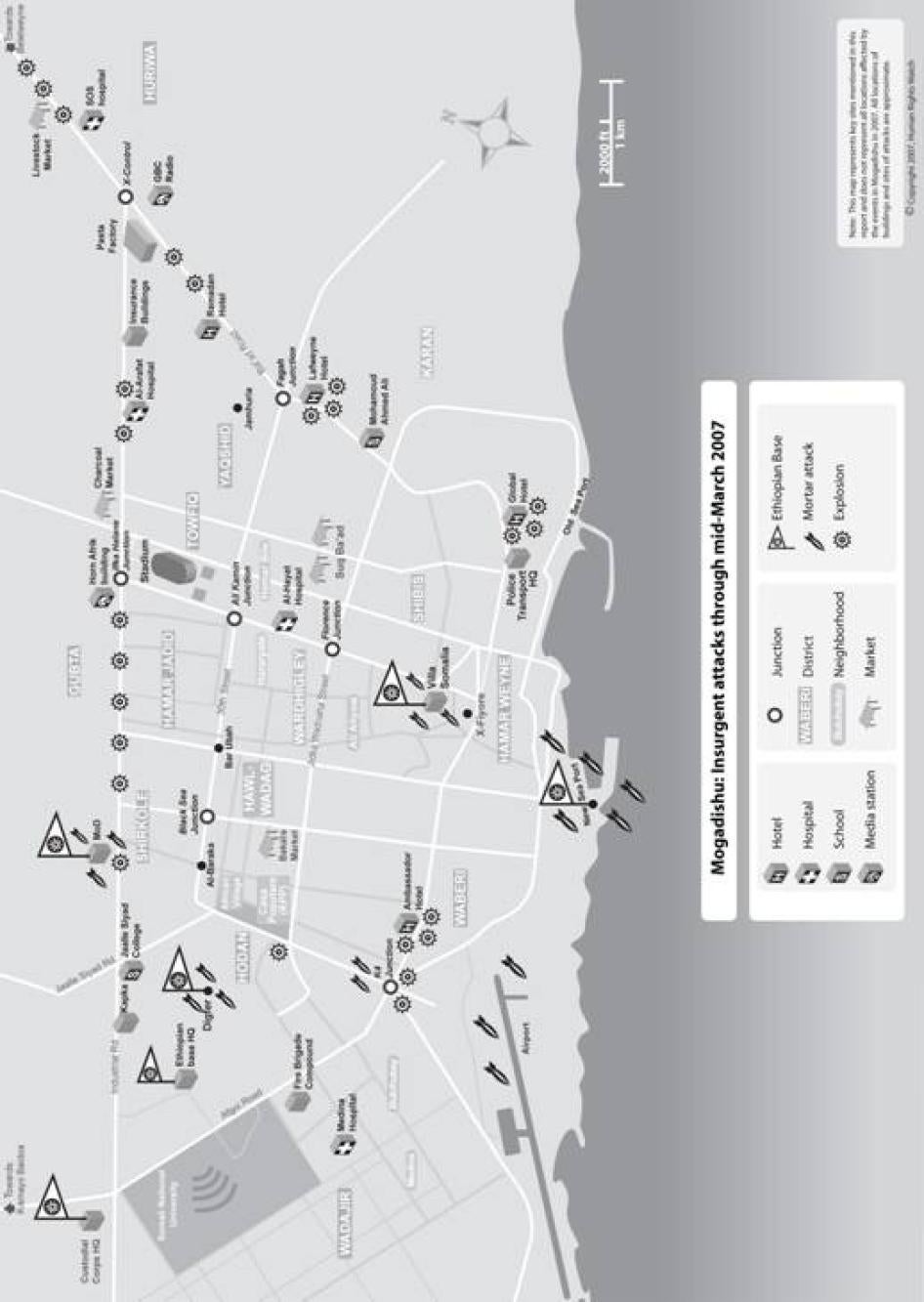
Map 1: Mogadishu: Insurgent attacks through mid-March 2007
Map 2: Mogadishu: Ethiopian offensives in March and April 2007
I. Summary
The year 2007 brought little respite to hundreds of thousands of Somalis suffering from 16 years of unremitting violence. Instead, successive political and military upheavals generated a human rights and humanitarian crisis on a scale not seen since the early 1990s.
Since January 2007, residents of Mogadishu, the Somali capital, have been gripped by a terrifying campaign of violence that has killed and injured hundreds of civilians, provoked the largest and most rapid displacement of a civilian population for many years, and shattered the lives, homes, and livelihoods of thousands of people. Although overlooked by much of the world, it is a conflict whose human cost is matched by its regional and international significance.
The conflict in Mogadishu in 2007 involves Ethiopian and Somali government forces against a coalition of insurgent groups. It is a conflict that has been marked by numerous violations of international humanitarian law that have been met with a shameful silence and inaction on the part of key foreign governments and international institutions.
Violations of the laws of war documented in this report include the deployment of insurgent forces in densely populated neighborhoods and the widespread, indiscriminate bombardment of these areas by Ethiopian forces. The deliberate nature of these bombardments, evidence of criminal intent, strongly suggests the commission of war crimes.
Underpinning the developments in Somalia is the striking rise to power and rapid collapse of the Islamic Courts Union (ICU), a movement based on a coalition of sharia courts, in Mogadishu in mid-2006. The Islamic Courts were credited with bringing unprecedented stability to a city plagued by lawlessness and extreme violence. Speculation about whether early indicators of extreme and repressive action by the ICU would evolve into more moderate policy was cut short by the events that followed.
The presence of some radical and militant Islamist elements within the ICU and their belligerent statements stoked fears within and outside the region. The ICU's dominance also threatened the Somali Transitional Federal Government (TFG), which had little international support and minimal popular legitimacy, particularly in Mogadishu. In December 2006 Somalia's historic rival Ethiopia intervened in Somalia in support of the TFG and with the backing of the United States government, and ousted the ICU in a matter of days. Although the campaign was conducted in the name of fighting international terrorism, Ethiopia's actions were rooted in its own regional and national security interests, namely a proxy war with Eritrea and concern over Ethiopian armed opposition movements supported by Eritrea and the ICU.
Following the establishment of Ethiopian and TFG troops in Mogadishu in January 2007, residents of Mogadishu witnessed a steady spiral of attacks by insurgent forces aimed at Ethiopian and TFG military forces and TFG officials. Increasingly, Ethiopian forces launched mortars, rockets, and artillery fire in response. A failed March 21 and 22 disarmament operation by the TFG resulted in the capture of TFG troops and-in scenes evocative of the deaths of US soldiers in 1993-the mutilation of their bodies in Mogadishu's streets.
In late March Ethiopian forces launched their first offensive to capture Mogadishu's stadium and other locations, which met with resistance from a widening coalition of insurgent groups. Ethiopian forces used sustained rocket bombardment and shelling of entire neighborhoods as their main strategy to dislodge the mobile insurgency and then occupy strategic locations. Hundreds of civilians died trying to flee or while trapped in their homes as the rockets and shells landed. Tens of thousands of people fled the city.
Four days of intense bombardment and fighting was ended by a brief ceasefire negotiated by the Ethiopian military and Hawiye clan elders. The ceasefire faltered and then broke in late April, when Ethiopian forces launched their second major offensive to capture additional areas of north Mogadishu. Again, heavy shelling and rocket barrages were used against insurgents in densely populated civilian neighborhoods. Hundreds more people died or were wounded. On April 26 the TFG, which played a nominal role supporting the Ethiopian military campaign, declared victory. Within days, insurgent attacks resumed, increasingly based on targeting Ethiopian and TFG forces with remote-controlled explosive devices.
Based on dozens of eyewitness accounts gathered by Human Rights Watch in a six-week research mission to Kenya and Somalia in April and May 2007, plus subsequent interviews and research in June and July, this report documents the illegal means and methods of warfare used by all of the warring parties and the resulting catastrophic toll on civilians in Mogadishu.
The insurgency routinely deployed their forces in densely populated civilian areas and often launched mortar rounds in "hit-and-run" tactics that placed civilians at unnecessary risk. The insurgency possibly used civilians to purposefully shield themselves from attack. They fired weapons, particularly mortars, in a manner that did not discriminate between civilians and military objectives, and they targeted TFG civilian officials for attack. In at least one instance, insurgent forces executed captured combatants in their custody, and subjected the bodies to degrading treatment.
Ethiopian forces failed to take all feasible precautions to avoid incidental loss of civilian life and property, such as by failing to verify that targets were military objectives. Ethiopian commanders and troops used both means of warfare (firing inherently indiscriminate "Katyusha" rockets in urban areas) and methods of warfare (using mortars and other indirect weapons without guidance in urban areas) that violated international humanitarian law. They routinely and repeatedly fired rockets, mortars, and artillery in a manner that did not discriminate between civilian and military objectives or that caused civilian loss that exceeded the expected military gain. The use of area bombardments in populated areas and the failure to cancel attacks once the harm to civilians became known is evidence of criminal intent necessary to demonstrate the commission of war crimes. The Ethiopian forces also appeared to conduct deliberate attacks on civilians, particularly attacks on hospitals. They committed pillaging and looting of civilian property, including of medical equipment from hospitals.
The Transitional Federal Government forces failed to provide effective warnings when alerting civilians of impending military operations, committed widespread pillaging and looting of civilian property, and interfered with the delivery of humanitarian assistance. TFG security forces committed mass arrests and have mistreated persons in custody.
Reaction to these serious international crimes has been muted to the point of silence. Despite the scale and gravity of the abuses in Mogadishu in 2007, there has been no serious condemnation by key governments or institutions. The human rights crisis that has permeated Somalia for years, now significantly amplified in the past six months, has yet to even reach the agenda of many international actors. Easing the suffering of Somali civilians and building a stable state cannot be accomplished in a human rights vacuum.
Key governments and international institutions such as the United States, the European Union and its members, the African Union, the Arab League, and the United Nations Security Council must recognize the urgent need for human rights protection and accountability in Somalia.
International donors and actors must take immediate action to condemn the appalling crimes that have been perpetrated and senda clear signal to all the warring parties that impunity for these crimes willnot be tolerated. The United States and the European Union provide significant financial, technical, and other assistance to both Ethiopia and the Somali Transitional Federal Government and should use their leverage to press for respect for human rights and international humanitarian law.
Independent human rights monitoring and reporting must be increased and international donors should encourage, assist, and finance efforts to make those responsible for abuses accountable for Somalia's latest cycle of violence.
II. Key Recommendations
To the Transitional Federal Government of Somalia (TFG)
- Immediately issue clear public orders to all TFG security forces to cease attacks on and mistreatment of civilians and looting of civilian property, and ensure that detainees have access to family members, legal counsel, and adequate medical care while in detention.
- Ensure humanitarian assistance to all civilians in need, including by facilitating the access of humanitarian agencies to all displaced persons in and around Mogadishu.
- Investigate allegations of abuses by TFG forces and hold accountable the members of the TFG forces, whatever their rank, who have been implicated in abuses.
- Take all necessary steps to build a competent, independent, and impartial judiciary that can provide trials that meet international fair trial standards. Abolish the death penalty as an inherently cruel form of punishment.
- Invite the United Nations Office of the High Commissioner for Human Rights (OHCHR) to increase the number of staff monitoring and reporting on human rights abuses in Somalia and request technical support for the judiciary and the establishment of an independent national human rights commission.
To the groups comprising the insurgency
- Cease all attacks on civilians and civilian objects, including government officials and employees not directly participating in the hostilities. Cease all attacks that cause indiscriminate or disproportionate harm to civilians or civilian objects, including attacks in crowded civilian areas, such as busy roads, village or city streets, markets, or other public gathering places.
- Avoid locating, to the extent feasible, insurgent forces within or near densely populated areas, and where possible remove civilians from the vicinity of such forces. Avoid using populated areas to launch attacks and cease threatening civilians who protest the use of their neighborhoods as launching sites. Never purposefully use civilians to shield insurgent forces from attack.
- Publicly commit to abide by international humanitarian law, including prohibitions against targeting civilians, using indiscriminate and disproportionate attacks, and using civilians as "human shields."
To the government of Ethiopia
- Cease all attacks that deliberately target civilians and cease using means and methods of combat that cannot discriminate between civilians and military objectives. Civilian objects such as schools, hospitals, and homes must not be attacked unless currently being used for military purposes.
- Cease all indiscriminate attacks and attacks in which the expected civilian harm is excessive compared to the concrete and direct military gain anticipated. In particular, cease the use of area bombardments of populated areas of Mogadishu.
- Issue clear public orders to all forces that they must uphold fundamental principles of international humanitarian law and provide clear guidelines and training to all commanders and fighters to ensure compliance with international humanitarian law.
- Investigate and discipline or prosecute as appropriate military personnel, regardless of rank, who are responsible for serious violations of international humanitarian law including those who may be held accountable as a matter of command responsibility.
To the European Union and its member states, the European Commission, the United Nations Security Council, the African Union, the Arab League, and the government of the United States
- Publicly condemn the serious abuses of international human rights and humanitarian law committed by all parties to the conflict in Mogadishu in 2007, and call on the Ethiopian government and the Transitional Federal Government of Somalia to take all necessary steps, including public action, to ensure that their forces cease abuses against civilians.
- Support measures to promote accountability and end impunity for serious crimes in Somalia, including through the establishment of an independent United Nations panel of experts to investigate and map serious crimes and recommend further measures to improve accountability.
- Publicly promote and financially support civil society efforts to provide humanitarian assistance, services such as education, monitoring of the human rights situation, and efforts to promote national solidarity. Promote and support TFG efforts to improve the functioning of the judicial system and to establish a national human rights commission. Provide voluntary contributions to support an expanded OHCHR field operation in Somalia.
III. Background
The continuing crisis in Somalia is multifaceted, with roots that can be traced back to the 21-year rule of President Mohamed Siad Barre (19691991).[1] Barre's military coup in 1969 ended Somalia's first post-independence experiment with democratic civilian government (1960-69), a period which in later years became marked by corruption, inefficient governance, and increasingly fragmentary politics centered around clan-based political parties and patronage.[2]
When Siad Barre took power in 1969, he sought and obtained support from the Soviet Union and embraced "scientific socialism" for Somalia. Among his first steps were to abolish Somalia's clan and patronage system as counter-revolutionary: a national campaign (olole) against "tribalism, corruption, nepotism, and misrule" was launched and even informal references to clan alliances were outlawed.[3] A new intelligence agency, the National Security Service (NSS), was established in 1970 to monitor "security" offenses that included nepotism and tribalism.
Barre's early rule did have some positive aspects, such as his establishment of the first written script for the Somali language, a nationwide literacy campaign (1973-75), and the empowerment of women through fairer marriage, divorce, and inheritance laws. However, his government soon degenerated into increasing dictatorship, repression, and a personality cult focused around the "Holy Trinity" of Marx, Lenin, and "the Beneficent Leader" Barre, who established an increasingly repressive and authoritarian security state, placing himself in control of all facets of state power.[4]
Barre's government suffered a serious blow when he launched an unsuccessful military invasion of the ethnic Somali Ogaden region of Ethiopia in 1977. Barre's invasion accelerated the Soviet Union's decision to support the Marxist Ethiopian regime and to abandon support for Somalia, leading to a military defeat for Barre in 1978. This set in motion an economic and political crisis of legitimacy that ultimately led to the collapse of the Barre dictatorship.[5] After breaking with the Soviet Union,[6] Barre abandoned "scientific socialism," allied himself with the West, and sought refuge increasingly in the support of his Darod clan.[7]
The increasing clan basis of Barre's regime led to the formation of opposition fronts that were similarly clan-focused, as non-Darod clans felt excluded from power.[8] One of the first setbacks to Barre came in 1981 when his attempts to undermine the economic and political power of the Isaaq clan led to the formation of the Isaaq-dominated Somali National Movement (SNM).[9] The SNM soon began launching small-scale attacks against government and military posts inside Somalia.
Barre responded to the SNM with what Human Rights Watch described as "savage counterinsurgency tactics," ordering massive bombardments of northern towns and villages that killed tens of thousands of Somali civilians and led to the internal displacement of some 500,000 northerners, with another 500,000 seeking refuge in Ethiopia.[10]
Following his 1978 break with the Soviet Union, Barre had enjoyed substantial support from the West, particularly the United States[11]-allowing Barre to expand his army from an estimated 3,000 at the time of independence to a "suffocating" 120,000 by 1982.[12] Reports from Amnesty International, Human Rights Watch, and the press about the atrocities being committed by the Barre regime led, however, to a sharp reduction in US and western aid by late 1989.
The Fall of the Barre Regime and the Outbreak of Clan Fighting
President Barre was overthrown in January 1991 by a coalition of insurgency movements including the Isaaq-dominated SNM, Gen. Mohamed Farah Aideed's largely Hawiye clan-based United Somali Congers (USC) fighting in the south-central regions, and the Ogaden clan-dominated Somali Patriotic Movement (SPM) that was based in southern Somalia.[13]
The removal of the Siad Barre government spurred new conflict among and within the clan-based opposition movements. The USC split into two factions, one supporting General Aideed and a second supporting a Hawiye businessman from the Abgal sub-clan, Ali Mahdi Mohammed. Mohammed was appointed as interim president by a group of politicians and influential elders from the Hawiye clan within two days of Barre's ouster.[14]
By late 1991 increasing numbers of individuals and armed groups competed for power in the vacuum left by Siad Barre's departure. The early 1990s saw some of Mogadishu's worst fighting as militia mobilized by General Aideed fought with those of Ali Mahdi to impose their control over the capital and the rest of the country.[15]
The war divided the capital city into two zones separated by a "green line,"[16] displaced tens of thousands of people, and cost thousands of civilians in Mogadishu and south-central Somalia their lives. The fighting in Mogadishu and subsequent clan-based conflict further south also severely affected the local harvest, creating an unprecedented famine in fertile southern Somalia.[17] Humanitarian organizations estimated that between February 1991 and December 1992, 300,000 people may have lost their lives.[18]
Between 1991 and 1993, as people died of starvation and related illnesses in their tens of thousands, freelance and clan-based militia obstructed aid efforts and looted relief. A 1992 United Nations (UN)-negotiated ceasefire failed and prompted the first UN military intervention to protect relief access and aid workers-the operation known as the United Nations Operation for Somalia (UNOSOM). In December 1992 UNOSOM's failure to end the fighting led the United States to overcome its initial reluctance and to send troops, under US command, to the UN Task Force on Somalia (known as UNITAF and codenamed "Operation Restore Hope"). In May 1993 UNOSOM and UNITAF were replaced by UNOSOM II, which had a more robust mandate under Chapter VII of the UN Charter and more than 30,000 troops from various countries.[19]US troops withdrew in 1994 after they became embroiled in conflict with General Aideed.[20] UNOSOM II left Somalia in March 1995 without achieving a breakthrough towards long-term political stability for Somalia, initially a key objective of the mission.[21]
The civil war and the successive US and UN military interventions in the early 1990s left several legacies, including a dramatic increase in the number of Somali factions and armed groups (none of which shared any common political platform or national vision), the empowerment of individual warlords, and a deep reluctance on the part of powerful states such as the United States to intervene in Somalia.[22]
Successive Failed Peace Processes: 19912004
Peace initiatives began as early as 1991. After UNOSOM withdrew in 1995, diplomatic responsibility for Somalia was left to regional governments. Egypt, Djibouti, Yemen, Ethiopia, and Kenya took turns hosting peace conferences to end the violence and reestablish a Somali state.[23] Of more than a dozen peace conferences, two were noteworthy for an understanding of current events.
The first of these was in May 2000 in Arta, a town in neighboring Djibouti.[24] During the negotiations Djibouti tried to create an atmosphere that limited the role and influence of the warlords in the conference, instead emphasizing the role of civil society groups and clan elders. The conference resulted in the first Transitional National Government (TNG) led by Abdulkasim Salad Hassan, a controversial and long-time minister under Siad Barre.[25]
The Djibouti conference also created a 245-member parliament and approved the appointment of Ali Khalif Gallaydh as prime minister. It set up a power-sharing system based on the so-called 4.5 system-meaning an equal number of representatives for the four major clans and half of a major clan's share for all the minority clans together.
Key players such as the United States, the European Union, and the African Union (then the Organization of African States, OAS) were hesitant to make any firm commitment to Somalia, given the numerous previous failed peace processes, and provided little support to the TNG.[26] But the biggest setback came from local warlords who refused to recognize and collaborate with the new administration and instead formed a Somali Reconciliation and Restoration Council (SRRC) in Ethiopia in 2001 to challenge the legitimacy of the new government.[27]
By 2002 it was clear the TNG had failed to establish any credible administration and its mandate was running out. It lacked authority on the ground and could not prevail against the opposition of powerful warlords. Kenya offered to host both sides, the TNG and SRRC, for European Commission-financed talks in Eldoret in October 2002. After two years of difficult negotiations, in 2004 Kenya brokered a power-sharing agreement through the Inter-Governmental Authority on Development (IGAD, a regional umbrella group which comprises Ethiopia, Kenya, Djibouti, Sudan, Somalia, Uganda; Eritrea withdrew from membership this year in protest of IGAD's view on Ethiopia's role in Somalia).[28] The result of this process was the establishment of the current Transitional Federal Institutions: a Transitional Federal Charter, a Transitional Federal Government (TFG) and a Transitional Federal Parliament (TFP) consisting of 275 members.
In October 2004 the TFP elected Abdullahi Yusuf Ahmed, a leading member of the SRRC group, as president of the TFG, who in turn appointed Ali Mohammed Gedi as prime minister.[29] Following pressure from Kenya to relocate and establish a government in Somalia, in May 2005 the TFG tried to establish itself within Somalia, but immediately split, with some members moving to Jowhar and some to Baidoa.[30]
The Ethiopian Factor
Recent events in Somalia are closely linked to regional developments. Ethiopia and Somalia are historically, socially, and politically intertwined, with several episodes of religious and territorial disputes over the Somali region of eastern Ethiopia known as the Ogaden, most recently in 1964 and 1977.[31] Ethiopian concerns over continuing Somali nationalist sentiments towards the ethnic Somali Ogaden region remains a key element in Ethiopian foreign policy decision-making.[32]
Successive Ethiopian governments have supported Somali opposition leaders and movements and the Ethiopian government led by Prime Minister Meles Zenawi has been closely involved in the various Somali peace processes. Several of the current leading figures in Somalia's military and political landscape have either received longstanding support from-in the case of Abdullahi Yusuf-or had antagonistic relations with-in the case of Sheikh Hassan Dahir Aweys, a former deputy leader of the militant Islamist group Al-Itihaad Al-Islaami-the Ethiopian government.
Ethiopian mistrust of Sheikh Aweys stems from his connection to Al-Itihaad Al-Islaami, originally a Salafi religious movement that evolved into a militant Islamist organization. Sheikh Aweys was actively involved in forming Al-Itihaad's military wing in the early 1990s, which fought against Ethiopia and then-militia leader and current TFG President Abdullahi Yusuf's faction in Puntland.[33] Al-Itihaad was allegedly responsible for several bombings in Ethiopia in the mid-1990s that led to its designation on a US sanctions list of individuals and organizations after the September 11, 2001 attacks.[34] In 1998, following Ethiopia's defeat of Al-Itihaad in southwestern Somalia, Sheikh Aweys returned to Mogadishu and helped found one of the clan-based Islamic Courts.
Ethiopian involvement in Somalia remains a divisive and politically charged issue for Somalis, many of whom view Ethiopian motives in Somalia with deep distrust.[35] Some Somalis blame Ethiopia for the inability of the TNG, the predecessor to the current TFG, to establish an enduring government.[36]
Ethiopian interests in Somalia are also closely linked to Ethiopia's relations with Eritrea. Although there has been little active fighting since their bloody 1998-2000 border war ended, Eritrea and Ethiopia remain bitter rivals and both governments have engaged in a form of proxy war in Somalia dating back to the late 1990s.[37]Eritrea has provided military aid and training to a variety of Ethiopian insurgent groups based in the Ogaden and Somalia, and Ethiopia has supported the TFG.[38]
The Rise of the Islamic Courts in 2006
In June 2006 the Somali political scene was shaken by the emergence of an alliance of sharia (Islamic law) courts, the Islamic Courts Union (ICU). The ICU, with Sheikh Hassan Dahir Aweys among its leaders, drove the warlords from Mogadishu.[39] Although the appearance of the Islamic Courts as a potent political movement was a surprise to many observers, the courts had longstanding roots in Mogadishu.[40]
In December 2004, just two months after the formation of the TFG, a group of clan-based courts that had been operating in Mogadishu for years joined to launch the ICU.[41] Sheikh Sharif Sheikh Ahmed, a schoolteacher from Mogadishu, was appointed chair of the alliance.[42] By 2005 there were 11 Islamic Courts from different clans operating in Mogadishu under sharia.[43]
The increasing influence of the Islamic Courts came against the backdrop of growing US concern over the presence of alleged terrorism suspects in Somalia.[44] The US had claimed for several years that several individuals linked to al Qaeda and the 1998 bombing of the US embassies in Kenya and Tanzania were being sheltered by radical Islamists in Mogadishu.[45] The US Central Intelligence Agency (CIA) initially tried to capture the individuals by paying warlords in Mogadishu to abduct the men and transfer them to CIA custody. Three of the individuals most wanted by the US were Fazul Abdullah Mohamed, a national of the ComorosIslands, Abu Talha al-Sudani, a Sudanese national, and Saleh Ali Saleh Nabhan, a Kenyan.[46]
Reports of a growing jihadi network in Somalia strengthened fears that the ICU would encourage Somalia to become a breeding ground for terrorism in the Horn of Africa.[47] On February 18, 2006, a few key warlords in Mogadishu formed a new alliance called the Alliance for the Restoration of Peace and Counter-Terrorism (ARPCT), with US backing.[48] Its aim was to capture the individuals linked to the east Africa bombings.[49]
Instead, US support for the notorious warlords who formed the APRCT backfired, generating further popular support for the ICU,[50] which extended its territorial control over a large part of central and southern Somalia and ultimately defeated the APRCT in bitter fighting in Mogadishu in June 2006.[51]
As the ICU fought the US-backed warlords in early 2006, the Transitional Federal Government of Somalia was struggling to establish itself in Somalia.[52] It set up temporary bases, initially in Jowhar town and later on in Baidoa, 250 kilometers northwest of Mogadishu, but received little international support.[53] It was only when the ICU emerged as a powerful political actor in southern Somalia that regional and international actors turned to the TFG as a more palatable form of Somali leadership.[54]
Within a matter of four months, between June and October 2006, the ICU was in control of seven of the ten regions in south-central Somalia. The Islamic Courts had restructured into the Council of Somali Islamic Courts (CSIC), with the formation of a consultative council headed by Sheikh Aweys and an executive body headed by Sheikh Sharif Sheikh Ahmed.[55] The appointment of Sheikh Aweys as one of the main leaders of the CSIC further alarmed both Ethiopia and the US, which had already placed Sheikh Aweys on a sanctions list in 2001 for his alleged links to terrorism.[56]
A June 30, 2006 video message from Osama Bin Laden urged Somalis to support the ICU and build an Islamic state, and threatened to fight the US if it intervened in Somalia.[57]
Nationalist statements from some of the ICU leadership further fuelled Ethiopian fears that the ICU hoped to unite ethnic Somali communities in neighboring northern Kenya and Ethiopia's Ogaden with Somalia. Ethiopia was also concerned by the potential impact on Ethiopia's own large Muslim and Somali population of the Islamic Courts' effort to establish political Islam in Somalia.[58]
The emergence of the ICU as a military threat in 2006 prompted the Ethiopian government to strengthen its political and military support to the TFG.[59]Ethiopia was the primary supplier of arms to the TFG and some individual warlords, but Uganda and Yemen also contributed arms and other supplies.[60]
On the other side, UN experts monitoring Somalia's utterly ineffective arms embargo in 2006 documented arms flows and supply of military materiel and training to the Islamic Courts from seven states: Djibouti, Egypt, Eritrea, Iran, Libya, Saudi Arabia, and Syria.[61]
Following the ICU's victory over the warlords in June 2006, Ethiopia moved increasing amounts of troops and military materiel into Baidoa, the TFG stronghold, to protect it from any ICU attack.[62] The US government supported its ally Ethiopia.[63]
Peace Talks Fail: JuneDecember 2006
The rise of the Islamic Courts narrowed down the rival groups in Somalia to two: the Transitional Federal Government and the Islamic Courts Union. Appeals for peace talks mounted in an effort to combine the political legitimacy of the TFG and the stability restored to many parts of southern Somalia by the Islamic Courts.
Sudan agreed to host negotiations and on June 22, 2006, the two sides agreed on mutual recognition and further talks in Khartoum. A second round of talks under Arab League auspices in September 2006 made further apparent progress, with agreement on integrated security forces and a commitment to discuss power sharing arrangements. A third round of negotiations was scheduled for October 30, 2006, but was forestalled by Somalia's first suicide bombing on September 18, an assassination attempt on President Abdullahi Yusuf.[64] ICU leaders denied responsibility for the attack.[65]
Throughout the negotiations both the ICU and the TFG/Ethiopia continued to bolster their military preparations. In the run-up to the third round, the ICU also continued its territorial expansion, taking the strategic southern town of Kismayo in late September 2006, allegedly with a coalition of forces including advisors from Eritrea and fighters from the Ogaden National Liberation Front (ONLF) and the Oromo Liberation Front (OLF).[66]
The TFG, Ethiopia, and international government backers viewed this development with alarm, interpreting it as a prelude to an ICU attack on Baidoa, the only TFG stronghold in south-central Somalia. The Ethiopian military moved to bolster its presence not only in Baidoa, but also in Puntland and other areas of Somalia.[67]
By the time the third round of talks began in Khartoum in October 2006, the situation was at an impasse. The ICU insisted that Ethiopian troops leave Somalia and that IGAD should not have a mediating role in the talks. The TFG took the opposite position, calling for IGAD involvement and the ICU's withdrawal from recently captured areas. The talks ended in deadlock and Somalia entered a new round of hostility.[68]
The Fall of the Islamic Courts
November and December saw rising tensions between the ICU and the TFG/Ethiopians and increasing military preparations on the ground by both sides.[69] The UN Security Council on December 6 passed resolution 1725 authorizing a regional military intervention in Somalia, a development long desired by the TFG. The US-led resolution did little to reduce the tensions and in fact may have increased them.[70] Although the final resolution specified that troops from bordering countries should not be included in IGASOM, the proposed IGAD deployment in Somalia, it made no mention of the existing Ethiopian presence in Somalia and contained enough elements to be viewed as pro-TFG by the Islamic Courts and independent analysts.[71]
The ICU saw the Security Council resolution as blatant support for the Ethiopian presence. On December 12, 2006, the ICU's defense chief, Sheikh Yusuf Mohamed Siyad Indha'adde, gave the Ethiopian military in Somalia a week to withdraw or face forcible expulsion.[72] The day after the deadline passed, December 20, fighting started around Baidoa. Although the Ethiopian military were actively defending the town, they denied involvement for several days and only publicly acknowledged their role four days later.[73]
Ethiopian and TFG forces went on the offensive (TFG militia included forces from Puntland-the President's home region, the Sa'ad subclan of the Hawiye, and Rahanweyn clan militias) and quickly drove the ICU from Mogadishu and its other urban positions.[74] The resistance apparently dissolved after several battles south and east of Baidoa and in the central regions of Somalia just south of Galkayo town. Hundreds of Islamic Courts militia members and some foreign fighters who supported what they viewed as jihad[75] reportedly died under Ethiopia's superior firepower, particularly its aerial capacity.[76]
The Islamic Courts leadership left Mogadishu on December 26 as the Ethiopian forces advanced on the capital, moving south towards Kismayo and the JubaValley while many of their Somali supporters merged back into the civilian population.[77] Kismayo fell to the Ethiopians on January 1, 2007, forcing the Islamic Courts leadership and supporters further south. The outflux included dozens of foreigners who supported the Islamic Courts, some of whom had been living in Mogadishu with their wives and children.[78] Fazul Mohammed and several other individuals on the US wanted list were apparently among the exodus from Mogadishu.[79]
The US became overtly involved in the military campaign when it launched several airstrikes from AC-130 gunships in southern Somalia on January 7 and 8,[80] apparently targeting these fleeing individuals, and sent a limited number of special forces across the border.[81] The US had previously made cautious public statements supporting the Ethiopian offensive, but left the military ground operations to its Ethiopian ally. In mid- and late January, Ethiopian, US, and Kenyan security forces cooperated in a coordinated pincer operation. While Ethiopian troops pushed the fleeing Islamists and their supporters towards Ras Kamboni, at the very tip of Somalia on the Kenyan border, US navy ships positioned off the Somali coast cut off potential escapes by sea across the Gulf of Aden.[82]
As hundreds of people fleeing the conflict arrived at border crossings or in Kenya, Kenyan security forces closed the border and arrested dozens of Somali and foreigners suspected of affiliation with the Islamic Courts or with men wanted by the US (see above).[83]
Meanwhile, as the Ethiopian and US forces pursued supporters of the Islamic Courts south towards Kismayo, other Ethiopian units and TFG forces settled into military bases and buildings in Mogadishu in the first days of January 2007. These sites included strategic locations such as the new seaport, the airport, Somalia's former Presidential Palace (also known as Villa Somalia), and other strategic buildings including the former Ministry of Defense and the former headquarters of the Custodial Corps.[84] The Ethiopian military also occupied three former Somali military bases situated on the two main highways that link Mogadishu to the southern and central regions.[85]
IV. Mogadishu Under Siege: JanuaryApril 2007
By the end of January 2007 three main actors emerged in the looming military confrontation: the insurgency, the Ethiopian armed forces, and the forces supporting the Transitional Federal Government.[86]
The Ethiopian government has closely guarded details of the number of troops deployed in Somalia and statistics of casualties incurred in the fighting, but credible sources told Human Rights Watch that by early 2007 Ethiopia may have had as many as 30,000 troops in Somalia.[87] In 2006 Ethiopian military convoys carrying troops and military materiel came into Somalia regularly from Ethiopia, passing through Beletweyne town, in Somalia's Hiran region.[88] Ethiopian forces deployed in Mogadishu in early 2007 included infantry and air support.
The Ethiopians provided the backbone of the military power on the side of the TFG, which itself brought an estimated 5,000 fighters into Mogadishu. The bulk of the TFG forces consist of militias from President Yusuf's home region, Puntland, and members of the Rahanweyn Resistance Army.[89] Most of these militia forces had basic military training by the Ethiopians in Manaas and Daynuunay former military barracks in Bay region in 2006.[90] Ethiopian military officers also gave up to 3,000 newly recruited Somali government militias a few weeks of training at Balidogle airport early in 2007.[91]
While much remains unknown about its organization, membership, and leadership, it is widely believed that the insurgency consists of three groups:[92]
The first group is comprised of members of Al-Shabaab, a well-trained militia and the core of the group that led the Islamic Courts to victory during their rise to power in mid-2006. Many observers believe that Al-Shabaab consisted of between 500 and 700 fighters, largely from the Hawiye and Ogaden clans. Sheikh Hassan Turki is reportedly their spiritual leader while their operational commander is Adan Hashi Ayrow.[93]
The second group consists of members of the Hawiye clan militia who loathed the presence of the TFG leadership and the Ethiopian military in Mogadishu. These comprised perhaps the largest group in terms of numbers within the insurgency; the leadership and organizational structure of these militia is unclear.
The third group consists of disgruntled fighters and nationalists who opposed Ethiopian involvement in Somalia's affairs. It too has no known leadership.[94]
Although Hawiye fighters constituted the largest group in terms of numbers, some analysts believe that Al-Shabaab members are the backbone of the insurgency and provided discipline and strategy for all groups.[95] All the groups seem to have respected the brief ceasefires negotiated on their behalf by the Hawiye elders (see below).
Initially, many of the Somali media reports referred to the insurgency as "unidentified groups."[96] The international media described the armed groups in Mogadishu as "insurgents" or "remnants of the ICU," while by February 2007 many residents of Mogadishu referred to them as Muqaawama [the Resistance].[97]
A witness told Human Rights Watch, "The fighters were a mixture of the ICU, Al-Itihaad, Al-Shabaab, but the majority were Hawiye clan fighters. They had defenses in the areas where they fought against the government, hiding behind concrete walls. They were firing weapons-they would fire and then leave the area. They would come to the people and say, "This is our jihad, come out and join us."[98]
Hurtling Toward Conflict
Somali Prime Minister Ali Mohammed Gedi arrived in Mogadishu on December 29, 2006, the first senior TFG official to return to the capital.[99] Among his first public statements was a request to clan elders to surrender the three men wanted by the US as alleged al Qaeda affiliates.[100] In another exercise to signal the government's arrival, on January 1, 2007, he ordered that all weapons be handed over to TFG forces within three days or Mogadishu residents would face forced disarmament.[101] The order did not go down well with some of the clans in Mogadishu.[102]
Within a week of the TFG and Ethiopian army's arrival in Mogadishu the first insurgent attacks began.[103] Ethiopian and TFG forces responded by sealing off areas around the attack sites and conducting house-to-house searches.[104] The TFG also passed a three-month emergency law in parliament on January 13, 2007.[105] The provisions of the emergency law gave the TFG much wider powers and allowed President Yusuf to rule by decree.[106]
Between January and March 2007 insurgent attacks took several forms: assassinations of government officials; attacks on military convoys; and rocket-propelled grenade (RPG) or mortar attacks on police stations, TFG and Ethiopian military bases, or other locations or individuals deemed by the insurgency to be political or military targets. For instance, several hotels known to accommodate TFG officials, such as the Ambassador, Global, and Lafweyne Hotels, were repeatedly hit with RPGs and mortar rounds and were the site of attempted assassinations of TFG officials (see Map 1).[107]
The insurgency was mobile, often using hit-and-run tactics in its attacks or setting up and launching mortar rounds within minutes, then melting back into the civilian population. After an insurgent attack on a convoy or other mobile target, Ethiopian and TFG forces typically sealed off the area and conducted house-to-house searches of the area. The Ethiopian and TFG response to mortar attacks increasingly included the return firing of mortars and rockets in the direction of origin of insurgency fire.
On March 1 President Yusuf announced plans to hold a National Reconciliation Congress (NRC) on April 16,[108] but also maintained that it would not negotiate with those responsible for the attacks in the capital.[109] Many of Mogadishu's residents distrusted the TFG's capacity to implement genuine and effective reconciliation, feared potential reprisals, and were concerned about the Ethiopian presence and agenda in Somalia.[110]As insurgent attacks escalated, the government made further security announcements to the effect that the capital would be a safe venue for the meeting[111]: Deputy Defense Minister Salad Ali Jelle announced that Mogadishu would be secured in 30 days.[112] Media reports indicated that Mogadishu residents were nervous and concerned after the government's announcements. In the words of one resident, "There is fear that it will lead to more violence and more displacement if not properly handled."[113]
Many Somalis talked about the possibility of the Mogadishu situation reviving clan-based hostilities. For instance, many in Mogadishu who belong to the Hawiye clan distrusted the president, a member of the Darod clan. The Hawiye elders who later arranged ceasefire agreements with the Ethiopian military claimed in several statements that the president was instigating the hostility in Mogadishu in order to exact revenge on the Hawiye, who had been responsible for many abuses against the Darod during the civil war of the early 1990s.[114] Many Hawiye felt the security operations were aimed at disarming them, one of the biggest reasons they were opposed to the security operation announced by the deputy defense minister.[115]
The attacks and counter-attacks between the insurgency and the Ethiopian and TFG forces steadily escalated in March 2007. Insurgent tactics took a new twist when they also resorted to suicide bombings.[116]
The 1,500-member African Union force of Ugandan troops deployed in Mogadishu in early March had a limited mandate and did not become directly involved in the hostilities, although the troops occupied key positions at the airport and the TFG base at Villa Somalia.[117]
On March 21 and 22, 2007, the TFG launched its first major disarmament operation. Insurgent groups ambushed an Ethiopian and TFG convoy near the Ministry of Defense and fighting spread to several neighborhoods. At least 200 wounded people were brought to Mogadishu's hospitals.[118] More than 20 TFG militiamen were captured by the insurgency. The insurgents summarily executed several of the captured fighters and dragged their burned bodies through the streets.
A March 26 suicide attack on an Ethiopian base just outside Mogadishu, and the Ethiopian army's apparent determination to occupy more strategic locations in the city appear to have been among the catalysts for a serious escalation in the fighting.[119]
March 29 marked the start of the first round of major fighting between the insurgency and the Ethiopian forces. In the period from March 29 to April 1, several districts of Mogadishu that were either perceived to be insurgent strongholds or were located in strategic areas received the full brunt of Ethiopian offensives and bombardment (see Map 2).
Neighborhoods like Casa Populare (KPP) in the south, Towfiq and Ali Kamin around the Stadium, all along Industrial Road, and the road from the Stadium to Villa Somalia were heavily shelled or repeatedly hit by Ethiopian BM-21 multiple-rocket-launcher and mortar rounds.[120] The Ethiopian military objective appeared to be to capture the Stadium and control the main roads leading to it from the Ministry of Defense and Villa Somalia. During the course of the bombardment, the insurgency continued to use neighborhoods around the Stadium to fight and shell Ethiopian and TFG targets, and to ambush Ethiopian convoys, particularly during the battle for the Stadium.
The impact of the fighting on the civilian population was devastating. Reports from local human rights groups claimed that nearly 400 civilians were killed in the first round of fighting, although these figures could not be corroborated.[121] Local Hawiye clan elders and the Ethiopians negotiated a brief ceasefire beginning April 2, 2007, to collect the dead,[122] but shooting and sporadic rocket exchanges continued. Tens of thousands of people used the brief respite in the bombardment to flee the city.[123]
On April 18, amid spiraling conflict and tension, particularly following another suicide bombing aimed at an Ethiopian barrack, the second round of fighting began.[124] Ethiopian forces resumed heavy artillery shelling and rocket barrages, which expanded to new areas of the city, such as in the northeast around the Ramadan Hotel and the Pasta Factory. The Ethiopian aim in this offensive was clearly to take the Pasta Factory, which was thought to be an insurgent base and a strategic junction.
The second round of fighting ended abruptly on April 26 when the insurgency apparently and unexpectedly dissipated and the TFG announced victory.[125] The second bout of fighting was alleged to have claimed at least 300 civilian lives, again a figure that could not be independently verified. Although the shelling was described as even heavier than in the first round (March 29 to April 2), civilian casualties in the second round were estimated to be fewer because many people had already fled the city.
By late April the UN estimated that at least 365,000 people had fled the city.[126] In the days and weeks during and following the end of the fighting on April 26, humanitarian agencies trying to reach the displaced around Mogadishu were obstructed by TFG restrictions that included onerous limitations on aid convoys and on movement into Mogadishu. This prompted key governments such as the US and the EU to issue several statements and condemnations in late April.
Since May 2007 it has been increasingly apparent that the March and April fighting did not stem the insurgency. Roadside bombings and assassination attempts targeting TFG officials resumed in May and have continued on an almost daily basis. Attempts to convene the reconciliation conference were postponed by the TFG, first until mid-June, and then to mid-July.[127]
Many details about the specific events, intent, and acts of the warring parties remain murky. However, what is abundantly clear in reviewing the events of January to June 2007 in Mogadishu is that none of the three main warring parties-the insurgency, the Ethiopian forces, and the forces of the transitional Somali government-have made any meaningful efforts to protect civilians. On the contrary, the military strategies used by all parties during the events in Mogadishu demonstrate a wanton disregard for civilian life and property in violation of international humanitarian law. When committed with criminal intent-evident for instance in the Ethiopian area bombardments of populated neighborhoods-such violations amounted to war crimes.
Regional and international actors likewise did little to help protect the civilian population: the African Union peacekeeping mission was constrained by its mandate and was apparently unwilling to act on behalf of civilians during Mogadishu's worst fighting in 15 years, despite having some 1,500 troops on the ground. Key players with strategic involvement in the region like the US and the EU failed even to condemn the abuses as they were happening, remarking only on obstruction to humanitarian relief. As has been the case for more than a decade, the suffering of hundreds of thousands of Somali civilians was met with almost total silence.
V. International Humanitarian Law and the Armed Conflict in Somalia
International humanitarian law (the laws of war) imposes upon parties to an armed conflict legal obligations to reduce unnecessary suffering and to protect civilians and other non-combatants. It is applicable to all situations of armed conflict, without regard to whether the conflict itself is legal or illegal under international or domestic law, and whether those fighting are regular armies or non-state armed groups. All armed groups involved in a conflict must abide by international humanitarian law, and any individuals who violate humanitarian law with criminal intent can be prosecuted in domestic or international courts for war crimes.[128]
International humanitarian law does not regulate whether states and armed groups can engage in hostilities, but rather how states and armed groups engage in hostilities. Insurgency itself is not a violation of international humanitarian law. The laws of war do not prohibit the existence of insurgent groups or their attacks on legitimate military targets. Rather, they restrict the means and method of warfare and impose upon insurgent forces and regular armies alike a duty to protect civilians and other non-combatants and minimize harm to civilians during military operations.[129]
VI. Patterns of Abuses by Parties to the Conflict in Mogadishu
Indiscriminate or Disproportionate Attacks
Early in the morning of the first day, bullets started flying between the insurgents and the government; we could not even leave our homes. The militia [insurgents] that were fighting were behind our compound, I don't know if they were Al-Shaabab or Hawiye fighters. They were firing mortars and then running away. They were firing the mortars at the TFG and the Ethiopians, at the Presidential Palace and at the Ministry of Defense where the Ethiopians were based. Whenever the insurgents fired mortars at the Ethiopians, the Ethiopians responded with shells, but the Ethiopians shot them untargeted, they killed many civilians and even our animals.
-42-year-old woman from Towfiq neighborhood, describing the events of March 29, 2007[130]
While the laws of war do not prohibit fighting in urban areas, combat in Mogadishu has been conducted with little or no regard for the safety of the civilian population, resulting in massive and unnecessary loss of civilian life. All parties to the Somalia conflict have committed serious violations of international humanitarian law by using weapons in Mogadishu without discriminating between military objectives and civilians. Ethiopian forces conducted area bombardments in populated areas and failed to call off attacks that disproportionately harmed civilians. Commanders who order indiscriminate attacks knowingly or recklessly are responsible for war crimes. Casualties have been further heightened by the deployment of insurgent forces in densely populated areas and the launching of attacks from such areas. None of the parties has taken-as international law requires-all feasible precautions to spare the civilian population from the effects of attacks.
The human cost
The appalling consequences of indiscriminate attacks, the deployment of forces in densely populated areas, and the failure of all warring parties generally to take steps to minimize civilian harm is reflected in the thousands of civilians who died or whose lives were shattered by the injuries they sustained or by the loss of family members. It is also reflected in the staggering numbers of people who fled Mogadishu in March and April 2007 and in the scale of the destruction of homes, hospitals, schools, mosques, and other infrastructure in Mogadishu.
Local human rights groups and Hawiye clan elders estimated that the numbers of civilians killed in the first round of fighting in March 2007 alone ranged from nearly 400 to 1,000, with more than 4,000 others wounded.[131] Hawiye elders estimated that the second round of fighting resulted in the deaths of almost 300 civilians and wounded 587 more.[132] It is not possible to give more precise mortality figures at this stage for several reasons.
The intensity of the fighting and bombardment in late-March restricted civilian movement in and around conflict areas. As the fighting escalated on March 29, many of the dead were left in their homes, in other buildings, or even on the streets where they had been killed because it was too dangerous to collect and bury the bodies.[133] By April 2, when Ethiopian forces and Hawiye clan elders negotiated a ceasefire to collect and bury the dead, some bodies had already seriously decomposed in the heat, making identification difficult.
On April 4 and 6 the ceasefire committee of Ethiopian officials, Hawiye elders, and Red Crescent staff toured parts of the affected areas. A group of Somali Red Crescent volunteers tried to collect bodies around Ali Kamin junction and Al-HayatHospital, just south of the Stadium, which had been one of the frontlines in the previous days, but were unable to move beyond the main road into the affected neighborhoods and assess the situation more closely.[134] A credible source said that on April 4 and 6 the Somali Red Cross collected at least 24 bodies from one small section of the neighborhood around Al-Hayat, the vast majority of them civilians.[135]
According to members of the ceasefire committee interviewed by Human Rights Watch, although some of the dead were not recognizable, others were clearly identified as civilians. For instance, one body was identified by committee members as that of a "madman" who was known in the area, another was a woman who died with a prescription in her hand, and a third was a watchman who was shot while guarding private vehicles. A journalist who joined the ceasefire committee recalled a haunting sight: "I saw a mother and a child, apparently trying to flee the fighting, were caught by bullets and fell in front of their house, dead. They were holding hands."[136]
The volatile situation along the frontlines did not permit further attempts to continue collecting bodies and the operations came to a halt. The Hawiye elders estimated on April 10 that based on battlefield assessment, talking to civilians, and hospital records, more than 1,000 people had been killed in the first round of fighting alone.[137]
Given the scale of the displacement from Mogadishu and the dispersal of families across the country, it is almost impossible to methodically gather and corroborate information about dead or missing family members. In addition, many of the people who died on the spot, or were severely injured and died of their wounds before they were able to access medical care, were not registered in medical facilities or by independent sources. As one medical professional told Human Rights Watch:
Most patients die when wounded, and the worst of it is that patients can't make it to the hospital after being wounded. Most of the people who arrived at the hospital survived-less than 5 percent died once they reached the hospital. But no one can count how many people died-some just disappeared [were blown apart].[138]
Access to medical care was particularly difficult during the periods of intense fighting between March 29 and April 1 and in late-April. In addition to the constant rockets, shelling, and mortar fire, both the insurgency and the Ethiopian and TFG forces closed the roads. Thus, many wounded people had to wait until the following days to even try to access hospitals, sometimes in wheelbarrows, on donkey carts, or carried by family, friends, and neighbors.
Al-Hayat and Al-Arafat hospitals, both of which are located in the frontline areas, were also bombarded in the first days of the offensive (see below, "Attacks on Medical Facilities.") Most of the staff fled and the hospitals stopped functioning, which meant that many civilians had to undertake dangerous journeys through the city to get to functioning facilities further away, such as Medina and Kaysanay. Several Somali doctors working in the hospitals made public appeals to all parties to permit wounded civilians to access medical care, as did the International Committee of the Red Cross (ICRC), but no one heeded these appeals.[139]
Even though an unknown number of people died from their injuries or were unable to access medical care, Mogadishu's hospitals were still inundated as the fighting escalated. The types of injuries treated in the city's medical facilities illustrate the change in the means of warfare to more destructive forms of weaponry. Gunshot wounds, by far the most common type of violence-related trauma injury in Mogadishu in the first months of the year (and in prior years), were rapidly outnumbered by shrapnel wounds as the conflict escalated.
As one medical staff member noted:
The injuries and profile of the injured are different from the usual violence in Mogadishu, which is usually injuries of individuals from light weapons. Different weapons are being used than before. At the hospitals you see injuries from tank shells, mortars, Katyusha rockets. It's urban warfare in the middle of the cityYou see whole families at the hospitals, because the shells are landing on homes. The scenes at the hospital are horrible: children with legs and arms amputated, people with intestines coming out and with head injuries.[140]
Types of weaponry used in Mogadishu
Ethiopian forces, TFG forces, and the insurgency have used weaponry without sufficient precision to minimize or avoid civilian casualties in an urban setting such as Mogadishu. Some weapons, particularly the BM-21 multiple-rocket-launchers (firing "Katyusha" rockets) used by Ethiopian armed forces, are inherently indiscriminate weapons that should never be deployed in a populated urban environment. Other indirect-fire weapons, such as mortars, can be very accurate weapons when used with spotters or other guidance systems; however, Human Rights Watch's research found no evidence of the systematic use of spotters or other guidance for the mortar rounds fired by the insurgency or Ethiopian forces, making such indirect fire attacks indiscriminate. The result was hundreds of civilian casualties in a very short period.
According to photograph and video evidence and eyewitness accounts obtained by Human Rights Watch, insurgent groups in Somalia are armed with 60, 80, 81, or 82 millimeter (mm) mortars,[141]rocket-propelled grenades (RPGs), B-10 recoilless rifles, Zu-23 and Zu-50 anti aircraft guns, and various other small arms.[142] Anti-aircraft artillery mounted on the back of pickup trucks (known as "technicals") have also been a typical feature of the Somali conflict.
In 2006 the UN Panel of Experts monitoring the porous arms embargo on Somalia documented the supply to the ICU by Eritrea of large quantities of DShK (heavy machine guns), 82 and 120 mm mortars, B-10 recoilless rifles, RPGs, ZU-23 anti-aircraft ammunition, as well as large quantities of PKM machine guns and AK-47 and FAL assault rifles.[143] The November 2006 UN report also noted that "new and more sophisticated weapons are also coming into Somalia, including man-portable surface-to-air missiles such as the Strela-2 and 2M, also known as the SA-7a and 7b 'Grail,' and the SA-6 'Gainful' low-to-medium altitude surface-to-air missile."[144]
While the ICU no doubt used some of this weaponry during fighting with the Ethiopian forces in December 2006, it is very likely that much of it was left in Mogadishu when the ICU fled. The ICU had confiscated many arms from Mogadishu militia when it took control in June 2006, but clan elders apparently demanded that the ICU return confiscated arms when the Ethiopians were approaching.[145] The insurgency would also have had access to independent arms traders in Mogadishu's Bakara market in the early months of 2006.[146]
By January 7, within 10 days of the arrival of Ethiopian and TFG forces in Mogadishu, armed groups began attacking them with small arms, mortars, and other weaponry. By late March the attacks expanded to include suicide bombings and, in later months, the use of remotely-controlled explosive devices.
The Ethiopian armed forces have used BM-21 multiple barrel rocket launchers firing Katyusha-type rockets, 120 mm mortars, T-55 tanks firing 100mm shells, and M-30 and D-30 artillery in the course of their attacks.[147] The Ethiopian military also used Mi-24 helicopter gunships in the first two days of the March offensive, which fired into neighborhoods of Mogadishu. Human Rights Watch's research has not been able to verify what types of weapons were used on the helicopter gunships, but these gunships have an internal 12.7 machine gun and also likely used 57 or 80 mm rockets. The Ethiopian army ceased using the helicopters after insurgents shot one down on March 30.[148]
Human Rights Watch was often able to determine the weapons used in a particular attack because civilians in Mogadishu became expert at identifying different weaponry by their specific characteristics. Dozens of eyewitnesses consistently named specific weapons that were used, and accurately described to Human Rights Watch the sound or sight of different types of weaponry even when they were unable to name the exact type of weapon. For instance, individuals repeatedly named BM-21 rockets or Katyushas, which they called "Bii-em" or described as "whistling" due to the sound they made when launched and the loud noise upon impact.[149]
Numerous eyewitnesses accurately told Human Rights Watch that mortars, by contrast, were silent in their flight. As one person noted, "Katyushas, you know the sound, it sounds like 'whooooo,' and then a thud. But with mortars you don't hear anything."[150]
Indiscriminate attacks by Ethiopian forces
When the insurgency launched rocket or mortar attacks, the Ethiopians responded with barrages of rockets, artillery, and mortar shelling of areas of Mogadishu perceived to be the areas of origin of the attack or strongholds of the insurgency. Eyewitnesses to the fighting in March repeatedly told Human Rights Watch that the Ethiopian barrages came from Ethiopian bases located in the former Ministry of Defense building, Villa Somalia, the Custodial Corps headquarters, Kabka (a former repairs factory for the Somali military), and, in April, from the Mohamoud Ahmed Ali Secondary School and the former headquarters of the Somali Police Transport (see Map 2). Many of these locations are two or more kilometers from the neighborhoods they were targeting, distances that would require a spotter in the air or on the ground for mortar shelling to be used with any degree of precision.
The Ethiopian rockets were inherently unable to target specific military objectives. Residents of Mogadishu described patterns of rocket barrages that match the use of BM-21 multiple barrel rocket launchers. The use of BM-21s by the Ethiopian forces was confirmed not only by eyewitness descriptions of the weapons by name but also by description of the sounds they made when fired.
There is strong evidence that the indiscriminate bombardment of populated neighborhoods by Ethiopian forces was intentional. Commanders who knowingly or recklessly order indiscriminate attacks are responsible for war crimes. In Towfiq, Hamar Jadid, and Bar Ubah neighborhoods, eyewitnesses reported that the Ethiopian BM-21 rockets and heavy artillery often landed in systematic patterns, equidistantly, and at regularly spaced time intervals. In Towfiq, for instance, Ethiopian rockets landed 10-20 meters apart, while in Hamar Jadid they were sometimes 40 meters apart.[151] One man with a military background told Human Rights Watch, "The Ethiopians would shell on a line-start with one area and move to the next, and the next day they started all over again, the same way."[152] Another man observed, "The shells were coming in a sustained format: each shell fell 40 meters from the other. In some areas, you would find 10 houses next to each other destroyed."[153]
According to military experts this type of shelling is typical of area shelling where troops move the coordinates from one target to the next, going down a grid pattern. Area bombardment is fundamentally inappropriate as a strategy to target a mobile insurgency in a densely populated civilian setting. It constitutes an indiscriminate attack, which is a serious violation of international humanitarian law. This type of attack on populated neighborhoods is indicative of criminal intent to blanket an entire area rather than hit specific military objects-evidence of a war crime.
Indiscriminate and disproportionate attacks by the insurgency
Although the insurgency generally targeted military objectives such as Ethiopian and TFG military units and convoys, there frequently were civilian casualties. Human Rights Watch conducted an analysis of some of the reported attacks by the insurgency between January and March 2007. The numbers presented here are rough estimates based on media and other reports, and are not a conclusive analysis of the impact of insurgent attacks on civilians, and Human Rights Watch was not able to investigate and confirm details of many of the attacks. However, these estimates provide a preliminary basis for assessing the impact of such attacks on civilians. Our analysis covered more than 80 attacks that appeared to target Ethiopian and TFG forces, police and police stations, and military objectives such as the airport and seaport where Ethiopian and TFG forces were located. In the period of January to March, approximately 50 civilians died and up to 100 were injured from the attacks; 20 attacks generated the majority of the deaths. In terms of the impact on civilians, one of the clear conclusions is that the insurgency's attacks, particularly its use of mortars, have at times been indiscriminate or caused disproportionate civilian casualties compared to the expected military gain.
Insurgency attacks on military targets such as military convoys or bases in crowded civilian areas were sometimes conducted without any apparent effort to minimize the effects of such attacks on civilians. While Ethiopian or TFG forces may themselves have failed to take all feasible steps to minimize the risks to the civilian population, such as by establishing bases in crowded civilian neighborhoods, this did not relieve insurgent forces of the obligation to minimize civilian harm when conducting attacks. (See also below, "Deployment in populated areas.")
Many mortar attacks launched at military targets appear to have been poorly targeted because spotters were not used. These mortar attacks failed to hit military objectives, frequently killing and injuring civilians instead. Photo and video evidence of mortar fire by the insurgency confirms that the weapons were typically fired without guidance. A few examples demonstrate these types of attacks:
- On February 7, 2007, suspected insurgents fired a mortar shell that struck a Qur'anic school in south Mogadishu. Medical officers recorded seven deaths.
- On February 14 insurgents fired at least five mortar rounds at or in the direction of Ethiopian forces based in Hodan (possibly DigferHospital), the seaport, and Bakara market. A shell apparently aimed at the seaport landed near a group of children who were swimming. One child died and six were wounded. In total, the five shells killed at least four civilians and wounded 17 people, all of whom are believed to be civilians.[154]
- On March 8 insurgents targeted an African Union convoy with a rocket propelled grenade but missed as it passed a busy junction, two days after Ugandan AU troops arrived in the city. According to press reports, 10 civilians died from the explosion and subsequent gunfight.[155]
- On March 18 the insurgency launched more than 10 simultaneous mortar attacks on the seaport and former intelligence headquarters. The mortar attack on the seaport hit a restaurant, killing one person and wounding at least three other civilians.[156]
As the fighting intensified in late-March, so did the bombardment of neighborhoods like X-Fiyore, just behind Villa Somalia. A resident of X-Fiyore told Human Rights Watch,
The first madfa' [Somali word for artillery that Somalis often use to describe a weapon making a loud noise] that hit the area came during the Stadium fighting. Four madfa' landed; it was the second day of the fighting [March 30] around 1 p.m. One man was injured. His name was Dalab, around 65 [years old]. He was taken to Medina hospital. [Others who] died during the stadium battle in Sheikh Sufi neighborhood were two children, age seven and eight years. Both of them were boys. [The children's aunt] who was visiting the family was injured. This happened on Monday, April 2, 2007. It happened when a mortar hit their house. The missiles that were landing in the area continued. On Thursday, April 5, 2007, three mortars landed in the neighborhood, wounding two sisters [Halimo and Amina Hussein, age around 34 and 35]. Amina's six-day-old baby girl was killed in the same incident. This happened around 2 p.m. On the same day, two other mortars landed on a house-one in the house and the other just beside it. The house belonged to a friend, Mohamoud Abshir Shiine. Eight people were injured in this incident. Just the day before we left, another mortar landed in front of the former national museum. A prominent elder in the area-Sheikh Ali, around 55 [years old], who lived in the museum, was killed. He just came back from prayers at the mosque, around 3 p.m., and was sitting outside when the mortar landed near him. The shell cut him to pieces. Another elder ran towards him in order to help but a second mortar landed and cut off both of his legs. They had both came back from Sheikh Abdilqadir Mosque. You could only see dust and shrapnel at the scene.[157]
Human Rights Watch cannot confirm which group was responsible for these attacks.However, the area is close to Somalia's Presidential Palace which has been a constant target for the insurgent groups.
One eyewitness who lived close to the Ambassador Hotel described to Human Rights Watch attacks that may have violated the prohibition against indiscriminate or disproportionate attacks:
I could not tell the type of weapons used but our area was a constant target for bombings. One of the explosions went off around 100 meters from the Ambassador Hotel. Two people were killed in this attack. It happened between 4 and 6 p.m., I can't remember the exact date. Another explosion followed another day at around 7 p.m., killing one man instantly; a second man died of his wounds. Both men were civilians. These explosions seemed to have been targeting a Corolla car transporting a government official.[158]
Deployment in Populated Areas
International humanitarian law requires that all warring parties must to the extent feasible avoid locating their forces within or near densely populated areas, and must remove civilians under their control from the vicinity of military objectives. They must never intentionally use civilians to shield themselves from attack or to carry out attacks.
The insurgency groups regularly used several populated neighborhoods to launch mortar and other attacks. Residents of several of these areas described to Human Rights Watch the nature of attacks and counter-attacks in the period leading up to the first round of fighting in late-March 2007.
A 33-year-old woman who lived in Laba-dhagax neighborhood, near the Stadium, told Human Rights Watch that insurgent groups had been using her neighborhood to launch attacks and that the Ethiopians responded with BM rockets:
The Muqaawama used to bring their madfa' in sacks and reassemble [them] on the scene. When the Muqaawama arrived, they used to give orders to people to close their doors and put hands over their ears. They used to come in the evening. They used to launch up to 20 rounds of madfa' at a time. Sometimes they used to fire madfa' just opposite my house; they have done this around six times. When this happened we used to vacate the house and take refuge in a concrete building nearby. Sometimes the Muqaawama fired up to 16 madfa' and the Ethiopians responded with six rounds of BM missiles.[159]
A 45-year-old woman living in the Arwo Itko area between Hamar Jadid and Bar Ubah also described insurgency fighters firing mortars from the area. She noted that on the night the Presidential Palace was first targeted on January 19, nine rounds were fired from the area. Ten rockets came in by return fire.[160]
A resident of the Bar Ubah neighborhood in Hawlwadag district explained the tactics used by the insurgency when firing mortar and artillery shells from within the residential areas:
They used to fire madfa' from the area and then run away. They have done this continuously throughout [the conflict]. We saw them hiding themselves. They had their eyes and mouth masked. They would come, fire a single madfa' and run away immediately. They would go somewhere else in the neighborhood and do the same.[161]
Ethiopian and TFG forces may also have violated the prohibition on deploying a military asset near a densely populated civilian area by placing one of their central bases in Villa Somalia. Action should have been taken to transfer civilians from the vicinity of the base.
Insurgency abuses in response to civilian protests
In some neighborhoods, local residents tried to stop the insurgency from using their areas as locations to launch mortar rounds or stage other attacks. A resident of Wardhigley district said, "They were just 20 people without cars, moving around. They would tell the people there that they come to fight so we could choose to leave. Some elders tried to speak to them to tell them to stop fighting in the area, but they didn't respect them, saying it was their duty to fight the Ethiopians."[162]
By late February, some neighborhoods set up vigilante squads to resist insurgent attempts to use the areas as launch sites for attacks. The underlying motive was to deter Ethiopian and TFG counter-attacks or reprisals on the neighborhoods. According to news reports, some of the areas that applied this strategy included Tawakal in Yaqshid district, Gubta, Hamar Jadid and Wardhigley districts, and NBC neighborhood in Hodan district.[163]
In a few cases investigated by Human Rights Watch, the insurgency apparently summarily executed individuals who resisted the use of their neighborhoods as launch sites or who were suspected of being informers. A photograph taken on April 24, 2007, appears to show two insurgent fighters in the process of shooting an unarmed man lying on the ground who was suspected of being an informer.[164]
The February 21 killing of Abdi Omar Googooye, the deputy commissioner of Wadajir District (see below, "Deliberate killings of public officials"), was allegedly due to his involvement in a campaign to set up neighborhood guards and stop the area from being used by the insurgency to launch attacks.[165] In Bar Ubah neighborhood of Hawlwadag district, a resident said the "Muqaawama" murdered four members of the neighborhood guards-two who were killed in Bar Ubah and two others killed in the Black Sea area. She could not remember the dates or other details of the killings, and Human Rights Watch could not independently confirm the information.[166] A woman living in the Arwo Itko area between Hamar Jadid and Bar Ubah told Human Rights Watch that when a local vigilante group in Hamar Jadid tried to confront the armed insurgency, the latter summarily executed six of them.[167] Human Rights Watch learned of these cases in two independent interviews, but was unable to obtain further details of either allegation.
Attacks on Medical Facilities
The Ethiopian military bombardment in March and April hit several hospitals during the course of the fighting in Mogadishu, causing some hospitals to suspend their provision of medical care at a time when this care was desperately needed by hundreds of people. The protection of hospitals and other medical facilities is a bedrock principle of international humanitarian law. The Second Additional Protocol of 1977 to the Geneva Conventions (Protocol II), on the protection of medical units and transports, which is reflective of customary international law, states,
1. Medical units and transports shall be respected and protected at all times and shall not be the object of attack.
2. The protection to which medical units and transports are entitled shall not cease unless they are used to commit hostile acts, outside their humanitarian function. Protection may, however, cease only after a warning has been given setting, whenever appropriate, a reasonable time-limit, and after such warning has remained unheeded.[168]
The SOS, Al-Arafat, and Al-Hayat hospitals were located in critical frontline areas caught up in the conflict. Human Rights Watch research found that Mogadishu's hospitals were bombarded repeatedly and without warning, with loss of civilian life and significant destruction. While it is not clear to what extent the insurgents fired from the near vicinity of the hospitals, the Ethiopian forces should have had no trouble spotting the often tall (by Mogadishu standards) and highly visible hospital buildings. This failure to spare them from bombardment indicates, at minimum, indiscriminate attacks and, at most, deliberate attacks on the hospitals. [169]
Shelling and occupation of Al-ArafatHospital
Ethiopian troops first searched Al-Arafat hospital on January 14, 2007, soon after they arrived in Mogadishu, so its status as a medical facility was known to them. According to eyewitnesses, Ethiopian forces entered the hospital that day at around 5:30 a.m. and conducted a thorough search. Ethiopian soldiers confiscated weapons that were being used by the hospital to protect equipment and patients.[170] While international humanitarian law prohibits the use of medical facilities for military purposes, medical personnel may be equipped with light individual weapons.[171] A person present said that Ethiopian personnel told hospital staff that day that the hospital was suspected of being a base for the "Courts" and "Ayr clan" insurgent groups.[172]
Soon thereafter, senior members of the hospital staff visited Ethiopian bases in El-Irfid and Maslah, seeking the return of the confiscated weapons. However, the Ethiopian officials at these bases denied that any confiscation operation had been organized from their base.[173]
Al-Arafat hospital is located along Industrial Road, northeast of the Stadium in Towfiq neighborhood. On March 29, when the first round of heavy fighting started around the stadium (see Chapter VII, "A Case Study in Laws of War Violations"), the hospital was hit at least four times, including by tank shells and BM-21 rockets. The tank shells hit the water tank, the store, and the office of the hospital director.[174] When the fighting started there were more than 30 patients at the hospital. A relative of one of the patients was injured by shrapnel. During the following days, as the fighting continued in the area, the patients were released or referred to other hospitals. The hospital staff took the precautionary step of removing some of the key medical equipment, such as the laboratory equipment and medicines, out of the hospital.[175]
During the second round of fighting in late April the hospital was hit again. A total of seven rockets struck the hospital: three rockets hit the outpatient department; another three rockets hit the generators store, putting all three generators beyond use;[176] and a seventh rocket struck the hospital kitchen. Staff quarters in the hospital were also damaged by these rockets.[177]
One of the staff who witnessed the events told Human Rights Watch,
These were heavy shells. The shells damaged the outpatient department, making a big hole. The three shells that destroyed the electric generators were the first to hit the hospital around April 20-21. The BMs and rockets landed on top of the buildings. The three shells which hit the generators landed simultaneously. They came from the direction of the Custodial Corps [under control of Ethiopian forces]. The shells which landed in the office of the director and the water tank were tank shells. I know this because it was a direct hit. Our staff saw the tank at the Charcoal Market.[178]
Available evidence indicates the attacks on Al-Arafat may have been deliberate. Unlike rockets or artillery, tank guns are primarily direct-fire weapons-the tank crew is expected to aim at the target at which it is firing. One of the tank shells struck squarely on the front face of the building, just below a large sign with the name of the hospital. There is little other shell or rocket damage evident on the front of the building.
The actions by Ethiopian officials at the hospital in January raise concerns that the military might have believed the hospital was being used to treat wounded insurgents. This was denied by an eyewitness, who told Human Rights Watch, "[W]e never received any wounded militias."[179] However, even if wounded insurgents had been there, under the laws of war wounded combatants no longer taking part in the hostilities may not be attacked. Others at the hospital-patients, medical personnel, and visitors-are also protected from attack. To deliberately target a hospital is a war crime.[180]
On April 26, at the end of the fighting, the Ethiopians came into the hospital and occupied the facility for three days. They ordered hospital security guards to leave the hospital after disarming the only security guard, who was armed with an AK-47 to protect the facility.
When staff from Al-Arafat returned to the facility after the Ethiopians moved out on April 29, the hospital had been completely ransacked. One staffer described the scene to Human Rights Watch: "They have broken all doors, the safe, and put everything out of its place. There were files, letters, and books littered inside the rooms. They have taken some of the text and reference books as well as some medical filesThe Ethiopian military left graffiti on the walls. One read, 'al Qaeda Hospital.'"[181] The reference of course suggested that the hospital was being used by terrorists.
Shelling and occupation of Al-HayatHospital
Al-Hayat hospital is located on the main road from Villa Somalia to the Stadium, close to Ali Kamin junction. Ethiopian bombardments frequently hit this site, particularly in the late March fighting.
On March 29, as the Ethiopian military fought their way to the Stadium from Villa Somalia (see Chapter VII, "A Case Study in Laws of War Violations"), an Ethiopian unit entered Al-Hayat hospital, inspected the facility, and left. There were more than 70 patients in the hospital at the time. The Ethiopian commander did not ask or suggest that staff at the hospital evacuate the patients.[182]
The following day, March 30, a rocket apparently launched from a BM-21 landed inside the hospital compound, wounding three people including a doctor and damaging cars and rooms in the hospital. Most of the patients were evacuated or left the facility that day, as did many of the staff. A few staff remained to try to protect the facility.[183]
Two days later, on April 1, Ethiopian troops returned to the hospital and detained the remaining staff. One of the hospital staff who was held at gunpoint and questioned described the events to Human Rights Watch:
The soldiers were different from those who had come the other day. The Ethiopians tried to get into the hospital at around 6 a.m. First they tried to break the gate with a bullet. But the door wouldn't open. Then they kept knocking until I opened for them. A soldier asked me if there were "al Qaeda" [insurgents] in the hospital. I replied "no." I showed him around the hospital, the medical equipment, beds, etc. He asked about the patients, I told him they fled because of the fighting.[184]
According to eyewitness accounts, approximately 150 Ethiopian soldiers entered the hospital and took up defense positions, putting their guns out of the windows. Al-Hayat staff were detained in the building for the next seven days. They saw Ethiopian troops bringing sandbags and rockets into the hospital to consolidate their defense positions in the three-story building, which they used as a base in the following days.
Staff were questioned-"Where is 'al Qaeda'? Are you with the government or with al Qaeda?"-and were denied permission to leave when they requested it. On April 9, a week after the occupation of the hospital began, the staff were permitted to leave when the ceasefire commission visited Al-Hayat. One of the released staff told Human Rights Watch, "Until the day we left, the hospital and its materials were safe. The money for the hospital staff was secure in the safe; the medical equipment was in order. We were expecting they would leave the hospital intact. We contacted the interior minister and health minister in order to help us get the Ethiopians out."[185]
A week later, Al-Hayat staff returned to the hospital with a team of police officers and were shocked by the destruction they found. Heavy looting had taken place. "The computers, the laptops, the money, and the shelves-all destroyed," said an eyewitness. The Ethiopian army vacated Al-Hayat hospital on May 5, more than a month after first occupying it. According to a statement seen by Human Rights Watch, the hospital staff estimated that the Ethiopian military caused more than US$800,000 worth of damage.[186]
International humanitarian law not only prohibits attacks on hospitals, but also stipulates that they not be harmed in any way or that their functioning be impeded, even if they do not have any patients at the time.[187]
Shelling of SOSHospital
SOSHospital, a pediatric and obstetric facility located in Huriwa district, was heavily bombarded by Ethiopian forces in the last days of the conflict in late April. On April 23, 2007, at least five rockets landed in the grounds of the hospital and one rocket hit a ward housing 20 to 30 wounded adults.[188]
Prior to the bombardment on April 23, the hospital building had been hit by stray bullets but they had caused no casualties or damage. According to eyewitnesses, on April 19 several doctors and elders affiliated with the insurgent groups approached the hospital administration and said they wanted to use the SOS facility to treat their wounded. Apparently the insurgency's existing medical facility near the Pasta Factory was coming under intense shelling.[189]
The doctors and elders representing the insurgents and the hospital management agreed to meet the following day, April 20, but the meeting never took place. On April 21 the doctors and elders returned with more than 20 wounded people, the majority of them young men who were apparently fighters, but also some civilians. They came with their own medications to treat the wounded.
Two days later, on the morning of April 23, the hospital was hit four or five times, apparently by BM rockets, with a fixed interval between each rocket strike.[190] One round hit the children's department in the hospital, destroying one room and damaging another. Another round struck the wall of the hospital. Two other rounds landed in a sports field just opposite the hospital. There were no casualties.[191]
The hospital continued to serve wounded civilians and insurgents for two more days, as fighting grew closer. On the night of April 25 all the wounded people in the hospital were moved out of the facility. The following morning at 8 a.m. the Ethiopian military entered the hospital, asked the staff the whereabouts of the wounded people, searched the wards and stores, and left the hospital within half an hour.[192]
Over the next 10 days, Ethiopian military roadblocks and security checks in the area near the hospital restricted medical activity. Ethiopian troops returned and searched the facility again in early May, and then again in early July following clashes in the area, but otherwise left the facility untouched.[193]
Intentional Shootings and Summary Executions of Civilians
Human Rights Watch learned of various incidents in which Ethiopian troops are believed to have intentionally fired upon and killed or wounded plainly identifiable civilians.
On March 29, a 45-year-old charcoal porter and another male civilian were shot and wounded, and a woman civilian killed, by an Ethiopian soldier in Towfiq. The charcoal porter had been collecting charcoal in the Charcoal Market in Towfiq when fighting erupted. He told us,
I didn't get a chance to escape, [there was] no place to hide so I stayed near a lorry [truck]. There was also another man and a woman hiding by the lorry. There was an Ethiopian soldier close by, in a defensive position [he motions crouching down with a rifle]. Some shells landed near the soldier and he got angry and fired five bullets at us. The woman died and the two men were hit but survived. The soldier was maybe five meters away, he had been there more than five minutes before he fired on us. I know he was an Ethiopian because of his military uniform and they came in two convoys. He was holding a heavy machine gun. The woman's name was Noura; she was maybe 50, an older woman. She died on the spot.[194]
Other civilians were shot while trying to flee the area, or when they returned to see if their homes had survived the bombardment and fighting.
On April 26, a 35-year-old businessman came back to his home near the Pasta Factory having fled to Afgoi with his family during the fighting. He came back with two other neighbors to check on their property. He recalled what happened on their return:
We arrived in Huriwa at around 9:30 a.m. As we were walking towards our house near the Pasta Factory, the Ethiopian soldiers called us. They told us to "come." They spoke to us in SomaliThey began to call us repeatedly. We decided to run away from them. They fired at us as we tried to escape from them. The other two survived but I was hit in the upper arm by a small bullet. It is broken around the elbow. All three of us continued running despite the wound and the bleeding. The Ethiopians chased us momentarily but gave up.[226]The area between JaalleSiyadCollege and the Pasta Factory runs parallel to Industrial Road, is at least 10 kilometers long, and includes some of the most populated districts in Mogadishu. While precise population figures are impossible to obtain, a conservative estimate would be in the range of tens of thousands of residents. Any expectation that a civilian population of this size could relocate with a few hours' notice was totally unrealistic.
President Abdullahi Yusuf reiterated these positions in an interview with Voice of America on March 21. The president defended his government and the Ethiopian military's earlier bombardment of populated neighborhoods, asserting that government forces had the right to respond with force wherever they received attacks:[227]
Q: The government is using artillery to shell civilian areas according to reports, therefore why are you using these artilleries? A: Why shouldn't we use it? They are within the civilian areas. The public should make them [the insurgents] leave the civilian areas. When those guys leave the civilian areas no harm will come to the civilians. We want the civilians to remove them [insurgents] telling them to go away from our midst. It is you [insurgents] that are causing us all these troubles. It is them [insurgents] who are the cause of all the troubles and not the government because any place from which a bullet is fired [at us] we will bombard it regardless of whoever is there. Q: Even if civilians are there you are going to bombard it? A: Yes we will bombard it! Because the civilians should not be used as human shields. The civilians should get out of there and we have warned the civilians. We said there is fighting going on in those neighborhoods get out of there while the fighting is going on because one of the sides will be made to give up. The civilians have that warning.[228]Aside from these statements from officials on March 21, the government made no attempts to systematically inform civilians to leave specific locations, for instance by issuing repeated radio announcements (given the broad radio access in the city). No leaflets, speakers, TV, radio, newspaper, or online advertisements were used by the TFG to communicate the warnings.
In addition, there were no specific procedures or guidance for the civilians to follow when ordered to vacate their areas. There were also no provisions made to facilitate departure or relocation, particularly for the tens of thousands of destitute residents, including many internally displaced people who had been living in displaced persons camps or in abandoned buildings in Mogadishu for years.
Witnesses told Human Rights Watch that the TFG's warnings were totally insufficient:
One or other of the officials would make statements to the media, but there was no official campaign to warn people to leave and some of the statements came after the fact; the fighting [had] already started. It was a surprise to me to hear that such an amount of people living in a place had to leave. There are FM radio stations in Mogadishu.[229](For TFG failures adequately to protect civilians in flight from Mogadishu see Chapter VIII, "Displacement by the Fighting.")
Looting of civilian property
TFG militia forces are widely alleged to have been responsible for most of the looting and harassment of civilians that have taken place in Mogadishu over the past six months, for instance at checkpoints and during house searches. TFG forces were also described by several witnesses as moving behind or with the Ethiopian forces during their March and April offensives, breaking into shops and extensively looting the contents.[230]
Items usually confiscated by TFG militias included cell phones and cash. Several sources told Human Rights Watch that in April and May two communications centers in Huriwa were repeatedly raided by the TFG militias who ordered the staff out and then stole cell phones and cash.[231] The same items were targeted in stop-and-search operations, as a Huriwa resident described: "The government militias were stopping people. They would say to the person, 'Stop to be searched, you are a suspect.' Then they would take mobile [phones] and any money they found in pockets during the search."[232]
After the second round of fighting in late April, TFG militias looted khat (a mild stimulant widely used in Somalia) from the women vendors in the Huriwa area and established checkpoints at X-Control and Towfiq to extort money from passing vehicles.[233]
Some residents of Mogadishu described a difference between the Ethiopian and TFG troops in the city in this respect, and attributed some of it to discipline. One resident said,
The Ethiopians had a checkpoint near my house and there were no problems for one month. When the TFG replaced the Ethiopians, there were big problems with looting; the TFG soldiers would spread out looking for something to loot. Then the Ethiopians returned and it was quiet again.[234]However, in other instances, Ethiopian troops were clearly responsible for looting, for instance of materials and equipment in the hospitals they occupied (see above, "Attacks on Medical Facilities").
A resident of Medina neighborhood described a visit by TFG troops to his home in February, during one of the house-to-house searches: "They said they were looking for weapons, but they took cell phones, clothes. We were lucky-all of them had the safety off on their guns and I was afraid my children would be killed."[235]
TFG looting was also systematic in some cases. For instance on April 26, during the last day of the second round of fighting, the Ethiopian military reached an area near SOSHospital after pushing the insurgents back. The TFG forces continued to move further into the Livestock Market neighborhood. According to eyewitnesses, they were looting the shops, the business centers, and garages, but they were not entering the houses.
Checkpoints were set up on the roads to Afgoi and on Bal'ad road where TFG forces extorted money from commuting vehicles. Some witnesses also described TFG militias harassing fleeing civilians on minibuses on the road between Mogadishu and Afgoi (see Chapter VIII, "Displacement by the Fighting"). In some cases, passengers were ordered out of the vehicles, searched, and had their personal belongings confiscated.[236] TFG militias manning checkpoints within the city have also been accused of extorting money from civilian buses.[237]
Most recently, TFG militia were responsible for widespread looting in Bakara market during several weapons search operations in July. Two businessmen who were victims of the looting provided detailed accounts of the incidents to Human Rights Watch.
A fruit seller told Human Rights Watch that a group of armed TFG forces were in the area searching the stores and four policemen came into his store on July 5."They were wearing police uniforms, [a] white uniform and blue hats [and] were carrying their AK-47 gunsThey told us they were searching for weapons," he said."They told me to open the qasnad [the safe]. They saw the money inside which I counted and labeled separately: $3000 and $45. They shouted at me and told me to face the wall. One of them was searching the store, the other three were guarding us. They took the money and left the store."[238]
The fruit seller and another businessman told Human Rights Watch that after the looting they complained to police officers at Hawlwadag police station, who promised to investigate, but that to date nothing had been done.[239] On July 8 Mogadishu's mayor, Mohammed Dheere, apologized to the business community in Bakara Market and said, "We are going to investigate, and whoever is proved to be involved will be dealt with according to the law."[240]
Obstruction of humanitarian assistance by TFG officials
As tens of thousands of civilians fled the March and April offensives, TFG officials and security forces obstructed delivery of humanitarian assistance to the displaced population. Restrictions included limiting humanitarian agency access to and use of airstrips outside Mogadishu (which were essential given the ongoing attacks on Mogadishu International Airport); blocking aid convoys; the imposition of new regulations on aid workers and relief material, including taxes; and threats to aid workers.
A report by the UN Office of the Coordination of Humanitarian Affairs on April 20 described the restrictions:
Many of the displaced have not had adequate food, water or shelter for weeks. Meanwhile, aid deliveries to south/central Somalia have been hampered by the continued insecurity, including the harassment and detention of aid workers, as well as new bureaucratic regulations imposed by the TFG and lack of access to pre-positioned stocks in MogadishuThousands of people displaced in and around the Mogadishu areas are at high risk of infection. The United Nations and its partners have been working to deliver assistance to those in need, where possible.[241]In an April 9, 2007 letter written by the Somali interior minister, Mohamed Mohamoud Guled, and addressed to Peter Goossens, the World Food Programme (WFP) representative for Somalia, the minister stated,
It is the TFG decision that there will be no food distribution that can take place any where in Somalia without being inspected and approved by the government. Hence UN agencies and any other organisation that is planning to bring any relief to Somalia should submit the documents for the goods before shipment for checkup.He adds,
Any organisation that does un-authorized food and non-food items distribution will solely take the responsibility of any bad consequences from the consumption of that distribution. It is the government decision that any future items [whether be food or drug] should go under the government inspection.[242]An April 12 letter addressed to Prime Minister Gedi from the acting UN humanitarian coordinator raised concerns over the TFG's new directives and noted the "apparently systematic harassment of humanitarian workers by military forces."[243] It also described an incident in which a WFP convoy loaded with food for a distribution to more than 30,000 displaced people in Afgoi was turned back at a TFG checkpoint in early April on the grounds that "clearance had not been obtained from the TFG."[244] An April 23 letter from European Commissioner Louis Michel also condemned the "unreasonable administrative obstacles imposed by the Transitional Federal Government" and urged the TFG to allow "aid agencies to use all ports and airstrip facilities whose access is currently severely limited if not hindered."[245]
International humanitarian law requires that parties to a conflict allow and facilitate impartial humanitarian relief for civilians in need. The party concerned may require consent and ensure the quality of relief goods, but it must refrain from deliberately impeding the delivery of relief supplies to populations in need.[246] The TFG requirements were imposed suddenly on aid agencies in the midst of the largest displacement of civilians in many years, at a time when the TFG had neither the resources nor the administrative structures in place to appropriately inspect relief goods at the scale that was needed.
By late April the Somali government backed down on its restrictive regulations after diplomatic criticism of its stance on humanitarian assistance to the displaced population.[247]
Executions without due process
In January, when the TFG entered Mogadishu, it made efforts to reestablish the long defunct judicial system. Prime Minister Gedi presided over the swearing in of a number of judges to positions in the district courts (Mogadishu has 16, one for each district of the city). Currently, district and regional courts operate at a minimal level in Banadir (Mogadishu) and Baidoa, but many staff are not being paid.
Under Somali law, the legal period for detention without charge is 24 hours.Realistically, however, the judicial process in Mogadishu faces tremendous challenges given the fact that it has not been functioning since the collapse of the Siad Barre government and Mogadishu remains extremely insecure.
While it would not be realistic to expect the current TFG to realize all due process rights of detainees in the current environment, at an absolute minimum the Somali government should ensure that detainees are not summarily executed, tortured, or otherwise mistreated, in line with its obligations under international humanitarian law.Detainees should have access to family members and impartial humanitarian agencies. Ethiopian forces should also make every effort to support efforts by the TFG to reestablish the rule of law and a functioning judiciary, and should cease mistreating detainees in those cases where Ethiopian forces are participating in arrests or detentions.
On July 5, the TFG appears to have executed two men without minimal due process. Thirty-year-old Abdullahi Dahir Muse and 25-year-old Mohammed Abdi Wardhere were arrested on June 25, apparently on suspicion of killing two government soldiers. According to Human Rights Watch research, they were detained in Baarista Hisbiga (an underground detention center near Villa Somalia) and sentenced by a military tribunal (possibly within the detention center) on July 3.[248] On July 5 Abdullahi Dahir Muse and Mohammed Abdi Wardhere were shot dead by a firing squad. Human Rights Watch learned from credible sources that the two men had no access to legal counsel prior to their execution.[249] The speed of the judicial procedure and the lack of due process guarantees raise serious concerns.Human Rights Watch opposes the death penalty in all circumstances because of its inherent cruelty.
Mistreatment of detainees
Human Rights Watch is also concerned about detention practices by the TFG and Ethiopian forces. Since March TFG security forces, with Ethiopian military backing, have increasingly conducted mass arrests of people suspected of links to the insurgency and have detained many of them without any legal process.The majority of arrests appear to involve members of the Hawiye clan, from which the insurgency derives many of its fighters. Many individuals have been beaten in custody and held at different locations in Mogadishu without access to family members. Those who get released typically do so after paying bribes to their captors. Detainees paid at least US$50 for their release, but the majority paid more than US$100.[250]
Mass arrests became increasingly prevalent in June and July 2007 with TFG militias and Ethiopian troops cordoning off large neighborhoods of the city, and then arresting and detaining hundreds of individuals, including children in some cases.[251]
According to Human Rights Watch's research, the detainees are being held in several locations:Baarista Hisbiga;[252] Saldhigga Bari police station; Hawlwadag police station; the CID prison at K-4 junction; and a detention center inside Villa Somalia.[253] Some of the prisoners initially held in these locations were later transferred to the main central prison known as Galshire, near the sea port.[254]
A significant number of the detainees, including individuals who were arrested as long ago as March, were held without charge. The emergency law passed on January 13, 2007 (see Chapter IV, "Mogadishu Under Siege"), does not address periods that detainees can be held without charge, although apparently police told some detainees that they could hold people indefinitely without charge during the duration of the emergency law.[255] Although the emergency law was of only three months duration (and therefore due to end in April), it was July by the time the speaker of the Parliament announced its expiry.[256]
Human Rights Watch is concerned that detainees are being subjected to beatings, mistreatment, and possibly torture in detention. Released individuals have described serious abuses by TFG and Ethiopian security forces against detainees.
A man arrested by the Ethiopian military on March 30 told Human Rights Watch his experience.[257] He was arrested, along with seven other men, while passing Florence junction at 4:30 p.m. Three Ethiopian soldiers hit him with the butt of a gun when they were ordering him to sit down. Two hours later they transferred him to TFG militias who detained him in an underground bunker used as a detention center in Villa Somalia.[258] There were government troops as well as Ethiopian soldiers guarding the detainees. More than 30 prisoners were being held in the underground bunker.
TFG officials interviewed the detainees several times, he said, asking their nationality, other identifying characteristics, whether they were members of Al-Shabaab, and examining their hands and shoulders to see if there were signs of recent weapons handling. This detainee was released after 40 days in detention, without charge, but only after his family paid $50 to commanders in charge of the detention facility.[259]
Although this particular individual was not assaulted or mistreated in detention, he said he saw many other people who were. While detained in Villa Somalia he saw a wounded detainee of about age 20 who was regularly taken out for interrogation. He saw Somali government militias hitting him with a gun butt and kicking him in the legs.[260]
Another man who was arrested in a June 7 operation that detained more than 100 people was transferred to Baarista Hisbiga.[261] He saw at least five other detainees there who were badly beaten, with blood covering their faces, and some had broken noses, split lips, and other injuries to the head. He saw boys as young as 16 and 17 years old among the detainees.[262]
A released detainee described Baarista Hisbiga as the "worst place to be detained."[263] He added, "Some guards let a few detainees go outside to have some fresh air. Those who have influential people campaigning for their release often get this opportunity. The majority of the detainees do not get any chance to come out of these underground bunkers."[264]
Some detainees are wounded individuals who were arrested while in hospital. For instance, on June 2, TFG troops arrested a patient from a Mogadishu hospital. One of the hospital staff told Human Rights Watch that the patient had been brought to the hospital on May 10 with serious shrapnel injuries to both legs, and one leg had been amputated.[265]
Human Rights Watch learned that this prisoner was taken to Saldhigga Bari station where he was detained for 12 days before being transferred to Baarista Hisbiga without any notification of his family.[266] In Baarista Hisbiga, his leg became infected. "I did not have any treatment for eight days. It was desperately painful. I tried to crawl upstairs to ask for treatment. The guard at the stairs said I would be shot if I did not turn back. I crawled back," he said. "Other people who were released told my relatives that I was detained [in Baarista Hisbiga]. Then I had the first contact from my family. I received a visit from a pharmacist who treated me and gave me antibiotics."[267]
This man and many others were released on June 26 after a presidential amnesty. He said he and others signed a letter prior to release:
The letter said: "The President of Somalia pardons you from the crimes you have committed, and for being a collaborator and supporter of the Islamic Courts." I hesitated about signing the letter because I don't believe I have committed any crime. But other detainees who were signing it suggested I had no chance of getting out if I did not sign the letter.[268]VII. A Case Study in Laws of War Violations: The MarchApril Offensives
From March 29 through April 1, 2007, Ethiopian forces launched their first major offensive in the city. The aim of the offensive was apparently to capture Mogadishu's Stadium and several surrounding neighborhoods considered insurgency strongholds, and to control the main strategic roads leading from the former Ministry of Defense and from Villa Somalia to the Stadium (see Map 2).
Following negotiations with Hawiye clan elders, a brief ceasefire was declared on April 2. However, within days the Ethiopian military and the TFG launched a second major offensive, this time mainly in north Mogadishu, around Fagah junction, the Pasta Factory, and the Livestock Market.
From March 29 through April 1, and then again from April 18 through 26, Ethiopian forces used intense barrages of rockets, artillery, and mortar shells on areas of Mogadishu perceived to be insurgency strongholds, then used tanks and infantry to capture key strategic locations. Although TFG forces supported the military campaign in a number of important ways, it was Ethiopian troops who led the operation.
The devastating loss of civilian life and property in the neighborhoods fought over by the Ethiopian forces and the insurgency in March and April reflected an unwillingness by both sides to abide by the laws of war to minimize harm to the civilian population.
The first Ethiopian offensive: the battle for Mogadishu Stadium, March 29April 1
In the early hours of Thursday, March 29, the Ethiopian military launched twin attacks, almost simultaneously, in an attempt to take the Stadium, which was in insurgent controlled territory (a building near the Stadium used to be one of the headquarters of the ICU). The military offensive started between 4:30 and 5:30 a.m. The Ethiopian forces were based in a number of different buildings or compounds around Mogadishu, including the former Ministry of Defense, Villa Somalia, the Custodial Corps headquarters, DigferHospital, and other sites.
Many eyewitnesses described March 29 as the start of "the big fight." For the next four days, constant mortar shelling and rocket barrages were reported in the neighborhoods of Bar Ubah, Al-Baraka, Shirkole, Towfiq, Hamar Bile, Suq Ba'ad, and Hamar Jadid. Villa Somalia and the Ministry of Defense were the launching sites for most of the Ethiopian bombardment.[269]
The first ground attack was launched from the former Ministry of Defense, located just off Industrial Road. The Ethiopian military sent tanks and troops north along Industrial Road and reached the Charcoal Market just north of the Stadium with little resistance. A second attack was almost immediately launched from Villa Somalia along Wardhigley Road towards the Stadium.
Several eyewitnesses described what happened next. One man told Human Rights Watch, "The Ethiopians moved into Charcoal Market and then were ambushed. There was heavy fighting. I saw two tanks, two Urals [a large military truck for transporting personnel and logistics], one transporting soldiers and the other one carrying logistics. The Ethiopians were attacked and they had to move into the Stadium."[270]
Another eyewitness said, "The fighting started early in the morning. The TFG and Ethiopians were trying to capture the areas and control the main streets. They came with tanks and armored cars. They met resistance from local militias and big fighting started."[271]
The fighting soon spread to new areas around the Stadium, continuing for four days and nights as the Ethiopian forces tried to capture and control the Stadium and nearby strategic junctions: Ali Kamin, Ifka Halane, and Florence junctions, as well as Hamar Bile and Towfiq neighborhoods.[272] A 37-year-old woman who lived near Ali Kamin junction said, "In Ali Kamin, weapons were being fired from the area towards the Ethiopians in Hamar Bile. Those who were involved in this fighting lived in the area. I was not counting the number of rockets that came in as a reply but the area was receiving more shells than fired."[273]
Some of the areas most devastated by the bombardments were among the most densely populated areas in the capital. A journalist who toured the affected areas as the first bout of fighting declined on April 2 described what he saw:
From the Tawfiq neighborhood to the pasta factory, within a large perimeter around the stadium, the Ethiopianshelling with heavy artillery and Katyusha rockets was practically uninterrupted for several days. In these neighborhoods, all the buildings were hit, including ArafatHospital, whose facade and outbuildings havehuge gaping holesand where patients and doctors were wounded by shrapnel. In this part of Mogadishu, tens of thousands of people are currently fleeing in long human columns.[274]A retired soldier who lived opposite the Stadium told Human Rights Watch,
The fighting continued for four daysIf the [Ethiopians and TFG] had sent in more infantry to fight the insurgents, they would have overpowered them. But they didn't do this-they stayed in their positions and shelled, and this is what caused the destruction. The shelling was heaviest at night time, because the fighters also fired mostly at night...I didn't count the shells that fell, but in my area the shelling was heaviest between 2 and 3 a.m. At this time, there was a minimum of 10-30 rounds per hour, maybe up to 50 at some times.[275]Other residents corroborated that the heaviest bombardment was often at night, when the insurgency also launched mortar shells. A displaced woman who lived in the Ministry of Defense compound said, "The Ethiopians dug trenches in and around the compound. They were firing madfa' and were receiving madfa' too. Launching shells from the Ministry of Defense continued day and night-midnight, morning, and during the daytime. Midnight was always the heaviest."[276]
The first round of fighting, which started in the early hours of March 29, eased for several days when the temporary ceasefire agreement between Ethiopian military commanders and Hawiye elders came into effect on April 2. The purpose of the ceasefire was to collect bodies from the streets and free those trapped in the battle zones, but both sides used the interim period to rearm and reorganize.
Most residents of Mogadishu and observers anticipated that the conflict was far from over.[277] Tens of thousands of civilians used the lull to move to other areas or flee the city.
The second Ethiopian offensive: the battle for the Pasta Factory, April 1826
Although the ceasefire was in effect as of April 2, exchanges of fire, mortar shelling, and armed clashes continued in certain parts of the city, particularly in frontline areas and Fagah neighborhood, where the insurgents continued to fight TFG forces.[278] The insurgency dug trenches on many of the smaller streets in the Hamar Jadid, AfricanVillage, Ramadan Hotel, and Ali Kamin areas and in neighborhoods around the Stadium to block Ethiopian tank and vehicle access.[279]
On April 18 the insurgents carried out their second suicide attack in Mogadishu-a truck bomb at an Ethiopian base in the former Custodial Corps headquarters.[280] The city was on course for another wave of bloodshed and destruction.
By April 20 intensive Ethiopian bombardment of Mogadishu started anew. Eyewitnesses described the Ethiopian mortar, rocket, and artillery attacks as even heavier than in the first round of fighting in March. In the first period of fighting for control of the Stadium the Ethiopian military had been mainly launching rockets from Villa Somalia, the former Ministry of Defense, and the Custodial Corps headquarters, but after capturing the Stadium the Ethiopian military occupied several buildings in and around the Stadium and deployed artillery and BM-21 multiple-rocket-launchers in two new locations in the city: the former Mohamoud Ahmed Ali High School and the former headquarters of Somali Police Transportation.
For at least seven days the Ethiopian forces sent almost non-stop rocket fire from their bases into the Towfiq, Hamar Jadid, Bar Ubah, Hararyale, Suq Ba'ad, Jamhuriya, and Huriwa neighborhoods. A 44-year-old man living near the Livestock Market, in Huriwa district, described the intensity of the incoming rocket barrages in this period:
On April 18, around 11 p.m., heavy shelling started, targeting the Livestock Market. It was on Wednesday. I was at home when the shelling started. I heard BM rockets landing. People were saying it was BM because of its whistling sound. The [shells] were landing at X-Control-Bal'ad, Huriwa, and InsuranceBuildings. It is very difficult to tell the number. At a minimum, I believe 30-40 rounds were landing in these areas every hour. I heard the [rockets] were coming from various locations such as Villa Somalia, Shirkole, the Ministry of Defense, the Custodial Corps, and MohamoudAhmedAliSchool.[281]In some other areas such as Towfiq, witnesses estimated that there was a minimum of 10-30 rockets landing per hour.[282] Rockets were fired day and night but mostly at night.[283]
The relentless shelling and rocket barrages continued alongside sporadic armed clashes on the ground in Fagah and Jamhuriya areas. In the last three days of the fighting, between April 23 and 26, Ethiopian military ground operations escalated as both sides battled for control of the Pasta Factory. Insurgents launched their third suicide truck bomb on an Ethiopian military base in Afgoi on April 24.[284] The shelling and rocket barrages, and the battle at the frontlines, intensified. Some witnesses described the level of rocket barrages as "twice more than previous days."[285]
Capturing the Pasta Factory was strategically important for the Ethiopian and TFG forces because it is located on a strategic junction linking two main roads: Industrial Road and Bal'ad Road. It was also close to the insurgent stronghold in Huriwa district. The TFG militias joined the ground attack in the last few days of the fighting, deploying from Fagah area alongside the Ethiopian army. While the shelling and rocket barrages continued, sites like the Ramadan Hotel changed hands several times but neither side gained significant territory.[286] On April 25 reports began to emerge that the Ethiopian and TFG were cornering many of the insurgents. The following day the TFG announced victory.[287] Hundreds of civilians were dead, several thousand were wounded, and at least one-third and possibly more of the population of Mogadishu had fled.[288]
The civilian victims of the March-April indiscriminate rocket barrages and shelling
The deployment of insurgent forces in densely populated neighborhoods around the Stadium, the Pasta Factory, and the Livestock Market, and Ethiopian military offensives that relied on intense rocket, mortar, and artillery bombardments resulted in the unnecessary deaths of hundreds of civilians and injuries to thousands more. The Ethiopian forces violated international humanitarian law by failing to take all feasible precautions to minimize harm to civilians, to verify that targets were military objectives, to use means and methods of warfare that would avoid incidental loss of civilian life, and to cancel attacks when it became clear they were causing disproportionate civilian casualties compared to the expected military gain. These indiscriminate attacks, if committed intentionally or recklessly, were war crimes.
The Towfiq, Hamar Jadid, Bar Ubah, and Suq Ba'ad neighborhoods and areas around Ramadan Hotel, Jamhuriya neighborhood, and Ali Kamin junction were particularly severely hit, partly because these areas were insurgent strongholds and were frequently used by the insurgency to launch attacks. But in some instances, residents told Human Rights Watch that their neighborhoods were hit when there was no insurgent presence whatsoever. Further investigations are required to determine whether Ethiopian commanders intentionally directed rockets or artillery at populated areas where it was known that the insurgency was not present-and thus deliberately targeted civilians.
Human Rights Watch received scores of eyewitness accounts of Ethiopian army shelling and rocket barrages that resulted in numerous civilian casualties. Entire families were killed when Ethiopian rockets, mortars, or artillery hit their homes. A woman who lived near Ali Kamin junction said the rocket attacks on her area started on March 29 at around 2 a.m. and continued until 7 a.m., killing many civilians. She knew some of the victims in one home that was believed to have been hit by a BM-21 rocket:
When the fighting reached Mogadishu Stadium, shells were landing almost everywhere. In the neighborhood, lots of people were killed. In a nearby house three children and their mother died. They were Halimo Hassan [47 or 48 years old], Lul Osman Hersi [14], Falis Osman Hersi [13], and Yasin Osman Hersi [12]. This happened in the early afternoon on the first day of the fighting. Their father, Osman Hersi, was injured too. The family lived in a villa and used to run a telephone call centerAnother house was hit by shrapnel from a rocket which landed nearby. A religious man, Sheikh Hassan Moallim, died in this incident. He left seven children and their mother who fled earlier.[289]Another woman living near Ali Kamin had a similar description of the events on March 29:
I was living in Ali Kamin with my seven children and my husband. I heard the Ethiopians launched the offensive. Heavy shelling was used in the fighting. Both sides were firing madfa' but the Ethiopians fired more. In the morning lots of dead and wounded were reported. One of the shells landed on a house three doors away. The house collapsed. I do not know how many people were killed but the name of the lady who owned the house is Bisharo. She had six children. We fled three days later to the Livestock Market.[290]A 50-year-old man living in Gubta neighborhood told Human Rights Watch, "There were no confrontations in Gubta; it was only destroyed by shelling. There was no [insurgent] firing from Gubta, but they were firing from the edge of Gubta, near the cigarette and matches factory, towards Villa Somalia."[291]
A woman from Gubta told Human Rights Watch that her neighbor, Hawa Mohammed Osman, and her four children under 10 years of age were all killed when a rocket hit their house on March 31.[292] She said, "Whenever there was fighting between the Stadium and the Ministry of Defense they shelled our area. Most of the shells came from the Ministry of Defense."[293]
As described above, the insurgents often used mobile tactics that unlawfully placed civilians at additional risk: bringing mortars in bags or wheelbarrows to a location in a populated area, launching several mortar rounds indiscriminately in the direction of Villa Somalia, the Ministry of Defense or other Ethiopian targets, and then leaving the area. The Ethiopian return fire was frequently aimed at general areas and was certain to hit civilians and civilian objects rather than military targets, in some cases because the insurgents were already gone. A woman said, "The Ethiopians used to fire back at wherever they received fire from-they would respond within minutes and sometimes keep firing shells for a few hours."[294]
An elderly man from Towfiq told Human Rights Watch,
Some of the neighbors suffered a lot of destruction. Many houses were destroyed. In every five houses in Towfiq, three of them were destroyed by the shelling. The shelling was simultaneous. Both sides used to fire at every direction. However, the Ethiopians fired more shells. The Ethiopians targeted everywhere and at wherever they sensed some kind of movement. It was difficult to spot the insurgents. You could hear them firing mortars and then 50 shells came as a response.[295]A medical staff member at Al-Hayat Hospital, which was located on the frontline in Hamar Bile, near Ali Kamin junction, told Human Rights Watch that on March 30, one of the heaviest days of the fighting in that neighborhood, he estimated that between seven and 32 rounds of BM-21 rockets and other shells struck in the area per hour.[296]Al-HayatHospital itself was hit by at least one BM-21 rocket, and some of the staff were wounded (for further detail on the attacks on Al-Hayat, see Chapter VI, "Patterns of Abuse by Parties to the Conflict in Mogadishu," above). An eyewitness said, "I was in a ground floor room when a rocket making a whistling sound hit the car park in the building, spreading shrapnel. One of the shrapnel hit [me] in the leg while other shrapnel wounded [others]. The rocket came from the direction of Florence junction."[297]
Six people were killed in another incident outside Al-HayatHospital that same day. One witness told Human Rights Watch that all victims were killed by a BM rocket. A woman living in Hamar Bile said,
Lots of people were injured in the area. Just outside Al-HayatHospital, six people were killed, including men and women. Among the dead was SaladoShe used to sell tea outside Al-Hayat hospital. This happened on Friday [March 30] around 8 a.m. There were some men who were firing guns from the area. They carried AK-47s. The other side was responding immediately with heavy weapons. Sometimes they would continue bombardment for hours. On the day we fled, they [the Ethiopians] started the heavy shelling at around 12 noon and continued until 10 p.m.[298]A resident described the destruction of Towfiq mosque, which killed at least 10 people:
In our area, there was lots of shelling, many houses were destroyed or damaged. There were lots of people in the streets who died from the shelling and fighting. Our house was hit partially but one of the neighbours ran to a mosque with a concrete roof for safety. It was called Towfiq mosque. They were hit by a shell and they all died when the building collapsed-10 people died there at the mosque, including a two-month-old baby. It was in the second day of the fighting [March 30].[299]Like other civilian objects that can become military objectives if used by a warring party for military purposes, hospitals and mosques can lose their immunity from attack, but they should never be fired upon unless the attacker is able to target a military objective and the collateral loss of civilians and property would not exceed the expected military gain. Towfiq Mosque was very near to the Stadium, but it was not a military objective-it was being used by families for shelter because it was thought to be secure.
Ultimately, no area was truly secure. Civilians were killed and wounded by rockets, shells, and during firefights in their homes, on the streets, and in shops. While the deaths of civilians in combat situations does not necessarily mean that the laws of war were violated, the general disregard for the safety of the civilian population shown by both the insurgency and the Ethiopian forces raises legitimate concerns in every incident where there were civilian casualties.
Fahmo Elmi Ali was a 35-year-old woman who was nine months pregnant. When the rocket fire and shelling increased on March 30, she left Al-HayatHospital with her husband, and tried to go to SOSHospital, a maternity and pediatric hospital. According to medical staff at Al-Hayat, Fahom Elmi Ali and her husband left Al-HayatHospital at around 2 p.m. on their way to SOS. A few minutes later, a shell landed on them, killing her husband on the spot. She sustained injuries to both her legs. She was taken to the hospital where she gave birth to a stillborn baby. One of her legs was amputated in SOS. She was then transferred to Medina where her second leg was amputated. She died a few days later.[300]
A 42-year-old mother of seven from Towfiq said her uncle Gududow Abdullahi went to buy food and was hit by a shell on the way, near Al-ArafatHospital.[301]
A resident of the Livestock Market neighborhood described the terror of people fleeing under bombardment: "I saw people fleeing in groups. I saw terrified relatives pulling their elderly relatives out of the houses. People were fleeing to the open areas near MogadishuUniversity."[302] People fled on foot and on vehicles. Some sought to leave Mogadishu, carrying their belongings such as mattresses and bags. Others were seen trying to move to safer places within the city. Often the fighting and bombardment was so intense that any movement was impossible.
Many civilians lost their lives when trying to flee the fighting. An eyewitness described an incident on April 22 in Hawlwadag:
I saw three buses with fleeing civilians caught in the fighting. A BM [rocket] hit the convoy, all three of the buses were hit. The rocket blew one bus into two pieces; only the driver survived. The other two vehicles were also hit-all three buses burned. I saw this with my own eyes. I don't know how many died, but all three buses had fleeing civilians. People carried bodies out of the vehicles: some bodies were burned beyond recognition. It was Sunday, one day before I left [April 22], around 10:30-11 p.m. Those vehicles carry between 15 and 30 people-it was one minibus and two bigger buses.[303]Human Rights Watch research indicates that the first round of fighting in late-March resulted in most of the civilian casualties, since many civilians were unable to flee until the ceasefire came into effect. However some of the worst physical destruction to civilian areas appears to have occurred during the second period of fighting in late April, which mostly affected Towfiq, Suq Ba'ad, and northern areas of Mogadishu around the Pasta Factory and the Livestock Market. A resident of the area around the Livestock Market who witnessed most of the fighting explained:
There were no armed confrontations, just completely sustained shelling in our area. The heaviest shelling was a few days after the suicide bombing attack [April 18]. The [Livestock] Market received the heaviest shelling. It is difficult to describe the destruction, you have to see it with your own eyes. The shells were coming in a sustained format, each shell fell 40 meters from the other one. In some areas, you would find 10 houses next to each other destroyed. [The Livestock Market neighborhood] is huge-there are 14 main streets, and each block is eight houses by sixteen houses. Thirty to forty percent of the houses in my area of the Livestock Market were destroyed, but Ali Kamin is even more destroyed. Lots of people were killed; most of them were buried under the rubble of their homes. I don't know the names of the people who were killed, but the whole area was emptied because of the shelling. You could walk for blocks without seeing anyone. And you could smell the bodies under the rubble.[304]Dozens of civilians died in the last days of the April fighting, in the Livestock Market area and other areas that were shelled. On April 23, Abdullahi (not his real name) was with one of his wives in the SOSHospital area when he learned that his family's home in Towfiq had been hit by a rocket that killed his second wife and seven children:
I was phoned at the time [right after the attack], but there was no transport and it was too dangerous to go to Towfiq because of the fighting. It was the first time in my life that I cried, at the age of 65, and I am still crying all the time. The next morning, when I reached the house, there were no survivors. I tried to find survivors but I could only see blood and body parts. BM rockets, RT-5, and mortars were being fired into the neighborhood.[305]A 44-year-old resident of the Livestock Market area visited his mortally wounded brother-in-law at the SOSHospital on the day it was bombarded. He told Human Rights Watch that he saw three rockets strike in front and on either side of the hospital building around 12 noon. He said, "Some [patients] were being treated [on] the veranda; some were lying on a mat. I saw seven dead bodies-six men and a woman-and around 10 wounded persons. The ages of the dead ranged from 20 and above. But the majority of the wounded were women and children."[306]
Several residents of the Livestock Market area told Human Rights Watch the shelling and rocket barrages reached their peak in this area on April 25, a day before the offensive ended.
VIII. Displacement by the Fighting
Displacement within Mogadishu
As the clashes intensified in February and March, some civilians moved to different areas of the city, trying to find a safe place to live. However, for poorer communities this was less of an option. Some people who had sufficient money moved their families to safer neighborhoods or even outside of Mogadishu as the attacks and reprisals increased, and sometimes moved several times as the fighting shifted or neighborhoods came under attack from either side.
The experience of 39-year-old "Khadija" (not her real name) and her family illustrates the challenges of finding security in Mogadishu in this period. The family lived in the Bulahubay neighborhood, close to Villa Baidoa, a large complex about two kilometers northwest of the airport, which was a base for Ethiopian troops and quickly became a target for insurgency mortar fire.
Fearing that the Ethiopian troops in the proximity could be targeted, Khadija moved her family from the Bulahubay area to KPP, in Hodan district, in early February. However, insurgents deployed in Hodan soon became a target for Ethiopian fire. She said, "The insurgents used the area as a platform to launch rocket attacks. I had to move again. I was accommodated by a friend at Bakara market area. My friend and her two children lived in a concrete house as this was the best place to take refuge."[307]
When the fighting intensified in late-March, two more families moved into the house. Khadija's family survived the fighting during the first Ethiopian offensive from March 29 through April 1, although they heard and witnessed explosions in their area, and some of their neighbors lost family members. As soon as the ceasefire came into effect on April 2, she decided to flee Mogadishu, fearing-as indeed was the case-that the lull in the bombardment was temporary and the fighting would soon resume.
For many of the poorer residents and displaced people living in Mogadishu, moving around the city and renting new accommodation was impossible, and even paying for transport to flee the city was beyond their means. As the fighting and bombardment continued, the roads filled with many of the city's poorest people fleeing on foot.[308]
Treatment of Displaced People Fleeing Mogadishu
At least 365,000 people fled Mogadishu in the period from February to May 2007, according to UN estimates.[309] Many of those who fled the city escaped during the temporary ceasefire beginning April 2 and in the roughly two-week period that followed. Tens of thousands of people stayed within the vicinity of Mogadishu, relocating to neighboring towns such as Afgoi and Marka (respectively 30 and 100 kilometers from the city, but many others traveled as far as Hargeysa and Bosaso in the north or all the way to the Kenyan border in the south.
Bandit attacks on civilians fleeing Mogadishu
After leaving their homes and surviving the intense fighting in the city, thousands of displaced people from Mogadishu suffered further attacks from criminal elements as they fled the city in March and April. Many of the fleeing civilians were attacked in an area between Marka and Jilib along the route to Kismayo. Others who took the road to Baidoa were attacked near Lego village. Those people who fled north used the main road that leaves Mogadishu towards the central regions, and Human Rights Watch heard many accounts of attacks on this group between Bulaburte and Beletweyne and between Beletweyne and Mataban.
The armed individuals and groups responsible for the attacks varied depending on the location, though the attacks often shared certain characteristics. The attackers appear to have been motivated by the opportunity to steal cash, goods, and other assets from unarmed civilians. In addition, in some areas there was a pattern of rape and sexual violence against women and girls.
Witnesses blamed bandits and other criminal elements for the attacks, not TFG or Ethiopian forces or the insurgency. However, even in locations like Marka and Afgoi that were under TFG control, the TFG failed to take steps to improve security for those in flight. Likewise, Ethiopian troops present in locations where attacks were occurring made no effort to intervene to stop or prevent attacks. For instance, many fleeing people were attacked near Lego village, which is close to Ballidogle airport, where the Ethiopian military has one of its biggest bases in Somalia.
Human Rights Watch interviewed dozens of individuals who told consistent accounts of armed men firing on them, stealing their possessions, and occasionally raping women and girls.[310] A few illustrative accounts are provided below:
- A 17-year-old girl who fled Mogadishu on March 23 said that she and her sister were in a minibus on the way to Dobley when it was attacked between Marka and Jilib. Armed men fired at the bus to stop it, then ordered everyone out and looted all possessions. The gunmen told everyone to lie down and those who refused were beaten. The men took the loot on a donkey cart, told men not to look at them, and then they left. She said, "They took away three women including my sister. They raped all three women, kept them for three to four hours and allowed them to rejoin us. My sister told me that she was raped by two men, alternating between them."[311]
- A 17-year-old girl who fled Mogadishu on April 21 was in a convoy that was ambushed just past Afgoi at 10 p.m. She said, "I witnessed one incident when a girl was taken out of a vehicle and raped in the bush nearby, she was about 25 years old. I saw the woman after she was released. She could not speak, she was crying."[312] Later in the journey, as her convoy traveled between Bulohawo and Mandera, it was ambushed again. Up to six people were wounded, including a driver who later died.
- On April 2 a woman who traveled through Wanlaweyn witnessed the aftermath of an attack on a vehicle in Lego village. When armed men tried to stop a minibus, she said, "The driver of the minibus speeded up in order to escape, prompting the gunmen to fire. Two people were killed and five were injured. I saw two dead male bodies in the bus as we passed by. An Ethiopian checkpoint was not that far from where these incidents took place."[313]
- A 35-year-old woman who was nine months pregnant and fled Mogadishu in late-April was in a convoy that was ambushed at Bal'ad. After bandits fired on the vehicle, "The driver stopped the bus and bandits came and took household materials and clothes. They were three men armed with AK-47s. They kept on searching the bus for three hours. They took away a bag full of household materials from me. They did not take away any women from the bus."[314]
- A man who left Mogadishu on April 29 was in a convoy that was ambushed at Jimbiley village, near Buloburte. He said, "The vehicle in front of us was shot at first. The driver of our vehicle managed to drive back and escaped. Three women and the driver were wounded in the first vehicle. This happened around 10 p.m. We drove back to a small village. However, we heard they robbed the other vehicle and took bags, clothes and money.[315]
IX. Applying International Humanitarian Law to the Conflict in Somalia
A. Applicable International Law
Under international humanitarian law, the conflict in Somalia is considered a non-international armed conflict. (An international armed conflict is an armed conflict between two or more states.) Although Ethiopian forces (and initially some US forces) were involved in the conflict in Somalia, they were acting at the invitation of, and in coalition with, the Somali Transitional Federal Government.[316] All warring parties, including the armed groups that comprise the insurgency, are bound by international humanitarian law (the laws of war).[317]
Article 3 common to the four Geneva Conventions of 1949 (Common Article 3) expressly binds all parties to a non-international armed conflict, including non-state armed groups. Common Article 3 requires the humane treatment of civilians and captured combatants and prohibits violence to life and person, particularly murder, mutilation, cruel treatment, and torture; taking of hostages; outrages upon personal dignity; and the passing of sentences and the carrying out of executions without previous judgment pronounced by a regularly constituted court.[318]
International humanitarian law on the conduct of hostilities is set out in the Hague Regulations of 1907[319] and the First Additional Protocol of 1977 to the Geneva Conventions (Protocol I).[320] Protocol I, which provides the most detailed and current codification of the conduct of hostilities during international armed conflicts, is not directly applicable to the conflict. The Second Additional Protocol of 1977 to the Geneva Conventions (Protocol II) on non-international armed conflicts is also not directly applicable because Somalia is not a party to the protocol (although Ethiopia is). Nevertheless, many if not most of the provisions of Protocols I and II have been recognized by states to be reflective of customary international law.[321]
The legal analysis applied in this report frequently references norms enshrined in Protocols I and II, but as an important codification of customary law rather than as a treaty obligation. Customary humanitarian law as it relates to the fundamental principles concerning conduct of hostilities is now recognized as largely the same whether it is applied to an international or a non-international armed conflict.[322]
B. Protections for Civilians and Civilian Objects
International humanitarian law limits permissible means and methods of warfare by parties to an armed conflict and requires them to respect and protect civilians and captured combatants. "Means" of combat refers generally to the weapons used, while "methods" refers to the manner in which such weapons are used.
The two fundamental tenets of international humanitarian law are those of "civilian immunity" and "distinction."[323] They impose a duty, at all times during the conflict, to distinguish between combatants and civilians, and to target only the former. Article 48 of Protocol I states, "Parties to the conflict shall at all times distinguish between the civilian population and combatants and between civilian objects and military objectives and accordingly shall direct their operations only against military objectives."[324] While Protocol I recognizes that some civilian casualties are inevitable, parties to a conflict may not target civilians and civilian objects and may direct their operations against only military objectives.
Civilian objects are those that are not considered military objectives.[325] Military objectives are combatants and those objects that "by their nature, location, purpose or use make an effective contribution to military action and whose total or partial destruction, capture or neutralization, in the circumstances ruling at the time, offers a definite military advantage."[326] In general, the law prohibits direct attacks against what are by their nature civilian objects, such as homes and apartments, places of worship, hospitals, schools, or cultural monuments, unless they are being used for military purposes.[327]
International humanitarian law prohibits indiscriminate attacks. Indiscriminate attacks are "of a nature to strike military objectives and civilians or civilian objects without distinction." Examples of indiscriminate attacks are those that "are not directed at a specific military objective" or that use means that "cannot be directed at a specific military objective."[328]
One form of prohibited indiscriminate attack is area bombardment. Any attack, whether by artillery shelling or other means, that treats as a single military objective a number of clearly separated and distinct military objectives located in a city, town, or other area containing a concentration of civilians and civilian objects, is regarded as an indiscriminate attack and prohibited. Similarly, if a combatant launches an attack without attempting to aim properly at a military target, or in such a way as to hit civilians without regard to the likely extent of death or injury, it would amount to an indiscriminate attack.[329]
Also prohibited are attacks that violate the principle of proportionality. Disproportionate attacks are those that are expected to cause incidental loss of civilian life, injury to civilians, or damage to civilian objectives that would be excessive in relation to the concrete and direct military advantage anticipated from the attack.[330] The expected danger to the civilian population and civilian objects depends on various factors, including their location (possibly within or near a military objective), the accuracy of the weapons used (depending on the trajectory, the range, environmental factors, the ammunition used, etc.), and the technical skill of the combatants (which can lead to random launching of weapons when combatants lack the ability to aim effectively at the intended target).[331]
International humanitarian law requires that the parties to a conflict take constant care during military operations to spare the civilian population and to "take all feasible precautions" to avoid or minimize the incidental loss of civilian life, as well as injury to civilians and damage to civilian objects.[332] In its authoritative Commentary on Protocol I, the International Committee of the Red Cross explains that the requirement to take all "feasible" precautions means, among other things, that the person launching an attack is required to take the steps needed to identify the target as a legitimate military objective "in good time to spare the population as far as possible."
These precautions include:
- Doing "everything feasible to verify" that the objects to be attacked are military objectives and not civilians or civilian objects. If there are doubts about whether a potential target is of a civilian or military character, it "shall be presumed" to be civilian.[333] The warring parties must do everything feasible to cancel or suspend an attack if it becomes apparent that the target is not a military objective.[334]
- Taking "all feasible precautions in the choice of means and methods" of warfare so as to avoid and in any event minimize "incidental loss of civilian life, injury to civilians and damage to civilian objects."[335]
- When circumstances permit, giving "effective advance warningof attacks which may affect the civilian population."[336]
- "When a choice is possible between several military objectives for obtaining the same military advantage," carrying out the attack that may be "expected to cause the least danger to civilian lives and civilian objects."[337]
- Avoiding "locating military objectives within or near densely populated areas."[338]
- Endeavoring "to remove the civilian populationfrom the vicinity of military objectives."[339]
International humanitarian law does not prohibit fighting in urban areas, although the presence of civilians places greater obligations on warring parties to take steps to minimize harm to civilians. Humanitarian law prohibits belligerents from using civilians to shield military objectives or military operations from attack. "Shielding" refers to purposefully using the presence of civilians to render certain points, areas, or military forces immune from military attack.[340] Taking over a family's home and not permitting the family to leave for safety so as to deter the enemy from attacking is a simple example of using "human shields."
The prohibition on shielding is distinct from the requirement that all warring parties take "constant care" to protect civilians during the conduct of military operations by, among other things, taking all feasible precautions to avoid locating military objectives within or near densely populated areas.[341] Such a determination will depend on the situation.
With respect to individual responsibility, serious violations of international humanitarian law, including deliberate, indiscriminate and disproportionate attacks harming civilians, when committed with criminal intent, are considered war crimes. Individuals may also be held criminally liable for attempting to commit a war crime, as well as assisting in, facilitating, aiding or abetting a war crime. Responsibility may also fall on persons planning or instigating the commission of a war crime.[342] Commanders and civilian leaders may be prosecuted for war crimes as a matter of command responsibility when they knew or should have known about the commission of war crimes and took insufficient measures to prevent them or punish those responsible.[343]
C. Violations of International Humanitarian Law by the Parties to the Conflict in Mogadishu
This report describes numerous violations of the laws of war by insurgent, Ethiopian, and TFG forces since January 2007. Violations by one party to a conflict do not justify violations by the opposing side: the unlawful deployment of insurgent forces in densely populated neighborhoods of Mogadishu did not justify indiscriminate and disproportionate bombardments of those areas by Ethiopian forces. Serious violations committed by individuals knowingly or recklessly are war crimes. States have an obligation to investigate and prosecute individuals implicated in war crimes committed on their territory.[344]
Violations by the insurgency
The insurgency:
- Deployed their forces in densely populated civilian areas and often launched mortar rounds in "hit-and-run" tactics that placed civilians at unnecessary risk. Further investigation is required to determine whether insurgents purposefully used civilians to shield themselves from attack, a war crime.
- Fired weapons, particularly mortars, in a manner that did not discriminate between civilians and military objectives.
- Targeted TFG civilian officials for attack.
- In at least one incident executed captured combatants in their custody, and subjected the bodies to degrading treatment.
Violations by Ethiopian forces
Ethiopian forces:
- Failed to take all feasible precautions to avoid incidental loss of civilian life and property. They failed to verify that targets were military objectives.
- Failed to take all feasible precautions to avoid civilian casualties by their choice of means (firing inherently indiscriminate rockets in urban areas) and methods (using mortars and other indirect weapons without spotters) of warfare.
- Routinely and repeatedly fired rockets, mortars, and artillery in a manner that did not discriminate between civilian and military objectives or that caused civilian loss of life that exceeded the expected military gain. The use of area bombardments in populated areas and the failure to cancel attacks once the harm to civilians became known is evidence of criminal intent necessary to demonstrate the commission of war crimes.
- In specific instances-namely attacks on hospitals-appeared to deliberately target civilian objects known to contain civilians.
- Committed widespread pillaging and looting of civilian property, including of medical equipment at hospitals.
Violations by the Transitional Federal Government forces
TFG forces:
- Failed to provide effective warnings when alerting civilians of impending military operations.
- Committed widespread pillaging and looting of civilian property.
- Interfered with the delivery of humanitarian assistance and in some instances directly attacked humanitarian personnel.
- Committed mass arrests and mistreated persons in custody.
X. Recommendations
To the Transitional Federal Government of Somalia (TFG)
- Immediately issue clear public orders to all TFG security forces to cease attacks on and mistreatment of civilians, and looting of civilian property.
- Ensure humanitarian assistance to all civilians in need, including by facilitating humanitarian agencies in their access to all displaced persons in and around Mogadishu.
- Publicly reassure all displaced residents of Mogadishu that they are welcome to return to Mogadishu and that the TFG is cognizant of its responsibility to provide security to all Somali civilians under its control, regardless of clan affiliation.
- Cease all mistreatment of detainees and ensure that they have access to family members, legal counsel, and adequate medical care while in detention. Immediately and publicly communicate these instructions to all police and other security forces in Mogadishu. Encourage independent monitoring of detention facilities.
- Investigate allegations of abuses by TFG forces and hold accountable members of the TFG forces, whatever their rank, implicated in abuses.
- Take all necessary steps to build a competent, independent, and impartial judiciary that can provide trials that meet international fair trial standards. Abolish the death penalty as an inherently cruel form of punishment.
- Support efforts to deter abuses in Somalia in the future, such as by inviting and facilitating UN and independent international human rights organizations to investigate allegations of abuses by all sides.
- Invite the UN Office of the High Commissioner for Human Rights to increase the number of staff monitoring and reporting on human rights abuses in Somalia and request technical support for the judiciary and the establishment of an independent national human rights commission.
To the groups comprising the insurgency
- Cease all attacks on civilians and civilian objects. Commanders and other leaders of the Al-Shabaab and other armed groups should ensure that civilians are never targeted for attack. International humanitarian law defines civilians to include government officials and employees not directly participating in the hostilities, school teachers and other non-combatant civil servants, humanitarian aid and development workers, journalists, and doctors.
- Cease all attacks that cause indiscriminate or disproportionate harm to civilians or civilian objects. Insurgent forces attacking military targets must take all feasible steps to minimize harm to civilians. No attack should be carried out that uses means and methods of war that do not distinguish between civilians and combatants or are expected to cause excessive civilian harm. The insurgency should avoid any attacks in crowded civilian areas, such as busy roads, village or city streets, markets, or other public gathering places.
- Avoid locating, to the extent feasible, insurgent forces within or near densely populated areas, and where possible remove civilians from the vicinity of such forces. Avoid using populated areas to launch attacks and cease threatening civilians who protest the use of their neighborhoods as launching sites. Never purposefully use civilians to shield insurgent forces from attack.
- Publicly commit to abide by international humanitarian law, including prohibitions against targeting civilians, using indiscriminate and disproportionate attacks, and using civilians as "human shields."
To the government of Ethiopia
- Cease all attacks that deliberately target civilians and cease using means and methods of combat that cannot discriminate between civilians and military objectives. Civilian objects such as schools, hospitals, and homes must not be attacked unless currently being used for military purposes.
- Cease all indiscriminate attacks and attacks in which the expected civilian harm is excessive compared to the concrete and direct military gain anticipated. In particular, cease the use of area bombardments of populated areas of Mogadishu.
- Avoid locating, to the extent feasible, military assets such as bases in or near densely populated areas.
- Protect medical facilities and other protected sites.
- Issue clear public orders to all forces that they must uphold fundamental principles of international humanitarian law and provide clear guidelines and training to all commanders and fighters to ensure compliance with international humanitarian law.
- Investigate and discipline or prosecute as appropriate military personnel, regardless of rank, who are responsible for serious violations of international humanitarian law including those who may be held accountable as a matter of command responsibility.
To the participants in the National Reconciliation Conference and representatives of civil society
- Call for accountability and oppose amnesties for serious violations of international law committed by all parties to the conflict to help ensure the rights of individual victims to justice and an effective remedy, and to build a genuine and lasting peace.
- Acknowledge the plight of women, displaced persons and minorities and allow their representatives to participate meaningfully in the National Reconciliation Conference.
To the European Union and its member states, the European Commission, the government of the United States, the African Union, and the Arab League
- Publicly condemn the serious abuses of international human rights and humanitarian law committed by all parties to the conflict in Mogadishu in 2007, and specifically call on the Ethiopian government and Transitional Federal Government to take all necessary steps, including public action, to ensure that their forces cease abuses against all persons in custody.
- Support measures to promote accountability and end impunity for serious crimes in Somalia, including through the establishment of an independent United Nations panel of experts to investigate and map serious crimes and recommend further measures to improve accountability.
- Remind the Ethiopian and Somali governments of their obligations under international law to investigate and discipline or prosecute as appropriate military personnel, regardless of rank, who are responsible for serious violations of international human rights or humanitarian law, including those who may be held accountable as a matter of command responsibility.
- Reiterate that amnesties at the national level are not applicable to international crimes.
- Publicly and privately demand that the Ethiopian government cease summary executions, deliberate attacks against civilians and civilian objects, and the use of area bombardment in populated areas, reminding the government that these are grave violations of international humanitarian law that can amount to war crimes.
- Publicly promote and financially support civil society efforts to provide humanitarian assistance, services such as education, monitoring of the human rights situation, and efforts to promote national solidarity, and also TFG efforts to improve the functioning of the judicial system and to establish a national human rights commission. Provide voluntary contributions to support an expanded OHCHR field operation in Somalia.
To the government of the United States
- Investigate reports of abuses by Ethiopian forces, identify the specific units involved, and ensure that they receive no assistance or training from the United States until the Ethiopian government takes effective measures to bring those responsible to justice, as required under the "Leahy law," which prohibits US military assistance to foreign military units that violate human rights with impunity.
To the African Union
- Ensure that the African Union Mission in Somalia (AMISOM) publicly raises concerns over violations of international human rights and humanitarian law with all parties to the conflict in Mogadishu.
- Establish dialogue mechanisms with TFG and Ethiopian commanders as well as the insurgency about rules of engagement, tactics and international humanitarian law.
- Provide adequate pre-deployment training and establish a human rights monitoring mechanism by AMISOM contingents regarding protection of civilians, especially women and children, and sexual violence.
To the United Nations
To the UN Security Council
- Condemn serious violations of international humanitarian and human rights law that have been and continue to be perpetrated in Somalia by all parties to the conflict.
- Support measures to promote accountability and end impunity for serious crimes in Somalia, including through the establishment of an independent panel of experts to investigate and map serious crimes and recommend further measures to improve accountability.
- Ensure that any peacekeeping operation authorized by the United Nations Security Council, whether a regional or UN operation, includes robust protection of civilians within its mandate, and gender and child specific components.
- Call on the UN secretary-general to take immediate action on the grave human rights situation in Somalia including by:
- Providing monthly progress reports on the human rights situation to the Security Council; and
- Establishing an independent panel of experts to investigate abuses associated with the recent conflict in Mogadishu, retrospectively map the most serious crimes in Somalia's recent history, and present recommendations for accountability.
To the UN Secretary-General
- Support an increase in the number of OHCHR staff monitoring and publicly reporting on human rights abuses in Somalia and urge donors to provide additional voluntary contributions for this operation.
- Establish an independent panel of experts to investigate abuses associated with the recent conflict in Mogadishu, retrospectively map the most serious crimes in Somalia's recent history, and present recommendations for accountability.
To the UN Office of the High Commissioner for Human Rights (OHCHR)
- Increase the number of human rights officers monitoring and publicly reporting on human rights abuses in Somalia, and include staff with expertise on child and minority protection and sexual and gender-based violence.
- Explore the possibility of providing technical support to the Somali judiciary and to Somali government efforts to establish an independent national human rights commission.
To the UNDP Resident Representative (and head of the UN Country Team)
- Ensure that the program and advocacy work of the UN agencies operating in Somalia highlights the protection of displaced and conflict-affected populations and that it is based on international human rights and humanitarian law standards.
- Support an increase in the number of OHCHR staff monitoring and publicly reporting on human rights abuses in Somalia and urge donors to provide additional voluntary contributions for this operation.
- Ensure that all TFG forces participating in UNDP-funded training programs have been screened for human rights abuses.
XI. Methodology
This report is based on a six-week fact-finding mission to Kenya and Somalia in April and May and subsequent telephone research in June and July 2007. Human Rights Watch researchers included staff with extensive experience investigating violations of international humanitarian law in armed conflicts.
In April and March Human Rights Watch researchers conducted in-depth interviews in Nairobi, Galkayo, Hargeysa, Bosaso, and Mogadishu with more than 70 victims, family members of victims and other eyewitnesses. Researchers also conducted more than 30 telephone interviews with victims and witnesses to events in Mogadishu in June and July. In addition, we interviewed dozens of medical staff, independent analysts, diplomatic officials, aid workers, and journalists, some of whom were eyewitnesses to events described in the report.
For security reasons, many people spoke to Human Rights Watch on the condition of confidentiality, requesting that the report not mention their names or other identifying information. We also omitted details about individuals and locations of interviews where we believed that information could place a person at risk.
XII. Acknowledgements
Researchers in the Africa division wrote this report based on research in Kenya and Somalia in April and May 2007 by Africa division and emergencies program staff, and subsequent research by Africa division staff in June and July.
The report was edited by Georgette Gagnon, deputy director of the Africa division, and Iain Gorvin, consultant to the program office. Several Human Rights Watch staff reviewed sections of the report, including Peter Bouckaert, emergencies director; Marc Garlasco, senior military analyst; and Joanne Mariner, terrorism and counter-terrorism program director. James Ross, legal and policy director, provided legal review.
Anna Gressel, associate in the Africa division, coordinated report production and provided invaluable administrative support. Thanks are due to Ndeye Fatu Sesay, Anja Kortenaar, Lucy Cohen, and Michael Ginsberg, interns in the Africa division, who provided research assistance. Veronica Matushaj, audio-visual director of Human Rights Watch, and Anna Lopriore assisted with the cover photograph. Andrea Holley and Fitzroy Hepkins made possible the production of the report. Yaron David designed the maps of Mogadishu.
Human Rights Watch would like to thank the many individuals and organizations who offered assistance, analysis, or information that made this report possible. Many of their names have been withheld due to the fear of reprisals.
Above all, Human Rights Watch is deeply grateful to the many Somali men and women who agreed to share their experiences with our researchers.
[1]Maj.-Gen. Mohamed Siad Barre took power in a bloodless coup in October 1969, six days after the assassination of President Abdurashid Ali Sharmarke. For further description and analysis of Somalia's troubled history, see I.M. Lewis, A Modern History of the Somali: Nation and State in the Horn of Africa (Athens, OH: Ohio University Press, 2003); and Lee V. Cassanelli, The Shaping of Somali Society: Reconstructing the History of a Pastoral People, 1600-1900 (Philadelphia: University of Pennsylvania Press, 1982). See also Ismail I. Ahmed and Reginald Herbold Green, "The heritage of war and state collapse in Somalia and Somaliland: local-level effects, external interventions and reconstruction," Third World Quarterly 1999, http://somali-jna.org/downloads/Heritage%20of%20war%20&%20state%20collapse.pdf (accessed August 2, 2007).
[2] Catherine Besteman, Unraveling Somalia: Race, Violence, and the Legacy of Slavery (Philadelphia: University of Pennsylvania Press, 1999), p. 12.
[3] Lewis, A Modern History of the Somali, pp. 209-210.
[4] Ibid., pp. 211-212; Amnesty International, "Somalia: Report on an Amnesty International Visit and Current Human Rights Concerns," AI Index: AFR 52/01/90, 1990.
[5] See Maria H. Brons, Society, Security, Sovereignty and the State in Somalia: From Statelessness to Statelessness? (Utrecht, Netherlands: International Books, 2001); Ali Jimale Ahmed, The Invention of Somalia (Trenton, NJ: Red Sea Press, 1995); Ahmed I. Samatar, The Somali Challenge: From Catastrophe to Renewal? (Boulder, CO: Lynne Rienner Publishers, 1994); I.M. Lewis, Blood and Bone: The Call of Kinship in Somali Society (Trenton, NJ: Red Sea Press, 1997).
[6]President Barre reacted angrily to the Soviet refusal to support Somalia's invasion of the Ogaden region and the ensuing war with Ethiopia. All Soviet military experts and diplomatic representatives were expelled from Somalia and Somalia switched policy towards the West. For further analysis, see Ahmed I. Samatar, Socialist Somalia: Rhetoric and Reality (London: Zed Books, 1988); and David A. Korn, Ethiopia, the United States and the Soviet Union (Carbondale, IL: Southern Illinois University Press, 1988).
[7] Lewis, A Modern History of the Somali, p. 222.
[8]One of the first of these opposition movements was the Somali Salvation Democratic Front (SSDF), led by then-Colonel and current President Abdullahi Yusuf after he survived a failed coup attempt against Siad Barre and fled to Ethiopia in 1978. See Daniel Compagnon, "The Somali Opposition Fronts," Horn of Africa, vol. 13, no. 1 & 2, April-June 1990, pp. 29-54.
[9] Lewis, A Modern History of the Somali, p. 252.
[10]In 1988 Somalia and Ethiopia signed a peace agreement. The SNM feared the loss of its bases in Ethiopia and attacked and briefly captured Hargeysa and Burco. The Barre government bombarded Hargeysa and Burco in reprisal. See Human Rights Watch, "Human Rights in Selected African Countries," remarks prepared for the House Subcommittee on Foreign Operations by Holly Burkhalter, February 7, 1989; Robert Gersony, "Why Somalis Flee: Conflict in Northern Somalia," Cultural Survival Quarterly, 13(4), 1989; I.M. Lewis, "The Ogaden and the Fragility of Somali Segmentary Nationalism," African Affairs, vol. 88, no.353 (1989), pp. 573-579.
[11] Jeffrey Lefebvre, Arms for the Horn: U.S. Security Policy in Ethiopia and Somalia, 1953-1991 (Pittsburgh: University of Pittsburgh Press, 1991), p. 14.
[12] Hussein M. Adam, "Somalia: A Terrible Beauty Being Born?" in I. William Zartman, ed., Collapsed States: The Disintegration and Restoration of Legitimate Authority (Boulder, CO: Lynne Rienner, 1995), p. 71.
[13] Jack L. Davies, "The liberation movements of Somalia," Civicwebs.com, August 27, 1994, http://www.civicwebs.com/cwvlib/africa/somalia/1994/lib_movments/lib_movements.htm (accessed July 6, 2007).
[14] "Reaction to USC Presidential appointment noted," BBC World Service London (in English), January 30, 1991, 17:09 hrs GMT, transcript reproduced at http://www.biyokulule.com/Jan_%201991_%206.htm (accessed July 27, 2007).
[15]Africa Watch (now Human Rights Watch/Africa) and Physicians for Human Rights, No Mercy in Mogadishu: The Human Cost of the Conflict & The Struggle for Relief, March 26, 1992, http://www.hrw.org/reports/1992/somalia/.
[16] Jane Perlez, "Airlift to Somalia's Capital Begins As Strife Between Clans Continues," New York Times, December 21, 1991, http://query.nytimes.com/gst/fullpage.html?sec=health&res=9D0CE5DA1031F932A15751C1A967958260&n=Top%2fReference%2fTimes%20Topics%2fOrganizations%2fR%2fRed%20Cross (accessed July 3, 2007); Peter Biles, "Africa's new hell chokes in despair," Observer (London), January 5, 1992, reproduced at http://www.biyokulule.com/January_%201992(3).htm (accessed July 3, 2007).
[17] "U.N. Urges Warlords to OpenSomaliPort," New York Times, November 22, 1992, http://query.nytimes.com/gst/fullpage.html?res=9E0CE7DC133DF931A15752C1A964958260 (accessed July 3, 2007).
[18] "1992: American marines land in Somalia," BBC News Online, December 9, 1992, http://news.bbc.co.uk/onthisday/hi/dates/stories/december/9/newsid_4013000/4013143.stm(accessed July 3, 2007).
[19] Human Rights Watch/Africa, Somalia Faces the Future: Human Rights in a Fragmented Society, vol. 7, no. 2, April 1995.
[20]Ibid.
[21] Ibid. See also John L. Hirsch and Robert B. Oakley, Somalia and Operation Restore Hope (Washington DC: United States Institute of Peace Press, 1995).
[22] The six factions that existed just after Siad Barre left power fragmented into dozens of other factions and splinter groups each vying for power and national resources. See Alex de Waal, Social Science Research Council, "Class and Power in a Stateless Somalia," February 20, 2007, http://hornofafrica.ssrc.org/dewaal/index3.html (accessed July 3, 2007).
[23]Ethiopia hosted four peace conferences, Kenya and Djibouti each hosted three, while Egypt, Yemen and Libya hosted one conference each. These conferences sometimes undermined each other. US State Department, "Background Note: Somalia," May 2007, http://www.state.gov/r/pa/ei/bgn/2863.htm (accessed August 3, 2007); Ibrahim H. Gagale, "The only Road to Peace in Somalia," February 8, 2007, http://www.garoweonline.com/stories/publish/article_7525.shtml (accessed August 3, 2007).
[24] "Somali National Peace Conference," IRINnews, July 4, 2000, http://www.irinnews.org/IndepthMain.aspx?IndepthId=54&ReportId=72039 (accessed July 4, 2007).
[25] "Hero's welcome for Somali President," BBC News Online, October 14, 2000, http://news.bbc.co.uk/1/hi/world/africa/972414.stm (accessed July 4, 2007).
[26] The UN did support the TNG, however, and a TNG representative occupied Somalia's seat at the UN, which had been vacant since 1991. Andre le Sage, Centre for Humanitarian Dialogue, "Stateless Justice in Somalia Formal and Informal Rule of Law Initiatives," July 2005, http://www.hdcentre.org/datastore/Justice/Somalia%20final.pdf (accessed August 1, 2007).
[27] "Somali warlords form unity council," BBC News Online, March 22, 2001, http://news.bbc.co.uk/1/hi/world/africa/1235434.stm (accessed July 4, 2007).
[28] For analysis of the negotiations see Ken Opala, "Foreign Powers Stalk Somali Peace Talks," Nation (Kenya), July 21, 2003, reproduced at http://www.somalilandtimes.net/2003/79/7906.shtml (accessed July 4, 2007); Zablon Odhiambo and Neddy Mbori, "Somalia: EU backs Igad on peace process," East African Standard (Kenya), July 19, 2003, reproduced at http://www.afrika.no/Detailed/3847.html (accessed July 4, 2007); "SOMALIA: IGAD ministers meet in bid to kick-start Somali peace process," IRINnews, May 21, 2004, http://www.irinnews.org/report.aspx?reportid=49980 (accessed July 4, 2007); "Somali warlords make peace," BBC News Online, January 29, 2004, http://news.bbc.co.uk/1/hi/world/africa/3440611.stm (accessed July 4, 2007).
[29] Prime Minister Ali Mohammed Gedi is a former veterinarian who had little political experience when he was appointed to the position. President Abdullahi Yusuf is a former warlord whose relations with Ethiopia started in 1978 during the Derg regime, when Abdullahi Yusuf and other former Somali army officers orchestrated a failed coup to unseat Siad Barre. When Barre executed most of the officers who planned the coup, Yusuf escaped to Ethiopia and helped create one of the first rebel groups based in Ethiopia, the SSDF (see footnote 8). Yusuf was later detained by the Derg government after a difference of opinions, but he was released by Meles Zenawi after Zenawi took power in Ethiopia in May 1991. For further analysis see Mohammed Adow, "Why Ethiopia is on war footing," BBC News Online, July 21, 2006, http://news.bbc.co.uk/1/hi/world/africa/5201470.stm (accessed August 2, 2007).
[30] International Crisis Group, "Can the Somalia Crisis be Contained?" Africa Report No. 116, August 10, 2006, p. 4.
[31]Peter Woodward, The Horn of Africa: Politics and International Relations, (London, New York: Tauris Academic Studies, 1996); David D. Laitin and Said S. Samatar, Somalia: Nation in Search of a State, (Boulder, Colorado: Westview Press, 1987). For a brief timeline on the historical events, see "Timeline: Ethiopia and Somalia," BBC News Online, January 25, 2007, http://news.bbc.co.uk/1/hi/world/africa/6159735.stm (accessed July 4, 2007).
[32]Somali nationalism stems from the 19th century "scramble for Africa" by the European powers. The northern regions of Somalia came under the protectorate of Britain in 18841886. Between 1889 and 1905, the Italian government established its control over the southern regions. In 1896 France claimed Somalia's red sea coast region and named it French Somaliland (later to become Djibouti after independence in 1977). These three regions plus the northeastern region of Kenya (named the Northern District Frontier by the British), and the western Somali region known as the Ogaden or Region 5 in eastern Ethiopia constitute "Greater Somalia." In 1960 two of these five regions joined to make the first Somali republic. But Somalia's first post-independence president, Aden Abdulle Osman (Aden Adde) asserted that Somalis must get the "missing regions" through peaceful means no matter how long it takes.
[33] There is debate among analysts about the extent to which Al-Itihaad remained a potent force after its defeat by Abdullahi Yusuf and Ethiopian forces in the 1990s. For analysis of Sheikh Aweys and the origins of Al-Itihaad Al-Islaami see International Crisis Group, "Counter-Terrorism in Somalia: Losing Hearts and Minds?" Africa Report No. 95, July 11, 2005; "Somalia's Islamists," Africa Report No. 100, December 12, 2005; and "Can the Somali Crisis Be Contained?" See also Andr Le Sage, "Prospects for Al Itihad and Islamist Radicalism in Somalia," Review of African Political Economy, vol. 27, no. 89, September 2001.
[34]Al-Itihaad was placed on a US list of organizations designated for asset freezes on September 23, 2001. Sheikh Aweys was named on the same US list on November 7, 2001. See US Department of the Treasury, Office of Foreign Assets Control, "Executive Order 13224-Blocking Property and Prohibiting Transactions with Persons who Commit, Threaten to Commit, or Support Terrorism," http://www.treasury.gov/offices/enforcement/ofac/programs/terror/terror.pdf(accessed August 1, 2007).
[35] Abdirahman Aynte, "Somalis Decry Ethiopian Invasion, U.S. Support," Mshale.com, January 8, 2007, http://www.mshale.com/article.cfm?articleID=1338 (accessed August 2, 2007); Stephanie McCrummen, "Ethiopia Steps Up Attacks on Somalia," Washington Post, December 26, 2006, http://www.washingtonpost.com/wp-dyn/content/article/2006/12/25/AR2006122500154_pf.html (accessed July 4, 2007); and Martin Fletcher, "We don't have civil servants. We have guns," Times (London), April 27, 2007, http://www.timesonline.co.uk/tol/news/world/africa/article1712030.ece (accessed July 4, 2007).
[36] See United Nations Security Council, Report of the Secretary-General on the situation in Somalia, S/2002/709, June 27, 2002, p. 4, http://daccessdds.un.org/doc/UNDOC/GEN/N02/439/83/PDF/N0243983.pdf?OpenElement (accessed August 1, 2007).
[37] In "Avoiding Conflict in the Horn of Africa," published by the Council on Foreign Relations, regional analyst Terrence Lyons argued that the breakdown of the Eritrea-Ethiopia peace implementation process precipitated the intervention of both countries in neighboring Somalia. Eritrea's policy of supporting the ICU and rebel groups fighting inside Ethiopia-such as the Ogaden National Liberation Front (ONLF) and the Oromo Liberation Front (OLF)-escalated in 2006. These rebel groups are led by Gen. Mohammed Omar and Dawud Ibsa respectively and both men are currently based in Eritrea. Terrence Lyons, Council on Foreign Relations, "Avoiding Conflict in the Horn of Africa," December 2006, http://www.cfr.org/content/publications/attachments/Ethiopia_EritreaCSR21.pdf (accessed August 5, 2007). For further analysis see Abdul Mohammed, Social Science Research Council, "Ethiopia's Strategic Dilemma in the Horn of Africa," February 20, 2007, http://hornofafrica.ssrc.org/Abdul_Mohammed (accessed July 4, 2007).
[38]For a detailed description of Eritrean military support to the ICU and Ethiopian military support to the TFG in early 2006, see United Nations Security Council, Report of the Monitoring Group on Somalia pursuant to Security Council resolution 1676 (2006), S/2006/913, November 22, 2006, pp. 11-21.
[39] Sheikh Aweys took a leading role in the rise of the ICU and became chair of the ICU's consultative council in mid-2006. After the fall of the courts in December 2006, he apparently fled Mogadishu and is currently thought to be in Asmara, Eritrea.
[40]The establishment of Islamic courts in Mogadishu began in 1994, while UNOSOM II was still present in Somalia, and quickly received popular support from a population exhausted by years of lawlessness and violence at the hands of numerous corrupt warlords. The main aim of the courts was to tackle pervasive crime in Mogadishu. As the courts expanded, they drew the attention of north Mogadishu's then-political leader, Ali Mahdi Mohammed, who feared that the courts' growing support base could diminish his power. In 1996 he cracked down on the courts in north Mogadishu, but popular support for the Courts continued. In 1998, with the support of the business community, two of the clans in south Mogadishu set up Islamic courts to curb banditry and murders within their own clans. US State Department, "Somalia: Country Reports on Human Rights Practices," Bureau of Democracy, Human Rights, and Labor, February 23, 2001, http://www.state.gov/g/drl/rls/hrrpt/2000/af/780.htm(accessed August 2, 2007).
[41] Ken Menkhaus, "There and back again in Somalia," Middle East Report Online, February 11, 2007, http://www.merip.org/mero/mero021107.html (accessed July 5, 2007).
[42]Asad Mohamed, "Who is the most powerful man in Mogadishu?" (Waa kuma ninka uku awooda badan magaalada Muqadisho), Radio Dalmar, June 13, 2007, http://www.dalmar.org/view_articles.php?articleid=783 (accessed March 28, 2007).
[43] International Crisis Group, "Can the Somali crisis be contained?"p. 10.
[44] James Phillips, "Somalia and Al-Qaeda: Implications for the War on Terror," Heritage Foundation, April 5, 2002, http://www.heritage.org/Research/HomelandDefense/BG1526.cfm (accessed July 11, 2007); International Crisis Group, "Counter-Terrorism in Somalia"; United Nations Security Council, Report of the Monitoring Group on Somalia pursuant to Security Council resolution 1558 (2004), S/2005/153, March 8, 2005.
[45]US State Department, Office of the Coordinator for Counterterrorism, Country Reports on Terrorism 2004, April 27, 2005, http://www.state.gov/s/ct/rls/crt/45388.htm (accessed August 1, 2007).
[46] International Crisis Group, "Counter-Terrorism in Somalia," p. 8. All three individuals are on US sanctions lists for their alleged affiliation to terrorist activity, along with several Somalis, including Sheikh Aweys and Hassan Al-Turki.
[47] "A state of utter failure-Somalia," Economist, December 17, 2005.
[48]The Somali warlords behind the formation of the ARPCT were members of the TFG. They included Muse Sudi Yalahow (trade minister), Mohammed Qanyare Afrah (security minister), Botan Issa Alim (disarmament minister), and Omar Mohammed Finish (religious affairs minister), as well as several business and other militia leaders.
[49] "Avoid Kenya, US warns," BBC News Online, May 15, 2003, http://news.bbc.co.uk/1/hi/world/africa/3029889.stm (accessed July 3, 2007).
[50] "US secretly backing Somali warlords," Washington Post, May 18, 2006; C. Bryson Hull, "U.S. moves diplomat critical of Somali warlord aid," Reuters, May 30, 2006; Antony Barnett and Patrick Smith, "US accused of covert operations in Somalia," The Observer, September 10, 2006.
[51] "Islamists claim Mogadishu victory," BBC News Online, May 5, 2006, http://news.bbc.co.uk/1/hi/world/africa/5047766.stm (accessed July 3, 2007); Xan Rice, Oliver Burkeman, and Rory Carroll, "US policy in Somalia unravels as Mogadishu falls," The Irish Times, June 10, 2006. For further analysis see Roland Marchal, Social Science Research Council, "Somalia: A new front against terrorism," February 5, 2007, http://hornofafrica.ssrc.org/marchal/ (accessed August 1, 2007).
[52]"US urges Somali unity in rare personal appeals to warlords," Agence France-Presse, January 27, 2006.
[53] "Somalia: TFG preparing to begin operating from Jowhar," IRINnews, June 22, 2005, http://www.globalsecurity.org/military/library/news/2005/06/mil-050622-irin03.htm (accessed July 14, 2007).
[54]Rob Crilly, "Somalia's transitional government on the verge of collapse," Christian Science Monitor, August 4, 2006.
[55] "Formation of Islamic Courts Council Announced" (Gole kulmiya maxkamadaha Somaliya oo lagu dhawaaqay [Magacyada Golaha shuurada & kan fulinta]), Goobjood, June 25, 2006, http://www.goobjoog.net/news/125/ARTICLE/3154/2006-06-25.html (accessed July 11, 2007); "SOMALIA: Islamic courts set up consultative council," IRINnews, June 26, 2006, reproduced at http://www.globalsecurity.org/military/library/news/2006/06/mil-060626-irin02.htm (accessed July 11, 2007).
[56] Marc Lacey, "Somalis present a militant face: new leader seen as terrorist by U.S.," International Herald Tribune, June 27, 2006.
[57] "Bin Laden releases Web message on Iraq, Somalia," USA Today, July 1, 2006, http://www.usatoday.com/news/world/2006-07-01-bin-laden-plans-message_x.htm (accessed August 1, 2007).
[58] International Crisis Group, "Counter-Terrorism in Somalia." See also Tom Allard, "Terrorists look to Somalia as an emerging safe haven," Sydney Morning Herald, November 4, 2006.
[59] Both the ICU and the TFG received substantial military support and supplies from regional and other states, as well as independent arms trading networks. The UN Security Council imposed an arms embargo on Somalia in 1992, but the embargo has been repeatedly violated. For further details on the arms flows and military build up in 2006, see United Nations Security Council, Report of the Monitoring Group on Somalia pursuant to Security Council resolution 1676 (S/2006/913), November 22, 2006, and previous reports by the UN Monitoring Group, http://www.un.org/Docs/sc/committees/Somalia/SomaliaSelEng.htm (accessed July 14, 2007).
[60] United Nations Security Council, Report of the Monitoring Group on Somalia pursuant to Security Council resolution 1676 (S/2006/913), November 22, 2006, pp. 27-29.
[61] Ibid., pp. 10-16, 21-25. Much of the UN report was viewed by independent experts and analysts as largely credible, with the exception of allegations of ICU support and cooperation with Hezbollah and allegations that Iran attempted to trade arms for Somali uranium. Confidential email communication from correspondent (name withheld) to Human Rights Watch, November 21, 2006. See also Andrew McGregor, "Accuracy of New UN Report Doubtful," Global Terrorism Analysis, The Jamestown Foundation, vol. 3, no. 45, November 21, 2006, http://jamestown.org/terrorism/news/article.php?articleid=2370213 (accessed July 14, 2007).
[62] Ibid., p. 17.
[63]A confidential UN cable obtained by Human Rights Watch indicates that in a conversation with UN officials in June 2006, US Assistant Secretary of State Jendayi Frazer noted that the situation in Somalia was "uncertain." According to the notes, she presented the view that Eritrea had stepped over the line and that Ethiopia viewed Eritrean action in Somalia "as tantamount to opening a second front against Ethiopia." Dr. Frazer's best-case scenario was that the ICU and TFG would engage in dialogue; the worst-case scenario was the expansion of the ICU throughout Somalia and the disintegration of the TFG. Dr. Frazer noted that the latter scenario would have a major negative impact in the Horn and that the US and IGAD would not allow it. She allegedly expressed the view that while the US feared an Ethiopian intervention could rally "foreign elements," the US would rally with Ethiopia if the "Jihadists" took over. Document on file with Human Rights Watch.
[64] "Somali government forms panel to probe suicide bombing," Agence France-Presse, September 20, 2007.
[65] "Somali car ban to stop bombers," BBC News Online, December 4, 2006, http://news.bbc.co.uk/1/hi/world/africa/6206250.stm (accessed July 17, 2007).
[66] "Somalia: Protests after Islamic courts take Kismayo," IRINnews, September 25, 2006, http://www.globalsecurity.org/military/library/news/2006/09/mil-060925-irin01.htm (accessed July 14, 2007). See also United Nations Security Council, Report of the Monitoring Group on Somalia pursuant to Security Council resolution 1676 (2006), p. 41.
[67]Ethiopia may have also been concerned by the apparently strengthening links between Eritrea, the ICU, and the Ethiopian insurgencies. United Nations Security Council, Report of the Monitoring Group on Somalia pursuant to Security Council resolution 1676 (2006), pp. 17-19.
[68]Ali Musa Abdi, "War fears mount after peace talks collapse," Agence France-Presse, November 2, 2007, reproduced at http://www.news.com.au/heraldsun/story/0,21985,20687412-5005961,00.html (accessed July 3, 2007).
[69]Mark Tran, "Looming Somali war menaces whole region," Guardian (London), December 14, 2006, http://www.guardian.co.uk/international/story/0,,1972298,00.html (accessed August 1, 2007).
[70]"Security council approves African protection, training mission in Somalia," UN Security Council news release, December 6, 2006, http://www.un.org/News/Press/docs/2006/sc8887.doc.htm (accessed July 4, 2007). For a critical analysis of the resolution see Matt Bryden, "Storm Clouds over Somalia as Rivals Prepare for Battle," Nation, December 8, 2006.
[71] Resolution 1725 mandated the mission to monitor progress by the Transitional Federal Institutions and the Islamic Courts Union in implementing agreements reached in their dialogue, to ensure the free movement and safe passage of all involved with the dialogue process, and to maintain and monitor security in Baidoa. United Nations Security Council, Resolution 1725, S/RES/1725 (2006), December 6, 2006, http://www.un-somalia.org/docs/Resolution1725-2006.pdf (accessed August 1, 2007).
[72]Sahal Abdulle, "Somali Islamists give ultimatum to Ethiopia," Reuters, December 12, 2006, reproduced at http://www.mg.co.za/articlePage.aspx?articleid=293132&area=/breaking_news/breaking_news__africa/ (accessed July 5, 2007).
[73] Aweys Osman Yusuf, "Ethiopia Denies its Troops were involved in Somalia's clashes," Shabelle Media Network, December 21, 2006; "Somali fighting escalates as Ethiopia deploys tanks: residents," Agence France-Presse, December 21, 2006; "Ethiopia Forced into War against Somali Islamists-PM," Reuters, December 24, 2006.
[74] "Somali Islamists retreat from positions after withering attacks," Agence France-Presse, December 26, 2006.
[75]Aweys Osman Yusuf, "Islamists Call World Muslim Fighters to Wage Their Jihad in Somalia," Shabelle Media Network, December 23, 2006; "Somalia Islamists suffer heavy casualties," Associated Press, December 26, 2006, reproduced at http://www.sudantribune.com/spip.php?article19460 (accessed July 5, 2007).
[76]Human Rights Watch interviews with eyewitnesses, diplomats, media, and others (names and locations withheld), February 2007.
[77]"Islamists abandon Somali capital," BBC News Online, December 28, 2006, http://news.bbc.co.uk/1/hi/world/africa/6213499.stm (accessed July 5, 2007). For analysis on the defeat of the Islamic Courts, see International Crisis Group, "Somalia: The Tough Part Is Ahead," Africa Briefing No. 45, January 26, 2007. See also Dr. Abdishakur Jowhar, "A war of miscalculation," Hiiraan.com, December 2006, http://www.hiiraan.com/op2/2006/dec/a_war_of_miscalculation.aspx (accessed July 5, 2007); and "Islamic leader vows to keep fighting for control of Somalia," Associated Press, December 29, 2006, reproduced at http://www.cbc.ca/world/story/2006/12/29/somalia-islamists.html (accessed July 5, 2007).
[78] Mike Pflanz, "US hunts Al-Qaeda suspects fleeing Somalia," Daily Telegraph (London), January 5, 2007, http://www.telegraph.co.uk/news/main.jhtml?xml=/news/2007/01/05/wsomalia05.xml (accessed July 5, 2007). For a description of the individuals wanted by the US and an analysis of US counter-terrorism policy in Somalia, see International Crisis Group, "Counter-Terrorism in Somalia," pp. 9-11.
[79] Human Rights Watch interviews with eyewitnesses (names and locations withheld), February and April 2007.
[80] Jim Garamone, "Aircraft Attack Al Qaeda Haven, Ike Moves off Somalia Haven," American Forces Press Service, January 9, 2007, http://www.defenselink.mil/news/newsarticle.aspx?id=2625 (accessed August 1, 2007). James Gordon Meek, "US Targets Al Qaeda Bigs in Somalia," New York Daily News, January 10, 2007; "US airstrikes in Somalia target embassy bombers," Independent (London), January 9, 2007, http://news.independent.co.uk/world/africa/article2137783.ece (accessed August 1, 2007).
[81] An eyewitness told Human Rights Watch that US agents interrogated captured suspects in this period in Kismayo and Ras Kamboni. Human Rights Watch telephone interview, July 17, 2007. A Pentagon spokesperson initially claimed the attacks targeted the "principal al-Qaeda leadership in the region" but later acknowledged that the strikes had missed their intended targets. Jim Garamone, "Aircraft Attack Al Qaeda Haven, Ike Moves off Somalia Haven"; Andrew England, "Somalia air strike 'missed Al Qaeda leaders,'" Financial Times, January 12, 2007. Instead, dozens of villagers and hundreds of animals were allegedly killed in air strikes in that period, although whether responsibility lay with the US or with Ethiopian aircraft remains unclear. "Somali elders say about 100 killed in US, Ethiopian airstrikes," Agence France-Presse, January 11, 2007; "At least 70 people killed in Somali aerial attacks: Oxfam," Agence France-Presse, January 12, 2007.
[82] "US deploys forces to capture fleeing Somali Islamists," Agence France-Presse, January 3, 2007; Chris Tomlinson, "Target of U.S. Air Strike Wanted by FBI," Associated Press, January 9, 2007. Human Rights Watch interviews in Nairobi, February 2007. US warships off the coast launched further strikes in Puntland, northern Somalia, on June 1, 2007. Mahad Elmi and Shashank Bengali, "US warship targets suspected militants in Somalia," McClatchy, June 2, 2007, http://www.mcclatchydc.com/staff/shashank_bengali/story/16551.html (accessed August 5, 2007).
[83] "Kenya captures Islamists Fleeing Somalia," United Press International reproduced in World Peace Herald, January 3, 2007, http://wpherald.com/articles/2874/1/Kenya-captures-Islamists-fleeing-Somalia/Include-foreign-jihadists.html (accessed August 1, 2007). Among the people detained in Kenya were more than 30 women and children of numerous nationalities, including the family of Fazul Mohammed, a man on the US wanted list. After weeks and months in detention in Nairobi prisons, where many were interrogated by US and British security agents, at least 85 people were expelled to Somalia and then transferred to Ethiopia, where many are still in incommunicado detention. Daniel Maldonado, a US citizen, was rendered from Kenya to the US for prosecution in federal court. "US: Stop the Guantanamo Circus," Human Rights Watch news release, March 27, 2007, http://hrw.org/english/docs/2007/03/27/usdom15572.htm.In June the US Department of Defense announced that another detainee, Mohammed Abdulmalik, had been rendered to Guantanamo several days after he was reportedly arrested. "Terror Suspect Transferred to Guantanamo," Department of Defense news release, June 6, 2007, http://www.defenselink.mil/releases/release.aspx?releaseid=10976 (accessed August 5, 2007). At least 25 women and children were deported from Kenya to Somalia in January and February, some of whom were the subject of pending habeas corpus applications in the Kenyan courts. See "Somalia: People Fleeing Somalia War Secretly Detained," Human Rights Watch news release, March 30, 2007, http://hrw.org/english/docs/2007/03/30/kenya15624.htm. For further detail see Letter from Human Rights Watch to Kenyan Director of Political Affairs Thomas Amolo, March 22, 2007, http://hrw.org/english/docs/2007/03/30/kenya15622.htm.
[84] The headquarters of Somalia's Custodial Corps (Prison Services) is close to a number of key roads that go to the sea and airport and lies on the main highway that leaves the capital towards Baidoa, Kismayo, and the southern regions of the country.
[85]The bases are Arbiska, on Afgoi road, and El-Irfid and Maslah Barracks, situated on Bal'ad road.
[86] The term Transitional Federal Government and Somali government are used interchangeably in this report.
[87] Human Rights Watch interview with diplomatic officials, Nairobi, May 29, 2007.
[88] Confidential communications on file with Human Rights Watch, November 2006.
[89] Human Rights Watch interviews, Nairobi and Mogadishu, AprilMay 2007.
[90] "Training closed for up to 3000 army members" (Ciidamo gaaraya 3 kun oo manta tababar loogu xiray Daynuunay), Wardheer News, November 18, 2006, http://www.wardheernews.com/News_06/November_06/18_Daynuunay.html (accessed July 10, 2007); "Somali President, Abdullahi Yusuf, visits Manaas barracks at Baidoa outskirt" (Madaxweynaha Soomaaliya C/laahi Yusuf Axmed oo booqday xerada Manaas oo kutaala Duleedka Magalada Baydhabo),Mudugonline, May 29, 2006, http://www.mudugonline.com/viewArticle.php?articleid=996 (accessed July 10, 2007).
[91] Confidential communication on file with Human Rights Watch, March 23, 2007. See also "Somalia gov't set to relocate to Mogadishu," Xinhua, March 8, 2007, http://english.people.com.cn/200703/08/eng20070308_355368.html (accessed July 17, 2007).
[92] Human Rights Watch interviews with witnesses, politicians, diplomats, and others, Nairobi and Somalia, AprilMay 2007. See also Jean-Philippe Rmy, "The Ceasefire is Very Fragile in Mogadishu" (Le cessez-le feu est trs fragile Mogadisciu), audio report, Le Monde Panorama, April 5, 2007, http://www.lemonde.fr/web/panorama/0,11-0@2-3212,32-892545@51-754471@1-6551,0.html (accessed July 14, 2007).
[93] Human Rights Watch interviews with analysts, journalists, and diplomats, Nairobi, 2007. See also International Crisis Group, "Counter-Terrorism in Somalia," pp. 5-7.
[94] Human Rights Watch was told by at least one interviewee, a civilian, that sometimes the insurgencyfighters operating in a Mogadishu neighborhood offered people cash to join them. Human Rights Watch interview with a resident of Towfiq neighborhood (name withheld), Bosaso, May 7, 2007.
[95] Human Rights Watch interviews (names withheld), Mogadishu, May 2007. See also "PM says time for Somalia pull out, AU desperate for Ethiopia stay over," Daily Monitor (Kampala), May 16, 2007, reproduced at http://www.somalilandtimes.net/sl/2007/278/04.shtml (accessed July 17, 2007).
[96] "Ethiopian troops under attack," Reuters, January 8, 2007, reproduced at http://tvnz.co.nz/view/page/425822/953966 (accessed August 2, 2007).
[97] In this report the term insurgency is generally used to refer to the various armed groups who were responsible for attacks on Ethiopian or TFG forces. The term "Muqaawama" ("the Resistance" in Somali), is used only when individuals interviewed by Human Rights Watch specifically used that term.
[98] Human Rights Watch interview (name withheld), Nairobi, April 28, 2007.
[99] Mike Pflanz, "Cheering Crowds line the streets of Mogadishu as army moves in," Daily Telegraph (London), December 30, 2006, http://www.telegraph.co.uk/news/main.jhtml?xml=/news/2006/12/30/wsomali30.xml (accessed July 14, 2007).
[100] Rob Crilly, "Hunt for Al Qaeda men in Mogadishu," Sunday Times (London), December 31, 2006.
[101] "Somalis stroll Mogadishu under eye of gov't victors," Reuters, January 1, 2007, reproduced at http://www.alertnet.org/thenews/newsdesk/N30266342.htm (accessed June 28, 2007). See also "Somali PM announces Mogadishu disarmament plan," ABC News Online, http://www.abc.net.au/news/newsitems/200701/s1820142.htm (accessed June 28, 2007).
[102]"Violence flares in Somalia over disarmament," ABC News Online, January 7, 2007, http://www.abc.net.au/news/stories/2007/01/07/1822535.htm (accessed July 11, 2007); "'Somalia's Political Future Appears to be its Pre-Courts Past," Power and Interest News Report, January 17, 2007, http://www.pinr.com/report.php?ac=view_report&report_id=603&language_id=1 (accessed July 11, 2007).
[103] On January 5, 2007, an alleged statement from al Qaeda urging Somalis to fight Ethiopian forces was posted on the internet. It is unclear whether there was any connection between the alleged statements and growing insurgent activity, although TFG and Ethiopian officials claimed this was the case. "Al-Qaeda No. 2 urges Somali Islamists to fight 'crusaders,'" Associated Press, January 5, 2007, reproduced at http://www.cbc.ca/world/story/2007/01/05/alqaeda-message.html (accessed August 2, 2007).
[104]"Ethiopian troops kill 3 people in Somalia," Associated Press, January 23, 2007, reproduced at http://www.sudantribune.com/spip.php?article19877 (accessed July 11, 2007).
[105] "Somali Parliament approves martial law," CBC News, January 13, 2007, http://www.cbc.ca/world/story/2007/01/13/somalia.html (accessed July 17, 2007).
[106] Although the emergency law was only supposed to be valid for three months, and was never extended, it took almost six months for the speaker of the Parliament to announce that the law had expired. "Parliament Speaker: Martial Law Over," Banadir.com, July 8, 2007, http://banadir.com/martial.shtml (accessed July 9, 2007).
[107] "Mortar attacks in Somalia kill five, wound 10," Associated Press, February 12, 2007, reproduced at http://www.taipeitimes.com/News/world/archives/2007/02/12/2003348707 (accessed July 17, 2007).
[108] "Somalia Sets Date for National Reconciliation Conference," Xinhua, March 2, 2007, reproduced at http://www.somalilandtimes.net/sl/2006/267/21.shtml (accessed June 28, 2007).
[109] Steve Bloomfield, "Scores dead in battle-ravaged Somali capital," Independent (London), April 1, 2007, http://news.independent.co.uk/world/africa/article2411404.ece (accessed August 1, 2007).
[110] Alisha Ryu, "Analyst says Somalia a handicap for Ethiopia," VOA News, March 28, 2007, http://www.voanews.com/english/archive/2007-03/2007-03-28-voa55.cfm?CFID=96832606&CFTOKEN=38089055 (accessed July 17, 2007).
[111] "Somali President's home attacked," BBC News Online, March 13, 2007, http://news.bbc.co.uk/1/hi/world/africa/6446655.stm (accessed June 28, 2007).
[112] "Somalia: Government pledges to secure capital in 30 days," IRINnews, March 12, 2007, reproduced at http://www.garoweonline.com/artman2/publish/Somalia_27/SOMALIA_Government_pledges_to_secure_capital_in_30_days.shtml (accessed June 27, 2007).
[113]Ibid.
[114]Andrew McGregor, "The Leading Factions behind the Somali Insurgency," Terrorism Monitor, The Jamestown Foundation, vol. 5, no. 8, April 8, 2007, http://www.jamestown.org/terrorism/news/article.php?articleid=2373348 (accessed July 17, 2007.
[116] The first suicide bombing took place in September 2006. There have been at least five suicide attacks since then: November 30, 2006, and March 26, April 18, April 24, and June 3, 2007.
[117] The mandate of the African Union Mission in Somalia (AMISOM), as described in UN Security Council Resolution 1744, is limited to supporting the political dialogue, protecting the Transitional Federal Institutions, and "[t]o contribute, as may be requested and within capabilities, to the creation of the necessary security conditions for the provision of humanitarian assistance." It does not include protection of civilians. United Nations Security Council, Resolution 1744, (S/RES/1744) February 21, 2007, http://daccessdds.un.org/doc/UNDOC/GEN/N07/245/31/PDF/N0724531.pdf?OpenElement (accessed August 5, 2007).
[118] Human Rights Watch interview with aid official, Nairobi, April 2007.
[119] Mohamed Olad Hassan, "Bodies of Somali soldiers burned in street by Islamist fighters," Independent (London), March 22, 2007, http://news.independent.co.uk/world/africa/article2381114.ece (accessed July 17, 2007).
[120] For a detailed description of the fighting by an international journalist who was in Mogadishu throughout the March 29-April 2 period see Jean-Philippe Rmy, "Between Two Bombardments, Population of Mogadishu Tries to Flee Combat Zone" (Entre deux bombardements, la population de Mogadisciu tente de fuire les zones de combats), Le Monde, April 2, 2007.
[121] "381 die in 4 days of Somali war: human rights group," CBC News, April 2, 2007, http://www.cbc.ca/world/story/2007/04/02/mogadishu-evacuate-070402.html (accessed July 17, 2007).
[122] Salad Dhuhul, "Mogadishu buries its dead after week of fierce fighting," Independent (London), April 5, 2007, http://news.independent.co.uk/world/africa/article2422655.ece (accessed July 17, 2007).
[123] "Clashes threaten Somali ceasefire," BBC News Online, April 11, 2007, http://news.bbc.co.uk/1/hi/world/africa/6544223.stm (accessed July 17, 2007).
[124] It is unclear who was responsible for the attack and whether the incident was connected to an earlier statement from a senior ICU leader. Two days earlier, former ICU chairman Sheikh Sharif Sheikh Ahmed, who was interviewed by Al Jazeera in Qatar, had said, "There is no Al Qaida in Somalia." Salad Dahul, "Islamic leader says Al Qaida does not exist in Somalia," Associated Press, April 16, 2007. Deputy Defense Minister Salad Ali Jelle alleged that al Qaeda was responsible for the April 18 suicide attack, but it is unclear on what evidence he based the allegation. Salad Duhul, "Al Qaida blamed for suicide car bombing at Ethiopian army base in Somalia," Associated Press, April 19, 2007.
[125] "Premier claims Somali 'victory,'" BBC News Online, April 26, 2007, http://news.bbc.co.uk/2/hi/africa/6594603.stm (accessed July 17, 2007).
[126] UN Office for the Coordination of Humanitarian Affairs, "Situation Report: Somalia, April 27, 2007," April 27, 2007, http://www.reliefweb.int/rw/rwb.nsf/db900SID/EVOD-72NHDZ?OpenDocument (accessed July 17, 2007).
[127] "Somali conference postponed again," BBC News Online, June 13, 2007, http://news.bbc.co.uk/2/hi/africa/6747999.stm (accessed July 17, 2007).
[128] See International Committee of the Red Cross (ICRC), Customary International Humanitarian Law (Cambridge, UK: Cambridge University Press, 2005),rule 158.
[129]While insurgency is not a violation of international law, acts by armed groups are frequently in violation of domestic law. The criminal law of Somalia is applicable with respect to many insurgent activities described in this report. Somali law, like the laws of most nations, proscribes basic domestic crimes including murder, assault, arson, rebellion, and crimes relating to attacks on government forces or installations. See Book 2, Chapter I of the Somali Penal Code, 1967. On May 3, 2007, the Somali parliament approved a new Anti-Terrorism Law. Human Rights Watch is still seeking confirmation of the final text as this report goes to press but a number of provisions in the available text are of concern because they are extremely vague and open to wide interpretation. Unofficial translation of Anti-Terrorism Law on file with Human Rights Watch.
[130] Human Rights Watch interview (name withheld), Galkayo, May 1, 2007.
[131]Stephanie McCrummen, "Clan Says Recent Mogadishu deaths exceed 1000," Washington Post, April 11, 2007, http://www.washingtonpost.com/wp-dyn/content/article/2007/04/10/AR2007041001618.html (accessed August 1, 2007).
[132] The Hawiye elders claimed their estimate excluded combatants. "Somalia: Mogadishu fighting claims 293, says Hawiye clan committee," Shabelle Media Network (Somali) reproduced in English translation by BBC Monitoring Service, April 25, 2007.
[133] Human Rights Watch interview, Mogadishu, May 23, 2007.
[134] Human Rights Watch interview (name withheld), Mogadishu, May 23, 2007.
[135] Human Rights Watch interview (name withheld), Mogadishu, May 23, 2007.
[136] Human Rights Watch interview with Somali journalist (name withheld), Nairobi, May 29, 2007.
[137] "Mogadishu clashes 'killed 1000,'" BBC News Online, April 10, 2007, http://news.bbc.co.uk/1/hi/world/africa/6540609.stm (accessed July 11, 2007).
[138] Human Rights Watch interview with medical officer (name withheld), Mogadishu, May 23, 2007.
[139]"Somalia: Thousands of civilians trapped in deadly fighting in Mogadishu,"ICRC press release, March 30, 2007, http://www.icrc.org/Web/Eng/siteeng0.nsf/html/somalia-news-300307; Mohammed Olad Hassan, "Red Cross: fighting in Somalia's capital is the worst in more than 15 years," Associated Press, March 31, 2007, reproduced at http://news.independent.co.uk/world/africa/article2408097.ece (accessed July 12, 2007).
[140]Human Rights Watch interview with medical officer (name withheld), Nairobi, April 23, 2007.
[141] Residents of Mogadishu call mortars "hoobiye."
[142] There is video and photographic evidence of the weaponry used by the insurgency. See "Violent Fighting between Ethiopian and Somali Forces" (Violents combats entre les forces thiopiennes et somaliennes), Reuters video report, reproduced in Le Monde vido, April 26, 2007, http://www.lemonde.fr/web/video/0,47-0@2-3212,54-902107@51-754471,0.html. See also Reuters photos on file with Human Rights Watch.
[143] Report of the Monitoring Group on Somalia pursuant to Security Council resolution 1676 (2006), United Nations Security Council (S/2006/913), pp. 11- 17.
[144] Ibid., p. 9.
[145] Human Rights Watch interviews, Nairobi, April and May, 2007.
[146] Arms sales in Mogadishu's Bakara market declined considerably after the ICU took control and imposed regulations on the weapons market in late 2006. However, sales swiftly resumed after the ICU was ousted. United Nations Security Council, Report of the Monitoring Group on Somalia pursuant to Security Council resolution 1676 (S/2006/913), November 22, 2006, pp. 29-30; and Report of the Monitoring Group on Somalia pursuant to Security Council resolution 1676 (S/2007/436), July 18, 2007, p. 18.
[147] Residents of Mogadishu called the latter M-30 and D-30, and referred to BM-21 multiple-rocket-launchers as "BM."
[148] Media reports on the type of weapon used to shoot down the helicopter varied from rocket-propelled grenades to anti-aircraft missiles. See Alisha Ryu, "Helicopter Shot Down in Somalia," VOA News, March 30, 2007, http://www.voanews.com/english/archive/2007-03/2007-03-30-voa7.cfm?CFID=174401568&CFTOKEN=69449398 (accessed July 12, 2007).
[149] Human Rights Watch interviews in Nairobi, Galkayo, Bosaso, and Mogadishu, April-May 2007.
[150] Human Rights Watch interview (name withheld), Mogadishu, May 21, 2007.
[151] Human Rights Watch interviews with eyewitnesses in Galkayo and Mogadishu, May 2007.
[152] Human Rights Watch interview with displaced person from Mogadishu (name withheld), Galkayo, May 2, 2007.
[153] Human Rights Watch interview with displaced person from Mogadishu, (name withheld), Galkayo, May 1, 2007.
[154] Mohamed Olad Hassan, "4 Civilians Killed by Mortars in Somalia," Associated Press, February 15, 2007.
[155] Mohamed Olad Hassan, "At least 10 civilians killed in ambush on peacekeepers in Somalia," Associated Press, March 8, 2007.
[156] Mohamed Olad Hassan, "2 killed in Mortar Attack in Somalia," Associated Press, March 18, 2007.
[157] Human Rights Watch interview (name withheld), Hargeysa, May 10, 2007.
[158]Human Rights Watch interview with a 67-year-old resident of Waberi district, Bosaso, May 7, 2007.
[159] Human Rights Watch interview (name withheld), Nairobi, April, 27, 2007.
[160] Human Rights Watch interview (name withheld), Galkayo, May 1, 2007.
[161] Human Rights Watch interview (name withheld), Galkayo, May 1, 2007.
[162] Human Rights Watch interview with displaced woman (name withheld), Galkayo, May 1, 2007.
[163] "Somalia: Mogadishu residents set up vigilante groups to counter insurgents," Radio HornAfrik (Somali) reproduced in English translation by BBC Monitoring Service, February 21, 2007.
[164] Photograph on file with Human Rights Watch.
[165] Abdirahman Mohamed Hassan, "District Commissioner for Yaqshid and Deputy District Commissioner for Wadajir killed in Mogadishu tonight in separate circumstances" (Gudoomiyihii Degmada Yaaqshiid iyo Kuxigeenkii Degmada Wadajir oo caawa Siyaabo kala duwan Magaalada Muqdisho loogu dilay), Somaliweyn Media Center, February 21, 2007, http://www.somaliweyn.com/pages/news/Feb_07/21Feb23.html (accessed July 20, 2007).
[166] Human Rights Watch interview (name withheld), Galkayo, May 1, 2007.
[167] Human Rights Watch interview (name withheld), Nairobi, April 27, 2007.
[168]Protocol II, art. 11.
[169] Although this report focuses on the events in Mogadishu between January and June 2007, these accounts of attacks on medical facilities are not the only indications that Ethiopian forces have deliberately interfered with the functioning of hospitals. During the December 2006 offensive against the ICU, Ethiopian forces entered a hospital in Dinsor, southern Somalia, confiscated confidential medical files and threatened staff. See "After a week of intense fighting in Somalia, MSF is extremely concerned about the security of medical staff and safety of patients," MSF news release, December 28, 2006, http://www.msf.org/msfinternational/invoke.cfm?objectid=CE048BD6-5056-AA77-6CCE27E54B230182&component=toolkit.pressrelease&method=full_html (accessed August 2, 2007).
[170] Yaasiin Maxamed Ali, "Ethiopian and Somali troops undertake disarmament operations in Mogadishu as they confiscate weapons from Al-ArafatHospital" (Hawlo hub ururin ah oo ay ciidamada dawladda iyo kuwa Itoobiya ka wadaan caasimadda iyadoo saaka hubkii cisbitaal Carafaat ay la wareegeen), Somalitalk.com, January 14, 2007,http://www.somalitalk.com/2007/jan/14jan027.html (accessed July 16, 2007).
[171] See ICRC, Customary International Humanitarian Law, pp. 85-86.
[172] Human Rights Watch interview (name and location withheld), May 22, 2007.
[173] Human Rights Watch interview (name and location withheld), May 22, 2007.
[174] Human Rights Watch interviews (names and locations withheld), May 22, 2007.
[175] Human Rights Watch interviews (names and locations withheld), May 22, 2007. See also Abdifitahaam Ahmed, "Clashes overnight in Mogadishu caused heavy losses" (Dagaalkii xalay Muqdishu ka dhacay oo khasaare xooggan gaystay), Simba Radio, April 18, 2007, http://www.simbanews.com/news/News%2018%20Apr%204.htm (accessed July 17).
[176] Ibid.
[177] Ibid.
[178] Human Rights Watch interview (name withheld), Mogadishu, May 22, 2007.
[179] Human Rights Watch interview (name withheld), Mogadishu, May 22, 2007.
[180] See, for example, Rome Statute of the International Criminal Court (Rome Statute), U.N. Doc. A/CONF.183/9, July 17, 1998, entered into force July 1, 2002, art. 8(2)(e)(ii).
[181] Human Rights Watch interview (name withheld), Mogadishu, May 22, 2007.
[182] Human Rights Watch interview with Al-Hayat staff, Nairobi and Mogadishu, May 4 and 22, 2007.
[183] Human Rights Watch interview with Al-Hayat staff, Nairobi and Mogadishu, May 4 and 22, 2007.
[184] Human Rights Watch interview with Al-Hayat staff member, Mogadishu, May 22, 2007.
[185] Human Rights Watch interview with Al-Hayat staff member, Mogadishu, May 22, 2007.
[186] Document on file with Human Rights Watch.
[187] See ICRC, Customary International Humanitarian Law, rule 28 ("Medical units exclusively assigned to medical purposes must be respected and protected in all circumstances"); ibid., p. 96.
[188] "Missile hits pediatric hospital in Mogadishu," International Herald Tribune, April 24, 2007, http://www.iht.com/articles/ap/2007/04/25/africa/AF-GEN-Somalia.php (accessed July 12, 2007).
[189] Human Rights Watch interview (name withheld), Nairobi, May 3, 2007, and telephone interview with SOS staff member (name withheld), Nairobi, July 18, 2007.
[190] Human Rights Watch interview with journalist (name withheld), Nairobi, May 3, 2007.
[191] Human Rights Watch telephone interview with SOS staff member (name withheld), Nairobi, July 18, 2007.
[192] Human Rights Watch telephone interview with SOS staff member (name withheld), Nairobi, July 18, 2007.
[193] Human Rights Watch telephone interview with SOS staff member (name withheld), Nairobi, July 18, 2007.
[194] Human Rights Watch interview with 45-year-old charcoal porter with gunshot wound, Mogadishu, May 22, 2007.
[195] Human Rights Watch interview with wounded businessman (name withheld), Mogadishu, May 21, 2007.
[196]Human Rights Watch telephone interview (name and other details withheld), Mogadishu, June 20, 2007.
[197]Human Rights Watch telephone interview (name and other details withheld), Mogadishu, June 20, 2007.
[198]Human Rights Watch telephone interview (name and other details withheld), Mogadishu, June 20, 2007.
[199] Human Rights Watch telephone interviews (names and other details withheld), July 2007.
[200] "Colonel Mohamed Ali Khalaf is killed in Mogadishu" (Col. Maxamed Cali Khalaf oo lagu dilay Muqdisho), Somali Radio, February 3, 2007, http://www.somaliradio.dk/qubanaha.php (accessed July 20, 2007).
[201] Abdirahman Mohamed Hassan, "District Commissioner for Yaqshid and Deputy District Commissioner for Wadajir killed in Mogadishu tonight in separate circumstances" (Gudoomiyihii Degmada Yaaqshiid iyo Kuxigeenkii Degmada Wadajir oo caawa Siyaabo kala duwan Magaalada Muqdisho loogu dilay), Somaliweyn Media Center, February 21, 2007, http://www.somaliweyn.com/pages/news/Feb_07/21Feb23.html (accessed July 20, 2007).
[202] Ibid.
[203] Mohamed Ibrahim Moallimu and Yusuf Hassan Mursal, "Fighting Flares in Mogadishu" (Dagaal ka dhacay Muqdishu), BBC Somali Service, March 13, 2007, http://www.bbc.co.uk/somali/news/story/2007/03/070313_fightmog.shtml (accessed July 20, 2007).
[204]"District Commissioner for Huriwa shot dead" (Gudoomiyihii degmada Huriwaa oo toogasho lagu diley), Marka Cadeey, May 14, 2007, http://www.markacadeey.com/may/20070514_4.htm (accessed July 20, 2007).
[205] "Funeral for slain District Commissioner for Hawlwadag as Banadir administration speaks out" (Gudoomiyihii degmada Hawladaag oo la aasey iyo maamulka gobolka Banaadir oo ka Hadley dilkaasi), Marka Cadeey, June 2, 2007, http://www.markacadeey.com/june/20070602_3.htm (accessed July 20, 2007).
[206]"District Commissioner for Shibis is shot this morning" (Gudoomiyihii degmada Shibis oo saakay la toogtey), Marka Cadeey, June 14, 2007, http://www.markacadeey.com/june/20070614_1.htm (accessed July 20, 2007).
[207]Mohamed Abdi Farah, "Somalia: DeputyDC slain in Mogadishu," SomaliNet, July 2, 2007, http://www.somalinet.com/news/world/Somalia/11568 (accessed July 20, 2007).
[208]Human Rights Watch telephone interview (name withheld), Afgoi, July 30, 2007.
[209] A curfew was imposed following the attack. "Curfew took effect in Afgoi district overnight" (Bandoow xalay ka dhaqan galay degmada Afgooye), Shabelle Media Network, July 16, 2007, http://www.shabelle.net/2007/july/n12336.htm (accessed July 30, 2007).
[210] Human Rights Watch telephone interview (name withheld), Mogadishu, July 31, 2007.
[211] Article 3 of the Geneva Convention for the Amelioration of the Condition of the Wounded and Sick in Armed Forces in the Field (First Geneva Convention), 75 U.N.T.S. 31, entered into force October 21, 1950; Geneva Convention for the Amelioration of the Condition of Wounded, Sick and Shipwrecked Members of Armed Forces at Sea (Second Geneva Convention), 75 U.N.T.S. 85, entered into force October 21, 1950; Geneva Convention relative to the Treatment of Prisoners of War (Third Geneva Convention), 75 U.N.T.S. 135, entered into force October 21, 1950; Geneva Convention relative to the Protection of Civilian Persons in Time of War (Fourth Geneva Convention), 75 U.N.T.S. 287, entered into force October 21, 1950; see also Protocol II, art. 4(2)(a), and the Rome Statute, art. 8(2)(c).
[212] Common Article 3 and Protocol II, art. 4(2)(a); see also the Rome Statute, art. 8(2)(c)(ii) on "committing outrages upon personal dignity." According to the Elements of Crimes for the ICC, this provision applies to dead persons. See commentary to Rule 90 of the Elements of Crimes.
[213] "Interview with President Abdullahi Yusuf," VOA Somali service, March 21, 2007. Audio recording on file with Human Rights Watch.
[214] Press accounts of the total number of casualties differed. Most stated that a total of 13 or 14 people were killed, including either six or seven combatants, and that several of the dead fighters were alleged to be Ethiopian soldiers, but this remains unclear. See Mustafa Haji Abdinur, "Angry residents burn bodies in Mogadishu mayhem," Agence France-Presse, March 21, 2007, reproduced at http://www.reliefweb.int/rw/RWB.NSF/db900SID/LSGZ-6ZHE8N?OpenDocument (accessed July 9, 2007).
[215] Human Rights Watch interviews with journalist and woman observer, Nairobi, April 27 and May 29, 2007.
[216] Jeffrey Gettleman, "Again, bodies are mutilated in Mogadishu's streets," International Herald Tribune, March 21, 2007, http://www.iht.com/articles/2007/03/21/news/somalia.php (accessed July 9, 2007).
[217] Aweys Osman Yusuf, "More than 10 die as heavy fighting continues in Mogadishu," Shabelle Media Network, March 21, 2007, http://www.shabelle.net/news/ne2599.htm (accessed July 9, 2007); Mohammed Olad Hassan, "Bodies of Somali soldiers burned in streets by Islamists."
[218] Human Rights Watch interview (name withheld), Nairobi, May 29, 2007.
[219] Human Rights Watch interview (name withheld), Nairobi, May 29, 2007. The witness could not remember the exact date, but other accounts indicated that it was March 21.
[220] Human Rights Watch interview (name withheld), Nairobi, April 27, 2007.
[221] Ali Musa Abdi, "Somali Clan Releases Prisoners in Peace Gesture," Agence France-Presse, March 26, 2007, reproduced at http://www.somalilandtimes.net/sl/2006/271/091.shtml (accessed August 1, 2007).
[222] Human Rights Watch interviews (names and other details withheld), Nairobi and Mogadishu, AprilMay 2007.
[223] See ICRC, Customary International Humanitarian Law, rule 20.
[224] "Gedi orders vacating neighborhoods" (Geedi oo amray in laga guuro xaafado), Somalicongress.org, March 21, 2007, http://www.somalicongress.org/article276.html?debut_articles_rubrique=105&archives=2007-06 (accessed April 19, 2007).A copy of the statement is on file with Human Rights Watch.
[225] "Press conference by Interior Minister," Simba Radio, March 21, 2007. Audio recording on file with Human Rights Watch.
[226] Ibid.
[227] "Interview with President Abdullahi Yusuf," VOA Somali Service, March 21, 2007. Audio recording on file with Human Rights Watch.
[228] Ibid.
[229] Human Rights Watch interview with a local health worker, Mogadishu, May 23, 2007.
[230] Human Rights Watch interview (name withheld), Mogadishu, May 24, 2007.
[231]Human Rights Watch interviews (names withheld), Mogadishu, June 22, 2007.
[232]Human Rights Watch interview with Huriwa resident (name withheld), May 24, 2007.
[233] Human Rights Watch interview with Huriwa resident, (name withheld), Mogadishu, May 24, 2007.
[234] Human Rights Watch interview (name withheld), Nairobi, April 23, 2007.
[235] Human Rights Watch interview (name withheld), Nairobi, April 23, 2007.
[236] Human Rights Watch interview (name withheld), Mogadishu, May 21, 2007.
[237] "Somalia: Government soldiers take extortion money from bus drivers," Shabelle Media Network, July 10, 2007, http://www.shabelle.net/news/ne3262.htm (accessed July 10, 2007).
[238] Human Rights Watch telephone interview with 40-year-old Bakara market businessman (name withheld), Mogadishu, July 20, 2007.
[239] Ibid.
[240] "Mohamed Dheere apologizes over traders' complaints about robbery by government forces" (Maxamed Dheere oo raali gelin ka bixiyay ganacsato ka cabaneysay in ciidamada dowlada dhac u geysteen), Marka Cadeey, July 8, 2007, http://www.markacadeey.com/july/20070708_6.htm (accessed July 20, 2007).
[241] "UN and NGO partners need better access to displaced Somalis," OCHA press release, April 20, 2007, http://www.reliefweb.int/rw/rwb.nsf/db900SID/SHES-72FMY5?OpenDocument (accessed July 11, 2007).
[242] Reference letter WAG/150/07 by Minister for Interior, Mohamed Mohamoud Guled, April 9, 2007.
[243] Letter from Graham Farmer, Acting UN Resident and Humanitarian Coordinator for Somalia, to Prime Minister Ali Mohammed Gedi, April 12, 2007. A copy of the letter is on file with Human Rights Watch.
[244] Ibid.
[245] Letter from Louis Michel to President Abdullahi Yusuf, April 23, 2007. A copy of the letter is on file with Human Rights Watch.
[246] See ICRC, Customary International Humanitarian Law, rule 55, citing Protocol II, art. 18(2).
[247]"Somali aid 'not reaching needy,'" BBC News Online, May 14, 2007, http://news.bbc.co.uk/1/hi/world/africa/6656283.stm (accessed July 10, 2007).
[248] Human Rights Watch telephone interview, Mogadishu, July 19, 2007.
[249]Human Rights Watch telephone interviews, Mogadishu, July 9, 2007.
[250] Human Rights Watch telephone interviews (names withheld), Mogadishu, June 1522, 2007.
[251] Human Rights Watch telephone interviews (names withheld), Mogadishu, June 1522, 2007.
[252]Baarista Hisbiga is a three-story building originally built for the former Somali Revolutionary and Socialism Party (SRSP) of Siad Barre. It contains an underground detention bunker which the Barre government used to detain political dissidents. It reportedly has seven to ten large rooms which can accommodate up to 200 people. The center is currently believed to be controlled by the National Security Agency.
[253] The detention center in Villa Somalia is apparently a single large underground hall. It is believed that the most valuable detainees are detained here. Human Rights Watch telephone interviews, Mogadishu, June and July 2007.
[254] Human Rights Watch telephone interviews with released detainees, Mogadishu, June 15-22, 2007.
[255] Human Rights Watch interview with former detainee, Mogadishu, May 24, 2007.
[256]"Parliament Speaker: Martial Law Over," Banadir.com.
[257]Human Rights Watch telephone interview with released detainee (name withheld), Mogadishu, June 20, 2007.
[258]The single bunker had four small air holes in the roof but no windows or lights. According to the witness, Ethiopian soldiers sometimes talked to the prisoners through these holes, saying "Hey al Qaeda" or "Hey Al-Shaabab." Human Rights Watch telephone interview (name and location withheld), June 20, 2007.
[259] Human Rights Watch telephone interview (name and location withheld), June 20, 2007.
[260] Human Rights Watch telephone interview (name and location withheld), June 20, 2007.
[261] According to eyewitness accounts, each room in Baarista Hisbiga is about 6x6 meters and can take up to 30 detainees. It has no running water, no fresh air, no windows, and is hot, humid and overcrowded. Human Rights Watch telephone interviews (names withheld), Mogadishu, June 15, 2007.
[262] Human Rights Watch telephone interview (name withheld), Mogadishu, June 15, 2007.
[263] Human Rights Watch telephone interview (name withheld), Mogadishu, June 15, 2007.
[264] Human Rights Watch telephone interview with a released detainee (name withheld), Mogadishu, June 15, 2007.
[265] Human Rights Watch telephone interview (name and location withheld), June 25, 2007.
[266] Human Rights Watch telephone interview with a relative (name withheld), Mogadishu, June 23, 2007.
[267] Human Rights Watch telephone interview (name withheld), Mogadishu, July 30, 2007.
[268] Human Rights Watch telephone interview (name withheld), Mogadishu, July 30, 2007.
[269] Human Rights Watch interviews with dozens of eyewitnesses, Nairobi, Galkayo, Bosaso, Hargeysa, and Mogadishu, AprilMay 2007.
[270] Human Rights Watch interviews, Galkayo, May 2, and Nairobi, May 29, 2007.
[271] Human Rights Watch interviews, Galkayo, May 12, 2007.
[272] For a media description of the fighting see Jonathan Clayton, "War-scarred Mogadishu plunges back into the abyss,"Times, April 2, 2007, http://www.timesonline.co.uk/tol/news/world/africa/article1599965.ece (accessed July 11, 2007).
[273] Human Rights Watch interview with 37-year-old displaced man (name withheld), Galkayo, May 1, 2007.
[274] The original French description was "Du quartier Tawfiq jusqu' l'usine de spaghettis, dans un large primtre autour du stade, le pilonnage thiopien l'artillerie lourde et aux roquettes Katioucha ne s'est pratiquement pas interrompu, plusieurs jours durant. Dans ces quartiers, tous les btiments ont t touchs, y compris l'hpital Arafat, dont la faade et les communs portent d'immenses trous bants, et o des patients et des mdecins ont t blesss par des clats. A prsent, dans cette partie de Mogadisciu, des dizaines de milliers de personnes fuient en longues colonnes humaines." Rmy, "Entre deux bombardements," Le Monde.
[275]Human Rights Watch interview (name withheld), Galkayo, May 2, 2007.
[276] Human Rights Watch interview with 35-year-old displaced man (name withheld), Galkayo, May 1, 2007.
[277] "Somalia: End Indiscriminate Attacks in Mogadishu," Human Rights Watch news release, April 7, 2007, http://hrw.org/english/docs/2007/04/05/somali15666.htm.
[278]Sahal Abdulle, "Sporadic clashes in Mogadishu amid truce talks," Reuters, April 13, 2007.
[279] Human Rights Watch interviews with various eyewitnesses, Mogadishu and Nairobi, AprilMay 2007. Photographs on file with Human Rights Watch.
[280] "Suicide bomb and market attack in Mogadishu," Reuters, April 19, 2007, reproduced at http://www.newssafety.com/hotspots/countries/somalia/alertnet/somalia190407.htm (accessed July 9, 2007).
[281] Human Rights Watch interview (name withheld), Mogadishu, May 24, 2007.
[282] Human Rights Watch interview (name withheld), Galkayo, May 2, 2007.
[283] Human Rights Watch interviews with various witnesses (names withheld), Galkayo, Nairobi, and Mogadishu, AprilMay 2007.
[284] "Suicide car bomb targets an Ethiopian military base in southern Somalia," Shabelle Media Network, April 24, 2007,http://www.shabelle.net/2007/April/n11385.htm (accessed July 9, 2007).
[285] Human Rights Watch interviews (names and details withheld), May 24, 2007.
[286] Ramadan Hotel is owned by Somali businessman Abubakr Omar Aden, who is alleged to be one of the principal financiers of the Islamic Courts. "Prominent Somali Businessman Denies Ties to Terrorism, Calls for New Government," Associated Press, February 18, 2007, reproduced in Somaliland Times, http://www.somalilandtimes.net/sl/2006/266/21.shtml (accessed August 2, 2007). For details on the April fighting around the Ramadan Hotel, see "Somalia: Heavy fighting rages in capital," BBC Monitoring Newsfile, April 21, 2007, from HornAfrik online.
[287] "Premier claims Somali 'victory,'" BBC News Online.
[288]For a description of the second round of fighting from April 18 to 26 see Martin Fletcher, "The warlords of death return to steal city's brief taste of peace," Times, April 26, 2007, http://www.timesonline.co.uk/tol/news/world/africa/article1706367.ece (accessed July 11, 2007).
[289] Human Rights Watch interview (name withheld), Nairobi, April 27, 2007.
[290] Human Rights Watch interview (name withheld), Galkayo, May 1, 2007.
[291]Human Rights Watch interview with 50-year-old displaced man, Galkayo, May 2, 2007.
[292] The victims were Hawa Mahamed Osman, mother, age around 40; Zakaria Abdi Mohamood, 9; Fatuma Abdi Mohamood, 7; Yunus Abdi Mohamood, 5; and Abdirisaq Abdi Mohamood, 3. Human Rights Watch interview with 24-year-old displaced woman (name withheld), Galkayo, May 1, 2007.
[293] Human Rights Watch interview with 24-year-old displaced woman (name withheld), Galkayo, May 1, 2007.
[294] Human Rights Watch interview (name withheld), Galkayo, May 1, 2007.
[295] Human Rights Watch interview with 75-year-old displaced man, Galkayo, May 1, 2007.
[296] Human Rights Watch interview with medical staff (name withheld), Mogadishu, May 21, 2007.
[297] Human Rights Watch interview with medical staff (name withheld), Mogadishu, May 22, 2007.
[298] Human Rights Watch interview (name withheld), Galkayo, May 1, 2007. She was living with her two children in one of the heavily affected areas of the fighting, Hamar Bile.
[299] Human Rights Watch interview with 19-year-old displaced woman (name withheld), Galkayo, May 1, 2007.
[300] Human Rights Watch interviews, Nairobi and Mogadishu, AprilMay, 2007.
[301] Human Rights Watch interview with 42-year-old mother of seven from Towfiq neighborhood, Galkayo, May 1, 2007.
[302] Human Rights Watch interview with a Livestock Market resident (name withheld), Mogadishu, May 24, 2007.
[303] Human Rights Watch interview with displaced man (name withheld), Galkayo, May 1, 2007.
[304] Human Rights Watch interview with displaced man (name withheld), Galkayo, May 1, 2007.
[305]Human Rights Watch interview with 65-year-old "Abdullahi," Galkayo, May 2, 2007.
[306] Human Rights Watch interview (name withheld), Mogadishu, May 24, 2007.
[307] Human Rights Watch interview (name withheld), Nairobi, April 25, 2007.
[308] "Somalia: Displaced trickle back to war-ravaged Mogadishu," IRINnews, May 2, 2007, http://www.irinnews.org/Report.aspx?ReportId=71902 (accessed August 4, 2007).
[309] "UN receives Somalia aid promise," Al Jazeera.net, April 25, 2007, http://english.aljazeera.net/NR/exeres/0DE11281-890F-40A8-B340-5F363C16BD9B.htm (accessed July 10, 2007).
[310] Human Rights Watch interviews, Nairobi, Galkayo, Hargeysa, and Bosaso, April-May 2007.
[311] Human Rights Watch interview (name withheld), Nairobi, April 28, 2007.
[312] Human Rights Watch interview (name withheld), Nairobi, April 28, 2007.
[313] Human Rights Watch interview (name withheld), Nairobi, April 25, 2007.
[314] Human Rights Watch interview with 35-year-old displaced man, Galkayo, May 1, 2007.
[315] Human Rights Watch interview (name withheld), Hargeysa, May 10, 2007.
[316] TFG officials have repeatedly called for the deployment of regional and international forces in Somalia to support the weak transitional government. On June 14, 2006, after long disagreement, the Somali parliament voted for the deployment of African Union troops "no matter what country they are from." "Somalia: Parliament votes in favor of foreign peacekeepers," IRINnews, June 15, 2007, http://www.reliefweb.int/rw/RWB.NSF/db900SID/LSGZ-6QSE39?OpenDocument (accessed July 18, 2007).
[317]See generally the discussion of the applicability of international humanitarian law to non-state armed groups in ICRC, Customary International Humanitarian Law, pp. 497-98.
[318] Article 3 of the First, Second, Third, and Fourth Geneva Conventions. Somalia became a party to the Geneva Conventions in 1962. Ethiopia became a party to the Geneva Conventions in 1969.
[319]Convention (IV) Respecting the Laws and Customs of War on Land and the Annexed Regulations Concerning the Laws and Customs of War on Land of 18 October 1907 (Hague Regulations), 3 Martens Nouveau Recueil (ser. 3) 461, 187 Consol. T.S. 227, entered into force January 26, 1910.
[320] Protocol Additional to the Geneva Conventions of 12 August 1949, and Relating to the Protection of Victims of International Armed Conflicts (Protocol I) of 8 June 1977, 1125 U.N.T.S. 3, entered into force December 7, 1978. Somalia is not party to Protocol I. Under article 96 of Protocol I, non-state actors may commit, under certain specific circumstances, to apply the Geneva Conventions and the protocols if they declare their willingness to do so to the Swiss government.
[321] See Yorem Dinstein, The Conduct of Hostilities under the Law of International Armed Conflict (Cambridge: Cambridge University Press, 2004), pp. 10-11 (the "Hague Convention (IV) of 1907 has acquired over the years the lineaments of customary international law" and "[m]uch of the Protocol may be regarded as declaratory of customary international law, or at least as non-controversial"). See generally ICRC, Customary International Humanitarian Law.
[322] One important difference relates to reprisals, which are permitted in very limited circumstances during international armed conflicts but not in non-international armed conflicts.
[323]See Protocol I, arts. 48, 51(2), 52(2).
[324] Ibid.I, art. 48.
[325] Ibid., art. 52(1).
[326] Ibid., art. 52.2.
[327] ICRC, Customary International Humanitarian Law, rule 8, citing military manuals and official statements.
[328] See Protocol I, art. 51(4).
[329] Ibid., art. 51(5)(a).
[330] Ibid., art. 51(5)(b).
[331] ICRC, Commentary on the Additional Protocols, p. 684.
[332] Protocol I, art. 57.
[333] Ibid., art. 52(3).
[334] Ibid., art. 57(2).
[335] Ibid., art. 57(2).
[336] Ibid., art. 57(2).
[337] Ibid., art.57(3).
[338] Ibid., art. 58(b).
[339] Ibid., art.58(a).
[340] Ibid., art. 57(7).
[341] Ibid., arts. 57, 58.
[342] See ICRC, Customary International Humanitarian Law, p. 554.
[343] Ibid., rule 153.
[344] Ibid., rule 158.