(New York) - The failure of Pakistan’s Election Commission to act on allegations of irregularities means the electoral machinery for national elections due on February 18, 2008 cannot be considered impartial, Human Rights Watch said today. The structure of the commission, which has wide powers to investigate complaints and take action, also suggests it will not rule fairly in the election.
Since the official election period commenced in November 2007, the Election Commission of Pakistan has ignored allegations of widespread irregularities, including arrests and harassment of opposition candidates and party members, and the misuse of state resources, administration and state machinery to the advantage of candidates backed by President Pervez Musharraf.
“There have been numerous complaints of improper government assistance to the ruling party and illegal interference with opposition activities,” said Brad Adams, Asia director at Human Rights Watch. “But the election commission has done nothing significant to address these problems, raising serious questions about its impartiality.”
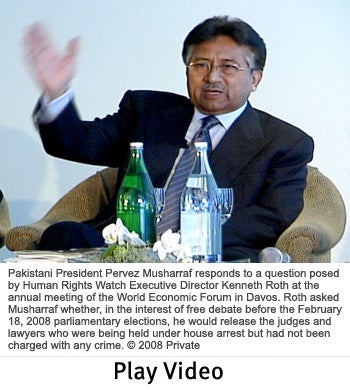
Human Rights Watch said that the Election Commission has taken virtually no action on the widespread harassment of opposition candidates through the registration of police cases against them, police obstruction of opposition rallies, and the removal of lawful opposition banners and billboards.
Human Rights Watch has documented the involvement of the local administration in helping Musharraf-backed candidates, particularly in Punjab and Sindh provinces. For example:
- In Lahore, the capital of Punjab province, the police have illegally put up banners and posters for the Musharraf-backed Pakistan Muslim League-(Q) (PML-Q) and torn down the electoral symbols of the opposition.
- On December 10, 2007, a television cameraman in Gahno Khose, Sindh province, who filmed police providing illegal assistance to the district mayor, deputy mayor, town police officer, executive district officer and caretaker ministers during an electoral campaign told Human Rights Watch that the mayor’s men snatched his camera and warned him against broadcasting the report. Police then threatened to lodge criminal cases against him. “I was afraid and informed my organization. They told me to keep quiet and took on the responsibility of talking to the concerned people,” he said. “They didn’t lodge [a criminal case] against me, but I am receiving further threats.”
- On December 26, 2007, police in Gujrat city, Punjab, prevented opposition Pakistan Muslim League-(N) (PML-N) candidates from preparing for a reception for their leader Nawaz Sharif, citing oral “orders from above.” Municipal administration staff overnight removed PML-N banners around the city. Police prevented the PML-N’s Gujrat youth wing from announcing Sharif’s arrival, confiscated their loudspeakers and detained six activists for several hours. Chaudhry Mohammad Faraz, the PML-N general secretary in Gujrat, told Human Rights Watch, “Police blocked all roads leading to the venue to stop people from welcoming Nawaz Sharif, from Jalalpur Jattan, Fatehpur, Shadiwal, Kunja and Bhimber. People had to come on foot, one by one.”
- On the night of December 20, 2007, unknown persons fired upon the PML-N office set up in the residence of Muhammad Afzal at Mohallah Kaloo Pura, Gujrat, after an anonymous telephone call telling Afzal to close the office down. Police did not collect evidence or register a complaint.
- In Thatta district, Sindh province, police have been obstructing the opposition Pakistan People’s Party (PPP) by not giving security clearance to its candidates to hold public meetings. The PPP’s Sassui Palijo, the only directly elected opposition party member in Thatta district, told Human Rights Watch that the administration has been interfering in their campaigns since the previous local bodies’ elections. “Now they are doing it again. They remove flags, banners after our party workers put them up. … We tell the election commission everything and show them evidence every three days. But they have done nothing to help us at all so far.” Palijo said that a PPP worker, Nawaz Ali Shah Qudusani, had to “go underground” after he went ahead with a rally that the local mayor had warned him against holding; police raided his house and arrested three people.
In its update of February 9, the Fair and Free Election Network (FAFEN), an independent coalition of nongovernmental organizations with observers in more than 260 districts around the country, said that one of the most frequent complaints they have received is of “police harassing candidates and/or workers of certain political parties by threatening that they will register cases against them. In addition, police are asking supporters and candidates of political parties who formed the opposition during the previous government to stop campaigning. In some cases, FAFEN observers reported that police had directly asked candidates and local government representatives to announce their support to the [Musharraf-backed] PML-Q.” Observers from FAFEN have gathered reports of intimidation and harassment by the police or other security agency districts in all provinces.
Extensive government transfers and postings of judges and other officials across the country violate legal provisions banning postings and transfers after the announcement of the election schedule, which took place on November 20, 2007. The Election Commission has failed to stop or reverse transfers of district judges; the government has put in place judges who independent observers fear could compromise investigations into electoral malpractice. The government appointed 59 civil judges in early January across the North West Frontier Province. Eleven civil judges were transferred. As well as investigating complaints, district judges are also responsible for aggregating the vote count on polling day.
In addition, Human Rights Watch has records of at least 90 transfers of officials in Sindh province. After the announcement of the election schedule, several police officers were transferred across Sindh. Some were posted as station house officers (SHOs) to police stations of Kharipur district in Sindh. When the assistant election commissioner (AEC) in Jacobabad, Sindh, Liaquat Ali Afridi, refused to change polling procedures or reduce the number of polling stations from 259 to 226, he was transferred and replaced with Hisaam Soomro, a relative of the caretaker prime minister in Sindh.
Candidates have sent in more than 1,500 complaints of irregularities from around the country, few of which have been investigated. Even visible violations, like the use of electoral banners on government offices, have been ignored. The secretary of the Election Commission of Pakistan, Kunwar Dilshad, denied responsibility, telling Human Rights Watch that the commission, which is dependent on the district-level judiciary to investigate these complaints, is helpless to investigate or act if judges send no evidence.
The Election Commission’s lack of independence and impartiality is among the crucial structural issues impeding free and fair elections. The president currently appoints the chief election commissioner and the other commission members. The election law requires members of the Election Commission, an ad hoc body, to be High Court judges; their part-time status in the Election Commission compromises their effectiveness. Two were appointed after Musharraf imposed a state of emergency on November 3, calling into question their impartiality. For example, Justice Ghulam Dastagir Shahani, a lawyer with no judicial experience, was appointed to the Sindh High Court on December 14 and to the Election Commission on January 5, by Musharraf, although more experienced judges were available. The current chief election commissioner, Qazi Muhammad Farooq, a retired Supreme Court judge, called his impartiality into question when he amended the rules of the presidential polls of October 2007 to allow Musharraf to contest the election while still army chief, in violation of a clear constitutional prohibition.
The Election Commission has ignored recommendations made by international observers, including the European Union, such as changing the method of appointment of the chief election commissioner and other members to ensure their impartiality. A key recommendation from international election monitors in past elections relates to the vote count aggregation and delays in announcement between results at polling stations and the final result. Problems identified in the past have included the provision of results at polling stations on unofficial papers. Transparency would be greatly improved if certified copies of each polling station result (compiled on form XVI) and aggregated results (compiled on form XVII) were made immediately available to the media, candidates, polling agents, and observers.
Under Pakistani law, the president cannot hold a party political affiliation and is obliged to be neutral in parliamentary elections. In the past, the presidency has been a largely ceremonial post and seen as “above” party politics. But, since taking power in a coup in 1999, Musharraf has radically changed the constitution to increase the powers of the presidency at the expense of parliamentary powers, at the same time creating and supporting a political party, thePML-Q, to serve his interests.
While Musharraf maintains that he has installed a neutral caretaker government to oversee elections, he has openly supported the PML-Q and its allied parties, and formed a caretaker government filled with PML-Q office-bearers and members. On December 17 Musharraf asked participants at a public meeting in Vehari town in southern Punjab to vote for parties that support him. Billboards in the central city of Lahore and elsewhere in Punjab province advertising development projects carry Musharraf’s photograph as well as that of outgoing chief minister Parvaiz Elahi, Punjab, provincial president of the PML-Q.
Prime Minister Mianmohammad Soomro, Information and Broadcasting Minister Nisar Memon and Federal Minister for Inter-Provincial Coordination, Dr. Muhammad Amjad, are prominent members of the PML-Q. Roshan Khurshid Bharucha, another PML-Q member, is not only a minister in the Balochistan provincial caretaker government, but is also running as a candidate, violating election rules that prohibit members of the caretaker government at the national and provincial level from contesting elections.
“The Election Commission should be quickly investigating all credible allegations of electoral irregularities, whether they relate to violence or misuse of state resources,” said Adams. “Instead of using its legal powers and moral authority to address these matters, the commission appears to be sitting on its hands.”