

![]() | ![]() ![]() | |
|
| ||
|
|
Women’s Human Rights Violence against Child Domestic Workers Violence against Child Domestic Workers Physical Abuse Sexual Harassment and Assault Psychological Abuse Forced Labor Trafficking Recommendations February 20, 2007 Printer friendly version Campaigning against Fear: Women’s Participation in Afghanistan’s 2005 Elections This document is based on dozens of interviews with women candidates and election workers during the past month. Human Rights Watch details the challenges confronting Afghanistan’s 582 women candidates, who make up approximately 10 percent of the total 5,800 candidates. August 17, 2005 Printer friendly version Decisions Denied: Women’s Access to Contraceptives and Abortion in Argentina Women in Argentina face arbitrary and discriminatory restrictions on their reproductive decisions and access to contraceptives and abortion. As a result, many women must choose between an unwanted or dangerous pregnancy and birth or an illegal and unsafe abortion that might seriously injure or even kill them. June 15, 2005 Also available in
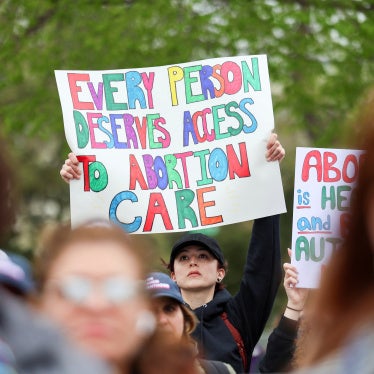
International Human Rights Law and Abortion in Latin America Latin America is home to some of the most restrictive abortion laws in the world. While only three countries—Chile, El Salvador, and the Dominican Republic—provide no exceptions or extenuating circumstances for the criminal sanctions on abortion, in most countries and jurisdictions, exceptions are provided only when necessary to save the pregnant woman’s life and in certain other narrowly defined circumstances. Even where abortion is not punished by law, women often have severely limited access because of lack of proper regulation and political will. May 1, 2005 Also available in
Printer friendly version Sexual Violence and its Consequences among Displaced Persons in Darfur and Chad This briefing paper documents how the Sudanese security forces, including police deployed to protect displaced persons, and allied Janjaweed militias continue to commit rape and sexual violence on daily basis. Even as refugees in Chad, women and girls fleeing the violence in Darfur continued to face the risk of rape and assault by civilians or militia members when collecting water, fuel or animal fodder near the border. Human Rights Watch interviewed many victims of sexual violence in camps in Chad and Darfur during two research missions to these areas in February. April 12, 2005 Printer friendly version A Dose of Reality Women’s Rights in the Fight against HIV/AIDS Governments around the world have done far too little to combat the entrenched, chronic abuses of women’s and girls’ human rights that put them at risk of HIV. Misguided HIV/AIDS programs and policies, such as those emphasizing abstinence until marriage, ignore the brutal realities many women and girls face. By failing to enact and effectively enforce laws on domestic violence, marital rape, women’s equal property rights, and sexual abuse of girls, and by tolerating customs and traditions that subordinate women, governments are enabling HIV/AIDS to continue claiming the lives of women and girls. Human Rights Watch has interviewed hundreds of women and girls living with HIV around the world. This briefing paper focuses on the links between HIV/AIDS and abuses of women’s and girls’ human rights. March 21, 2005 Also available in
Printer friendly version Between Hope and Fear Intimidation and Attacks against Women in Public Life in Afghanistan When a U.S.-led coalition invaded Afghanistan in October 2001, one of the justifications for the war was that it would liberate women from the misogynistic rule of the Taliban. Three years later, on the eve of the country’s first-ever national presidential elections on October 9, 2004, there have been notable improvements for women and girls. October 5, 2004 Advisory Note to Journalists Covering the Release of Regular Report on Turkey and Recommendations On October 6 the European Commission will publish its 2004 Regular Report on Turkey’s progress toward European Union membership. This document provides a background, highlights key issues to look for in the report, and ends with an assessment of the progress of reforms. October 4, 2004 Printer friendly version Darfur Documents Confirm Government Policy of Militia Support A Human Rights Watch Briefing Paper, July 20, 2004 Numerous reports from Human Rights Watch and other sources have described the “hand-in-glove” manner in which the Government of Sudan and the nomadic ethnic militias known as the Janjaweed have operated together to combat a rebel insurgency in Darfur. Hundreds of eyewitnesses and victims of attacks have testified to the close coordination between government forces and their militia partners in the conflict. Militia leaders and members have been supplied with arms, communications equipment, salaries and uniforms by government officials and have participated in joint ground attacks on civilians with government troops, often with aerial bombing and reconnaissance support from government aircraft. July 20, 2004 Also available in
Printer friendly version Condoms, Clean Needles, and Generic Drugs: Key Issues for the XV International AIDS Conference A Human Rights Watch Backgrounder Human Rights Watch has issued numerous reports showing that human rights abuses against persons living with and at high risk of HIV/AIDS contribute significantly to new HIV infections worldwide. This is true in Thailand, the host of this year’s AIDS conference, as well as in numerous other countries worldwide. The International AIDS Conference provides an opportunity to expose these abuses and to hold governments to their obligation to mount the most effective possible response to HIV/AIDS. July 10, 2004 Human Rights Watch’s Concerns with Regard to Academic Freedom in Higher Education, and Access to Higher Education for Women who Wear the Headscarf Memorandum to the Turkish Government Turkey’s public universities are still emerging from more than twenty years of military influence and centralized ideological and operational controls. Academic freedom in Turkey reached a low point shortly after the 1980 military coup, when the junta expelled hundreds of staff and thousands of students for their political activities and enacted a new education law imposing firm political prescriptions on Turkey’s higher education system. Although reforms, some as recent as May 2004, have improved campus life in important respects, many of the constraints remain in place. June 29, 2004 Also available in
Trafficking in Women and Girls in Bosnia and Herzegovina Additional Documents Human Rights Watch submitted a number of requests to the U.S. government for documents relating to trafficking in persons in Bosnia pursuant to the Freedom of Information Act. Two years after our initial request, we obtained a limited number of documents. June 14, 2004 Printer friendly version “The Guns are in the Bushes” Continuing Abuses in Liberia Despite significant changes in the political environment over the past six months, most notably the August 2003 signing of a peace agreement, the departure into exile of president Charles Taylor and the establishment of a newly-mandated United Nations peacekeeping mission, the plight of civilians in Liberia remains dire. January 21, 2004 Printer friendly version Background on Women's Status in Iraq Prior to the Fall of the Saddam Hussein Government Historically, Iraqi women and girls have enjoyed relatively more rights than many of their counterparts in the Middle East. The Iraqi Provisional Constitution (drafted in 1970) formally guaranteed equal rights to women and other laws specifically ensured their right to vote, attend school, run for political office, and own property. Yet, since the 1991 Gulf War, the position of women within Iraqi society has deteriorated rapidly. November 21, 2003 Liberia: Greater Protection Required for Civilians Still at Risk This information is based on interviews conducted by a Human Rights Watch researcher in Liberia from August 23 - September 9, 2003. The interviews were conducted in Monrovia and Buchanan with displaced persons, child soldiers, rape victims, and humanitarian and human rights workers, among others. September 9, 2003 “We Don’t Want to Be Refugees Again” Human Rights Watch urged Bhutan and Nepal to implement a screening and repatriation process that protects the human rights of more than one hundred thousand refugees of Nepalese ethnicity who were arbitrarily stripped of their citizenship and forced to flee Bhutan in the early 1990s. May 13, 2003 Printer friendly version Burundi: Civilians Pay the Price of Faltering Peace Process A ceasefire signed on December 3, 2002 by the government of Burundi and the rebel movement, the National Council for the Defense of Democracy-Forces for the Defense of Democracy (Conseil National pour la Défense de la Democratie-Forces pour la Défense de la Democratie, CNDD-FDD) raised hopes for an end to nine years of war in Burundi. The parties to the conflict re-affirmed their commitment to this agreement in a second document signed January 27, 2003. But after weeks of uncertainty and violations on both sides, the FDD suspended negotiations on February 21 accusing the government of blocking implementation and making decisions without consulting it. February 28, 2003 Labor Rights and Trade: Guidance for the United States in Trade Accord Negotiations Human Rights Watch Briefing Paper Free trade alone cannot ensure greater respect for workers' rights nor prevent millions of people from being excluded from the benefits of globalization. Human Rights Watch believes that measures to protect workers' rights should be built into trade agreements to ensure that globalization does not come at the expense of human rights. October 30, 2002 International Justice for Women: The ICC Marks a New Era Human Rights Watch Backgrounder, July 1, 2002 Women's rights activists throughout the world - of every political stripe, faith, sexual orientation, nationality, and ethnicity - mobilized at each step of the International Criminal Court (ICC) process. They have worked to create an independent court to afford women greater protection from violations of human rights and humanitarian law. July 1, 2002 Printer friendly version Afghanistan: Return of the Warlords As Afghan and United Nations officials prepare for the forthcoming loya jirga (grand national assembly), as called for in the 2001 Bonn Agreement to choose Afghanistan's next government, ordinary Afghans are increasingly terrorized by the rule of local and regional military commanders - warlords - who are reasserting their control over large areas of Afghanistan. June 6, 2002 Purchase online |
| ||||||||||||||||||||||||||||||||||||||
|
Contribute to Human Rights Watch
Home | About Us | News Releases | Publications | Info by Country | Global Issues | Campaigns | Community | Store | Film Festival | Search | Site Map | Contact Us | Press Contacts | Privacy Policy © Copyright 2006, Human Rights Watch 350 Fifth Avenue, 34th Floor New York, NY 10118-3299 USA |